To the Editor:
The first known report of irreducible hallux interphalangeal joint dislocation was in 1944 by Muller [
1], who treated a soldier who had sustained this injury while playing football. A lateral incision was used to excise the interposed sesamoid, and the result was satisfactory. Other English language reports of this disorder have been few: Eibel [
2] published another report with x-ray films in 1954; in 1981, Nelson and Uggen [
3] stated, “To our knowledge, no cases of dorsal dislocation of the interphalangeal joint of the great toe have been published.” The most cases appear to have been reported in the Japanese literature: Yasuda et al [
4] reported 33 cases obtained from the biomedical literature.
In most cases, irreducible hallux interphalangeal joint dislocation is caused by interposition of a sesamoid in the joint. In some cases, a flexor tendon may be incarcerated in the joint. [
3] This type of dislocation must be reduced surgically. Many approaches have been devised, including those through the dorsal, lateral, and plantar aspects. Most clinicians achieve good results after surgical reduction and removal of the offending sesamoid.
A 31-year-old male came to the emergency department with painful dislocation of the interphalangeal joint of the right great toe. The emergency physician made several unsuccessful attempts at closed reduction before seeking podiatric consultation.
The patient had injured the toe while kicking an object during tae kwon do class. The mechanism of injury was forced dorsiflexion of the hallux. The history and review of systems were uneventful. On examination, the distal aspect of the hallux was dorsiflexed and in varus position. Neurovascular status was intact, and other examination results were not clinically significant.
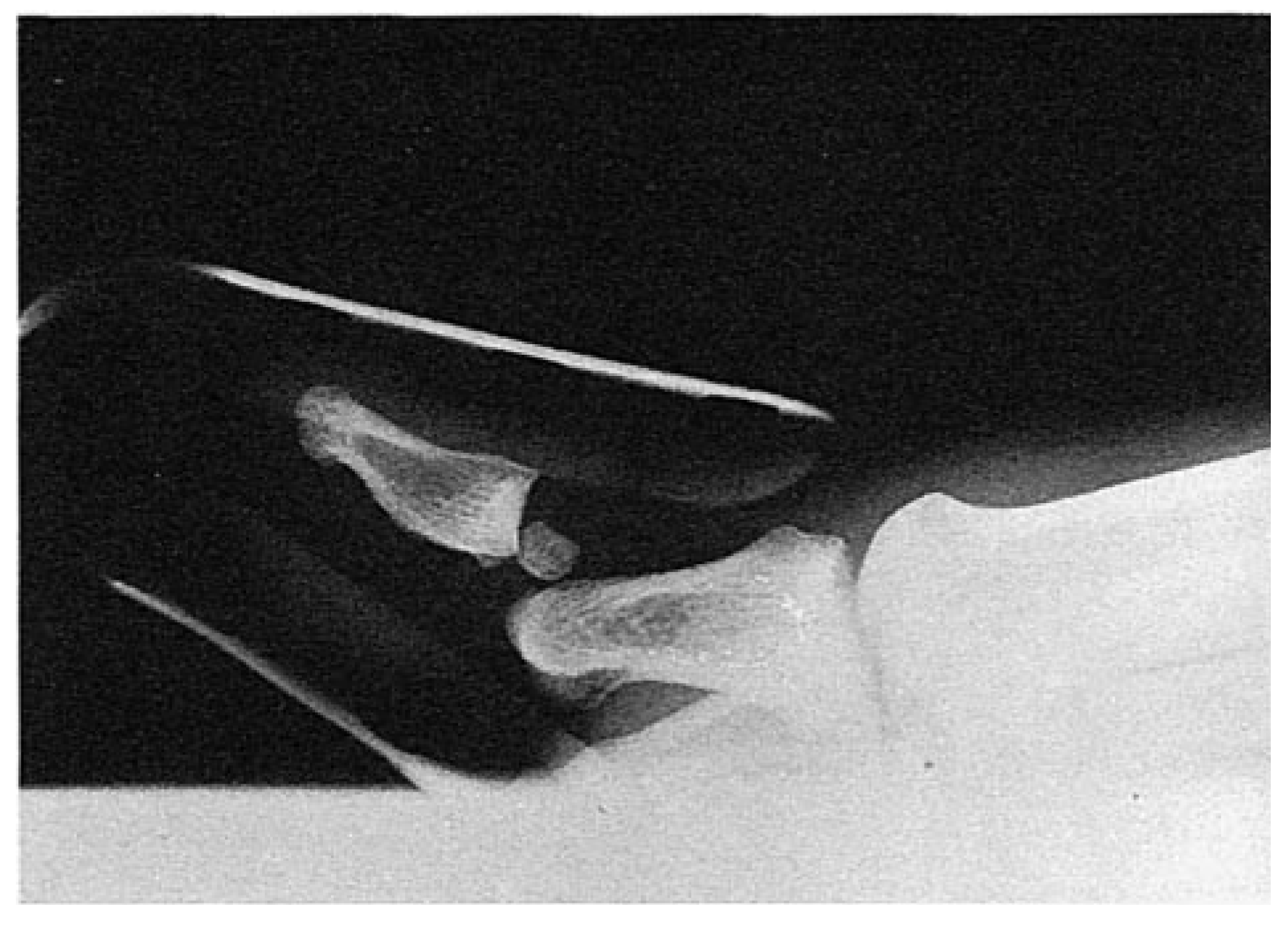
The local anesthetic block that had been administered was augmented, and an additional unsuccessful attempt at closed reduction was made. The x-ray films showed dislocation of the interphalangeal joint of the hallux with an interposed sesamoid (
Figure 1). The joint was splinted, and the patient was scheduled for surgery.
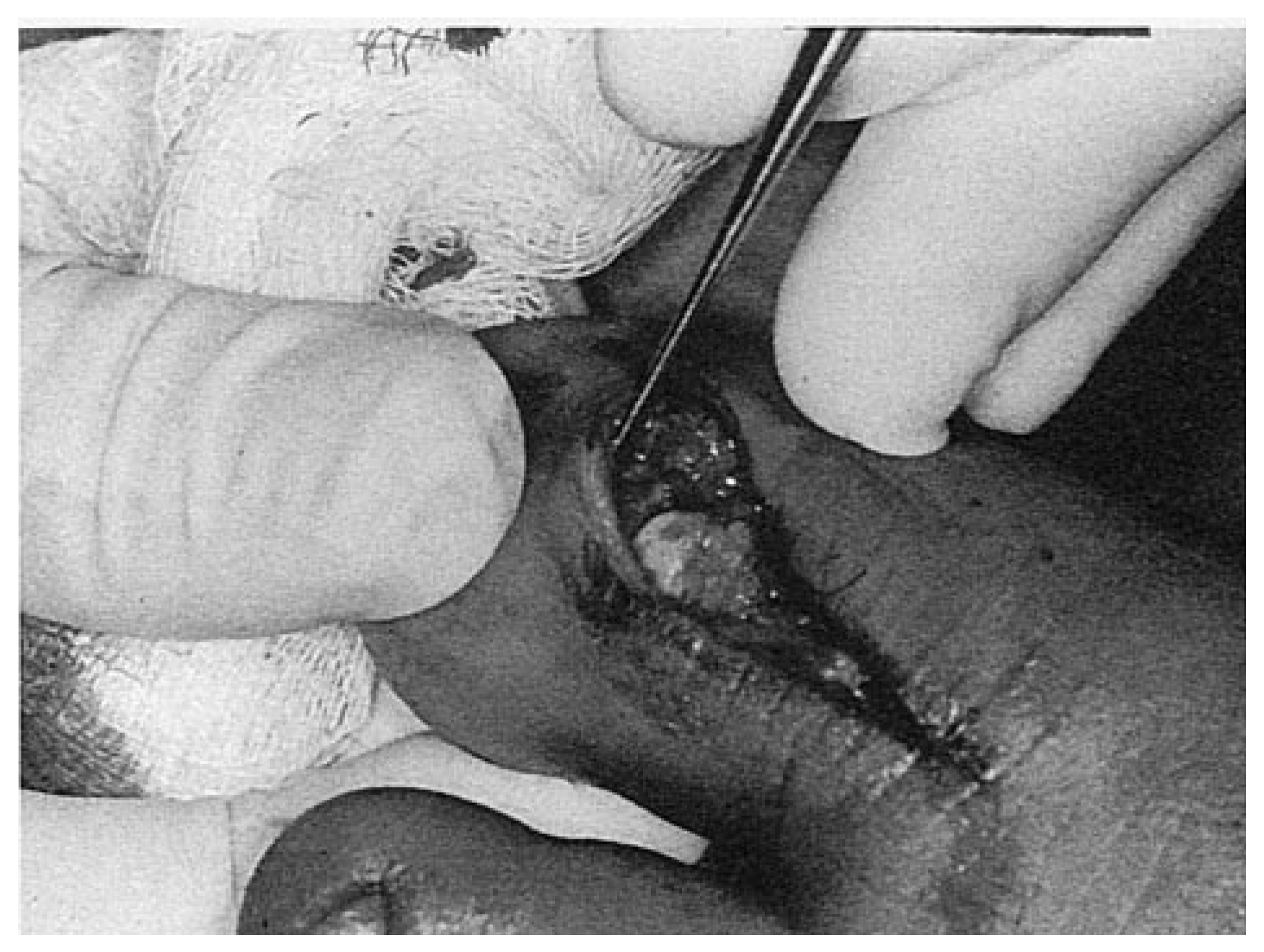
The next day, surgical reduction was done after induction of local anesthetic and sedation. A serpentine incision was made on the dorsal aspect of the hallux from the distal medial to the proximal lateral area transversing the interphalangeal joint. Careful dissection down to the extensor hallucis longus tendon was done. Transverse tenotomy and capsulotomy provided access to the interphalangeal joint, which revealed the sesamoid within the dorsal cartilaginous surface of the joint (
Figure 2). The sesamoid was grasped with forceps and carefully freed from soft tissue while care was taken to avoid damaging the long flexor tendon. After the sesamoid had been removed, the toe reduced spontaneously and assumed a normal position.
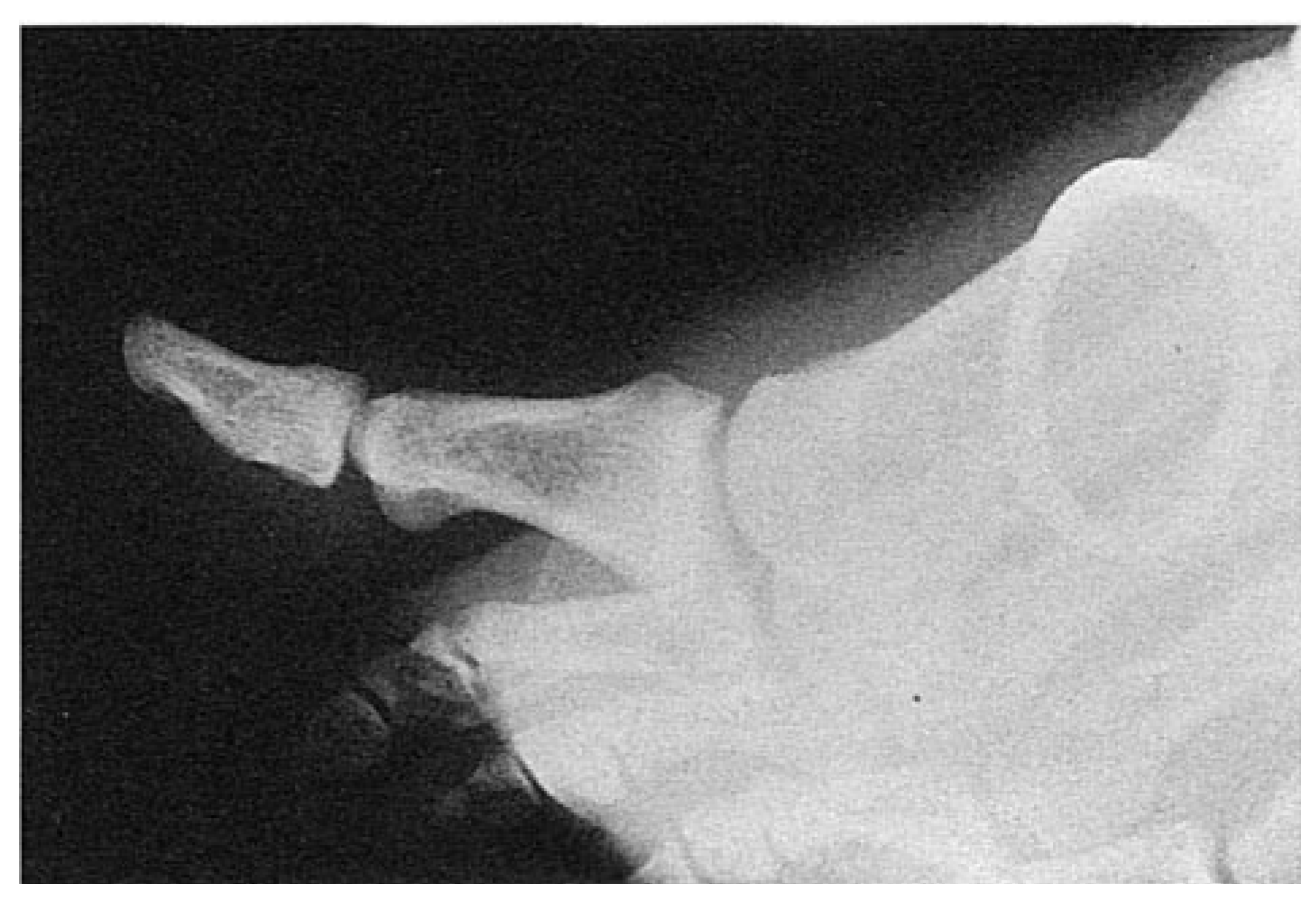
Intraoperative x-ray films showed a normal interphalangeal joint without malalignment (
Figure 3). The wound was flushed, the extensor tendon incision was closed with 3-0 absorbable suture, subcutaneous tissue was closed with 4-0 absorbable suture, and the skin was closed with 4-0 nylon suture. A bandage and cast were applied postoperatively.
The patient was kept nonweightbearing for 2 weeks by means of a short-leg cast with a full toebox, and then received a short-leg, walking cast for 2 weeks. Four weeks after the operation, the affected foot was fully weightbearing. Soreness of the great toe persisted for 14 months after the operation. The range of motion of the interphalangeal joint was only mildly restricted compared with that of the contralateral toe. The patient returned to work and other activity, including tae kwon do.
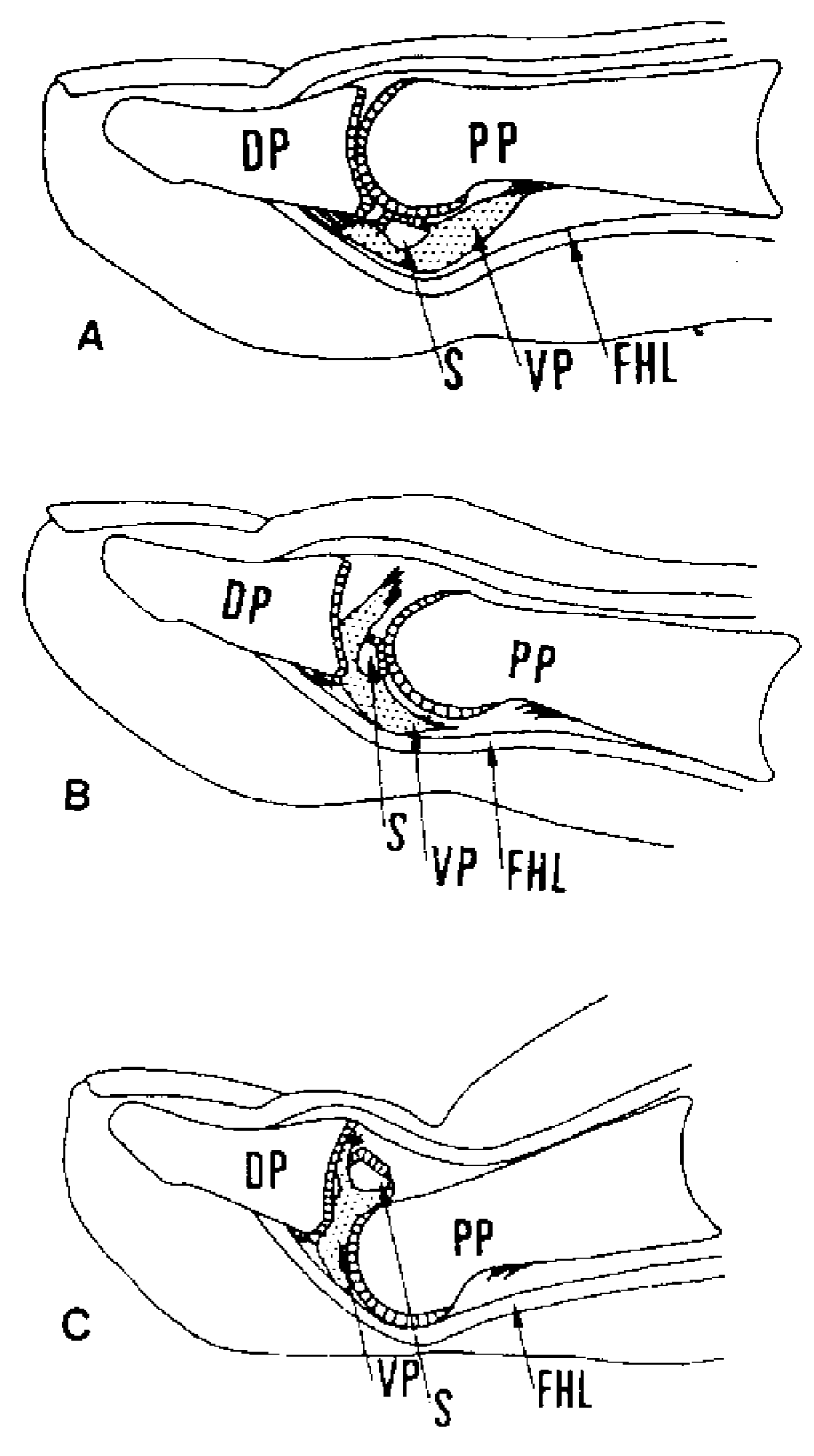
Miki et al [
6] identified two types of hallux interphalangeal joint dislocation (
Figure 4). In type I dislocation, “The volar plate is displaced into the space between the articular surfaces of the two phalanges.” In this case, deformity is not clinically notable, but xray films show interposition of the sesamoid, and generally, the patient is in pain.
In type II dislocation, “The volar plate is displaced completely dorsal to the interphalangeal joint so that the sesamoid bone overrides the proximal phalangeal head.” In this case, marked deformity is apparent, and x-ray films show a dorsally dislocated, distal phalanx. Attempting closed reduction can convert a type II into a type I dislocation. The clinical appearance of the deformity may improve, but pain generally remains. For this reason, the physician must take postreduction xray films to check for continued impingement of the interphalangeal sesamoid after reduction. If closed reduction fails, surgical excision of the sesamoid and reduction is recommended.[1-6]
In conclusion, the podiatric physician must realize that a traumatically dislocated interphalangeal hallux joint with sesamoid impingement is usually irreducible through closed manipulation. However, surgical reduction produces good results in these cases.