Next Article in Journal
Tailor's bunion. Is fixation necessary?
Previous Article in Journal
1996 Podiatric Practice Survey. Statistical results
 
 
Journal of the American Podiatric Medical Association is published by MDPI from Volume 116 Issue 1 (2026). Previous articles were published by another publisher in Open Access under a CC-BY (or CC-BY-NC-ND) licence, and they are hosted by MDPI on mdpi.com as a courtesy and upon agreement with American Podiatric Medical Association.
Article

Alterations in glomerular permeability in streptozotocin-induced diabetic rats

by
Robert B. Boyd
,
Victor W. Thompson
and
James Atkin
Department of Biomedical Sciences, Pennsylvania College of Podiatric Medicine, Philadelphia, USA
J. Am. Podiatr. Med. Assoc. 1996, 86(2), 57-62; https://doi.org/10.7547/87507315-86-2-57
Published: 1 February 1996
The alteration in glomerular basement membrane permeability associated with microangiopathy in streptozotocin-induced diabetic rats was studied by determining the movement across the glomerular basement membrane of anionic ferritin probes injected into rats at different points in the development of the disease. Visualization of the concentration gradient of anionic ferritin and changes in ultrastructure was accomplished by electron microscopic examination of renal tissue prepared from both control and diabetic rats. In all control rats, the anionic ferritin did not leave the glomerular capillary lumen, nor were there any changes in the normal morphology of the glomerular capillary wall. In the diabetic animals, the concentration of anionic ferritin shifted from the capillary lumen in the abluminal direction. Distinct morphologic changes, such as widening of endothelial intercellular junctions, focal detachment of podocyte foot processes, and extensive thickening of the glomerular basement membrane, were noted in the diabetic rat, and these changes appear to correlate with the observed increase in permselectivity of anionic ferritin across the glomerular capillary wall.
The authors have described the microscopic anatomy of the glomerular basement membrane in both the healthy individual and in the patient with diabetes [1]. It was further explained how pathologic changes in the glomerular basement membrane because of alterations in its chemical composition caused by diabetes mellitus adversely affected its role in permselectivity when dealing with plasma proteins. These changes are now described experimentally using the streptozotocin-induced diabetic rat as the animal model.
The endothelium of the microvasculature is composed of highly differentiated cells that help regulate the movement of macromolecules between vascular and extravascular spaces. Various components of the capillary wall have been associated with the permeability of macromolecules. These include plasmalemmal vesicles, transendothelial channels, intercellular junctions, and basement membranes [2,3,4,5].
Historically, structural studies of capillary permeability have been performed by time-course studies of transendothelial passage of intravascularly injected probes of graded sizes and varied chemical nature [6,7,8,9,10]. More recent studies have shown that the restricted transport of polyanions smaller than albumin through the capillary wall is primarily caused by the electrical charge of the polyanions (small pore theory), while the movement of macromolecules larger than albumin from the capillary lumen through the subendothelial layers of the basement membrane is related both to electrical charge and molecular size (large pore theory) [11,12,13,14,15].
It has been well established that a significant increase in the microvascular permeability of albumin occurs at the level of the glomerular capillary wall in the patient with diabetes. This is found in both the human with diabetes and the experimentally induced animal model [16,17,18,19]. These studies, however, only addressed diabetic microangiopathy at the regional or whole organ level.
In order to understand this phenomenon better, it is necessary to investigate changes in permeability at the endothelial cell level with these questions in mind: 1) where do the changes occur, intracellularly, intercellularly or both; 2) when in the course of progression of diabetes do the changes appear; and 3) how rapidly do they occur once they develop?
Recent studies have shown the efficacy of using intravascularly injected probes of graded sizes to study the onset of changes in permeability over time [20,21]. It was found that probes ranging in molecular diameter from 3.3 to 40 nm were differentially transported through the endothelium of myocardial capillaries.
The authors’ study was designed to determine if the rate of permeability of a specific-sized macromolecule (anionic ferritin) through the glomerular capillary wall was altered during the progression from short-term to long-term diabetes in the streptozotocin-induced diabetic rat.

Materials and Methods

  • Animals
Female Sprague Dawley rats weighing 150 g to 175 g were used. All animals were maintained on a standard rat chow diet and water ad libitum. Diabetes was induced by the injection of 0.5 ml streptozotocin (65 mg per kg body weight dissolved in sterile saline) into the tail vein of ether-anesthetized animals. Control animals received a similar injection of sterile saline.
  • Experimental Protocol
Animals that had diabetes for 1 week, 15 weeks, or 52 weeks were used in this study. Anionic ferritin, pI 4.5, 2X, and cadmium free, was used as received from the supplier. Ether-anesthetized rats were administered anionic ferritin intravenously into a tail vein. Tracer dosage was 10 mg per 100 g body weight. This dosage is comparable with those used by investigators in similar mammalian studies [22,23,24]. Ether-anesthetized animals were sacrificed by decapitation either 1 min or 3 min after ferritin injection.
  • Electron Microscopy
Representative kidney tissue samples were immediately immersed in 3% paraformaldehyde and 3% glutaraldehyde in 0.1 M phosphate buffer. All tissues were postfixed in 1% OsO4 in 0.1 M phosphate buffer, en bloc stained with uranyl acetate in sodium maleate buffer, dehydrated in graded alcohols, and embedded in epoxy resin. Thick sections (1 to 2 µm) were stained with 1% toluidine blue in 0.1% sodium borate. Thin sections with silver interference colors were mounted on copper grids, stained with uranyl acetate, and lead citrate and then examined at 80 kV in an electron microscope [25,26].

Results

  • Control Animals
In all control animals, regardless of age or circulation time, anionic ferritin did not leave the glomerular capillary lumen, nor were there any changes in the normal morphology of the glomerular capillary wall.
  • Diabetic Animals
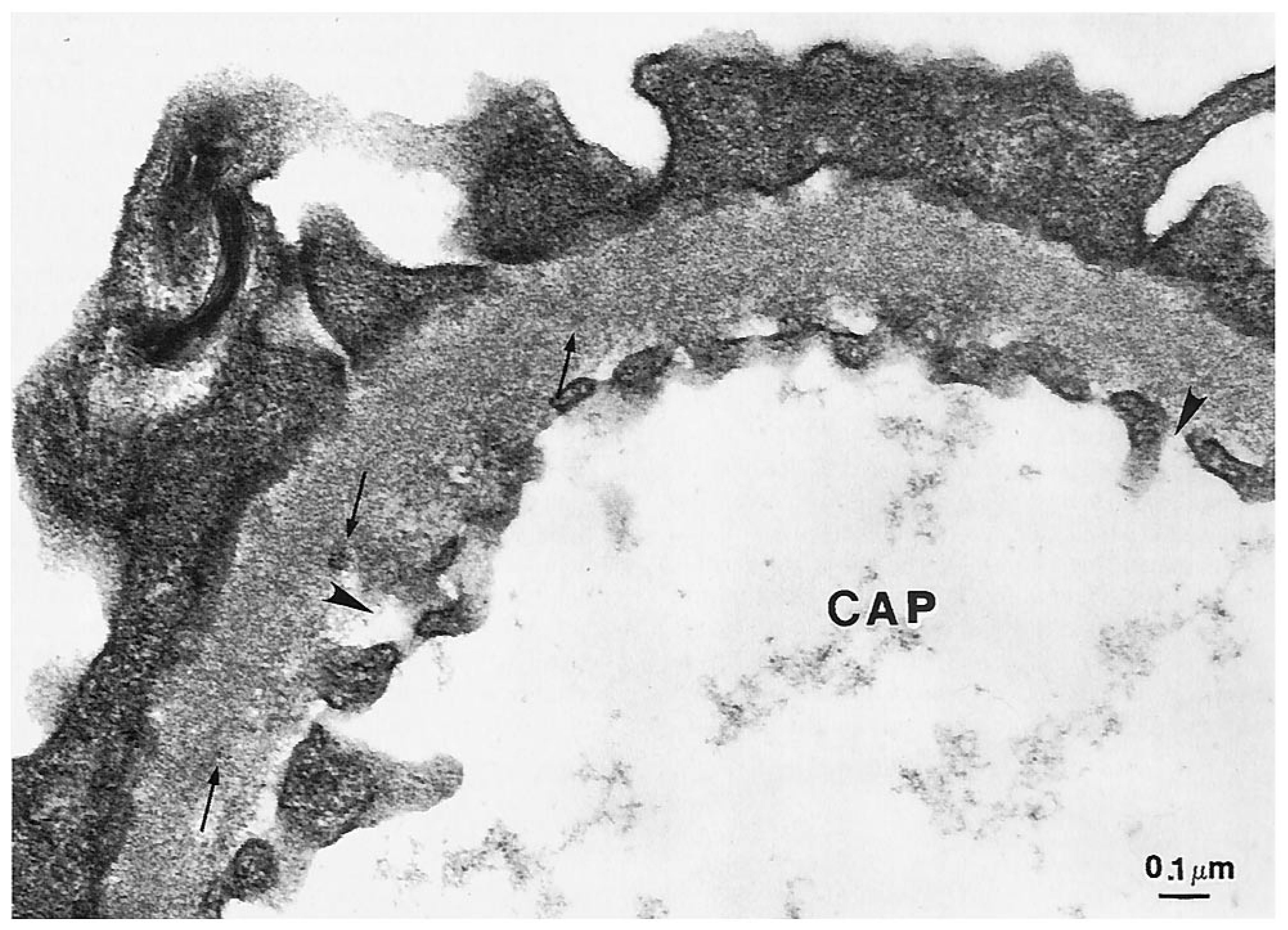
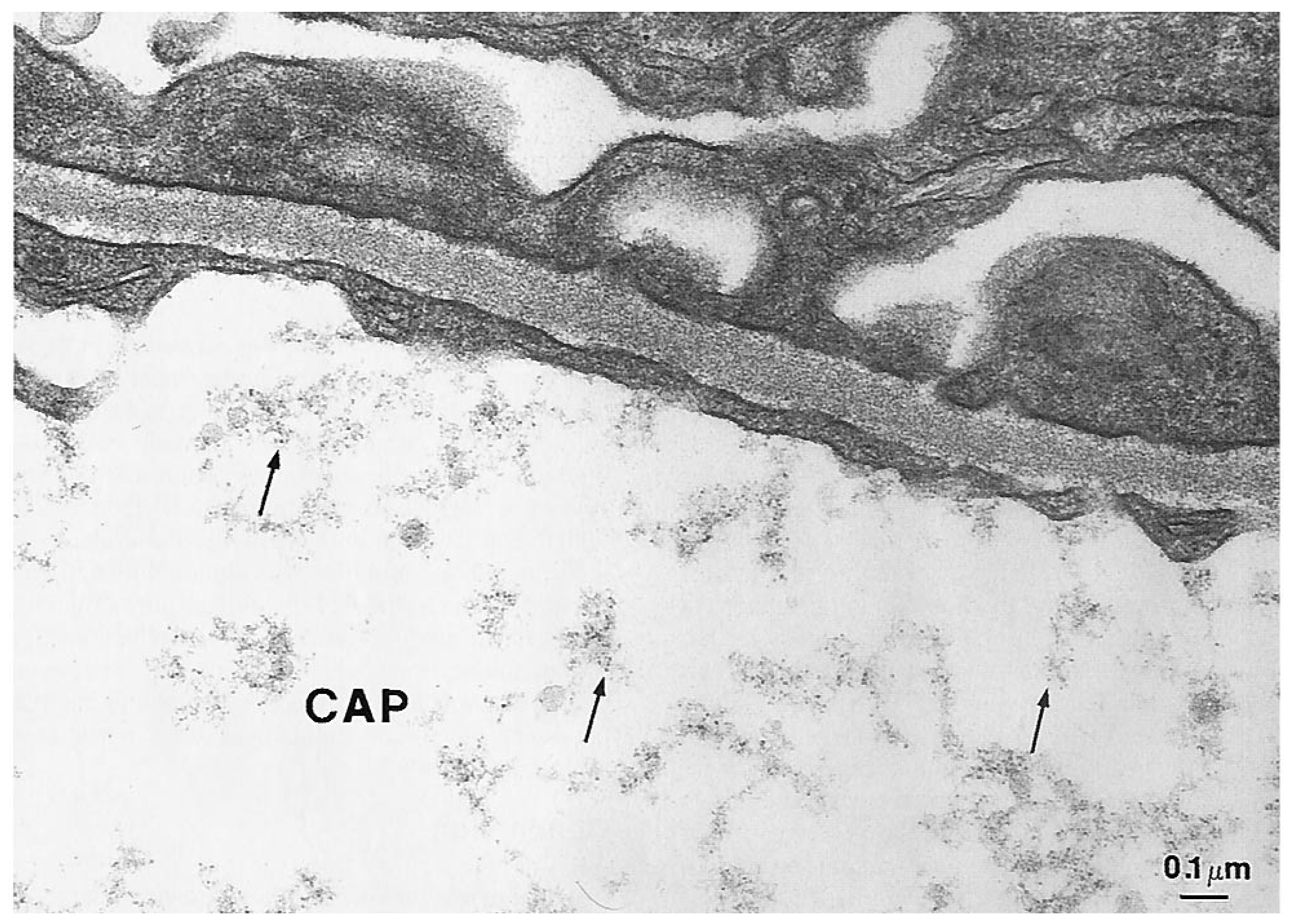
The 1-week, 1-min diabetic animals exhibited some movement of anionic ferritin from the capillary lumen into the glomerular basement membrane, while in the 1-week, 3-min animals, the concentration of anionic ferritin in the glomerular basement membrane increased, with a concomitant increase in its movement toward the abluminal surface of the glomerular basement membrane (Figure 1). The only apparent change in the ultrastructure was a slight thickening of the glomerular basement membrane. In the 15-week, 1-min animals, anionic ferritin was distributed on a continuous gradient toward the luminal surface (Figure 2). In both the 15-week, 3-min animals and the 52-week animals, the concentration of anionic ferritin had shifted in the abluminal direction (Figure 3).
Distinct morphologic changes were noted in the 15-week and 52-week diabetic animals. These included marked widening of endothelial intercellular junctions, focal detachment of podocyte foot processes, and extensive thickening of the glomerular basement membrane (Figure 3). These changes appear to correlate with the observed increase in permselectivity of anionic ferritin across the glomerular basement membrane.

Discussion

Glomerular basement membranes have been shown to be the primary filtration barrier in the mammalian kidney [12]. Kanwar and Farquhar [15] used cationized ferritin to establish that anionic binding sites are an intrinsic part of the mammalian glomerular basement membrane and that these sites are composed mainly of heparan sulfate proteoglycan, a sulfated glycosaminoglycan possessing a high density of fixed negative charges which is responsible for the generation of an electrostatic permeability barrier [27,28]. Proteinuria is one of the typical clinical signs of diabetes mellitus. It has been confirmed that this nephropathy is caused by a disruption in the charge barrier of the glomerular basement membrane [29,30]. Several studies have shown that the heparan sulfate proteoglycan content of the glomerular basement membrane is altered in diabetes mellitus and that this is responsible for the disruptive perturbations in the permselective barrier [31,32,33,34].
The authors’ finding that a slight, but definite, increase in movement of anionic ferritin across the glomerular basement membrane in the 1-week diabetic animal, regardless of the circulation time, supports the observation by Moriya et al. [35] that the charge barrier of the glomerular basement membrane is adversely affected within 1 week of streptozotocin induction. The results also confirm that movement of anionic ferritin through the glomerular basement membrane is controlled primarily by the electrostatic properties of the glomerular basement membrane and that this property is adversely affected in diabetes.
By 15 weeks, there was significant movement of anionic ferritin across the glomerular basement membrane, especially in the 3-min animals. This concurs with Moriya et al. [35] who found that by 8 weeks after streptozotocin induction, the charge barrier of the glomerular basement membrane had been significantly disturbed with a concomitant appearance of albuminuria.
Another factor to consider in the development of proteinuria in diabetes is the changes in the morphologic and biochemical makeup of the glomerular basement membrane and the effect of these changes on the permeability characteristics of the glomerular basement membrane because of the size of the permanent macromolecules. Ota et al. [36] observed that the glomerular basement membrane in nephrotic syndrome developed cavities that coalesced to form tunnels with diameters greater than the diameter of serum albumin molecules that would lead to proteinuria.
In diabetic nephropathy, quantitative alterations in type IV collagen, heparan sulfate, and laminin affect the structural integrity of the glomerular basement membrane and its biochemical integrity [37,38,39,40]. It is also known that all of these perturbations affect the porosity of the glomerular basement membrane and lead to an increase in proteinuria [41]. Ota et al. [42] have found that the cavitation of the glomerular basement membrane in diabetic nephropathy is sufficient to disrupt the size barrier (large pore theory); they postulate that this disruption is sufficient to permit massive proteinuria [42]. Moreover, Gall et al. [43] have found that an increase in large pore area of the glomerular basement membrane leads to increased proteinuria in the person with diabetes.
The observations of morphologic changes in the diabetic glomerular basement membrane by 15 weeks support the work of Østerby et al. [44] who showed a correlation between glomerular lesions and advanced diabetic nephropathy. The possibility that the glomerular basement membrane pathology that the authors observed was experimentally induced as a result of the polyanionic tracer used must be considered. Kubosawa et al. [45] described similar results after the administration of highly cationized ferritin in the rat. However, they found that this was caused by the electrostatic interaction of the cations with the anionic binding sites in the glomerular basement membrane and also with the anionic cell coat present on the surface of the glomerular podocytes. In any of the studies known to have used anionic ferritin or anionic horseradish peroxidase in either mammalian or nonmammalian kidneys, similar glomerular basement membrane pathologies have never been reported [11,13,14,28,46,47].

Conclusion

Vascular permeability of the glomerular capillary wall in the streptozotocin-induced diabetic rat increased significantly as the disease developed from 1 week to 52 weeks’ duration. This change in permeability was indicated by the rapid movement of anionic ferritin from the glomerular capillary lumen through the glomerular basement membrane and into the urinary space of Bowman’s capsule. Distinct morphologic changes in the glomerular capillary wall were evident in the 15-week and 52-week animals. These included thickening of the glomerular basement membrane, focal detachment of podocyte foot processes, and widening of endothelial cell junctions.

References

  1. BOYD RB, BURKE JP, ATKIN J, ET AL: Significance of capillary basement membrane changes in diabetes mellitus. JAPMA 80: 307, 1990.
  2. BRUNS RR, PALADE GE: Studies on blood capillaries: I. general organization of blood capillaries in muscle. J Cell Biol 37: 241, 1968.
  3. CLOUGH G, MICHEL CC: The role of vesicles in the transport of ferritin through frog endothelium. J Physiol (Lond) 315: 127, 1981.
  4. RENKIN EM, CURRY FE: Endothelial permeability: path-ways and modulations. Ann N Y Acad Sci 401: 248, 1982.
  5. SIMIONESCU M, SIMONESCU N, PALADE GE: Partial chemical characterization of the anionic sites in the basal lamina of fenestrated capillaries. Microvasc Res 28: 352, 1984.
  6. JENNINGS MS, MARCHESI VT, FLOREY HH: The transport of particles across the walls of small blood vessels. Proc R Soc Lond (Biol) 156: 14, 1962. 1962; 156, p. 14.
  7. BRUNS RR, PALADE GE: Studies on blood capillaries: II. transport of ferritin molecules across the wall of muscle capillaries. J Cell Biol 37: 277, 1968.
  8. CLEMENTI F, PALADE GE: Intestinal capillaries. I. permeability to peroxidase and ferritin. J Cell Biol 41: 33, 1969.
  9. SIMIONESCU N, PALADE GE: Dextrans and glycogens as particulate tracers for studying capillary permeability. J Cell Biol 50: 616, 1971.
  10. SIMIONESCU N, SIMIONSCU M, PALADE GE: Permeability of muscle capillaries to small heme peptides: evidence for the existence of patent transendothelial channels. J Cell Biol 64: 586, 1975.
  11. CHANG RLS, DEEN WM, ROBERTSON CR, ET AL: Permselectivity of the glomerular capillary wall: III. restricted transport of polyanions. Kidney Int 8: 212, 1975.
  12. CAULFIELD JP, FARQUHAR MG: The permeability of glomerular capillaries to graded dextrans identification of the basement membrane as the primary filtration barrier. J Cell Biol 63: 883, 1974.
  13. RENNKE HG, VENKATACHALAM MA: Glomerular permeability: in vivo tracer studies with polyanionic and polycationic ferritins. Kidney Int 11: 44, 1977.
  14. RENNKE HG, PATEL Y, VENKATACHHALAM MA: Glomerular filtration of proteins: clearance of anionic, neutral, and cationic horseradish peroxidase in the rat. Kidney Int 13: 324, 1978.
  15. KANWAR YS, FARQUHAR MG: Anionic sites in the glomerular basement membrane. J Cell Biol 81: 137, 1979.
  16. ALPERT JS, COFFMAN JD, BALODIMOS MC, ET AL: Capillary permeability and blood flow in skeletal muscle of patients with diabetes mellitus and genetic prediabetes. N Engl J Med 286: 454, 1972.
  17. VALENSI P, ATALLI JR, BEHAR A, ET AL: Isotopic test of capillary permeability to albumin in diabetic patients: effects of hypertension, microangiopathy, and duration of diabetes. Metabolism 36: 834, 1987.
  18. KILZER P, CHANG K, MARVEL J, ET AL: Albumin permeation of new vessels is increased in diabetic rats. Diabetes 34: 333, 1985.
  19. WILLIAMSON JR, CHANG K, TILTON RG, ET AL: Increased vascular permeability in spontaneously diabetic BB/W rats and in rats with mild versus severe streptozotocin-induced diabetes: prevention by aldose reductase inhibitors and castration. Diabetes 36: 813, 1987.
  20. MILICI AJ, WATROUS H, STUKENBROK H, ET AL: Transcytosis of albumin in capillary endothelium. J Cell Biol 105: 2603, 1987.
  21. PORTER GK, BANKATON PW: Functional maturation of the capillary wall in the fetal and neonatal rat heart: permeability characteristics of developing myocardial capillaries. Am J Anat 180: 323, 1987.
  22. SIMIONESCU N, SIMIONESCU M, PALADE GE: Differentiated microdomains on the luminal surface of the capillary endothelium: I. preferential distribution of anionic sites. J Cell Biol 90: 605, 1981.
  23. BRODY JS, VACCARO CA, HILL NS, ET AL: Binding of charged ferritin to alveolar wall components and charge selectivity of macromolecular transport in permeability pulmonary edema in rats. Circ Res 55: 155, 1984.
  24. SCHNEEBERGER EE: Interaction of plasma proteins with negatively charged sites on the pulmonary capillary endothelium of the rat. Cell Tissue Res 251: 417, 1988.
  25. STEMPAK JG, WARD RT: An improved staining method for electron microscopy. J Cell Biol 22: 697, 1964.
  26. VENABLE JH, COGGESHALL R: A simplified lead citrate stain for use in electron microscopy. J Cell Biol 25: 407, 1965.
  27. KANWAR YS, FARQUHAR MG: Presence of heparan sulfate in the glomerular basement membrane. Proc Natl Acad Sci U S A 76: 1303, 1979.
  28. KANWAR YS, FARQUHAR MG: Increased permeability of the glomerular basement membrane to ferritin after removal of glycosaminoglycans (heparan sulfate) by enzyme digestion. J Cell Biol 86: 688, 1980.
  29. DECKERT T, FELDT-RASMUSSEN B, DJURUP R, ET AL: Glomerular size and charge selectivity in insulin-dependent diabetes mellitus. Kidney Int 33: 100, 1988.
  30. VIBERTI GC, WISEMAN MJ: The kidney in diabetes: significance of the early abnormalities. Clin Endocrinol 15:753, 1986.
  31. ROHRBACH DH, HASSELL JR, KLEINMAN HK, ET AL: Alterations in the basement membrane (heparan sulfate) proteoglycan in diabetic mice. Diabetes 31: 185, 1982.
  32. ROHRBACH DH, WAGNER CW, STAR VL, ET AL: Reduced synthesis of basement membrane heparan sulfate proteoglycan in streptozotocin-induced diabetic mice. J Biol Chem 258: 11672, 1983.
  33. COHEN MP, SURMA ML: Effect of diabetes on in vivo metabolism of [35S]-labeled glomerular basement membrane. Diabetes 33: 8, 1984.
  34. ROHRBACH R: Reduced content and abnormal distribution of anionic sites (acid proteoglycans) in diabetic glomerular basement membrane. Virchows Arch B Cell Pathol 51: 127, 1986.
  35. MORIYA T, NAKAZAWA K, ITOH N: Loss of glomerular anionic sites and the development of albuminuria in rats with streptozotocin-induced diabetes. Nephron 65: 444, 1993.
  36. OTA Z, SHIKATA K, OTA K: Mechanisms of proteinuria in nephrotic syndrome. Acta Med Okayama 46: 483, 1992.
  37. BEISSWENGER PJ, SPIRO RG: Studies on the human glomerular basement membrane: composition, nature of carbohydrate units and chemical changes in diabetes mellitus. Diabetes 22: 180, 1973.
  38. SHIMOMURA H, SPIRO RG: Studies on macromolecular components of human glomerular basement membrane and alterations in diabetes: decreased levels of heparan sulfate proteoglycan and laminin. Diabetes 36: 374, 1987.
  39. PARTHASARATHY N, SPIRO RG: Effect of diabetes on the glycosaminoglycan component of the human glomerular basement membrane. Diabetes 31: 738, 1982.
  40. HOGEMANN B, BALLEISEN L, RAUTERBERG J, ET AL: Basement membrane components (7S collagen, laminin P1) are increased in sera of diabetics and active platelets in vitro. Haemostasis 16: 428, 1986.
  41. WU V-Y, WILSON B, COHEN MP: Disturbances in glomerular basement membrane glycosaminoglycans in experimental diabetes. Diabetes 36: 679, 1987.
  42. OTA K, OTA Z, SHIKATA K, ET AL: Ultrastructural changes of the glomerular basement membrane in diabetic nephropathy revealed by newly devised tissue negative staining method. Acta Med Okayama 47: 267, 1993.
  43. GALL M-A, ROSSING P, KOFOED-ENEVOLDSEN A, ET AL: Glomerular size- and charge selectivity in type 2 (non-insulin-dependent) diabetic patients with diabetic nephropathy. Diabetologia 37: 195, 1994.
  44. ØSTERBY R, PARVING H-H, HOMMEL E, ET AL: Glomerular structure and function in diabetic nephropathy: early to advanced stages. Diabetes 39: 1057, 1990.
  45. KUBOSAWA H, NAKAYAMA H, SANO T, ET AL: Morphological alterations of glomerulus induced by infusion of cationized ferritin. Acta Pathol Jpn 43: 445, 1993.
  46. BOYD RB, THOMPSON VW: Alterations in the permeability of the glomerular basement membrane in genetically diabetic mice. Anat Rec 214: 15A, 1986.
  47. BOYD RB, DEVRIES AL: The seasonal distribution of anionic binding sites in the basement membrane of the kidney glomerulus of the winter flounder Pseudopleuronectes americanus. Cell Tissue Res 234: 271, 1983.
Figure 1. Figure 1. Electron micrograph of glomerular capillary of the streptozotocin-induced diabetic rat after 1 week. The animal was sacrificed at 1 min after infusion of anionic ferritin. Anionic ferritin (arrows) is located primarily in the capillary lumen (CAP). Note there are no significant alterations in glomerular capillary wall morphology (× 59,000).
Japma 86 00057 g001
Figure 2. Electron micrograph of the glomerular capillary of a streptozotocin-induced diabetic rat after 15 weeks. The animal was sacrificed 1 min after infusion of anionic ferritin. Anionic ferritin (arrows) has moved into the glomerular capillary wall from the capillary lumen (CAP). The glomerular capillary wall shows morphologic changes (arrowheads) consistent with diabetic microvascular disease (× 59,000).
Japma 86 00057 g002
Figure 3. Electron micrograph of the glomerular capillary of a streptozotocin-induced diabetic rat after 1 year. The animal was sacrificed 1 min after infusion of anionic ferritin. Anionic ferritin (arrows) is distributed across the glomerular capillary wall, which shows morphologic changes (arrowheads) more pronounced than was seen in the 15-week diabetic animal (× 26,900).
Japma 86 00057 g002