Case Report

Osteochondroma of the Sesamoid Bone: A Case Report
by
Mustafa Karahan
1,
Damla Unal Zilcioglu
2,* and
Huseyin Karahan
3
1
Department of Orthopedics and Traumatology, Dunyapark Hospital, 21070 Diyarbakır, Türkiye
2
Program of Physiotherapy, Sakarya University of Applied Sciences, 54400 Sakarya, Türkiye
3
Department of Internal Medicine, Schaffhausen Kanton Hospital, 8208 Schaffhausen, Switzerland
*
Author to whom correspondence should be addressed.
J. Am. Podiatr. Med. Assoc. 2026, 116(3), 23; https://doi.org/10.3390/japma116030023
Submission received: 2 June 2025 / Revised: 7 July 2025 / Accepted: 12 August 2025 / Published: 24 April 2026

Abstract

Osteochondromas are the most common benign bone tumors; however, they are rarely found in the foot. To date, only three cases involving the sesamoid bone have been reported in the literature. We report the case of a 14-year-old female who presented with a 1.5-year history of foot pain and impaired gait. Clinical evaluation and imaging—including plain radiography and magnetic resonance imaging—identified a lesion in the medial sesamoid bone. The diagnosis of osteochondroma was confirmed histologically, and the lesion was excised with preservation of the sesamoid bone. Postoperatively, the patient’s pain resolved completely, and her gait returned to normal within two months. We recommend surgical excision of symptomatic osteochondromas of the sesamoid bone to alleviate pain and restore functional gait.

1. Introduction

Osteochondromas, also known as osteocartilaginous exostoses, are the most common benign bone tumors [1,2]. They typically originate from the growth plates of the metaphyses of long bones, particularly near joints [3]. Most osteochondromas occur as solitary lesions, approximately six times more frequently than in cases of hereditary multiple exostoses (HME), a genetic condition inherited in an autosomal dominant pattern [4]. These lesions are usually asymptomatic and may appear either pedunculated or sessile. Radiographically, they are characterized by a bony outgrowth capped with cartilage and are most commonly found in the femur, humerus, pelvis, and tibia. Occurrence in the foot is exceedingly rare [2,5], and involvement of the sesamoid bones is even more uncommon, with only four cases reported in the literature to date, including the present case.
Conservative treatment is recommended for asymptomatic lesions unless they become symptomatic, enlarge, or show signs of malignant transformation [6]. Conservative options include immobilization with splints, physiotherapy, nonsteroidal anti-inflammatory drugs (NSAIDs), and local anesthetic injections [7]. Cartilage cap thickness greater than 2 cm in adults and 3 cm in children, as well as new or rapidly progressing symptoms—especially after growth plate closure—may indicate malignant transformation [8]. Surgical resection is indicated for symptomatic lesions, complications, cosmetic concerns, or suspicion of malignancy [9]. Establishing an accurate differential diagnosis is essential for selecting the most appropriate treatment option. Due to the uncommon occurrence of osteochondroma in this bone, establishing a differential diagnosis can be challenging.
We report a 14-year-old female with a 3 cm × 2 cm × 1 cm osteochondroma located in the medial sesamoid bone of the right foot. This case is described in detail with its clinical and radiographic findings.

2. Case Presentation

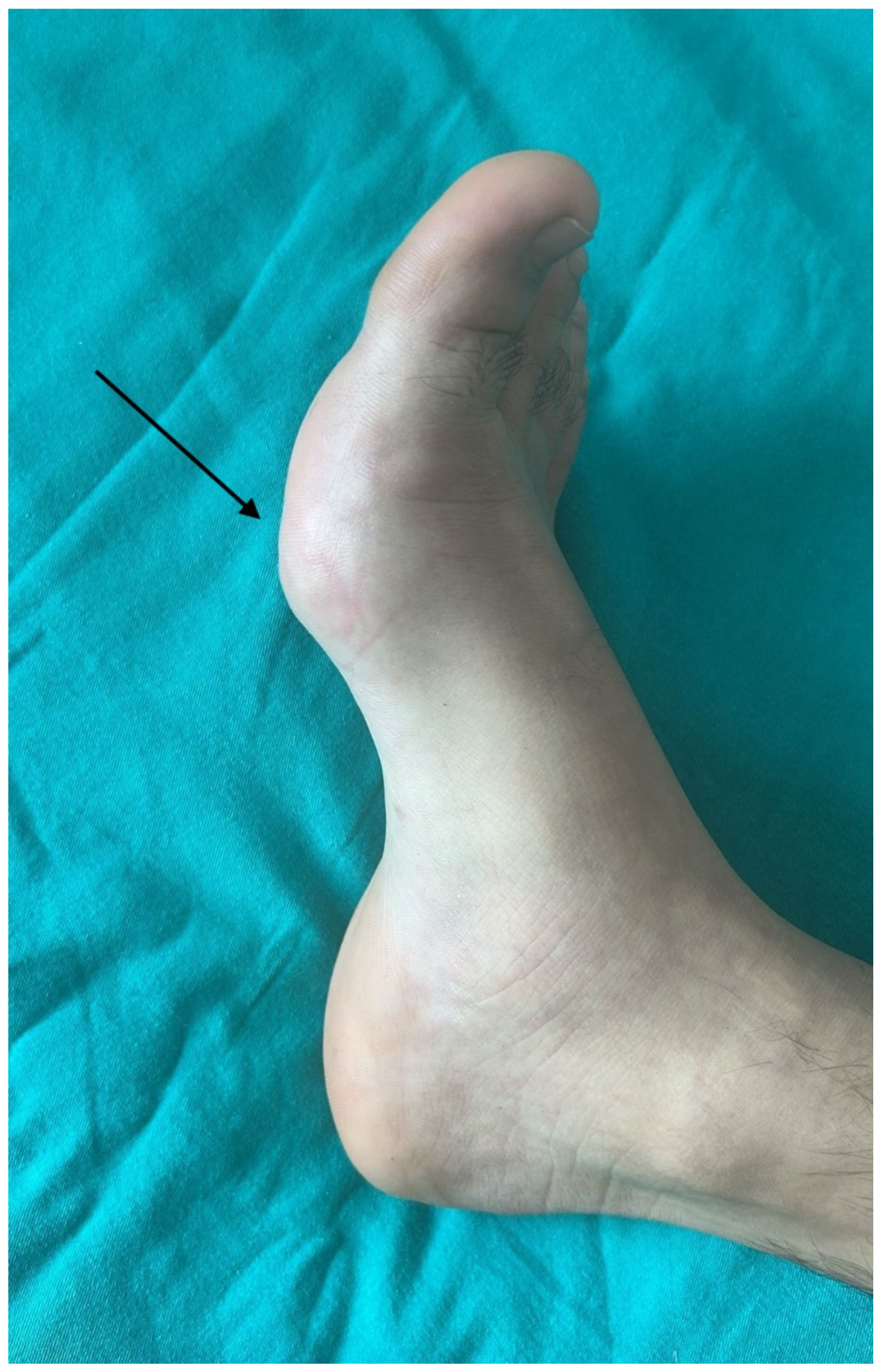
A 14-year-old female presented to our clinic with a 1.5-year history of right foot pain, a visible mass, and a noticeably altered gait pattern caused by discomfort during weight-bearing. Despite the chronicity of symptoms, she had not received appropriate treatment prior to this visit. On physical examination, a 3 cm × 2 cm × 1 cm firm, immobile, and poorly demarcated mass was palpated at the base of the first metatarsal. The mass was tender upon weight bearing (Figure 1). Callus formations were noted on the lateral aspect of the foot, consistent with chronic pressure or altered gait mechanics. No range of motion limitation was noted in the first metatarsophalangeal joint of the right foot.
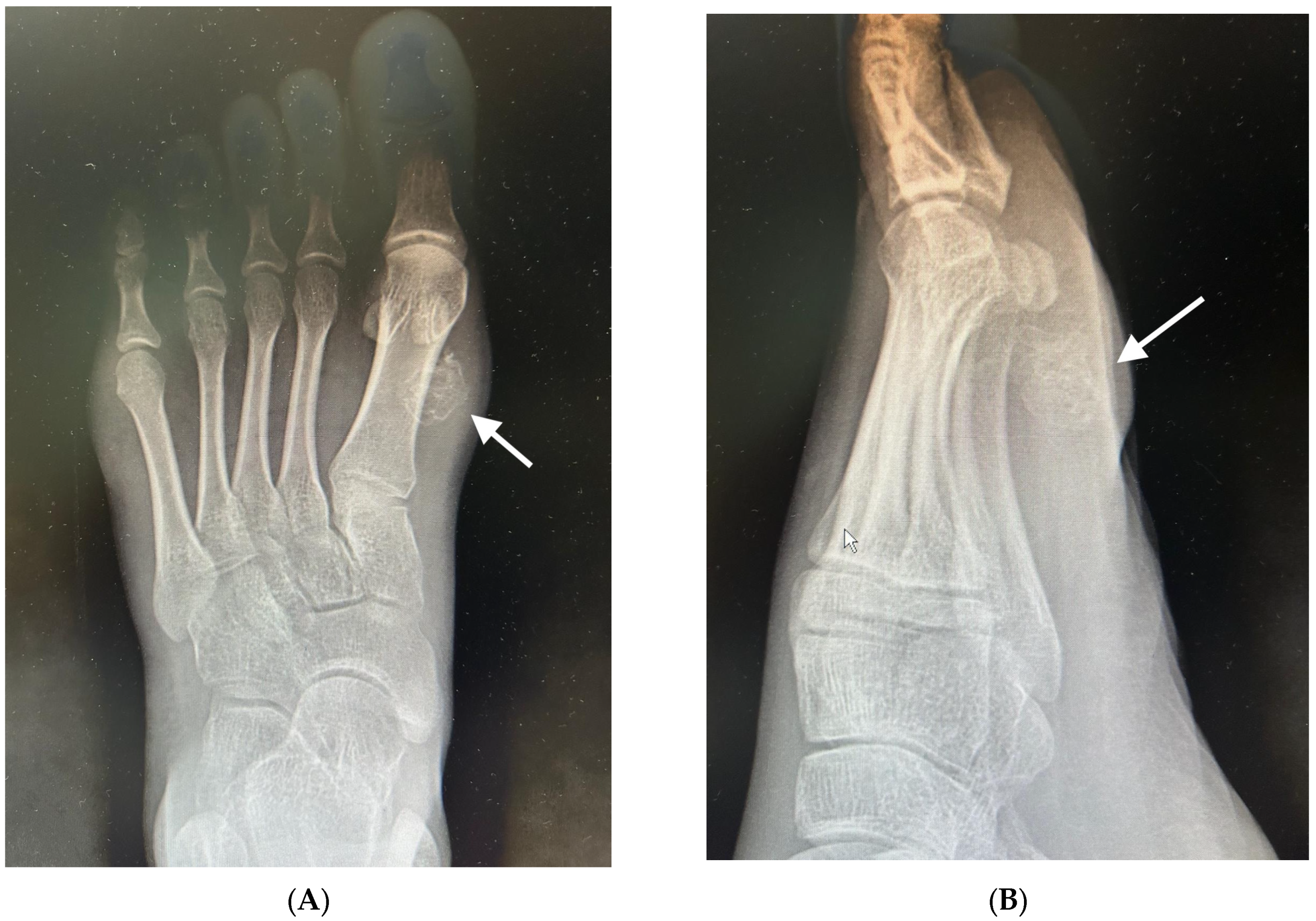
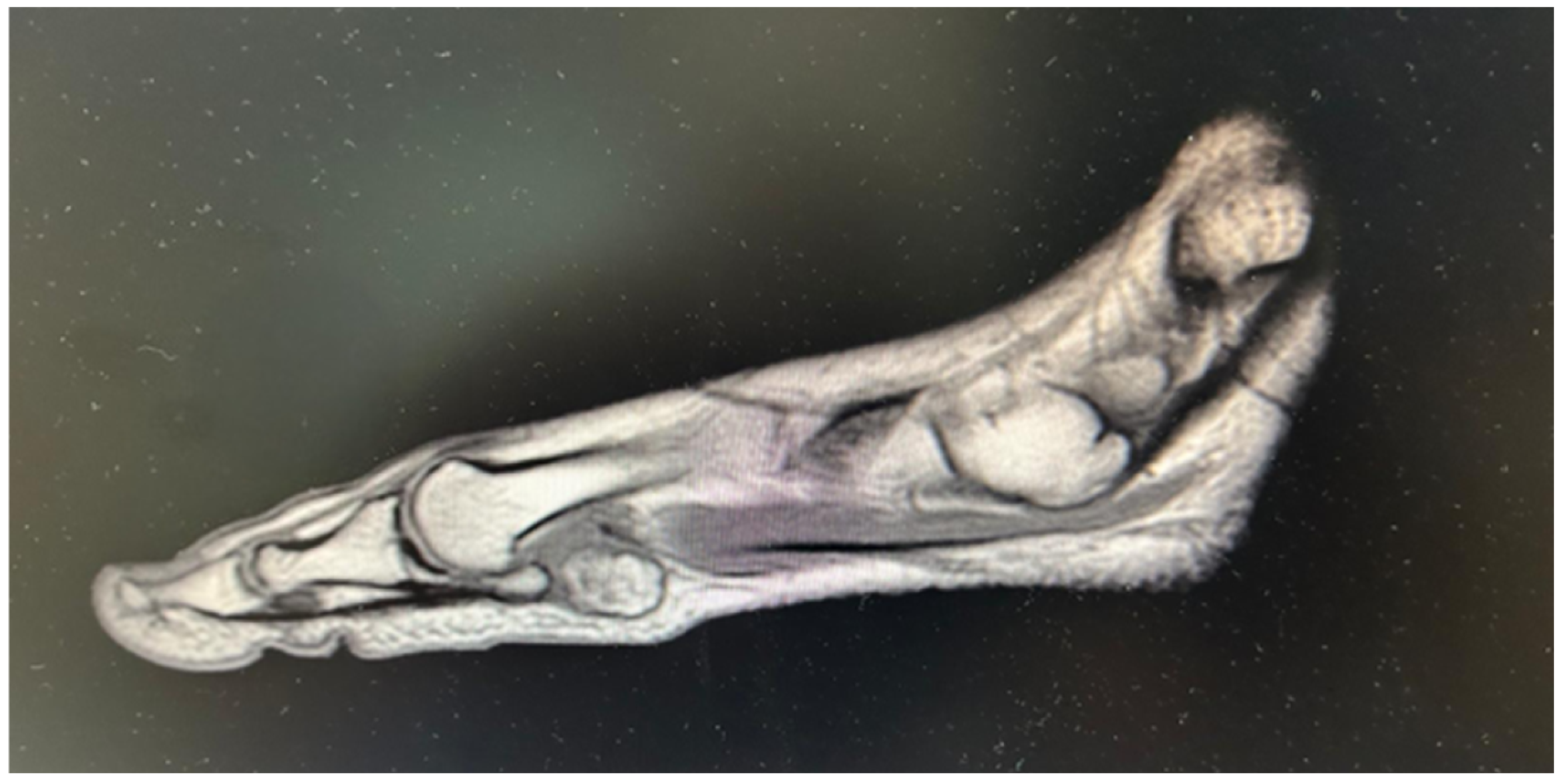
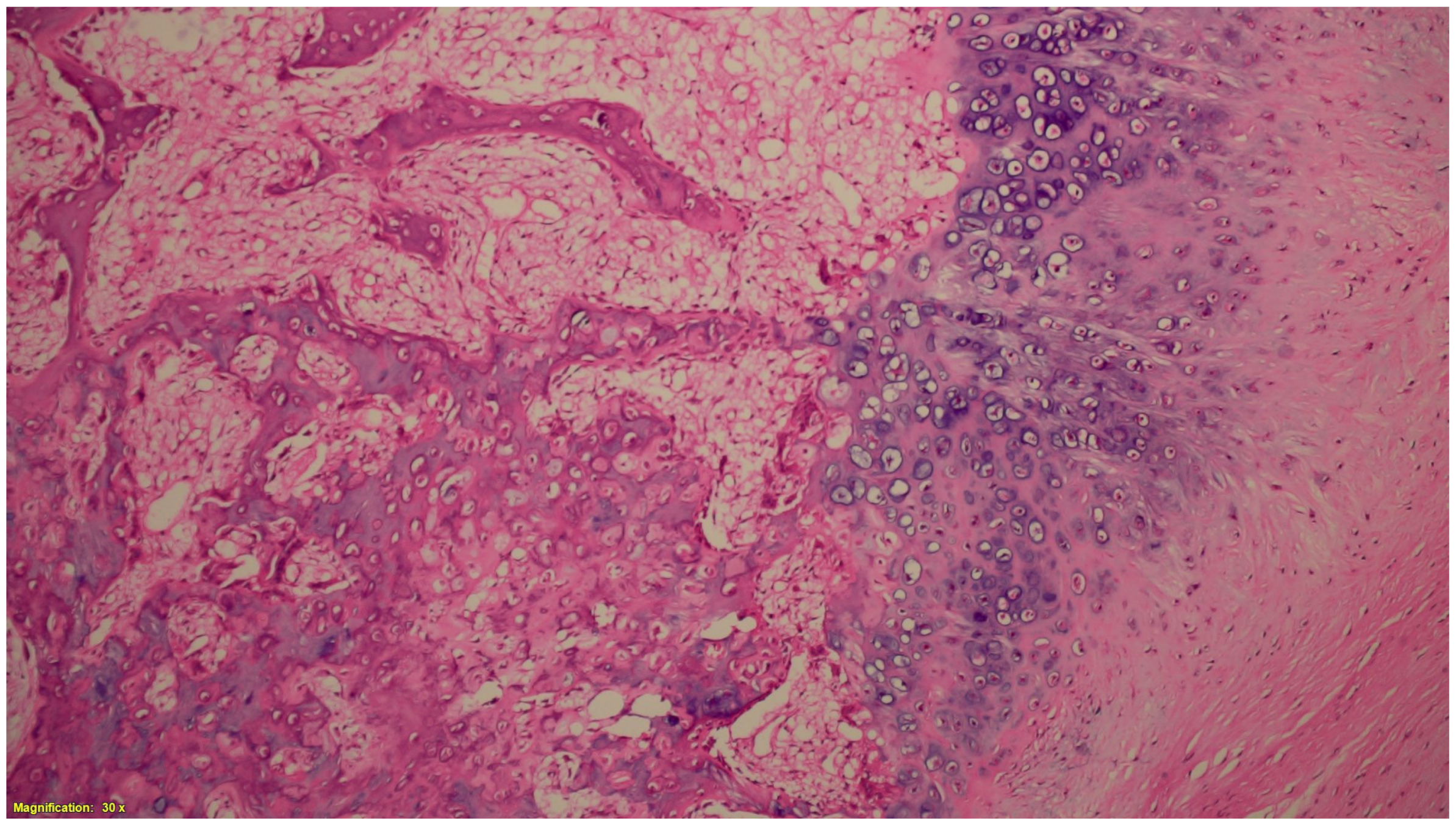
Initial imaging with anteroposterior and lateral plain radiographs was conducted, which showed a suspicious osseous mass near the first metatarsophalangeal joint, raising concerns for a potential osteochondroma (Figure 2). Magnetic resonance imaging (MRI) of the right foot was performed using T1-, T2-, and proton-density-weighted sequences. A 20 mm × 10 mm lobulated lesion exhibiting both soft tissue and adipose components was identified. Following intravenous contrast administration, enhancement was observed in the soft tissue component. The lesion was located on the plantar aspect of the distal first metatarsal, between the tibialis posterior and flexor hallucis longus tendons (Figure 3). A tru-cut biopsy was performed, and histopathological examination revealed trabecular bone containing fatty marrow without any atypical cells (Figure 4).
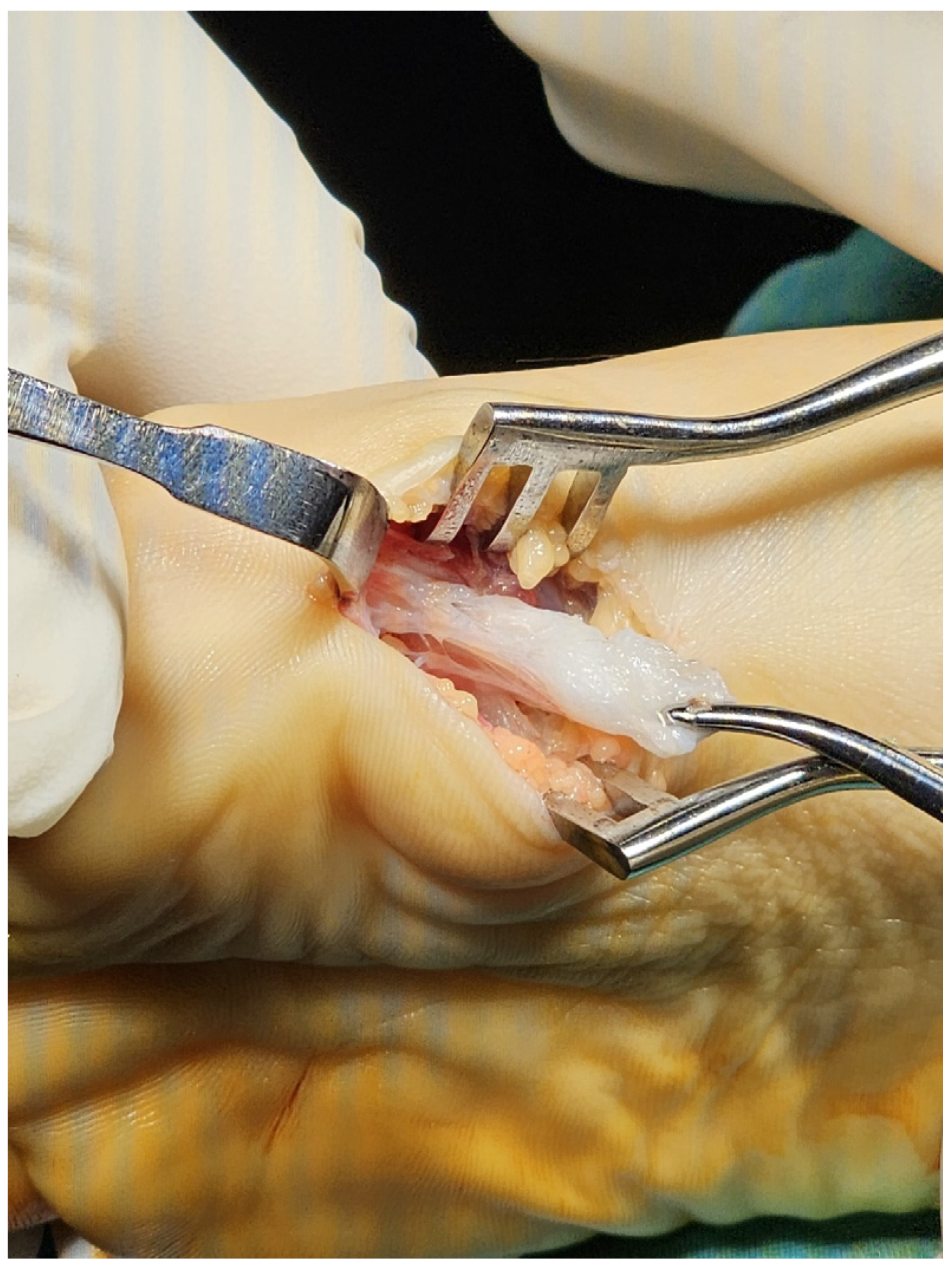
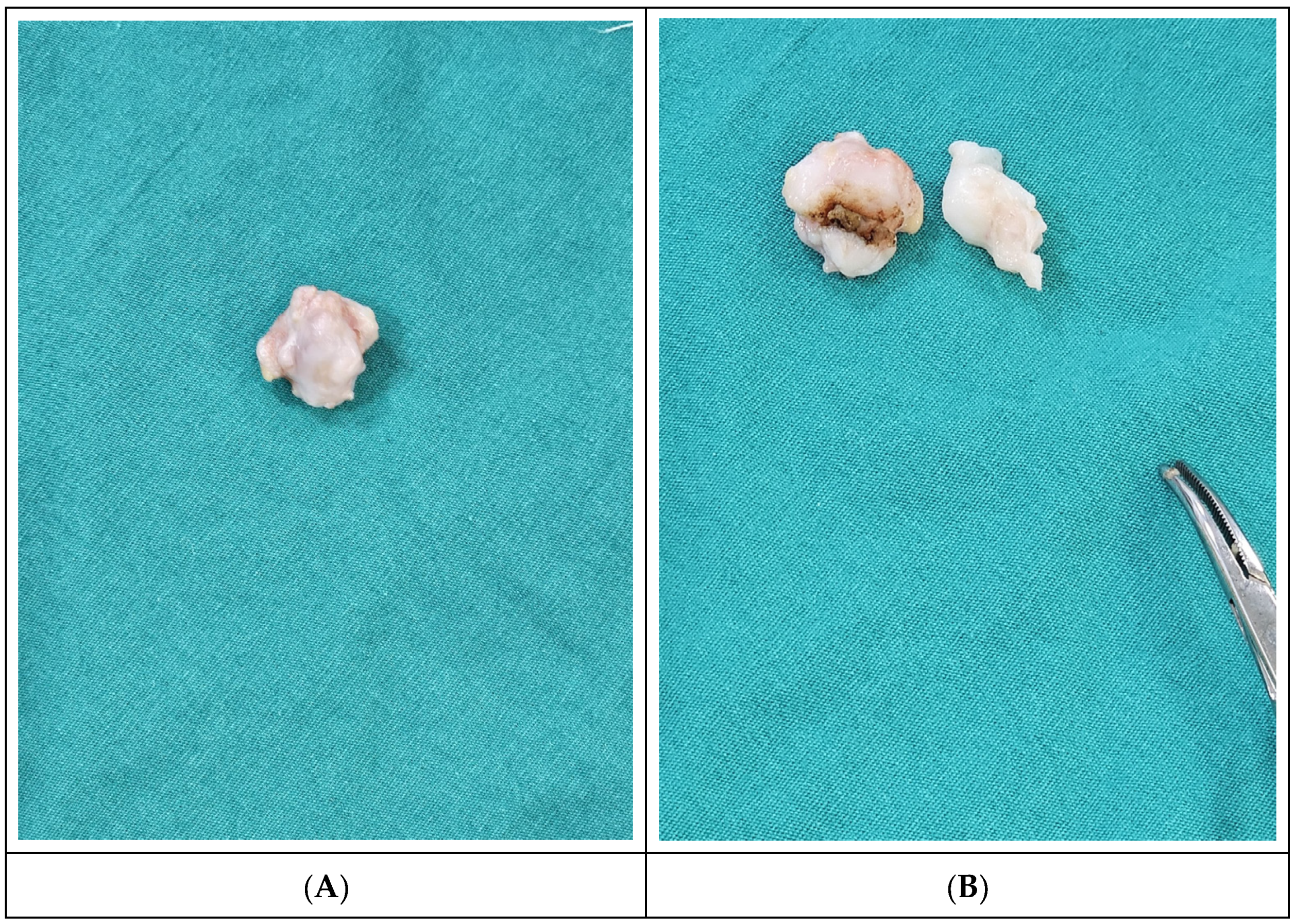
Given the patient’s ongoing pain and impaired gait, surgical excision was indicated. A 5 cm plantar incision was made over the distal first metatarsal. Dissection through the skin and subcutaneous tissues exposed the osseous mass, which was excised in its entirety after separation from the surrounding soft tissues (Figure 5). The pseudocapsule surrounding the tumor was identified as originating from the sesamoid bone. The dissection was extended to the site of origin within the sesamoid, and osseous prominences in this region were carefully removed. Intraoperative analysis of two tissue samples revealed trabecular bone with a chondroid cap on one side and fibrovascular tissue (Figure 6). Based on these findings, it was hypothesized that the connection between the osteochondroma and the sesamoid bone may have been disrupted during weight-bearing activities.
Postoperatively, the patient experienced complete resolution of pain, and normal ambulation was restored within two months. Additionally, weight-bearing calluses previously noted on the lateral aspect of the foot had begun to regress. At the 8-month clinical follow-up, the patient remained asymptomatic, exhibited no signs of recurrence or postoperative complications, and successfully resumed full functional activity.

3. Discussion

Osteochondromas are typically located in the metaphyses of long bones and are characterized by continuity with the medullary cavity and a cartilage cap. According to the World Health Organization, osteochondroma is defined as a benign bone neoplasm that develops on the external surface of the bone [10]. Osteochondromas involving the foot are rare; in a review of 783 cases, only 15 were located in the foot [11]. We present a case of osteochondroma arising from the medial sesamoid bone in a 14-year-old female whose symptoms began at age 12. To our knowledge, this is the fourth reported case of osteochondroma in this anatomical location in the English literature [5,12,13]. Uniquely, in our case, the connection between the lesion and the sesamoid bone appeared disrupted, and the patient experienced pain-related gait impairment.
Although typically asymptomatic, osteochondromas may cause symptoms due to compression of nearby vessels or nerves, fractures, skeletal deformities, bursa formation, or malignant transformation [1,8]. Some reports describe osteochondromas located beneath tendons, where repetitive movement over the bony lesion can cause pain [14]. We believe the pain in our case was due to the lesion’s rare location in the plantar region of the foot, situated between the tibialis posterior and flexor hallucis longus tendons, and its proximity to the first metatarsophalangeal (MTP) joint, where weight-bearing likely increased joint irritation during ambulation.
In our case, surgical excision was chosen due to persistent pain, visible mass, and the lesion’s location. Marginal excision is the recommended approach, preserving adjacent bone and soft tissues [1]. Complete resection should include the entire cartilage cap and periosteum, as recurrence may occur if remnants of hyaline cartilage or perichondrium remain [1,15]. When resection is complete, local recurrence rates are reported to be under 2% [8]. Histologically, recurrence can occur in both benign cartilage tumors and low-grade chondrosarcomas [8]. Due to the risk of recurrence, Ouchi et al. opted for total sesamoidectomy, in contrast to our approach [5]. Similar to the method described by Akram et al., we preserved the sesamoid bone [13]. Sesamoidectomy has been reported to carry risks such as the development of hallux valgus, reduction in the range of motion of the first metatarsophalangeal joint, and decreased plantar flexion strength, and is therefore rarely performed [16]. In our case, the capsule was dissected down to the sesamoid bone and completely excised, and osseous prominences at the site of origin of the osteochondroma within the sesamoid bone were carefully debrided.
Previous case reports of sesamoid osteochondromas, similar to our case, have described patients presenting with localized pain, swelling, or a palpable mass beneath the first metatarsophalangeal joint. In the case reported by Ouchi et al., a 62-year-old male underwent tibial sesamoidectomy, with full recovery and no recurrence at 12 months [5]. Mowad et al., reported a 46-year-old female who underwent surgical excision and remained asymptomatic at 6-month follow-up [12]. Akram et al., described a 54-year-old female with medial sesamoid exostosis, initially managed conservatively, followed by surgical excision due to persistent symptoms; full recovery was noted at 3 months [13]. All three cases highlight surgical excision as an effective treatment option, with no reported recurrences in the short to mid-term follow-up periods. In our case, surgical excision was similarly performed, and no recurrence was observed at the 8-month follow-up. Notably, our patient was a 14-year-old female, representing a significantly younger age group compared to previously reported cases, which contributes to the uniqueness of this presentation.
In this case, the lack of bony continuity, combined with the rarity of osteochondroma in this anatomical region, contributed to the difficulty in establishing a differential diagnosis. The differential diagnosis of lesions in this region includes extraskeletal osteochondromas (EO), a rare variant of soft tissue chondroma whose biological behavior is not well defined [17,18]. EO closely resemble typical osteochondromas grossly and histologically but lack bony continuity with adjacent skeletal structures [19]. EO are slow-growing, benign tumors generally found in the hands and feet and are usually smaller than 2–3 cm. A few EO cases in this region have been reported [6,19,20]. Another lesion to consider is Nora’s lesion [21], with a few reports involving the sesamoid region [22,23]. Radiographically, it appears to originate from the cortex without disrupting it, often in the metaphysis, and may present with a spiculated or irregular surface [24]. Computed tomography is useful to distinguish it from osteochondroma by showing the absence of medullary continuity between the lesion and host bone [24]. In our case, the diagnosis of osteochondroma was confirmed through imaging and histological findings, while other diagnoses were excluded.
In conclusion, we report a rare case of osteochondroma originating from the medial sesamoid bone. Despite its small size, the lesion was symptomatic and surgically treated, resulting in resolution of symptoms.

Author Contributions

Conceptualization, M.K. and D.U.Z.; methodology, M.K. and H.K.; software, M.K. and D.U.Z.; validation, M.K. and H.K.; formal analysis, M.K. and H.K.; investigation, D.U.Z.; resources, M.K. and D.U.Z.; data curation, D.U.Z. and H.K.; writing—original draft preparation, M.K. and D.U.Z.; writing—review and editing, M.K. and D.U.Z.; visualization, H.K.; supervision, H.K. and M.K. All authors have read and agreed to the published version of the manuscript.

Funding

This research received no external funding.

Institutional Review Board Statement

This manuscript is a case report and does not involve a prospective research protocol or experimental intervention. Therefore, formal ethics committee approval was not obtained.

Informed Consent Statement

Written informed consent for publication of this case report and any accompanying clinical details and images was obtained from the patient’s parent/legal guardian. Assent was also obtained from the patient.

Data Availability Statement

The data presented in this case report are available from the corresponding author upon reasonable request. The data are not publicly available in order to protect patient privacy.

Conflicts of Interest

The authors declare no conflicts of interest.

References

  1. Tepelenis, K.; Papathanakos, G.; Kitsouli, A.; Troupis, T.; Barbouti, A.; Vlachos, K.; Kanavaros, P.; Kitsoulis, P. Osteochondromas: An Updated Review of Epidemiology, Pathogenesis, Clinical Presentation, Radiological Features and Treatment Options. In Vivo 2021, 35, 681–691. [Google Scholar] [CrossRef]
  2. Galanis, V.; Georgiadi, K.; Balomenos, V.; Tsoucalas, G.; Thomaidis, V.; Fiska, A. Osteochondroma of the talus in a 19-year-old female: A case report and review of the literature. Foot 2020, 42, 101635. [Google Scholar] [CrossRef] [PubMed]
  3. Douis, H.; Saifuddin, A. The imaging of cartilaginous bone tumours. I. Benign lesions. Skelet. Radiol. 2012, 41, 1195–1212. [Google Scholar] [CrossRef] [PubMed]
  4. Bovée, J.V.M.G. Multiple osteochondromas. Orphanet J. Rare Dis. 2008, 3, 3. [Google Scholar] [CrossRef] [PubMed]
  5. Ouchi, K.; Hakozaki, M.; Kikuchi, S.-I.; Yabuki, S.-I. Osteochondroma of the Tibial Sesamoid: A Case Report and Review of the Literature. J. Foot Ankle Surg. 2017, 56, 628–631. [Google Scholar] [CrossRef]
  6. Okada, A.; Hatori, M.; Hashimoto, Y.; Lee, E. Painful extraskeletal osteochondroma under the tarsal sesamoid: A case report and review of literature. Eur. J. Orthop. Surg. Traumatol. 2011, 22, 215–220. [Google Scholar] [CrossRef]
  7. Khodnapur, G.; Kulkarni, S.; Patil, V.; Venkat, M.; Basavaraj, M.K. Case Series—Osteochondromas at Rare Locations. J. Orthop. Case Rep. 2023, 13, 74–80. [Google Scholar] [CrossRef]
  8. Woertler, K.; Lindner, N.; Gosheger, G.; Brinkschmidt, C.; Heindel, W. Osteochondroma: MR imaging of tumor-related complications. Eur. Radiol. 2000, 10, 832–840. [Google Scholar] [CrossRef]
  9. Gavanier, M.; Blum, A. Imaging of benign complications of exostoses of the shoulder, pelvic girdles and appendicular skeleton. Diagn. Interv. Imaging 2017, 98, 21–28. [Google Scholar] [CrossRef]
  10. Khurana, J.; Abdul-Karim, F.; Bovée, J.V.M.G. Osteochondroma. In Pathology and Genetics of Tumours of Soft Tissue and Bone; Fletcher, C.D.M., Unni, K.K., Mertens, F., Eds.; IARC: Lyon, France, 2002; Volume 1, p. 234. [Google Scholar]
  11. Gebhardt, M. Tumors and Tumorlike Lesions of Bone: Pathology, Radiology, and Treatment; Schajowicz, F., Ed.; Springer: New York, NY, USA, 1994; Volume 2. [Google Scholar]
  12. Mowad, S.C., Sr.; Zichichi, S.; Mullin, R. Osteochondroma of the tibial sesamoid. J. Am. Podiatr. Med. Assoc. 1995, 85, 765–766. [Google Scholar] [CrossRef]
  13. Akram, N.; Asif, A.; Mangwani, J. A Rare Case of Exostosis of the Medial Sesamoid Bone. J. Orthop. Case Rep. 2023, 13, 25–28. [Google Scholar] [CrossRef] [PubMed]
  14. Kitsoulis, P.; Galani, V.; Stefanaki, K.; Paraskevas, G.; Karatzias, G.; Agnantis, N.J.; Bai, M. Osteochondromas: Review of the clinical, radiological and pathological features. In Vivo 2008, 22, 633–646. [Google Scholar] [PubMed]
  15. Lee, J.; Yao, L.; Wirth, C. MR imaging of solitary osteochondromas: Report of eight cases. Am. J. Roentgenol. 1987, 149, 557–560. [Google Scholar] [CrossRef] [PubMed]
  16. Shimozono, Y.; Hurley, E.T.; Brown, A.J.; Kennedy, J.G. Sesamoidectomy for hallux sesamoid disorders: A systematic review. J. Foot Ankle Surg. 2018, 57, 1186–1190. [Google Scholar] [CrossRef] [PubMed]
  17. Helpert, C.; Davies, A.M.; Evans, N.; Grimer, R.J. Differential diagnosis of tumours and tumour-like lesions of the infrapatellar (Hoffa’s) fat pad: Pictorial review with an emphasis on MR imaging. Eur. Radiol. 2004, 14, 2337–2346. [Google Scholar] [CrossRef]
  18. Oliva, F.; Marconi, A.; Fratoni, S.; Maffulli, N. Extra-osseous osteochondroma-like soft tissue mass of the patello-femoral space. BMC Musculoskelet. Disord. 2006, 7, 57. [Google Scholar] [CrossRef]
  19. Hunter, A.M.; Farnell, C.; Doyle, J.S. Extraskeletal Osteochondroma of the Great Toe in a Teenager. J. Foot Ankle Surg. 2019, 58, 807–810. [Google Scholar] [CrossRef]
  20. Sheff, J.S.; Wang, S. Extraskeletal osteochondroma of the foot. J. Foot Ankle Surg. 2005, 44, 57–59. [Google Scholar] [CrossRef]
  21. Nishio, J.; Shinohara, Y.; Nakayama, S.; Koga, M.; Aoki, M.; Koga, T. Bizarre parosteal osteochondromatous proliferation revisited. In Vivo 2025, 39, 1799–1809. [Google Scholar] [CrossRef]
  22. Tetik, O.; Aslan, L.; Buyukdogan, K.; Chodza, M.; Kilicoglu, O. Bizarre Parosteal Osteochondromatous Proliferation (Nora's Lesion) in the Medial Sesamoid of the First Toe. J. Am. Podiatr. Med Assoc. 2020, 110, 17. [Google Scholar] [CrossRef]
  23. Harty, J.; Kelly, P.; Niall, D.; O'KEane, J.; Stephens, M. Bizarre parosteal osteochondromatous proliferation (Nora’s lesion) of the sesamoid: A case report. Foot Ankle Int. 2000, 21, 408–412. [Google Scholar] [CrossRef]
  24. Mahajan, S.; Chandra, R.; Mohan Lal, Y. “Nora lesion”—Bizarre parosteal osteochondromatous proliferation. J. Clin. Orthop. Trauma 2012, 3, 119–121. [Google Scholar] [CrossRef]
Figure 1. Clinical photograph showing the mass on the medial aspect of the patient’s right foot; the arrow indicates the lesion.
Japma 116 00023 g001
Figure 2. Plain radiographs of the right foot showing a mass plantar to the distal first metatarsal; the arrows indicate the lesion. (A) antero-posterior view, (B) lateral view.
Japma 116 00023 g002
Figure 3. Mass appearance in the plantar region on preoperative MRI.
Japma 116 00023 g003
Figure 4. Histopathological image showing findings consistent with osteochondroma.
Japma 116 00023 g004
Figure 5. The mass during surgical exposure.
Japma 116 00023 g005
Figure 6. Gross images of the excised osteochondroma. (A) first view (B) second view.
Japma 116 00023 g006
Disclaimer/Publisher’s Note: The statements, opinions and data contained in all publications are solely those of the individual author(s) and contributor(s) and not of MDPI and/or the editor(s). MDPI and/or the editor(s) disclaim responsibility for any injury to people or property resulting from any ideas, methods, instructions or products referred to in the content.