Social media are interactive technologies that facilitate the creation of highly interactive platforms via which individuals and communities share, create, discuss, and modify user-generated content [
1]. Instagram is a photo and video sharing social networking service that allows users to communicate, connect, and collaborate by posting media that can be shared publicly or with preapproved followers. Instagram was initially launched in 2010 and gained rapid popularity, with 1 million registered users in 2 months, 10 million registered users in 1 year, and 1 billion registered users by 2018 [
2]. The United States has been ranked as having the largest Instagram audience worldwide, with steady and consistent growth each year [
3]. In terms of social media demographics, most Instagram users have been identified as “Generation Z” and “Millennials.” [
4] More than half of global Instagram users are aged 34 years or younger, with the largest age group being 18 to 34 years old and consisting of approximately 62% of all users [
4].
As the use of social media continues to rise, so does its place in the medical field. Recent data show that 26% of the hospitals in the United States participate in social media, and 31% of health-care professionals use social media for professional networking [
5]. Similarly, podiatric medical students can use social media, such as Instagram, as a resource when making their decision to apply to, interview with, and rank a residency program. Instagram can be used as a tool for prospective applicants to learn more about the program, including current and past residents, faculty, surgical cases, academic sessions and workshops, and wellness initiatives. The interactive component of Instagram allows students to message programs for educational purposes to learn more about the programs they are considering applying to or for answers to any questions they may have. Social media has become an important avenue not only for fostering virtual connections but also for conveying the culture, educational experience, and ambience of an institution [
3]. The use of social media in residencies, including orthopedic surgery, urology, internal medicine, general surgery, anesthesiology, and oral and maxillofacial surgery, among others, has been studied in recent years, but the use of social media in podiatric medicine residencies has never been studied [
3,
6,
7,
8,
9,
10].
On successful completion of 4 years of graduate professional education, podiatric medical graduates participate in a podiatric medicine and surgery residency, which consists of 3 years of training in inpatient and outpatient medical and surgical management [
11]. Similar to other medical specialties, this training process occurs in teaching hospitals or academic health centers throughout the country [
11]. To obtain a residency position, students participate in the match process during their final year of podiatric medical school. At the conclusion of the interview period, residency applicants submit a “rank-order list” [
12]. The rank-order list details the programs where the applicant wants to train, ranked in his or her order of preference [
12]. Each residency program also submits a rank-order list of applicants it wants to train, ranked in the program’s order of preference.[
12] The match computer algorithm then attempts to assign each applicant to a residency position using the preferences expressed on the rank-order lists [
12]. After the match algorithm is run, any unfilled positions are offered to unmatched applicants in a second match called Match Phase II (MPII), commonly referred to as “the scramble.” The process then repeats itself.
The social media presence of podiatric medicine residency programs in the United States has not been studied to date, making this study the first of its kind. This pilot study aimed to evaluate the presence and use of social media, specifically Instagram, among podiatric medicine residency programs and its effect on the 2023 podiatric medicine residency match process.
Materials and Methods
A list of all of the accredited podiatric medicine residency programs in the United States was obtained from the Council on Podiatric Medical Education (CPME) Web site [
13]. The CPME Web site was also used to identify the state in which each of the podiatric medicine residency programs is located [
13]. The U.S. News & World Report Web site was reviewed to determine which podiatric medicine residency programs are located at a regionally or nationally ranked facility (hereinafter referred to as “ranked”) [
14]. Specifically, the U.S. News Best Regional Hospitals rankings were used to determine which podiatric medicine residency programs are at regionally ranked facilities [
14]. The U.S. News 2022–2023 Best Hospitals Honor Roll was used to determine which podiatric medicine residency programs are at nationally ranked facilities [
14]. Data regarding the total number of adult beds was gathered directly from the program’s hospital Web site, the American Hospital Association (AHA) Web site [
15], or the American Hospital Directory (AHD) Web site [
16].
To find a residency program Instagram account, a combination of Google searches and Instagram searches was used. The Google search was performed using the keywords podiatry residency Instagram and foot and ankle surgery residency Instagram. The Instagram search was performed using the keywords [program name] podiatry residency and [program name] foot and ankle surgery residency. In addition, programs were identified with the help of the communications department at the American Podiatric Medical Association, which posted a story from their Instagram account asking podiatric medicine residency programs to submit their Instagram handle. The information obtained from the American Podiatric Medical Association’s Instagram story was then communicated via e-mail to the corresponding author of this article.
Instagram accounts were analyzed for the number of posts, number of followers, use of highlights, use of reels, and date of last post to determine whether the account was active in the past 30 days (hereinafter referred to as “activeness”). Data were collected in February 2023, 2 days before the Central Application Service for Podiatric Residencies (CASPR) deadline for rank-order lists. One author (A.T.R.) independently conducted the search.
Match status results were released March 9, 2023, and were obtained from the national matching service for the CASPR Web site. A list of unfilled positions at programs throughout the country was reviewed and indicated which programs in each state were participating in MPII.
Descriptive statistics, including frequencies and percentages for categorical variables as well as medians and interquartile ranges for nonnormal continuous variables, were calculated. As appropriate, associations were evaluated using Wilcoxon rank sum, χ2, and Fisher exact tests. This study was exempt from institutional review board approval because no human subjects were involved in the study.
Results
The CPME-approved residency programs located in the tri-state area were evaluated. Of the 225 total US programs evaluated, three are located in Connecticut, 15 in New Jersey, and 36 in New York (n = 54). Hospital size ranged from 121 to 2,291 adult hospital beds, with a median of 467 beds. Moreover, 40.7% of hospitals (22 of 54) hosting podiatric medicine residency programs were regionally or nationally ranked (
Table 1).
Table 1.
Characteristics of 54 Podiatric Medicine Residency Programs with and Without an Instagram Account in the Tri-state Area.
Table 1.
Characteristics of 54 Podiatric Medicine Residency Programs with and Without an Instagram Account in the Tri-state Area.
Among these podiatric medicine residency programs, 48.1% have an Instagram account (26 of 54) (
Table 1), with more than half of the analyzable accounts (13 of 25, 52.0%) being active within 30 days of February 15, 2023 (
Table 2). The overall total number of posts ranged from three to 455, with the median being 18, and the total number of followers ranged from 91 to 1,769, with the median being 288. Furthermore, 52.0% used story highlights (13 of 25), and 28.0% used reels (seven of 25) (
Table 2).
Table 2.
Summary of Instagram Activity Among the 54 Podiatric Medicine Residency Programs in the Tri-state Area with Instagram Accounts (2023).
Table 2.
Summary of Instagram Activity Among the 54 Podiatric Medicine Residency Programs in the Tri-state Area with Instagram Accounts (2023).
In the tri-state area, 29 of 54 programs (53.7%) did not enter MPII during the 2023 match process (
Table 1). Notably, there is a significant difference in the MPII outcome comparing programs with versus without an Instagram account (
P = .006) (
Table 1). Specifically, among programs that entered MPII, most did not have an Instagram account (18 of 25, 72.0%), whereas 65.5% of programs (19 of 29) not entering MPII held accounts (
Table 1). However, among account holders, individual Instagram metrics (including total number of posts, total number of followers, use of story highlights, use of reels, and activeness) showed no significant difference in the MPII outcome (
P = .81, .47, .67, .63, and >.99, respectively) (
Table 2).
A higher percentage of podiatric medicine residency programs with an Instagram account were regionally or nationally ranked compared with those without an Instagram account (
Table 1). This result is significant with a
P < .05 (
P = .015) (
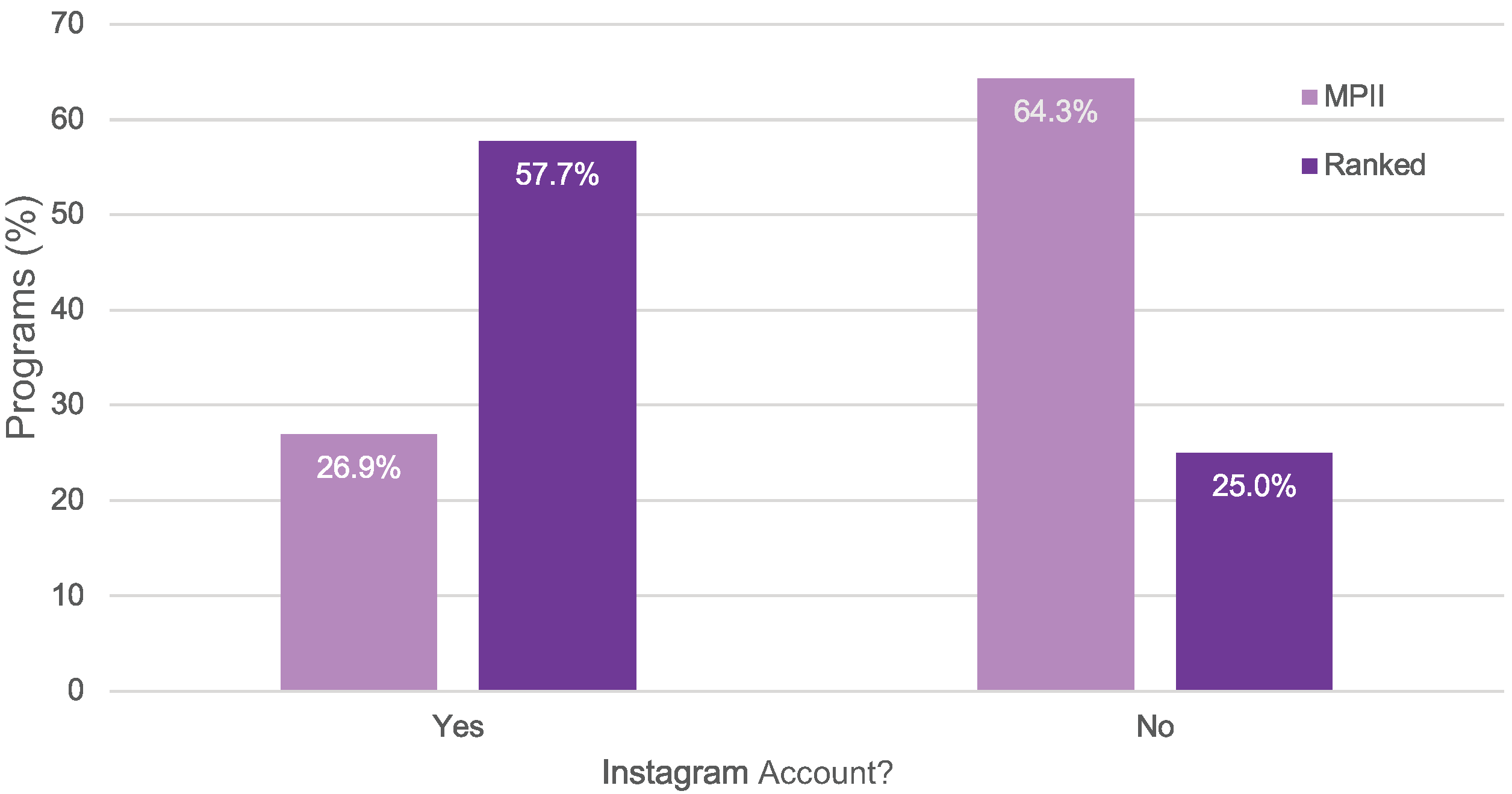
Table 1). Of podiatric medicine residency programs with an Instagram account there are a higher percentage of ranked programs (15 of 26, 57.7%) and a lower percentage that entered MPII (seven of 26, 26.9%) compared with those without an Instagram account, where there are a lower percentage of ranked programs (seven of 28, 25.0%) and a higher percentage that entered MPII (18 of 28, 64.3%) (
Fig. 1). Last, there is no significant correlation between total number of adult hospital beds (a proxy for facility size, staff support, and resources) and whether a podiatric medicine residency program has an Instagram account (
P = .117) (
Table 1).
Figure 1.
Percentage of the 54 podiatric medicine residency programs entering Match Phase II (MPII) and whether they were rank stratified by Instagram account status (2023).
Figure 1.
Percentage of the 54 podiatric medicine residency programs entering Match Phase II (MPII) and whether they were rank stratified by Instagram account status (2023).
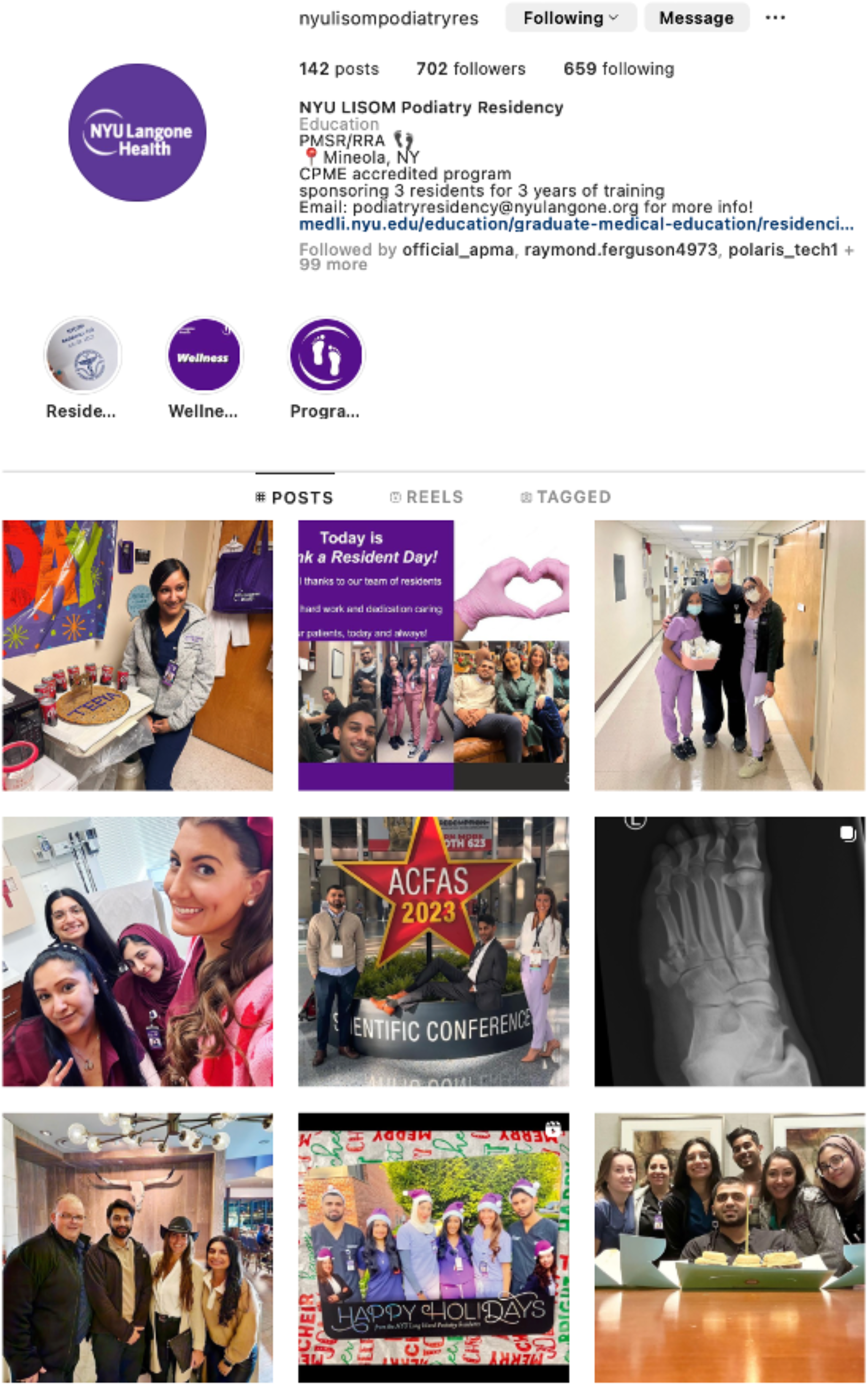
Figure 2 is an example of a podiatric medicine residency program Instagram account in the form of a screenshot taken from an online browser showing the use of highlights, posts, and reels to relay information about the program.
Figure 2.
Screenshot of a podiatric medicine residency program Instagram account from an online browser showing the use of highlights, posts, and reels to relay information about the program. The content shown includes information about current residents, faculty, and surgical cases, as well as various academic, clinical, and social events, which allows users to gain a feel for the overall culture of the program. Permissions were obtained from all of the individuals pictured in
Figure 2 for inclusion in this article.
Figure 2.
Screenshot of a podiatric medicine residency program Instagram account from an online browser showing the use of highlights, posts, and reels to relay information about the program. The content shown includes information about current residents, faculty, and surgical cases, as well as various academic, clinical, and social events, which allows users to gain a feel for the overall culture of the program. Permissions were obtained from all of the individuals pictured in
Figure 2 for inclusion in this article.
Discussion
The use of social media is widespread in the general population and among medical professionals [
10]. The use of social media in a variety of residency specialties has been studied, but this pilot study is the first to investigate the role of Instagram in the podiatric medicine residency match process [
3,
6,
7,
8,
9,
10,
11]. Based on this analysis, 48.1% of podiatric medicine residency programs in the tri-state area (26 of 54) have an Instagram account. Fifty-two percent of these programs (13 of 25) use story highlights, 28.0% (seven of 25) use reels, and 52.0% (13 of 25) exhibited activeness. Among all of the identified accounts, the mean number of posts was 43 and the mean number of followers was 434.
Within the tri-state area, a small subset of the United States, there seems to be an association between podiatric medicine residency programs with an Instagram account and a lower likelihood of entering MPII. In this subset, podiatric medicine residency programs that are ranked tend to have an Instagram account compared with those that are not ranked. We found that the total number of adult hospital beds alone and ranking alone did not impact MPII. In addition, individual Instagram metrics, including number of posts, number of followers, use of highlights, use of reels, and activeness, did not correlate with whether a program enters MPII. Although these findings cannot be extrapolated for the entire country, they are helpful in recommending that further research be performed on the impact of social media on residency placement.
The findings of this pilot study should be viewed in the context of its limitations. First, this pilot study solely considered Instagram as an influencing factor in the podiatric medicine residency match, and no other forms of social media, such as Facebook. Facebook is ranked as the most popular form of social media worldwide as of January 2023 based on the number of monthly active users [
17]. Including data regarding Facebook accounts among podiatric medicine residency programs in future studies would allow for a more comprehensive look at the role of social media in the podiatric medicine residency match.
This pilot study analyzes podiatric medicine residency programs in the tri-state area, which includes New York, New Jersey, and Connecticut, for a total of 54 CPME-approved podiatry residency programs. However, there are 225 CPME-approved podiatric medicine residency programs in the United States. A similar study on a larger scale that includes all CPME-approved podiatric medicine residency programs across the country should be considered in the future, as a larger sample size would be better representative of the role of Instagram in the podiatric medicine residency match.
Data regarding facility metrics, namely, the total number of adult beds, were obtained either directly from the hospital Web site or through the AHA and AHD Web sites. If information was unavailable on the individual hospital’s Web site, then the AHA or AHD Web sites were used. The authors noted that the total number of adult beds for the same facility varied slightly on the AHA and AHD Web sites. In addition, if the residency program name included more than one facility (ie, Long Island Jewish/North Shore at Northwell Health), then the total number of adult beds at each facility was summed. However, it is unclear whether residents rotate at additional facilities not included in the program name, and if so, the metrics for those facilities are unaccounted for.
At the time of data collection, one program in New Jersey had not accepted the follow-up request. Thus, we were able to identify the program as having an Instagram account, but we were unable to analyze the account for metrics. In addition, one residency program in New York is affiliated with both a hospital and a podiatric medical school. For this reason, we considered this podiatric medicine residency program to have an Instagram account and analyzed the account metrics, although the account’s content primarily relates to the podiatric medical school. It should also be noted that the individual program Instagram accounts may have been updated after the data collection date, although we believe that the data are representative of the Instagram accounts.
There are numerous other very important factors that exist that may influence why a program enters MPII. However, this pilot study solely focuses on social media influence, specifically Instagram. Although we acknowledge that this is certainly not the only deciding factor in why a program enters MPII, we believe it may be one of them and warrants further study.
Conclusions
The presence of podiatric medicine residency programs on social media continues to grow with time. With approximately half of CPME-approved residency programs in the tri-state area on Instagram, prospective applicants can use Instagram as a tool to gain insight into podiatric medicine residency programs. Podiatric medicine residency Instagram accounts give applicants a unique window into the inner workings of a residency program as well as an impression of the overall culture of the program. It allows for increased communication and the establishment of connections with prospective students while simultaneously promoting the residency program.
The hypotheses of this pilot study were overall well supported. Instagram, a proxy for social media presence among podiatric medicine residency programs, may be one of the factors that influence the podiatric medicine match process, and thus should be investigated further and on a larger scale. Future research on a national level may further validate the results of this pilot study that Instagram may be a useful resource for prospective applicants in the match process.