Running is increasingly popular because it is inexpensive, prevents health problems, and is practical in many environments. Although running has several advantages, there are disadvantages. A previous study reported that running-related injuries per 1,000 hours of running ranged from 2.5 to 33.0.[
1] The number of running-related injuries is expected to increase as the number of people who run increases. One of the most common running-related injuries is medial tibial stress syndrome (MTSS), and a previous study reported that MTSS accounts for approximately 60% of all lower-limb disorders.[
2] Risk factors for the development of MTSS include increased body mass index, female runners, a history of MTSS, and fewer years of running experience.[
3,
4] Because the recurrence rate of MTSS is high, it is important to prevent MTSS before its onset.
Recently, some studies suggesting a relationship between foot parameters and the development of MTSS have also been reported. Sharma et al[
5] demonstrated that peak plantar pressure of the medial side during walking was higher in the MTSS group than in the non-MTSS group. Because increased plantar pressure of the medial side indicates a decrease of the medial longitudinal arch (MLA), the decrease of the MLA is associated with the development of MTSS. According to traction theory,[
6] by the MLA decrease, the inverter muscles, which are the cause of MTSS, are stretched, and symptoms such as pain are likely to appear.
Repetitive loading during running contributes to the development of MTSS, and repetitive loading affects foot pressure. Fukano et al[
7] reported that repetitive loading during long-distance running causes a decrease in the MLA of the foot. These movements may increase medial plantar pressure and may result in MTSS. A previous study has evaluated plantar pressure in 10 and 20 km of running and reported that medial plantar pressure was higher after running than before running.[
8] However, the plantar pressure in 5 km of running, which is shorter than 10 and 20 km,[
8] is unknown. The 5 km of running would be easier for novice and recreational runners to engage in. There is evidence that novice runners are more likely to have injuries from running compared with experienced runners.[
9] If plantar pressure changes at a short distance of 5 km, even 5 km may suggest the need for early physical care, which may lead to prevention of the onset of MTSS.
Therefore, this study aimed to examine changes in plantar pressure before and after 5 km of running. Previous reports indicated that a 5-km run significantly changes ankle kinematics and kinetics.[
10] In addition, repetitive loading during long-distance running causes a decrease in the MLA.[
7] Thus, we hypothesize that plantar pressure also changes before and after 5 km of running, especially medial foot pressure, which may increase after 5 km of running.
Methods
Participants
This study enrolled ten healthy men with normal feet (mean ± SD: age, 21.0 ± 0 years; height, 176.6 ± 3.7 cm; body mass, 65.9 ± 5.3 kg). The inclusion criteria were 1) no lower-limb disorders, injuries, or pain at the time of measurement; 2) no history of lower-limb surgeries or neurologic disorders; and 3) a normal right foot during weightbearing. Foot posture was evaluated with the arch height index when double-leg standing using an arch height index measurement system (JAKTOOL LLC, Cranbury, New Jersey). Participants with arch height index values greater than 0.310 were considered to have a normal foot based on mean ± SD arch height index data in Japanese young students from a previous study.[
11] The present study was approved by the ethics committee of Niigata University of Health and Welfare (Niigata, Japan). All of the participants were given a thorough explanation of the study design in advance. Consent to participate in the experiment was obtained in writing.
Experimental Procedure
The protocol of this study was determined according to a previous study.[
10] The task was running for 5 km on a treadmill (Barwing model BW-SRM16; All Market Japan), and plantar pressure was compared before and after 5 km of running. Participants were barefoot when performing all of the procedures. Before the 5 km of running, plantar pressure was measured with the Footscan system (RSscan International, Paal, Belgium) at a sampling rate of 2,000 Hz. Because running performance unifies before and after 5 km of running, the running speed was set to approximately 10 km/h. Running speed was measured using two photoelectric tubes (Dashr, S&C Corporation, Japan). Participants ran 5 km on a treadmill, and the treadmill speed was set at 10 km/h (total of 30 minutes of running), with reference to a previous study.[
10] Finally, plantar pressure was measured again. The plantar pressure measurement before and after 5 km of running was performed over six successful trials, each defined as the participants correctly landing on the Footscan with the right foot.
Data Analysis
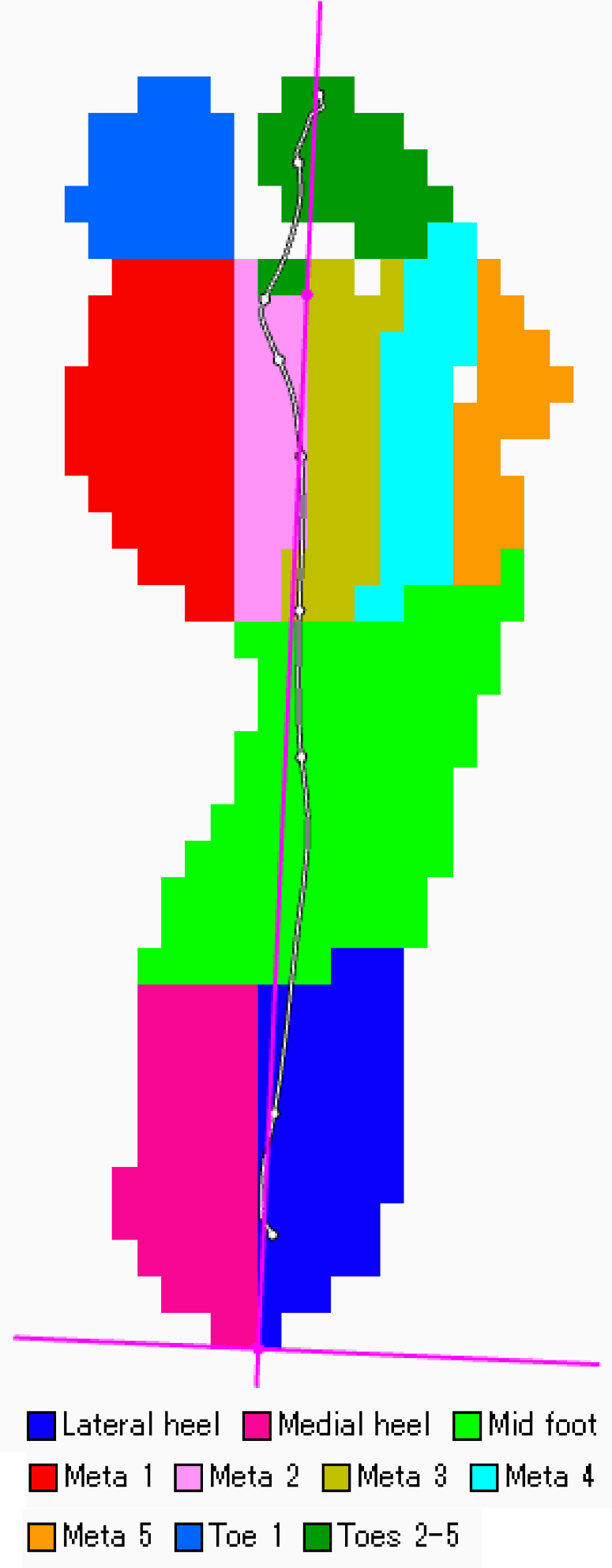
Plantar pressure data (
Fig. 1) were divided according to the following areas: toe (big toe, second–fifth toes), metatarsal (first–fifth metatarsals), heel (medial heel, lateral heel), medial (big toe, first metatarsal, medial heel), lateral (third–fifth metatarsals, lateral heel), anterior (big toe, second–fifth toes, first–fifth metatarsals), and posterior (metatarsal, medial heel, lateral heel). For each trial, data were time-normalized to the stance phase (101 data points) of the right foot, and data from six successful trials during the stance phase were averaged for each of the after and before running conditions. Finally, the peak value was detected as an outcome.
Figure 1.
Zones of plantar pressure in the right foot. Meta indicates metatarsal.
Figure 1.
Zones of plantar pressure in the right foot. Meta indicates metatarsal.
The peak values of each area during the stance phase were compared before and after 5 km of running. Normality tests were used to evaluate the normal distribution of all peak values. Normally distributed data were compared with the corresponding t test, and nonnormally distributed data were compared with the Wilcoxon signed rank test. The alpha level for all tests was set at 0.05. Statistical testing was performed using R (The R Foundation for Statistical Computing, Vienna, Austria).
Results
The peak values of plantar pressure before and after 5 km of running are shown in
Table 1. Peak pressure values of the big toe (
P = .01), first metatarsal (
P < .01), toe (big toe, second–fifth toes) (
P = .04), and medial (metatarsal, first metatarsal, medial heel) (
P = .04) areas after running significantly decreased compared with before running. The anterior area (big toe, second–fifth toes, first–fifth metatarsals) after running tended to decrease significantly compared with before running (
P = .09). In contrast, the medial heel (
P = .06) and posterior area (midfoot, medial heel, lateral heel;
P = .10) tended to increase after running compared with before running (
Table 1).
Table 1.
Peak Plantar Pressures by Area Before and After 5-km of Running
Table 1.
Peak Plantar Pressures by Area Before and After 5-km of Running
Discussion
This study examined the effect of repeated loading by running 5 km. We hypothesized that medial foot pressure would increase after 5 km of running. However, contrary to the hypothesis, foot plantar pressure after running significantly decreased in the big toe, first metatarsal, toe, and medial areas. In contrast, the anterior area tended to decrease significantly compared with before running. In addition, the medial heel and posterior area (midfoot, medial heel, lateral heel) tended to increase significantly after running compared with before running (
Table 1). A previous study evaluated plantar pressure after 10 and 20 km of running[
8] and reported that various plantar pressure areas changed after running. For example, it showed that plantar pressure of the first metatarsal increases as the distance increases. Although there is a study[
10] that has verified 5 km of running, joint kinematics and kinetics were assessed. To our knowledge, the plantar pressure after 5 km of running, which is shorter than 10 and 20 km, is unknown. This study is the first to investigate changes in plantar pressure before and after 5 km of running.
A previous study showed that the MTSS group had higher medial foot pressure during walking than the non-MTSS group,[
5] and the medial foot pressure increased after running 10 and 20 km.[
8] Furthermore, it has been reported that the ankle eversion angle during standing significantly increases after 5 km of running. Considering these reports, we believe that the medial foot pressure would also increase after 5 km of running. However, the present results did not support this hypothesis, and the medial foot pressure (big toe, first metatarsal, toe [big toe, second–fifth toe], and medial [metatarsal, first metatarsal, medial heel] areas) significantly decreased after 5 km of running. This may be because the participants were executing a strategy that avoided loading to the medial foot after 5 km of running. Ohya et al[
12] reported that shear elastic moduli (indirect index of tension applied to muscle) of the flexor digitorum longus and tibialis posterior muscles increased after a 30-min running task. Those muscles contribute to the decrease in medial foot pressure because of ankle inversion. Thus, it is possible that medial foot pressure decreased because the flexor digitorum longus and tibialis posterior muscles were overactive at 5 km of running. In particular, because the task was performed barefoot in this study, those muscles may have been worked excessively compared with under a shod condition. There is evidence that barefoot running increases lower-extremity muscle activity compared with shod running.[
13,
14] However, the exact reason behind this result as investigated in this study will require further analysis, including electromyography after 5 km of running.
In this study, the anterior area after running tended to decrease compared with before running, and the posterior area after running tended to increase significantly compared with before running. This phenomenon may be explained by changes in foot kinematics after 5 km of running. A recent study[
15] investigated rearfoot and forefoot kinematics after 5 km of running and reported that forefoot plantarflexion decreased and rearfoot dorsiflexion increased after 5 km of running. Therefore, after running 5 km, the pressure applied to the anterior area was reduced by reducing forefoot plantarflexion. Furthermore, some studies[
10,
16] have considered that long-distance running would lead to redistribution of the plantar pressure in various foot area. As the pressure of the anterior area was reduced in this study, the pressure was distributed to the posterior area, and it may have increased as a result.
These data may have clinical implications considering that novice runners are likely to cause running injuries such as MTSS. Because a previous study[
9] reported that novice runners are more likely to have injuries from running compared with experienced runners, it is important to prevent running injuries in novice and recreational runners. Running for 5 km is a distance that can be easily reached by novice and recreational runners. Meanwhile, 10 and 20 km of running increases foot pressure in the medial part of the foot as the distance increases,[
8] but 5 km of running decreased foot pressure in the medial part of the foot in this study. Based on these previous and present results, at 5 km, the medial pressure decrease due to excessive activity of the ankle inverter muscles, but after 10 km, those muscles become fatigued, resulting in an increase in medial pressure. Considering that the medial pressure had already changed at 5 km in this study, it may be necessary to take care of ankle inverter muscles from a short distance stage, such as 5 km of running, to prevent running-related injuries. Because previous studies[
6,
17] have suggested that the causative muscles of MTSS are the tibialis posterior and flexor digitorum longus, which are invertor muscles, it may be better to consider these muscles. However, note that the participants ran barefoot in this study. It is known that footwear protects the foot and changes the plantar pressure during running, as recently evidenced.[
18,
19] Moreover, insoles also change the stress on proximal joints such as the knee joint.[
20] Thus, future research should investigate foot pressure and knee joint stress after 5 km of running when wearing footwear and insoles.
This study has some limitations. The participants in this study ran barefoot when measuring plantar pressure. Because the foot scanner used in this study required placing the foot on a force plate, the task was performed barefoot to acquire accurate foot pressure measurements. A previous study[
21] reported that plantar pressures during running differ between barefoot and shod running. Therefore, the results of this study may have differed if data collection had occurred under shoe-wearing conditions. In addition, muscle activity was not examined before and after 5 km of running. Considering the change in foot pressure before and after running in this study, it is highly likely that muscle activity has changed, but it is difficult to conclude that changes in foot pressure are due to muscle activity. Last, we included only male participants. Thus, the results may not apply to females. These limitations should be addressed in future studies.
Conclusions
This study found a significant change in plantar pressure even after 5 km of running; specifically, the plantar pressure of the medial and anterior foot was decreased. This may be because the participants were adopting a strategy that avoided medial and anterior foot overloading throughout 5 km of running. The muscles that elevate the medial arch are overworked to avoid overload of medial plantar pressure at a 5-km distance. It may be necessary to take care of ankle inverter muscles from a short distance stage such as 5 km of running to prevent running-related injuries. Investigating muscle activity of the lower extremity before and after 5 km of running is warranted.