Pes planus (flatfoot) is a condition that describes a foot with a lowered medial longitudinal arch (MLA) height, which is frequently related to hindfoot eversion [
1]. Pes planus has two forms: rigid and flexible. Whereas the MLA is present during nonweightbearing conditions, it disappears during weightbearing conditions in flexible pes planus. However, in rigid pes planus, the MLA is absent in both weightbearing and nonweightbearing conditions [
2].
Mechanical overloading caused by the flattened MLA is transmitted to proximal regions, such as the knees, hips, and lower back over time [
3]. Although not all individuals with pes planus are symptomatic, there is a great prevalence of foot discomfort and an increased risk of injury, which can have a detrimental effect on the person's quality of life [
4]. The planus foot is subjected to more motions compared with the healthy foot during walking [
2], and because of the biomechanical inefficiencies in the foot and ankle, they could be more vulnerable to soft-tissue injuries [
5]. It has also been stated that the planus foot may cause compensatory malalignment in the lower extremities during walking [
6,
7]. Although the relationship between changes in foot posture and the mechanism of injury is unclear, it has been shown that there are some differences in plantar pressure distribution [
8] and muscle activity [
5,
6] between the healthy foot and the pathologic foot (such as pes planus or pes cavus) during walking [
9]. Because of biomechanical alterations, the muscle activity of the lower limb can be affected in individuals with pes planus. Most of these individuals experience early fatigue during walking, which is caused by excessive muscular activity [
6,
7]. Farmani et al [
7] reported that abnormal alignment of the foot joint improved with a suitable insole in shoes in runners with pes planus. Consequently, the degree of muscular activity may be changed, which is crucial in regulating this condition. By this way, the overall amount of energy consumed, the maximal oxygen consumption (VO
2) per kilogram of body weight, and the total amount of O
2 used by the body may be lowered [
7].
The O
2 cost of walking is the most important marker of walking economy and indicates the amount of VO
2 per kilogram of body weight per unit distance walked [
10]. Because it is a physiologic sign linked with pathologic gait disorders, the O
2 cost of walking is an essential indicator of walking dysfunction [
10]. There are few studies investigating the effects of foot orthoses on walking energy consumption in patients with pes planus [
7,
11–
13]. However, to our knowledge, there are few studies investigating the effect of pes planus on walking economy in individuals with pes planus and comparing the data with those of control participants. Although most of the available studies focused on investigating the effect of insoles on walking energy expenditure in individuals with pes planus, there is no common consensus on this issue. We think that to better understand the effect of using insoles on energy consumption in individuals with pes planus, the walking energy consumption of individuals with this pathologic disorder should primarily be investigated and compared with that of healthy individuals. If pes planus alters walking biomechanics, this situation may result in an increase in the energy cost of walking (ie, walking economy). If such a situation is detected, solutions to help regulate biomechanics, such as bracing and exercises for pes planus, can be considered. Therefore, the aim of the present study was to determine the O
2 cost of walking at two different walking speeds (preferred walking speed [PWS] and 30% above PWS) in participants with pes planus and control participants.
Methods
Participants
The present study included 86 physically sedentary participants (53 females and 33 males) recruited from the hospital staff, medical students, and relatives aged 18 to 33 years (
Fig. 1). All of the participants were nonsmokers and did not regularly exercise (≥3 times a week) for at least 6 months before the study. Pes planus was defined by a navicular drop test score of 10 mm or greater [
14] and a Foot Posture Index score [
15] between 6 and 12. Because both the navicular drop test and the Foot Posture Index are qualitative examinations and are related to the experience of the examiner, these tests were performed by a physiatrist (O.G.) with 23 years of experience. Based on both navicular drop test and Foot Posture Index scores, 34 participants (25 females and nine males) were found to have bilateral pes planus and 38 participants (28 females and ten males) to have normal feet. According to the Jack finger lift test, all of the pes planus feet were flexible [
16]. The exclusion criteria of the study were 1) body mass index (calculated as the weight in kilograms divided by the square of the height in meters) other than 18.5 to 24.9; 2) having known chronic metabolic, neuromuscular, or musculoskeletal system disorders (eg, arthritis, knee ligament injury, chronic ankle instability in the past 6 months, a history of balance disorder, lower-extremity injury, foot disorders) that may affect walking energy expenditure; 3) having any cardiorespiratory system diseases; 4) having a history of lower-extremity surgery within 6 months; and 5) having active systemic and local infections. Before being included in the control group, the participants were questioned again in terms of musculoskeletal problems and the presence of symptoms.
Of the 86 participants, four were excluded because they declined to participate in the study, ten because they met at least one of the exclusion criteria, and 12 because they could not complete the two walking trials. The study was completed with 30 participants with pes planus (21 females and nine males) and 30 participants with normal feet (23 females and seven males).
The participants were asked to complete the Physical Activity Readiness Questionnaire, which evaluated the readiness of the participant to engage in a physical activity [
17]. Ethical approval was obtained from the local ethics committee of the Mersin University Faculty of Medicine (Mersin, Turkey) before commencement of the study. Written informed consent was obtained from all of the participants. The study was performed in accordance with the principles of the Declaration of Helsinki.
Foot Assessments
Navicular Drop Test.
The navicular drop test was reported to be a reproducible, valid, and simple test for the assessment of MLA height [
14]. The navicular tubercle was marked, and its distance to the floor was measured while the individual was sitting without weight on their feet, which were only in contact with the ground. Then, the individual was asked to stand up and give equal weight on both feet. In this position, the distance between the floor and the navicular tubercle was measured again. Measurements were made bilaterally and recorded in millimeters [
18].
Foot Posture Index.
The participants were asked to stand in a relaxed position during the evaluation. Six items were evaluated: talar head palpation, the supra and infra curvature of the lateral malleolus, the pronation/supination of the calcaneus, the prominence of the talonavicular joint, the congruence of the MLA, and the abduction/adduction of the forefoot with respect to the rearfoot. Each of these criteria was scored between −2 and +2. The total score was recorded, and scores between 0 and +5 were interpreted as the foot in neutral position, +6 and +9 as slight pronation, +10 and +12 as increased foot pronation, −1 and −4 as slight supination, and −5 and −12 as increased foot supination [
15].
Foot Function Index.
The Foot Function Index was used to assess multiple dimensions of foot function. This index consists of 23 items collected under three domains (pain, disability, and activity limitation). Each item is evaluated according to the visual analog scale by marking on a 10-cm horizontal line, and the score of each domain is multiplied by 100. A total foot function score is derived by calculating the average of the three domain scores, with higher scores indicating greater impairment [
19].
Foot and Ankle Outcome Score.
Symptoms and functional limitations related to the foot and ankle were evaluated with the Foot and Ankle Outcome Score (FAOS). It consisted of five subscales: symptoms and stiffness, pain, function in daily living, function in sports and recreational activities, and quality of life. The scores are summed and normalized into a subscale score from 0 to 100. Higher scores indicate fewer problems or limitations [
20].
Determination of PWS
For the purpose of determining PWS, each participant was asked to walk at their self-selected speed along a 14-m walkway, including 2 m on the start and finish points to allow for acceleration and deceleration. The time they walked 10 m was recorded using a stopwatch. Time was measured in seconds. This process was performed three times, and the average time was recorded for analysis. The PWS (meters per second) was calculated by dividing the 10-m time by the average time of the three walking trials [
21]. The calculated speed unit was converted to kilometers per hour to be used for treadmill walking trials. The second walking speed was determined by calculating 30% more of these speeds. It was demonstrated that the speed of 30% above PWS did not force the participant to run but was more intense than PWS [
21].
Resting O2 Uptake
After an overnight fast resting, O
2 uptake was measured by the indirect calorimetry system (Quark PFT; Cosmed, Rome, Italy). The metabolic analyzer was calibrated before each test in line with the manufacturer’s suggestion. Heart rate was recorded by a wireless heart rate monitor (Polar; Cosmedwireless HR monitor, Rome, Italy). All of the participants were allowed to rest in the supine position for 15 min before the resting energy expenditure measurement. Then, inspired and expired gases were collected breath-by-breath with a face mask (Hans Rudolph Inc, Shawnee, Kansas) throughout 15 min to determine resting energy expenditure (
Fig. 1). All of the participants were instructed not to move, not to sleep, not to talk, and to breathe calmly during the test.
Walking Economy
These measurements were performed by the same physiologist (F.D.) with 20 years of laboratory experience. Before starting the measurement of VO
2 during walking on the treadmill (h/p/Cosmos Sports & Medical GMBH, Nussdorf, Germany), the individuals were allowed to walk on the treadmill for 10 min to get familiar with the treadmill. Afterward, they rested for 10 min. To determine walking economy, the participants were asked to walk at their PWS and 30% above PWS on the treadmill for 7 min [
21,
22]. The participants rested for at least 5 min to decrease their heart rate to the resting level (±5%) between the two walking trials (
Fig. 2). The average of the metabolic variables from the last 2 min was accepted as the steady state using a 10-sec rolling average throughout the test [
23]. Walking economy was expressed as both gross and net VO
2. Net VO
2 was calculated for each walking trial by subtracting resting VO
2 from gross walking VO
2, which was obtained during the last 2 min of the walking trial [
24]. The O
2 cost is determined by dividing the net VO
2 by the speed of walking [
10,
25]. The respiratory quotient was recorded for two walking trials to evaluate the intensity of the tests. The Borg scale (6–20) was also used to assess the rate of perceived exertion (RPE) [
26].
Statistical Analysis
A total of 52 participants were planned to be included in the study for an effect size of 0.80 (high) between two independent groups, with 80% power and 5% type I error. Twenty-six participants were included in the pes planus group and 26 in the control group (1:1 ratio). The calculation was made with a statistical analysis program (G*Power, Version 3.1.9.2). The Shapiro-Wilk test was used to determine whether the variables were normally distributed. Mean ± SD or median (range) was used to present descriptive statistics according to their normality distribution. The independent-samples t test and the Mann-Whitney U test were used according to the distribution assumption. Spearman correlation coefficient was calculated to determine the correlation between two variables. IBM SPSS Statistics for Windows (Version 21.0; IBM Corp, Armonk, New York) was used for data analysis. A level of P < .05 was considered statistically significant.
Results
Participant Characteristics
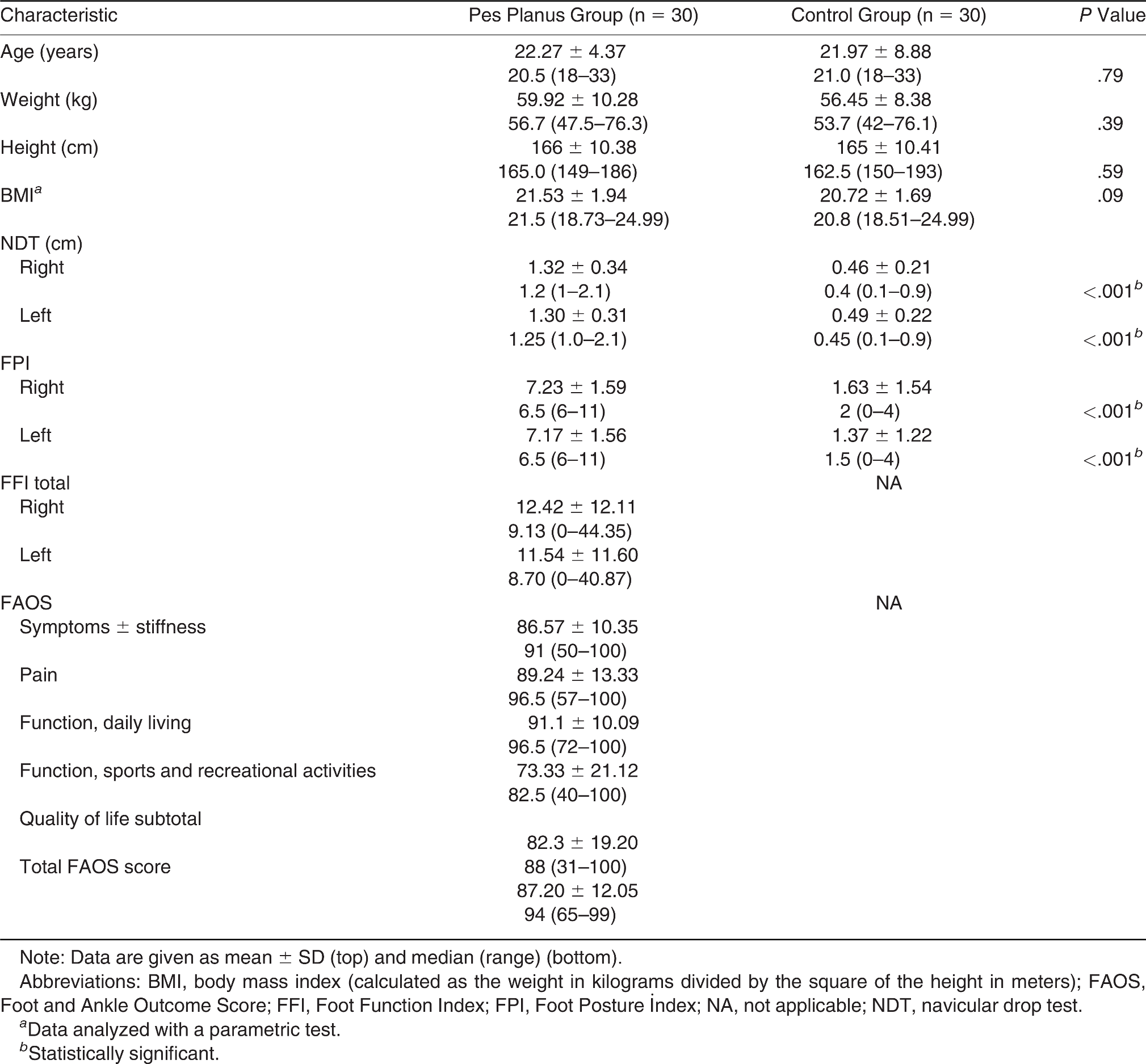
The demographic and clinical features of participants with pes planus and control participants are presented in
Table 1. There were no significant differences between the groups in terms of demographic characteristics (
P > .05). The median (range) values of the total right and left Foot Function Index were 9.13 (0–44.35) and 8.70 (0–40.87), respectively. The total mean ± SD FAOS score of the participants with pes planus was 87.20 ± 12.05 (
Table 1).
VO2 Results of the Participants
The mean ± SD PWS and 30% above PWS of the participants with pes planus and control participants were 4.99 ± 0.83 and 6.48 ± 1.08, and 5.04 ± 0.71 and 6.54 ± 0.93, respectively. No significant difference was observed between the groups in terms of PWS and 30% above PWS (
P > .05). None of the parameters of VO
2 was significantly different between groups (
P > .05) (
Table 2). There were significant changes within both groups in terms of VO
2 during walking at PWS and 30% above PWS (
P < .01 for both groups). However, there was no significant difference between the groups in terms of percentage increases in the amount of VO
2 of two walking stages (47.39% for the pes planus group and 50.13% for the control group;
P > .05).
Relationship Between VO2 Parameters and Clinical Features
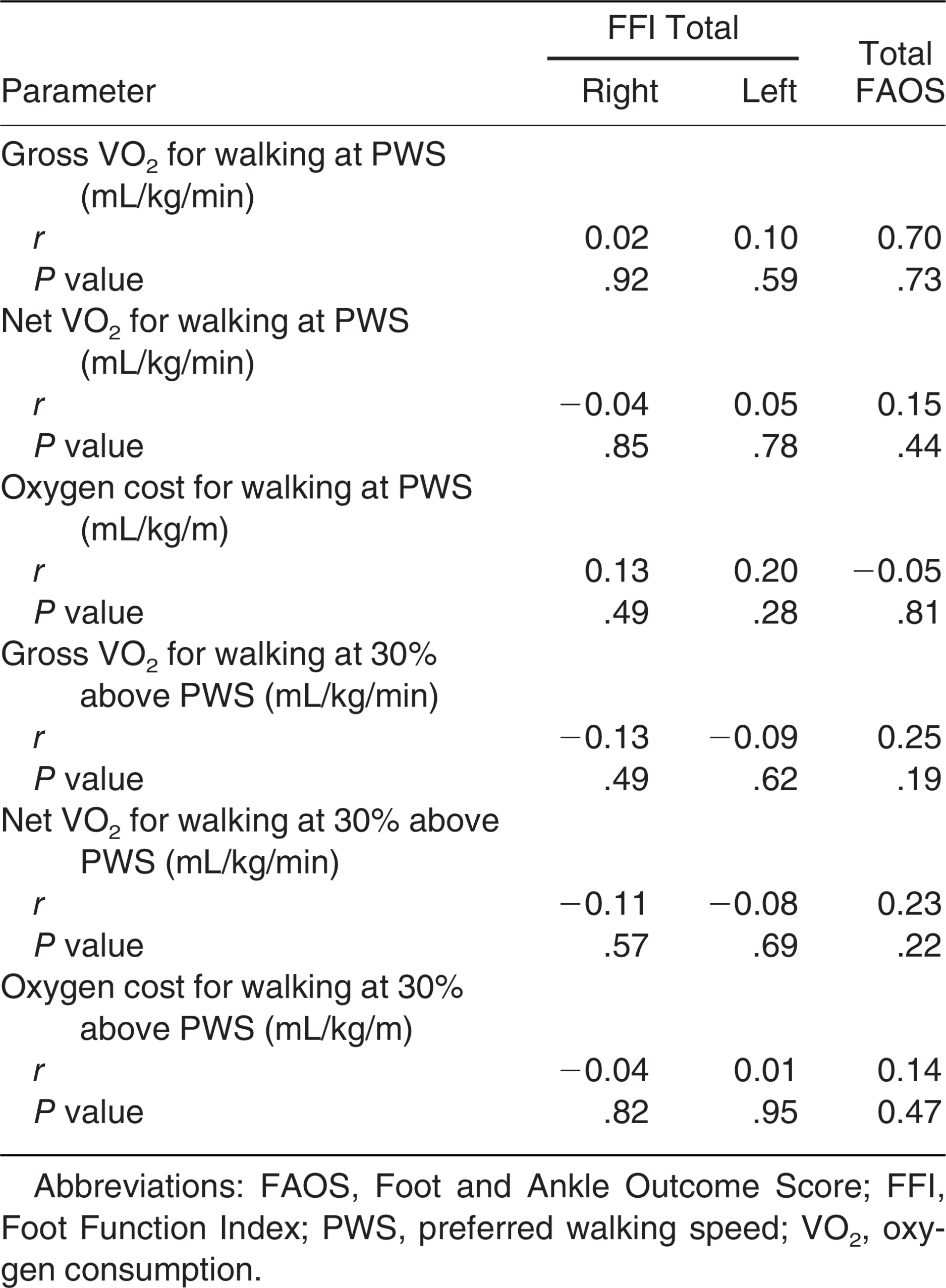
There was no significant correlation between clinical features (total Foot Function Index and FAOS) and VO
2 parameters in participants with pes planus (
P > .05) (
Table 3).
Discussion
To our knowledge, this is the first study measuring VO2 during walking with indirect calorimetry in participants with pes planus and comparing it with participants with normal arch. The main findings of the present study indicated no significant differences between participants with pes planus and their counterparts in the control group in walking speeds and walking economy for both walking speeds. There was also no significant relationship between VO2 parameters and the clinical characteristics of the pes planus group.
Karimi et al [
11] investigated the effects of using insoles on walking energy expenditure in individuals with pes planus and stated that the walking speed of individuals with pes planus was not different from that of control individuals (67.43 m/min and 69.16 m/min, respectively). However, energy consumption, which they evaluated using the Physiological Cost Index formula, was significantly higher in participants with pes planus [
11]. Although PWS of the pes planus group in the present study was higher than that reported by Karimi et al [
11], there was no significant difference between the pes planus and control groups (83.18 m/min and 83.26 m/min, respectively). We think that this difference in walking speeds may be because the group in the study by Karimi et al [
11] consisted of only females, not including both males and females, like the present study. Interestingly, Murley et al [
5] reported a slightly higher PWS for the pes planus group than for the control group (75.62 m/min and 68.75 m/min, respectively). They argued that this may be a compensatory mechanism developed by individuals with flat feet to increase foot and lower-extremity stability during walking. However, it is noted that the observed differences in muscle activity between groups were unlikely to be due to differences in walking speeds [
5].
Although it has been stated that changes in muscle activity may affect normal walking, the results of kinematic and mechanic studies in participants with pes planus are unclear. Murley et al [
5] reported that the muscle activity of the tibialis posterior in individuals with pes planus was significantly greater compared with participants with normal arch during walking at a comfortable speed. It was noted that differences in muscle activity in participants with pes planus might be indicative of an enhanced neuromuscular compensation to reduce MLA overload [
5]. Twomey et al [
27] reported an increased external rotation in the hip joint in individuals with pes planus compared with healthy participants, but this finding was contrary to the study by Lin et al [
28] in which no significant differences were reported in hip kinematics. A decreased midfoot joint range of motion in the frontal plane in participants with pes planus during walking was reported by Buldt et al [
29]. On the other hand, it was reported that the use of appropriate insoles in runners with flat feet can correct the misalignment in the foot-ankle, thereby modifying the muscle activity and consequently reducing the energy consumption required for the activity [
7]. Otman et al [
12] measured walking energy consumption with oximetry in 20 participants with pes planus and 20 control participants with and without insoles. Although they did not evaluate the difference between the groups, they reported that the use of insoles reduced energy consumption of walking [
12]. Karimi et al [
11] did not measure but calculated walking energy consumption with the Physiological Cost Index and reported that participants with pes planus had increased walking energy consumption compared with healthy participants [
11]. In the absence of indirect calorimetry measurements (gold standard to measure energy expenditure), predictive equations are used such as the Physiological Cost Index, in which walking energy consumption is calculated by the following formula: (Walking Heart Rate – Resting Heart Rate)/Speed. Therefore, comparing the data from Karimi et al [
11] with the indirect calorimeter data in the present study will not give an accurate and reliable result. In a recent study, VO
2 was investigated during walking with rocker-soled shoes on the treadmill in women with pes planus and the results were compared with walking barefoot. As a result of the study, it was reported that there was a significant increase in the amount of VO
2 and the RPE during walking with rocker-soled shoes compared with walking barefoot. It was concluded that this increase observed in walking energy consumption may be due to the weight of the rocker-soled shoes [
13]. Hunt and Smith [
6] reported that they could not reveal the expected biomechanical changes in their study in which they examined the ankle-foot kinematics of normal and pes planus feet. In the present study, there were no significant differences in terms of walking VO
2 parameters between participants with pes planus and normal arch for both walking trials. The RPE of the two walking trials were also not different between groups. The lack of difference in the RPE between the groups for both walking trials means that the participants with pes planus did not have more difficulty than control participants. In addition, whether the shoes worn by the individuals participating in the study have arch support and the difference in sole and ankle characteristics may also have affected the measured outcome variables. Walking all of the participants in a standard pair of shoes can help remove this doubt. Furthermore, we think that the fact that most of the patients with pes planus were asymptomatic may have affected the results of the present study. Although it was stated that mechanical overload causes excessive motion during walking in individuals with pes planus, there is not enough evidence for asymptomatic individuals in this regard [
6]. Hunt et al [
6] reported that pes planus foot indicators, such as pronounced calcaneal eversion, were not associated to total inversion-eversion or maximal rearfoot eversion while walking and that the person with the greatest pes planus foot posture displayed the least motion [
30]. This finding suggests that appropriate adaptation can be achieved by muscle compensations during walking in asymptomatic individuals [
6]. Fatigue of the controlling muscles was suggested as a factor in the development of metatarsal fractures during military training in soldiers with asymptomatic pes planus [
31]. Perhaps individuals with symptomatic pes planus are less able to compensate for passive deficits during normal walking [
6].
This study has several strengths, including the use of indirect calorimetry to measure walking VO2 objectively, two different walking speeds (PWS and 30% above PWS), and a relatively large sample size (N = 60) compared with other studies. However, there are some limitations that need to be acknowledged in the present study. All of the participants were asked to walk in their own daily shoes. Standard shoes could be provided to participants to ensure that the shoes they were wearing did not promote flat feet and thus mask any effect on the measured outcome variables. Because some of the pes planus population consisted of asymptomatic individuals, perhaps 7 min of walking may not have been sufficient to reveal differences in energy consumption in individuals compared with the control group. In future studies, they may be able to walk for longer periods, which could trigger their symptoms. The participants in this study were young, healthy, and mostly asymptomatic, so these results may not be generalizable to older adults and symptomatic populations. Further research is required to overcome the limitations of the present study.
Conclusions
The participants with pes planus did not reveal any differences from the control group in terms of walking speed, walking VO2, and RPE.