Osteochondral lesions may result from a traumatic cause or repetitive microtrauma. It starts with cartilage lesions and continues with variable involvement of the subchondral bone. It has been reported that the developing pain is not caused by a cartilage lesion but develops because of repetitive high fluid pressure during walking, stimulating the subchondral bone [
1]. Conventional radiography is preferred in the first stage in the diagnosis of talus cartilage lesions. Magnetic resonance imaging (MRI) is used to make a definitive diagnosis and to determine the size of the lesion, the level of bone marrow edema, and whether it is accompanied by a bone lesion. Accurate determination of the stage of the disease is important in the selection and success of treatment.
Many imaging methods are used in the classification of talus osteochondral lesions: the Berndt and Harty classification [
2] is used in the radiologic evaluation, the Ferkel and Sgaglione classification [
3] in the computed tomography (CT) evaluation, and the Hepple classification [
4] in the MRI evaluation. To our knowledge, the validity of the Hepple classification, which is frequently used in the clinic, has not been evaluated. It was hypothesized that the Hepple classification would be reproducible with high confidence in osteochondral lesions of the talus.
The purpose of this study was to investigate the intraobserver and interobserver validity of the Hepple classification used in talus osteochondral lesions.
Materials and Methods
The MRIs of 32 patients with talus osteochondral lesions were included in this study after approval was received from the institutional review board of Usak University Faculty of Medicine local ethical committee. Between January 1, 2021, and January 1, 2022, 247 patients who applied to our clinic (Usak University Faculty of Medicine, Department of Orthopaedics and Traumatology) and underwent ankle MRI were scanned retrospectively. All of the MRI was performed with a 1.5-T system (Magnetom Aera; Siemens, Erlangen, Germany). Exclusion criteria were patients without talus chondral lesion (n = 195), without optimal MRI (n = 7), younger than 18 years (n = 2), and older than 65 years (n = 11). The MRIs (all axial, coronal, and sagittal sections) of 32 patients (13%) whose osteochondral lesions were confirmed and included in the study were obtained from picture archiving and communication systems recordings.
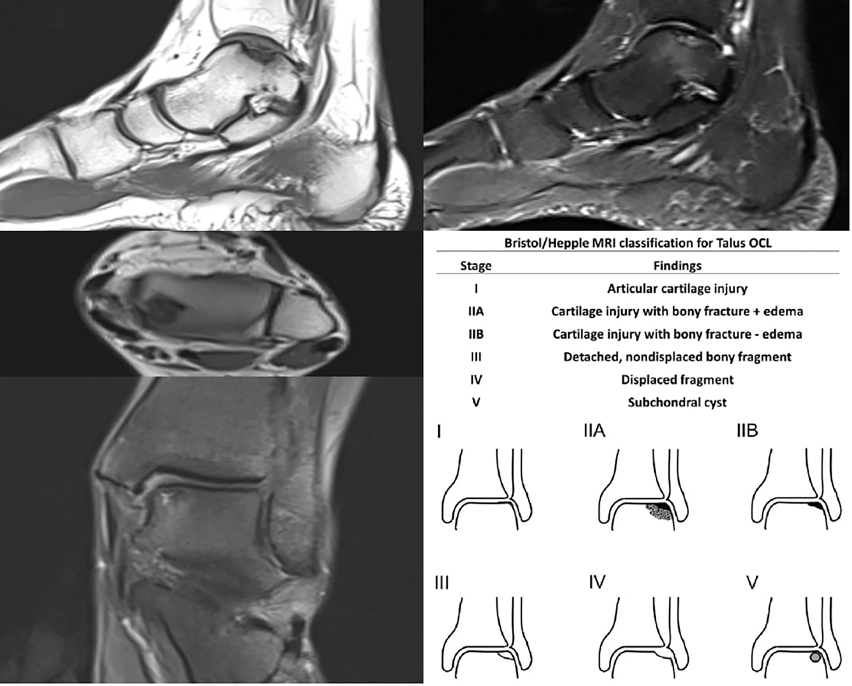
A slideshow presentation (PowerPoint; Microsoft Corp, Redmond, Washington) was prepared from MRI views containing sagittal, coronal, and axial sections of 32 skeletally mature patients of both sexes who did not meet the exclusion criteria (
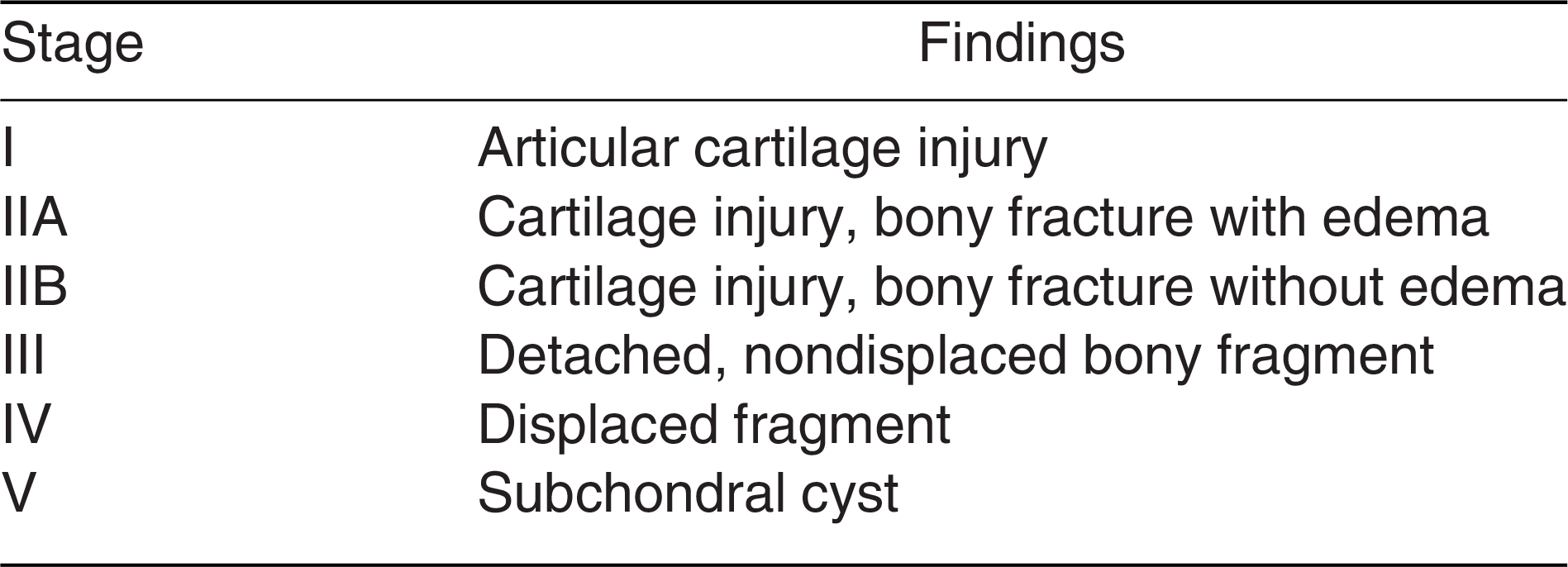
Fig. 1). The Hepple classification was presented to the observers after MRI views of each patient (
Table 1) [
4]. They were asked to classify the MRI views according to the Hepple classification in 1 week.
Figure 1.
An example of a slide. MRI, magnetic resonance imaging; OCL, osteochondral lesion.
Figure 1.
An example of a slide. MRI, magnetic resonance imaging; OCL, osteochondral lesion.
Table 1.
Hepple Classification
Table 1.
Hepple Classification
Six orthopedic specialists with at least 3 years of experience participated in the study as observers. The observers were divided into two groups according to their experience. In the first group there were three people with at least 6 years of orthopedic specialty practice (7, 8, and 14 years), and in the second group there were three people with less experience (4, 5, and 5 years). Each observer made separate evaluations from the others. Observers evaluated the MRIs of 32 patients that were relocated at 6-week intervals, without accessing their previous responses. The order of the slides was changed in the second presentation by an orthopedic surgeon who was not included in the study. Intraobserver and interobserver validity was statistically evaluated.
A statistical software program (IBM SPSS Statistics for Windows, Version 24.0; IBM Corp, Armonk, New York) was used for statistical analysis. Fleiss kappa (
κ) coefficient was used for the interobserver validity and Cohen
κ coefficient for the intraobserver validity [
5,
6]. A
κ value is always between 0 and 1; the
κ values were graded as slight (0–0.2), fair (0.21–0.40), moderate (0.41–0.60), substantial (0.61–0.80), and almost perfect (0.81–1) [
7].
Results
Seventeen of the patients (53%) whose MRI views were evaluated were women, and their mean ± SD age was 43.5 ± 14 years (range, 22–62 years). The mean ± SD age of the men was 39.3 ± 11.2 years (range, 24–60 years). Nineteen of the injuries (59%) were at the left ankle.
In the interobserver evaluation, all of the results, except the second evaluation of the less experienced group, resulted in moderate agreement (
κ = 0.440–0.590). The second assessment in the less experienced group showed fair agreement (
κ = 0.239). When all of the observers were evaluated, it was seen that there was moderate agreement (set one
κ = 0.511, set two
κ = 0.406) (
Table 2).
Table 2.
Interobserver Reliability Values
Table 2.
Interobserver Reliability Values
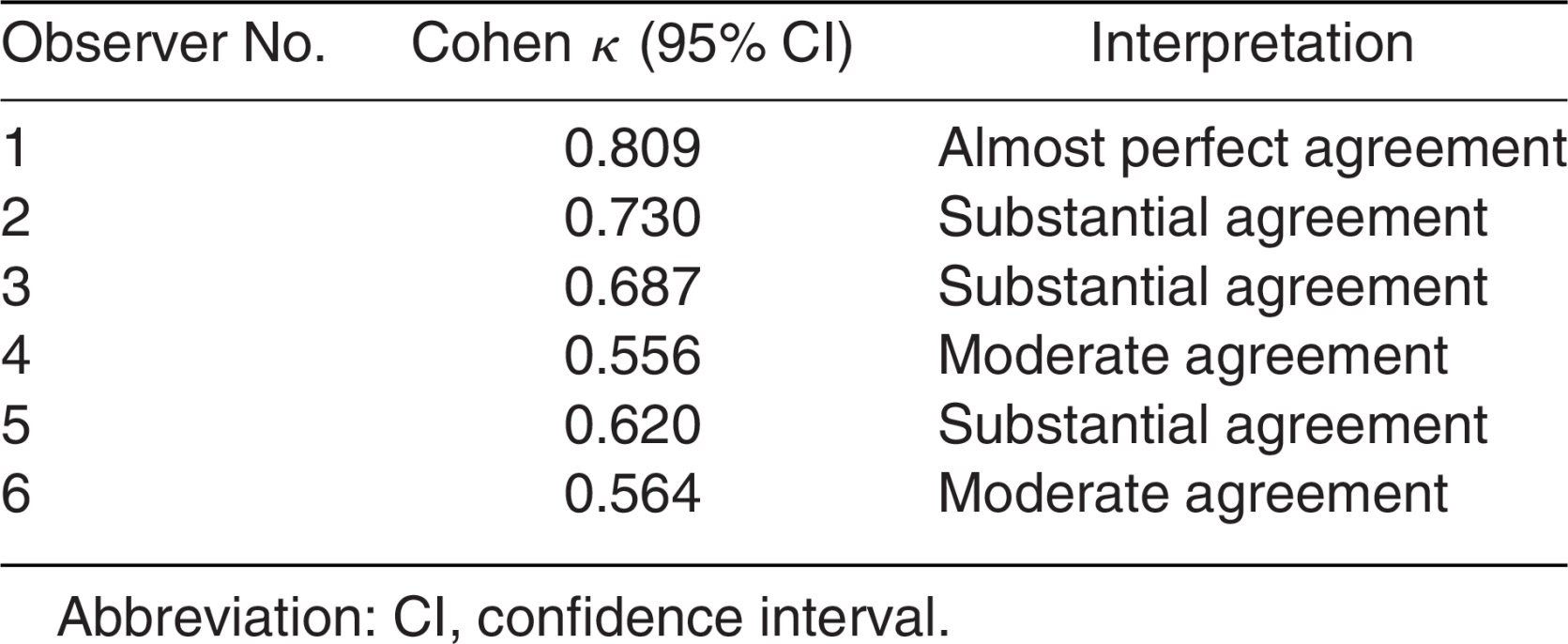
In the intraobserver reliability assessment, one observer from the experienced group showed almost perfect agreement (
κ = 0.809), one observer from the less experienced group showed moderate agreement (
κ = 0.556), and all of the other observers showed substantial agreement (
κ = 0.556–0.730) (
Table 3).
Table 3.
Intraobserver Reliability Values
Table 3.
Intraobserver Reliability Values
In two assessments at 6-week intervals, the intraobserver mean values resulted in moderate agreement in the less experienced group (
κ = 0.580) and substantial agreement in the experienced group (
κ = 0.742). When all of the observers were examined, it was seen that there was substantial agreement (
κ = 0.661) (
Table 4).
Table 4.
Mean Intraobserver Reliability Values
Table 4.
Mean Intraobserver Reliability Values
Discussion
A classification system must be valid, reliable, and reproducible. It should be expressed alike by both surgeons and researchers [
8]. Cartilage covers up almost 70% of the circumference of the talus bone. Because the articular cartilage does not have a vascular and nerve structure, the healing potential of developing cartilage lesions is low. Various classification systems are used in talus osteochondral lesions [
2–
4]. The classification system based on MRI, which is frequently used in clinical diagnosis, was defined by Hepple [
4]. Accurate staging of cartilage lesions is important for correct treatment. The present study showed that the average intraobserver reliability of the Hepple classification in the diagnosis of talus cartilage lesions was substantial agreement (
κ = 0.661) and the interobserver reliability was moderate (
κ = 0.406 and 0.511).
Bexkens et al [
9], in a study of patients with capitellar osteochondritis dissecans, asked observers to evaluate MRIs according to the Hepple, Dipaola/Nelson, and Itsubo classifications and the DeSmet/Kijowski and Satake criteria for lesion instability. Although the interobserver evaluation of the Hepple classification showed higher agreement (
κ = 0.23) compared with other classifications (
κ = 0.12–0.19), it was found to be fair agreement (
κ = 0.20–0.40). However, other classifications seem to be in slight agreement (
κ = 0.0–0.20). In the present study, in which talus osteochondritis dissecans were evaluated, moderate agreement was observed in the interobserver results (
κ = 0.511 and 0.406). However, the second evaluation in the less experienced group resulted in fair agreement, similar to this study (
κ = 0.239). In the present study, substantial agreement results were obtained in the intraobserver evaluation performed in addition to this study (
κ = 0.661).
Tamam et al [
10] compared MRI with single-photon emission CT (SPECT) combined with CT in image interpretation and treatment decisions in talus osteochondral lesions. In their study, which included arthroscopically validated cases, the Hart score system was used for SPECT/CT evaluation and the Hepple classification for MRI evaluation. It was reported that there was no significant difference between MRI and SPECT/CT (
P = .16). However, a significant relationship was determined between MRI and SPECT/CT (
r = 0.47;
P = .018). According to the study's conclusions, although MRI is the standard in diagnosing osteochondral lesions of the talus, it is suggested that the combined use of SPECT/CT and MRI is appropriate. However, considering the negative effects of CT, we recommend using MRI as the first choice in diagnosis. We believe that it is a method that can be preferred in cases where MRI cannot be used.
Many methods have been described in the treatment of osteochondral lesions of the talus, from immobilization to osteochondral autograft transplantation [
11–
18]. As in other cartilage lesions, treatment options in talus osteochondral lesions vary according to the degree of the lesion. Accurate knowledge of the degree of cartilage injury will guide the treatment. Therefore, there is a need for classification systems that are evaluated similarly by each observer. Frequently, MRI is used in the diagnosis and grading of cartilage lesions. For this reason, we planned the validity analysis of the Hepple classification used in the evaluation of talus cartilage lesions with MRI. According to the results of the present study, which showed substantial agreement in the intraobserver evaluation and moderate agreement in the interobserver evaluation, we concluded that the Hepple classification is reproducible and reliable.
Staats et al [
19] demonstrated in an arthroscopically validated study in patients with chronic ankle instability that MRI was helpful in preoperative diagnosis but not definitively sufficient. Although there is no definite consistency, we think that MRI is the most appropriate imaging method in clinical practice.
Claessen et al [
20] evaluated the interobserver agreement of the Berndt and Harty classification and the Ferkel and Sgaglione classification compared with other classifications in capitellar osteochondritis dissecans lesions. According to the results of their study, poor agreement was concluded for the Berndt and Harty classification (
κ = 0.20) and fair agreement was concluded for the Ferkel and Sgaglione classification (
κ = 0.22). Interobserver agreement of the Hepple classification was moderate in the present study, which we applied to talus cartilage lesions (
κ = 0.511 and 0.406).
It was stated that any kappa value between 0.40 and 0.60 indicates moderate agreement among the raters. [
21] The present study showed that interobserver reliability was moderate (
κ = 0.511 and 0.406).
The limitation of this study was that all of the classifications used in talus osteochondral lesions could be evaluated together. However, because MRI is used in the diagnosis of cartilage lesions in our clinical practice, CTs of the same patients were not available.
Conclusions
Whereas the intraobserver results showed substantial agreement, the interobserver results showed moderate agreement. Although the Hepple classification system is frequently used, the need for a more reliable classification system for osteochondral lesions of the talus remains. In addition, it was determined that surgical experience gave better reliability results.