Next Article in Journal
Is Pain Inevitable after Tibia Pilon Fractures? A 3-Year Prospective Analysis
Previous Article in Journal
Prevalence of Large Fiber Neuropathy in Nondiabetic Older Adults Seeking Routine Foot Care
 
 
Journal of the American Podiatric Medical Association is published by MDPI from Volume 116 Issue 1 (2026). Previous articles were published by another publisher in Open Access under a CC-BY (or CC-BY-NC-ND) licence, and they are hosted by MDPI on mdpi.com as a courtesy and upon agreement with American Podiatric Medical Association.
Article

A Uniquely Detailed Foot and Ankle Chart for Accurate Recording of Injuries in Dancers

by
Megan Maddocks
and
Demitri Constantinou
Department of Exercise Science and Sports Medicine, Faculty of Health Sciences, University of the Witwatersrand, Johannesburg, South Africa, 27 St. Andrews Road, Parktown, 2193
J. Am. Podiatr. Med. Assoc. 2025, 115(1), 23221; https://doi.org/10.7547/23-221
Published: 1 January 2025

Abstract

Background: Foot and ankle injuries are common in dance and well documented in ballet. Commonly used injury surveillance tools do not depict the foot and ankle in much detail and are often considered as a single anatomical structure. The foot and ankle houses some of the body’s most complex anatomy, and because of the incidence of injuries to these areas in dancers, and different management, a more detailed approach should be taken to reflect the complexity of the area for more accurate research and clinical application. This article proposes and demonstrates that the foot and ankle be broken down into more in detail when selected on a body chart. Methods: There is a conventional whole-body chart available in the Research Electronic Data Capture (RedCap) program that allows a selection of the foot and ankle. As part of a study of injuries in dancers, a custom chart was developed within this platform to expand on that selection by including smaller parts from the dorsal, medial, and plantar aspects. Results: All dance research needs to be more detailed regarding injuries to the foot and ankle for better clinical applications. Notable structures of clinical importance for ballroom and Latin American dancers are the first metatarsophalangeal joint, plantar fascia, and Achilles tendon. Such detail was determined using the newly developed chart and would not have been possible using conventional notations. Further, this chart provides a much clearer injury and clinical picture, which may differ in female ballet dancers who are dancing en pointe and other dance styles. Conclusions: Gathering detailed information using this chart will allow for the development of existing injury surveillance platforms and the advancement of foot and ankle injury research in dancers and may be transferable to other sports.

It has been well documented that dancers in general, but specifically ballet dancers, have a high risk and prevalence of injury.[1,2] Most literature agrees that the lower extremities are the areas most affected by injury,[1,2,3,4,5,6] and is a result of repetitive stress.[1] Ballroom and Latin American dancers, both professional and recreational, also have high injury risks.[7] Similar to other styles of dance, the most frequent injury sites are in the lower extremity.[7,8,9,10]
Due to different methodologies and anatomical categories, existing research on pain and injury related to ballroom and Latin American dance are not directly comparable. They do, however, provide an overview. The foot, in ballroom and Latin American dancers, is subject to sport-specific stress and extreme conditions, similar to that of the en pointe position in ballet (Melchert P, unpublished data, 2013). However, most studies use “foot and ankle” or “foot” and “ankle” in their anatomical break downs of the lower limb.[1,2,3,4,5,6,7,8,9,10] These are both areas of the body with complex anatomy and need to be investigated in more detail for clinical application. Unpublished data (Melchert P, 2013) showed that more than 60% of ballroom and Latin dancers with foot pain identified the first metatarsophalangeal joint (MTPJ) as the most frequent area of pain.[11] Other research agrees that there is “a remarkable incidence of injury in the ankle, foot, and first metatarsal.”[9] One study mentioned “toes” in their anatomical breakdown.[12]

Methods

The chart that we are demonstrating and proposing for use was developed through research that investigated pain, problems, and injuries in ballroom and Latin American dancers at two competitions in South Africa. The study used an adapted version of the Musculoskeletal Pain Intensity and Interference Questionnaire for Musicians.[12] Slight modifications to the wording of the questionnaire were necessary to make it applicable to dancers, however, the changes did not materially change the questionnaire. Research Electronic Data Capture (RedCap), an electronic data capture tool hosted by the University of Witwatersrand was used to conduct the survey.[13,14]
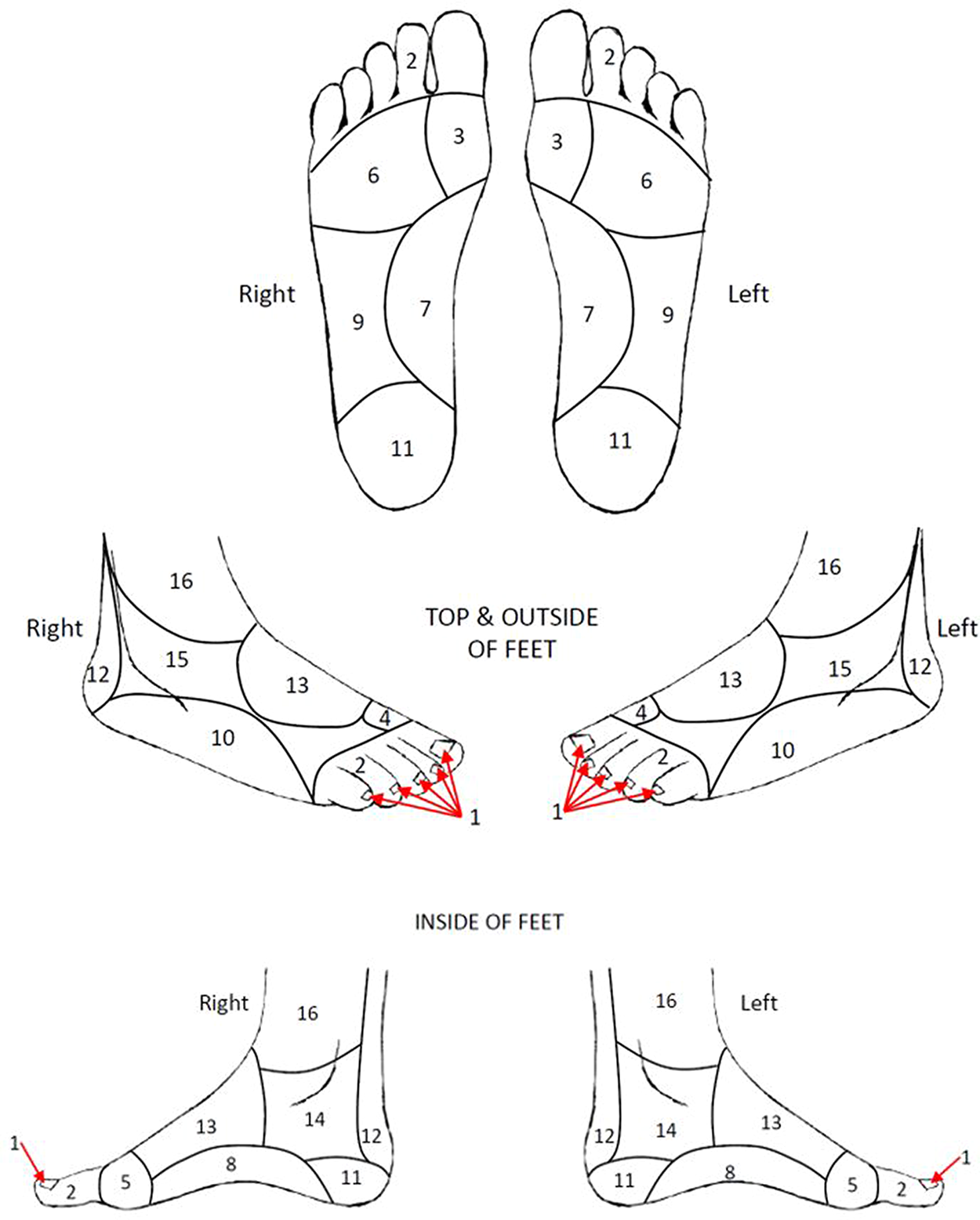
The foot and ankle segments of the REDCap Image Map were insufficiently detailed for this research project. Consequently, the additional, more detailed, foot and ankle chart was developed (Figure 1). If a participant selected either the foot and/or ankle segment, the online survey would present the more detailed diagram of the foot and ankle for further selection.
Figure 1. Newly developed, detailed foot chart that would be presented for selection if either of the foot and ankle segments were selected in the whole-body map.
Japma 115 23221 g001

Use of the New Foot Chart

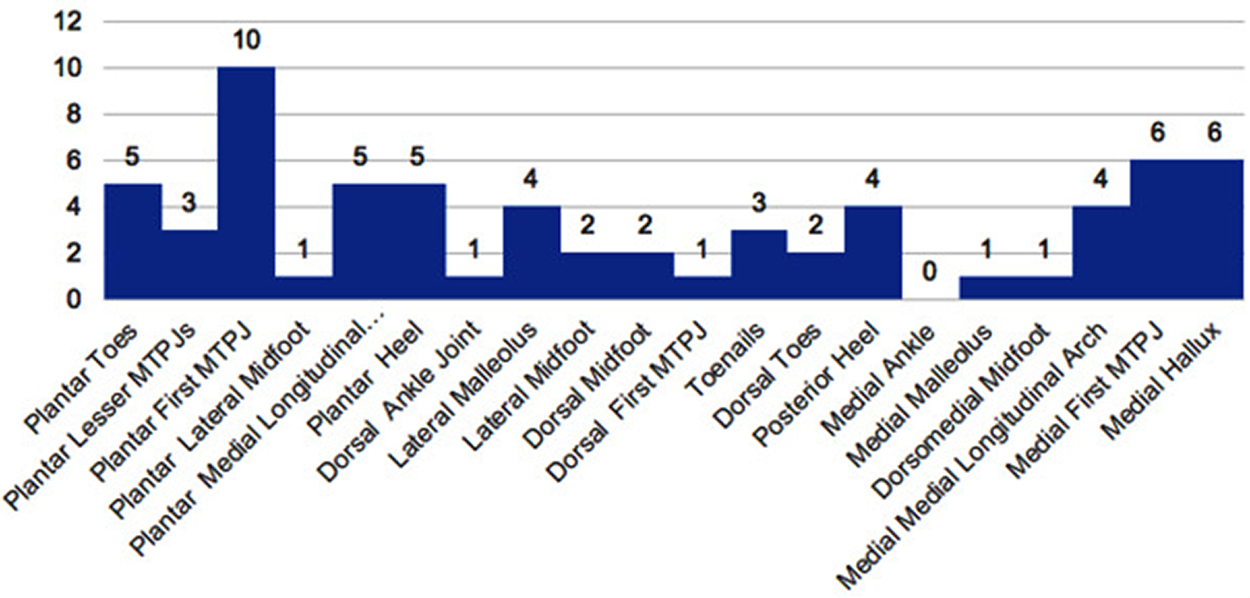
Dividing the foot and ankle into more detail provides a much more clinically applicable tool. We found that the first metatarsophalangeal joint area is the specific area of most pain in ballroom and Latin American dancers (unpublished manuscript, 2023) (Figure 2). This gives a more focused picture of the anatomy involved, as opposed to just the broader foot and ankle.
Figure 2. Exemplifies how the detailed breakdown of the foot and ankle segments is more clinically applicable. MTPJ, metatarsophalangeal joint.
Japma 115 23221 g002
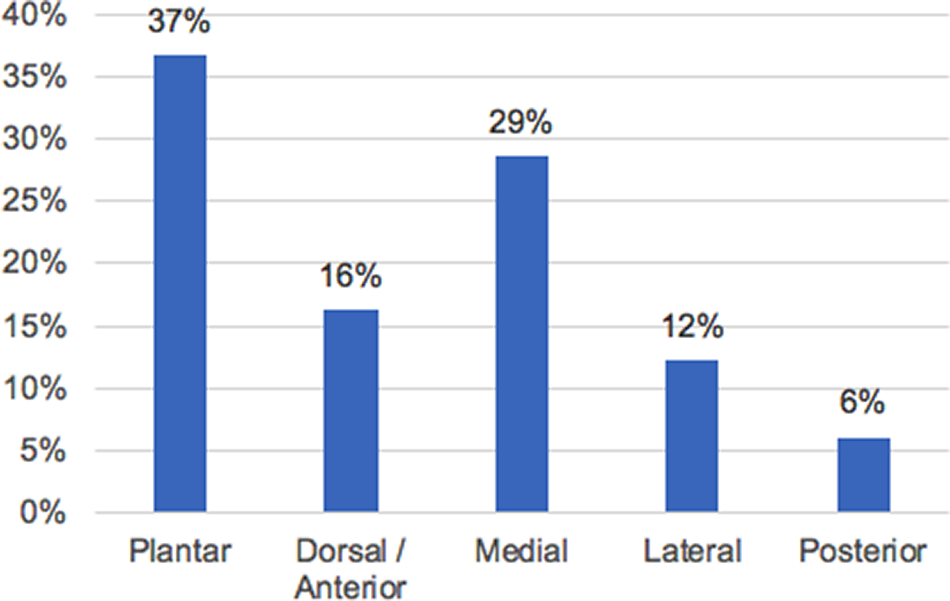
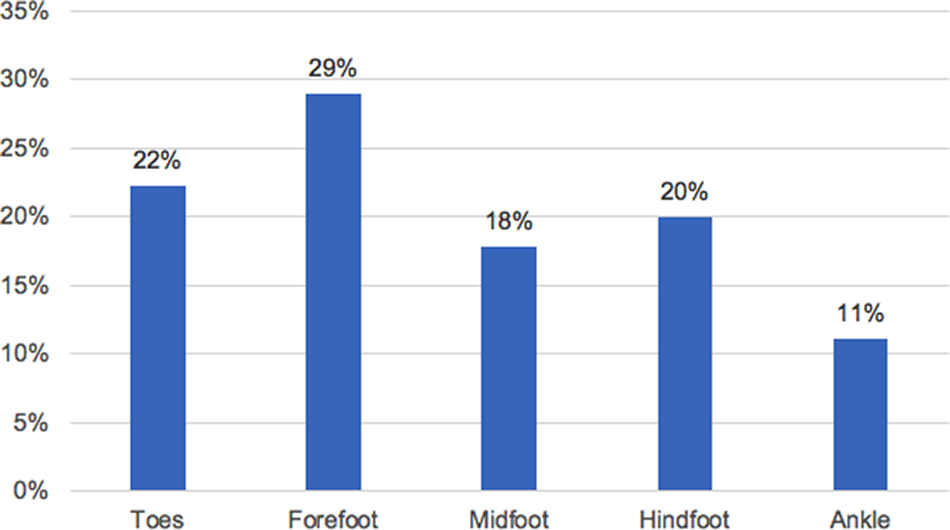
Segments in the detailed foot and ankle chart can also be grouped in a number of ways to make the information more appropriate for clinical applications. As a matter of data point management, it can be grouped by aspects (plantar, medial, etc) and anatomical areas (forefoot, midfoot, etc). For example, research in ballroom and Latin American dancers revealed that most pain was located on the plantar aspect of the foot (Figure 3) and the forefoot (Figure 4).
Figure 3. Demonstrates the grouping of the detailed foot and ankle segments into aspects.
Japma 115 23221 g003
Figure 4. Demonstrates the grouping of the detailed foot and ankle segments into anatomical areas.
Japma 115 23221 g004

Discussion

It is well known that dancers (of all styles) have a high incidence of injuries, with most of them occurring in the lower limb.[1,2,3,4,5,6] Most research just uses foot or ankle and most often those are combined into a single category (foot and ankle). Our article presents a chart with uniquely detailed breakdown of the foot and ankle to be used in injury and pain surveillance among dancers.
Having more detailed information about the foot and ankle is important because of the complex anatomy. Identifying smaller areas of pain allows for very specific structures to be identified, which has much better clinical application, as demonstrated in the finding from the study that led to the development of the tool. Figures 3 to 5 demonstrate the value of filtering injuries into further anatomical detail.
Identifying smaller areas of pain also allows for dance research to differentiate sites of foot and ankle injury among different dance styles and roles (male, female, lead, follow, etc). For example, in ballroom and Latin American dancers (particularly females), high heeled dance shoes shift the center of mass forward, increasing pressure under the ball of the foot. The standard technique of these dance styles having the dancer mostly on the balls of their feet, places high pressure under the medial side of the forefoot (first MTPJ). Improper technique, and aesthetic habits, such as abducting the foot, emphasizes this position, and therefore, increases the pressure on the medial forefoot. The first MTPJ is the most significant structure in the foot and forefoot for these dancers. Other notable structures of clinical importance reported are the plantar fascia and Achilles tendon. Such detailed information provides a much clearer injury and clinical picture, and it may well be very different for female ballet dancers who are dancing en pointe.

Conclusion

We hope this research stimulates existing injury surveillance platforms to develop more detailed selections regarding the foot and ankle, and that it will also encourage researchers to investigate the foot and ankle in more detail. We hope that this will be transferable to other areas of sports and activity as well, not just dance. We believe that foot and ankle injury research needs to evolve, be more specific, and clinically relevant in ways such as this assessment chart provides.

Financial Disclosure

None reported.

Conflict of Interest

None reported.

References

  1. Biernacki J, Stracciolini A, Fraser J, et al: Risk factors for lower-extremity injuries in female ballet dancers: A systematic review. Clin J Sport Med 31: e64, 2021.
  2. Bowling A: Injuries to dancers: prevalence, treatment, and perceptions of causes. Br Med J 298: 731, 1989.
  3. Cahalan R, Purtill H, O’Sullivan P, et al: A cross-sectional study of elite adult Irish dancers: Biopsychosocial traits, pain, and injury. J Danc Med Sci 19: 31, 2015.
  4. Cahalan R, Bargary N, O’Sullivan K: Pain and injury in elite adolescent Irish dancers: A cross-sectional study. J Danc Med Sci 22: 91, 2018.
  5. Evans RW, Evans RI, Carvajal S, et al: A survey of injuries among Broadway performers. Am J Public Health 86: 77, 1996.
  6. Werber B: Dance medicine of the foot and ankle: A review. Clin Podiatr Med Surg 28: 137, 2011.
  7. Mikkelsen P, Jarvis DN, Kulig K: Heeled shoes increase knee work demand during repeated hopping in dancers. Med Probl Perform Art 33: 243, 2018.
  8. Riding McCabe T, Ambegaonkar JP, Redding E, et al: Fit to dance survey: a comparison with dancesport injuries. Med Probl Perform Art 29: 102, 2014.
  9. Liébana E, Monleón C, Morales R, et al: Muscle activation in the main muscle groups of the lower limbs in high-level dancesport athletes. Med Probl Perform Art 33: 231, 2018.
  10. James AS, Lazarczuk SL: Epidemiology of injuries in West End performers. J Danc Med Sci 23: 139, 2019.
  11. Miletic D, Miletic A, Milavic B: Age-related progressive increase of lower back pain among male dance sport competitors. J Back Musculoskelet Rehabil 28: 551, 2015.
  12. Berque P, Gray H, McFadyen A: Development and psychometric evaluation of the Musculoskeletal Pain Intensity and Interference Questionnaire for professional orchestra Musicians. Man Ther 19: 575, 2014.
  13. Harris PA, Taylor R, Thielke R, et al: Research electronic data capture (REDCap)-A metadata-driven methodology and workflow process for providing translational research informatics support. J Biomed Inform 42: 377, 2009.
  14. Harris PA, Taylor R, Minor BL, et al: The REDCap consortium: Building an international community of software platform partners. J Biomed Inform 95: 103208, 2019A.