Next Article in Journal
A Uniquely Detailed Foot and Ankle Chart for Accurate Recording of Injuries in Dancers
Previous Article in Journal
Large Osteolipoma of the Posterior Ankle A Rare Tumor in an Unusual Location
 
 
Journal of the American Podiatric Medical Association is published by MDPI from Volume 116 Issue 1 (2026). Previous articles were published by another publisher in Open Access under a CC-BY (or CC-BY-NC-ND) licence, and they are hosted by MDPI on mdpi.com as a courtesy and upon agreement with American Podiatric Medical Association.
Article

Prevalence of Large Fiber Neuropathy in Nondiabetic Older Adults Seeking Routine Foot Care

Penobscot Community Health Center, Old Town, ME, and Graduate School of Biomedical Sciences and Engineering, University of Maine, 242 Brunswick St, Old Town, ME 04468
J. Am. Podiatr. Med. Assoc. 2025, 115(1), 23220; https://doi.org/10.7547/23-220
Published: 1 January 2025

Abstract

Background: Older adults qualifying for routine foot care (RFC) under the Medicare program are often diagnosed with diabetes, peripheral artery disease (PAD), or neuropathy. Specifically, large fiber neuropathy (LFN) has been shown to increase during the aging process, rendering patients more susceptible to unperceived trauma because of loss of protective sensation and an increased fall risk because of balance deficits. This study assessed the prevalence of LFN as diagnosed by the timed vibration test (TVT) in the nondiabetic segment of the Medicare population seeking RFC. A comparison was made between this group and those patients identified with PAD. Methods: A retrospective electronic medical record review of Medicare patients seeking RFC (Current Procedural Terminology codes 11720, 11721, and 11055) was conducted in a community health center-based podiatry clinic over a 5-year period. The prevalence of LFN as diagnosed by the TVT (International Statistical Classification of Diseases, Tenth Revision code G62.9 and TVT ≤4 sec at the hallux) and PAD as diagnosed per Medicare class findings for vascular impairment (International Statistical Classification of Diseases, Tenth Revision codes I70.203 and I73.9) was identified in nondiabetic Medicare patients seeking RFC. Results: The prevalence of LFN and PAD within the nondiabetic Medicare population seeking RFC was found to be 21.1% (91 of 431) and 27.6% (119 of 431), respectively. There was a 6.5% difference between the proportions of the LFN and PAD groups, which was significantly different (P = .026, confidence interval = 0.77–12.2%). A total of 10.9% of the population was found to have LFN and PAD concurrently. There was no significant difference between the ages of patients in the LFN and PAD groups (P = .36, standard deviation [SD] = 1.65), the LFN and LFN/PAD groups (P = .3, SD = 1.95), or the PAD and LFN/PAD groups (P = .07, SD = 1.95).Conclusions: LFN and PAD are both present in substantial proportions in nondiabetic Medicare patients seeking RFC. The prevalence of LFN in this at-risk population highlights the importance of accurate diagnosis and implementation of preventative measures designed to mitigate unperceived foot trauma and potential falls. This is especially relevant, as neuropathy in geriatric patients has been associated with earlier mortality.

Peripheral neuropathy in the lower extremities of older adults without diabetes occurs with such frequency it is often considered a biomarker of normal aging.[1] Although it can be attributed to numerous etiologies, including diabetes, radiculopathy, alcohol abuse, vitamin deficiency, autoimmune disorders, and hereditary conditions, an estimated 20% to 30% of cases are deemed idiopathic.[2,3] A recent study by Hicks et al[4] found the prevalence of idiopathic peripheral neuropathy in the feet of elderly, nondiabetic adults to be greater than 25%. This unanticipated finding prompted a call for further studies evaluating unrecognized idiopathic peripheral neuropathy in older, nondiabetic adults to assess possible effects on clinical outcomes.
In many cases, idiopathic pedal neuropathy in the elderly can be more properly defined as large fiber neuropathy (LFN). Large fiber neuropathy typically affects heavily myelinated Aα and Aβ peripheral nerve fibers.[5] Aα fibers terminating in the Golgi tendon organs within musculotendinous junctions provide proprioceptive feedback crucial in balance control during gait. Aβ fibers terminating in cutaneous mechanoreceptors (Pacinian and Meissner corpuscles) provide vibration and touch perception. Large fiber neuropathy affects both of these nerve types and their receptors. The resulting deficits, especially in the feet, can render older adults more susceptible to unperceived trauma because of loss of protective sensation (LOPS) as well as increased fall risk and potentially earlier mortality.[6,7,8,9,10,11,12]
Clinicians may diagnose LFN at point of care with simple neurologic screening tests. These tests include vibration testing with a 128-Hz tuning fork or biothesiometer, light touch testing with a Semmes-Weinstein monofilament (SWM), and Achilles tendon reflex and joint proprioception testing. Nerve conduction velocity testing is considered the reference standard for diagnosing LFN. However, nerve conduction velocity testing is not readily available in most health care settings, as it requires administration by specially trained providers using advanced instrumentation.
Given recent research suggesting the importance of unrecognized idiopathic neuropathy in the elderly, this study was undertaken to assess the prevalence of LFN in older adults without diabetes. Our podiatry clinic was deemed an appropriate venue, as many elderly patients seek routine foot care (RFC) for painful fungal toenails and calluses under the Medicare program.[13,14,15,16,17] We performed a retrospective electronic medical record search spanning a 5-year period to quantify the prevalence of LFN in this population. The prevalence of peripheral artery disease (PAD) in the same population was also assessed, allowing comparison of the two conditions.

Materials and Methods

Patients

A retrospective cross-sectional study, approved by the Penobscot Community Health Care research committee, was conducted through an electronic medical record search performed on patients attending a central Maine community health center spanning a 60-month interval. This search was limited to nondiabetic Medicare patients seeking RFC. Inclusion criteria were patients with the following International Statistical Classification of Diseases, Tenth Revision (ICD-10) and Current Procedural Terminology (CPT) codes: G62.9, I70.203, I73.9, 11720, 11721, and 11055. Patients with the G62.9 code for neuropathy were further limited to those with LFN as diagnosed by a timed vibration test (TVT) of ≤4 sec. This additional step was performed because vibration testing is a validated point-of-care method for assessing large nerve fiber function. The TVT has also been shown to identify those at risk of LOPS at the cutoff level of ≤4 sec.[18,19] Patients with codes I70.203 and I73.9 were diagnosed with PAD in accordance with Medicare class findings for vascular impairment.[20] The CPT codes selected were those most used for RFC in our clinic.

Statistical Analysis

Statistical analyses were performed using MedCalc version 19.1.5 (MedCalc Software, Ostend, Belgium) for Windows (Microsoft, Redmond, Washington). Analyses included the “n-1” χ2 test to compare proportions of the LFN and PAD groups and the two-sample t test to compare the ages of the LFN, PAD, and LFN/PAD groups.

Results

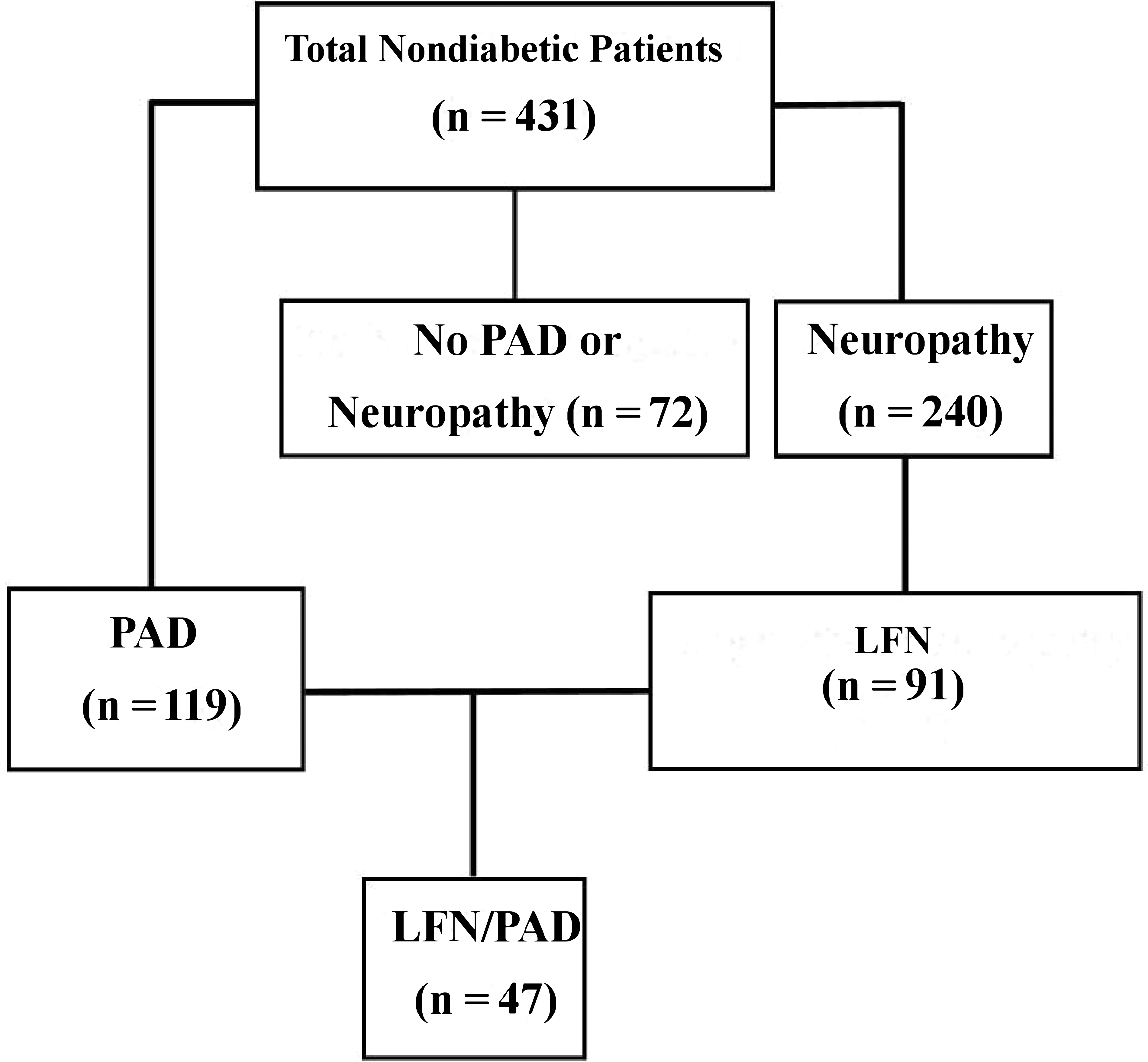
A total of 431 nondiabetic Medicare patients were identified seeking RFC (CPT codes 11720, 11721, and 11055) from 2017 to 2022 (Figure 1). Of these, 240 had the ICD-10 G62.9 code, and 91 of these were found to have LFN per the TVT cutoff value of ≤4 sec. A total of 119 patients were found to have PAD with ICD-10 codes I70.203 and I73.9 and Medicare class findings for vascular impairment, and 47 patients had both LFN and PAD.
Figure 1. Flowchart delineating patient medical record selection meeting inclusion criteria for large fiber neuropathy (LFN) and peripheral artery disease (PAD) from January 1, 2017, to December 31, 2022. The inclusion criteria for PAD consisted of International Statistical Classification of Diseases, Tenth Revision (ICD-10) codes I70.203 and I73.9 and Medicare class findings for vascular impairment. The inclusion criteria for LFN consisted of ICD-10 code G62.9 and timed vibration test values ≤4 sec.
Japma 115 23220 g001
Table 1 displays the demographic characteristics of patients meeting the inclusion criteria. There was a 6.5% difference between the proportions of the LFN and PAD groups, which was significantly different (P = .026, confidence interval = 0.77–12.2%). There was no significant difference between the ages of patients in the LFN and PAD groups (P = .36, standard deviation [SD] = 1.65), the LFN and LFN/PAD groups (P = .3, SD = 1.95), or the PAD and LFN/PAD groups (P = .07, SD = 1.95).
Table 1. Demographics of Study Patients With Large Fiber Neuropathy, Peripheral Artery Disease, and Large Fiber Neuropathy/Peripheral Artery Disease
Japma 115 23220 i001

Discussion

A 21.1% prevalence of LFN was found in our population of nondiabetic Medicare patients seeking RFC. This finding is consistent with the prevalence of idiopathic peripheral neuropathy in older adults reported elsewhere, ranging from 20% to 30%.[3,4,7] One major difference between our study and others is the focus on LFN. This is because of the availability of quantitative data obtained with the TVT. This is in contrast to other studies reliant on the 5.07 SWM test to diagnose neuropathy. The SWM may have picked up those patients with small fiber neuropathy, LFN, or both. We also restricted the cutoff value of the TVT to ≤4 sec to ensure better diagnostic accuracy. This was done to identify those with moderate to severe LFN, who are presumably more predisposed to foot injuries because of LOPS and falls because of balance deficits.
The prevalence of PAD in our study population was found to be 27.6%. This finding is slightly higher than other estimates of prevalence in older adults that range from 12% to 25%.[2122,23] The prevalence of PAD compared with LFN in our study was statistically significantly different. However, the 6.5% actual difference is modest in terms of clinical practice, illustrating the widespread nature of these conditions.
The prevalence of LFN/PAD was 10.9%. This group was also slightly older than the other groups, suggesting progression of these pathologies over time.
The ages of those with LFN, PAD, and LFN/PAD were not found to be significantly different. However, there was a trend toward significance between the ages of the PAD and LFN/PAD groups (77.5 versus 81.2 years old).
There were several limitations in the design of this study. Chief among these was the selection of diabetes as the sole medical exclusion. This was done in part for simplicity and to focus on nondiabetic peripheral neuropathy. Considerable attention has been focused on diabetic peripheral neuropathy for many decades.[24,25,26] One of the goals of this study was to highlight unrecognized LFN in older adults without diabetes. Other possible etiologies for neuropathy were not explored. For example, several patients qualified for inclusion based on unilateral TVT values suggesting undiagnosed radiculopathy or nerve entrapment. For this reason, our LFN cohort of 91 patients can be considered to have “all-cause” LFN, with the exception of diabetes.
Use of the TVT alone to diagnose LFN is another drawback. Vibration testing done in this study was at one anatomic location, the hallux. Although the TVT is simple and rapidly performed, it is not as sensitive as anatomic site-specific testing, which could have provided more accuracy and potentially diagnosed patients with local nerve entrapment or mononeuropathy multiplex. A more robust design could have identified these possibilities. Although our prevalence of LFN was comparable to that found by Hicks et al,[4] it is unclear how many of our patients truly had idiopathic neuropathy. Ultimately, it was beyond the scope of this study to perform a thorough diagnostic evaluation on all those identified with neuropathy.
Another limitation was the retrospective nature of the study. Additionally, the patient population studied was a relatively homogeneous group seen by one provider in one facility. Although this afforded consistency, a more varied population across multiple sites would have resulted in a more robust study. Despite this, it should be noted that our LFN prevalence agreed with ranges noted elsewhere.

Conclusions

LFN was found to be prevalent in a substantial proportion of nondiabetic older adults seeking RFC. This finding should alert providers to the widespread and often unrecognized nature of the condition. The prevalence of LFN in this at-risk population highlights the importance of accurate diagnosis and implementation of preventative measures designed to mitigate unperceived foot trauma and potential falls. Communication between foot care specialists and primary-care providers regarding unrecognized LFN should be directed toward thorough diagnostic evaluations in pursuit of identifiable diagnoses as well as referral to other specialties. This may include referral to neurologists for more in-depth evaluations and physical therapists for enrollment in fall prevention programs. This is especially relevant, as falls in geriatric patients have been associated with earlier mortality.

Financial Disclosure

None reported.

Conflict of Interest

None reported.

References

  1. Bouche P, Cattelin F, Saint-Jean O, et al: Clinical and electrophysiological study of the peripheral nervous system in the elderly. J Neurol 240: 263, 1993; doi: 10.1007/BF00838158.
  2. Bouche P: Neuropathy of the elderly. Rev Neurol (Paris) 176: 733, 2020; doi: 10.1016/j.neurol.2019.11.007.
  3. Brisset M, Nicolas G: Peripheral neuropathies and aging. Geriatr Psychol Neuropsychiatr Vieil 16: 409, 2018; doi: 10.1684/pnv.2018.0768.
  4. Hicks CW, Wang D, Windham BG, et al: Prevalence of peripheral neuropathy defined by monofilament insensitivity in middle-aged and older adults in two US cohorts. Sci Rep 11: 19159, 2021; doi: 10.1038/s41598-021-98565-w.
  5. Hall JE: Guyton and Hall Textbook of Medical Physiology, 13th Ed, WB Saunders, Philadelphia, 2015.
  6. Tentolouris A, Tentolouris N, Eleftheriadou I, et al: The performance and interrater agreement of vibration perception for the diagnosis of loss of protective sensation in people with diabetes mellitus. Int J Low Extrem Wounds 22: 72, 2023; doi: 10.1177/1534734621994058.
  7. Lawler FH, Mold JW, Liao X, et al: Peripheral neuropathy in older people is associated with reduced life expectancy. J Am Board Fam Med 36: 431, 2023; doi: 10.3122/jabfm.2022.220306R1.
  8. Richardson JK, Hurvitz EA: Peripheral neuropathy: a true risk factor for falls. J Gerontol A Biol Sci Med Sci 50: M211, 1995; doi: 10.1093/gerona/50a.4.m211.
  9. Richardson JK, Ashton-Miller JA: Peripheral neuropathy: an often-overlooked cause of falls in the elderly. Postgrad Med 99: 161, 1996.
  10. Hafström A: Perceived and functional balance control is negatively affected by diminished touch and vibration sensitivity in relatively healthy older adults and elderly. Gerontol Geriatr Med 4: 2333721418775551, 2018; doi: 10.1177/2333721418775551.
  11. Riskowski JL, Quach L, Manor B, et al: Idiopathic peripheral neuropathy increases fall risk in a population-based cohort study of older adults. J Foot Ankle Res 5 (suppl 1): P19, 2012; doi: 10.1186/1757-1146-5-S1-P19.
  12. Hicks CW, Wang D, Daya N, et al: The association of peripheral neuropathy detected by monofilament testing with risk of falls and fractures in older adults. J Am Geriatr Soc 71: 1902, 2023; doi: 10.1111/jgs.18338.
  13. Loo DS: Cutaneous fungal infections in the elderly. Dermatol Clin 22: 33, 2004; doi: 10.1016/s0733-8635(03)00109-8.
  14. Levy LA: Epidemiology of onychomycosis in special-risk populations. J Am Podiatr Med Assoc 87: 546, 1997; doi: 10.7547/87507315-87-12-546.
  15. Gupta AK, Venkataraman M, Talukder M: Onychomycosis in older adults: prevalence, diagnosis, and management. Drugs Aging 39: 191, 2022; doi: 10.1007/s40266-021-00917-8.
  16. George DH: Management of hyperkeratotic lesions in the elderly patient. Clin Podiatr Med Surg 10: 69, 1993.
  17. Helfand AE: Nail and hyperkeratotic problems in the elderly foot. Am Fam Physician 39: 101, 1989.
  18. Oyer DS, Saxon D, Shah A: Quantitative assessment of diabetic peripheral neuropathy with use of the clanging tuning fork test. Endocr Pract 13: 5, 2007; doi: 10.4158/EP.13.1.5.
  19. O’Brien T, Karem J: Combined utility of the Semmes-Weinstein monofilament and the timed vibration test in the prediction of diabetic foot ulcers. J Am Podiatr Med Assoc 112: 20, 2022; doi: 10.7547/20-174.
  20. Centers for Medicare & Medicaid Services: Billing and coding: routine foot care and debridement of nails. Available at: https://www.cms.gov/medicare-coverage-database/view/article.aspx?articleid=57759&ver=21&. Accessed December 6, 2023.
  21. Aronow WS, Ahn C, Gutstein H: Prevalence and incidence of cardiovascular disease in 1160 older men and 2464 older women in a long-term health care facility. J Gerontol A Biol Sci Med Sci 57: M45, 2002; doi: 10.1093/gerona/57.1.m45.
  22. Criqui MH, Aboyans V: Epidemiology of peripheral artery disease. Circ Res 116: 1509, 2015; doi: 10.1161/CIRCRESAHA.116.303849. Erratum in: Circ Res 117: e12, 2015.
  23. Criqui MH, Matsushita K, Aboyans V, et al: Lower extremity peripheral artery disease: contemporary epidemiology, management gaps, and future directions: a scientific statement from the American Heart Association. Circulation 144: e171, 2021; doi: 10.1161/CIR.0000000000001005. Erratum in: Circulation 144: e193, 2021.
  24. Elafros MA, Andersen H, Bennett DL, et al: Towards prevention of diabetic peripheral neuropathy: clinical presentation, pathogenesis, and new treatments. Lancet Neurol 21: 922, 2022; doi: 10.1016/S1474-4422(22)00188-0.
  25. Chang MC, Yang S: Diabetic peripheral neuropathy essentials: a narrative review. Ann Palliat Med 12: 390, 2023; doi: 10.21037/apm-22-693.
  26. Castelli G, Desai KM, Cantone RE: Peripheral neuropathy: evaluation and differential diagnosis. Am Fam Physician 102: 732, 2020.