Plantar heel pain (PHP), otherwise known as plantar fasciitis (“jogger’s heel,” “tennis heel,” “policeman’s heel”), is a common condition estimated to affect more than 1 million people worldwide each year.[
1] The exact pathophysiology of PHP is unknown; however, it is thought to be degenerative as a result of an inflammatory process that modifies morphological characteristics, leading to thickening of the fascia. [
2–
6] It classically presents as burning or aching pain medial to the calcaneal tuberosity that is exacerbated when attempting to mobilize after waking in the morning or after a period of prolonged rest. [
7,
8] Although it is not considered life- or limb-threatening, it can be a very disabling condition to many and career-threatening in elite athletes. [
9,
10]
There are a range of treatment modalities for the management of PHP. However, it is not currently clear which intervention (physiotherapy, podiatry, pharmacologic, electrotherapy, or surgery) provides the best response. [
5,
6,
11,
12] Treatment algorithms have been published that suggest implementation of best evidence therapies such as plantar fascia stretching, low-dye taping, and educational support followed by use of adjunctive therapies such as extracorporeal shockwave therapy or custom-made orthoses for patients requiring further treatment. [
13,
14]
Despite several treatment modalities and adjuncts, the pathology of PHP is not fully understood, which can make it difficult to treat. As a result, this condition may impact significantly on quality of life and potentiate symptoms of anxiety, stress, and depression. [
15]
There is a well-known association between musculoskeletal pain and depression and anxiety symptoms. [
16,
17] Anxiety and depression have been found to be linked to patellofemoral pain, [
18] rotator cuff tendinopathy, [
19] frozen shoulder, [
20] and back pain. [
21] Furthermore, patients with coexisting pain, anxiety, and depression symptoms have been shown to experience a greater level of pain and interference with activities compared with pain patients alone. This may lead to poor functional outcomes and lengthen the duration of symptoms. [
16] The association of depression and anxiety with other chronic musculoskeletal conditions suggests that they may also be clinically relevant in patients with PHP. If there is an association, in addition to localized pain, psychological symptoms should be taken into consideration as part of the management algorithm for PHP.
To our knowledge, no systematic review has been performed looking specifically at PHP and its association with depression, anxiety, and stress. Given that PHP is a common problem that is considered difficult to manage, it is important to examine whether there are associated psychological components that clinicians should manage in addition to treating this condition.
Materials and Methods
Research Question
We constructed our research question using the population, exposure, and outcome framework. [
22] Our aim was to assess whether patients with PHP have an association with depression, stress, and anxiety and discuss the potential negative impact this may have on the treatment of PHP.
Information Sources
A systematic search of the literature was conducted on May 19, 2021. A total of seven bibliographic databases were searched. The interface, name, and coverage for each database are listed in
Table 1. Forward and backward citation searches were conducted on articles identified as eligible for full-text review. Forward citation searches were conducted using Web of Science Core Collection.
Table 1.
Interface, Name, and Coverage of Each Database Searched
Table 1.
Interface, Name, and Coverage of Each Database Searched
Search Strategy
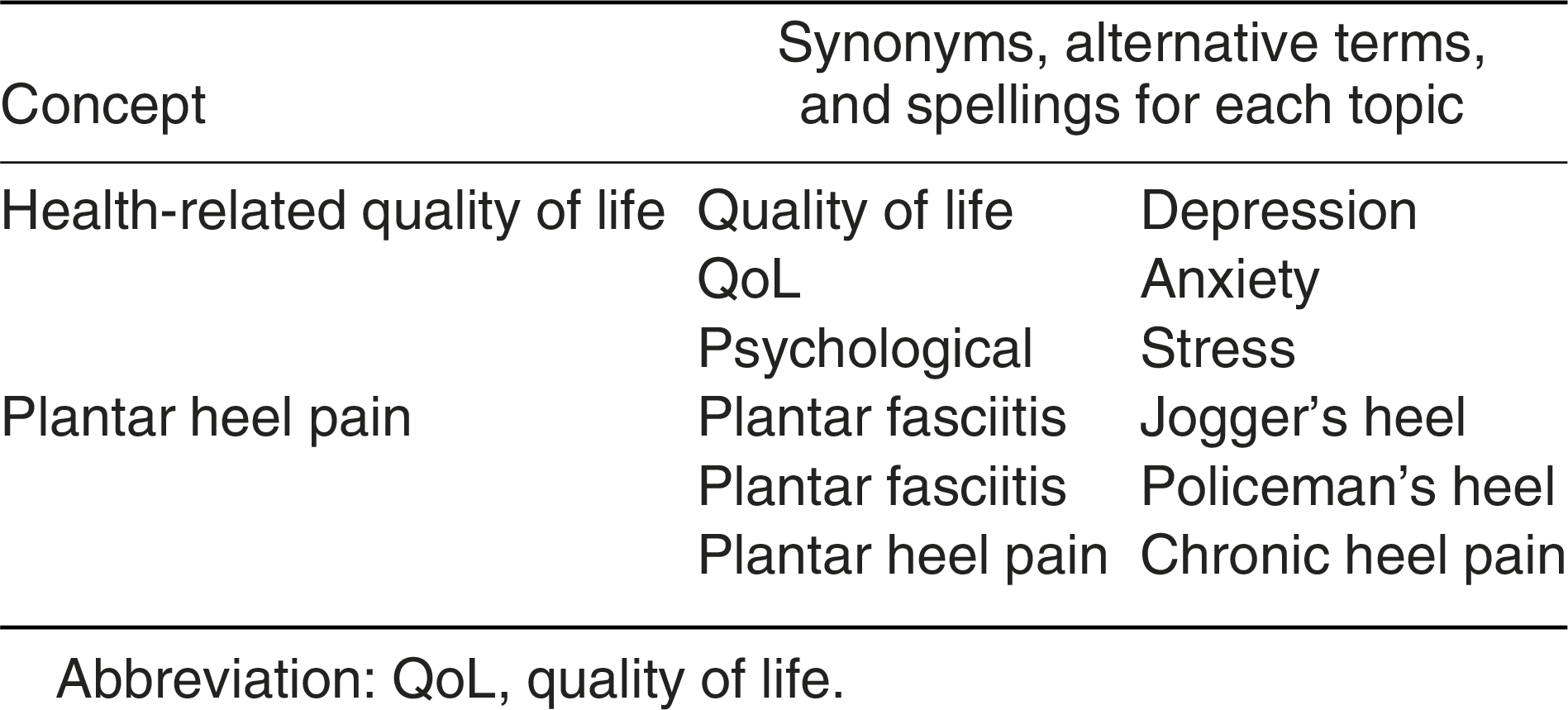
Full search strategies and results for each database are contained in Supplement 1. Key components of the research question were broken down into two concepts: PHP and quality of life. Synonyms and alternative spellings were listed to identify key terms (
Table 2). Searches were conducted using a combination of relevant keywords and subject headings. The search strategy was modified so that subject headings relevant to each specific database were selected. The results were then imported into EndNote and de-duplicated prior to screening.
Table 2.
Terms Used for Search Strategy
Table 2.
Terms Used for Search Strategy
Eligibility Criteria
Studies for inclusion were observational studies (case-control, cross-sectional, and cohort) that looked for a relationship between PHP and depression, anxiety, and stress and were reported in the English language. Excluded literature comprised single-case studies, technical notes, letters, and personal opinions.
Methods of Review
Studies were independently assessed for inclusion by two reviewers. The reviewers evaluated all identified titles and abstracts independently and excluded any articles that did not meet the inclusion criteria. All duplicates were removed. Full-text manuscripts were ordered when the study inclusion criteria could not be assessed from the abstract or title. If additional studies were identified from the reference list, they were also requested and assessed, leading to the sample of eligible articles. This study was reported using the Preferred Reporting Items for Systematic Reviews and Meta-Analyses framework. [
23]
Data Extraction
Data extraction for each eligible article was performed independently by two reviewers using a prepared data collection sheet. The data extracted from each study included 1) study design, 2) population characteristics (sample size, age, gender, duration of symptoms), 3) clinical diagnosis, 4) investigative imaging, 5) patient-reported outcome/quality of life measure assessment, and 6) overall outcome drawn from the study (ie, whether a relationship existed between PHP and anxiety, depression, and stress).
Critical Appraisal
There are a large number of possible tools to aid in the critical appraisal of observational studies. Evidence has shown that there is no generalizable tool to appraise different study designs. [
24] However, the Critical Appraisal Skills Programme (CASP) has developed a number of tools for different study designs. The CASP checklists are a systematic way to assess the reliability of the study and if there is associated bias and therefore an assessment of methodological quality. [
25] The checklists are based on study design and consist of ten to 12 questions. Appraisal using CASP checklists allowed us to assess the validity and risk of bias and therefore the quality of the selected studies in a standardized manner. We created a scoring system in order to create a systematic method for assessing study quality from three broad sections: validity, result interpretation, and application of outcome. The overall quality of each article was then determined by the number of satisfied CASP tool criteria (
Table 3). The scoring template and CASP appraisal tools themselves may be found in full in Supplement 2.
Table 3.
Quality Level Assessment According to Critical Appraisal Skills Programme Tool Criteria
Table 3.
Quality Level Assessment According to Critical Appraisal Skills Programme Tool Criteria
Results
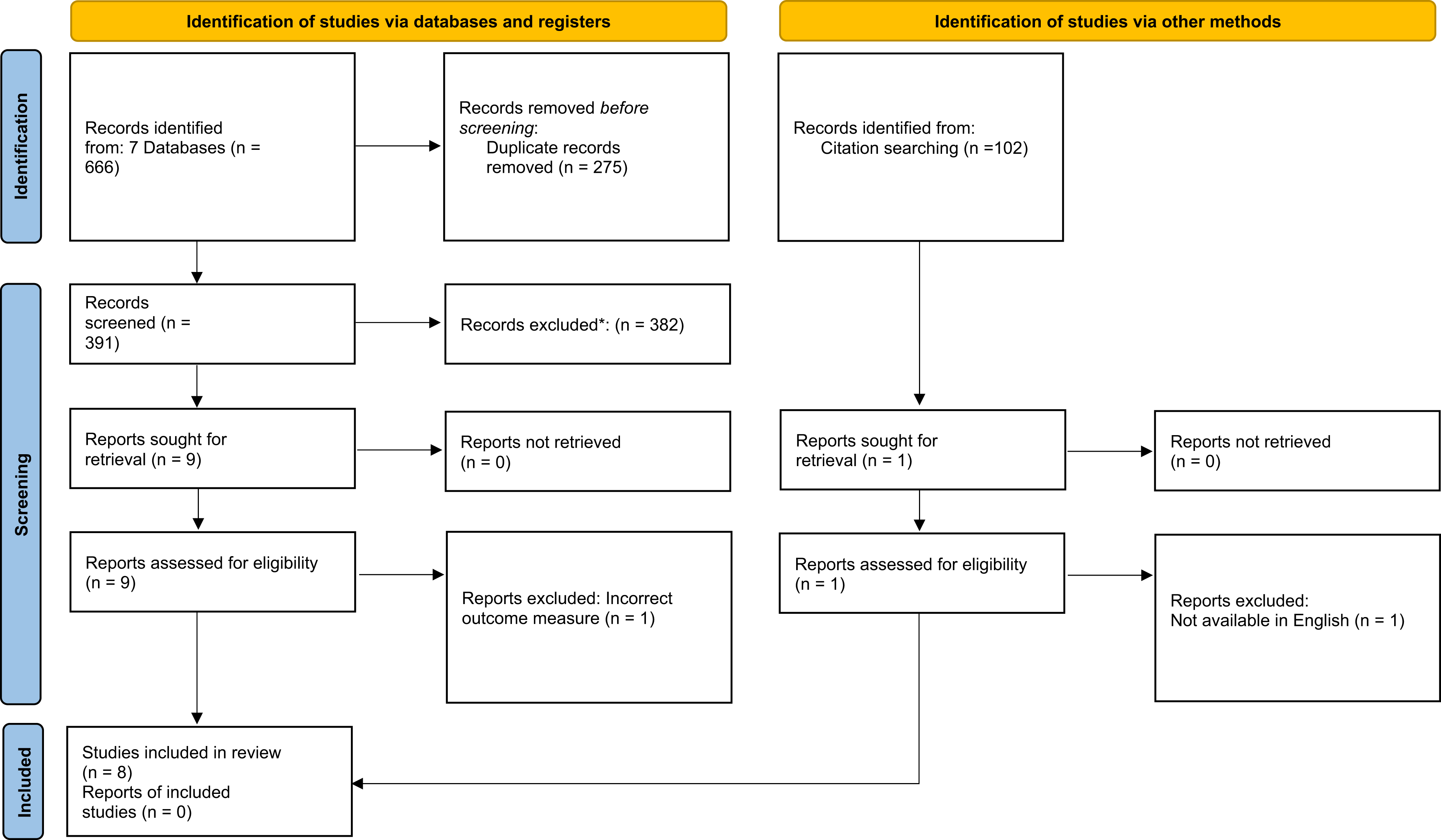
A total of 666 citations were identified through the search strategy. The results of the search strategy are presented in the Preferred Reporting Items for Systematic Reviews and Meta-Analyses flowchart (
Fig. 1).
Figure 1.
Preferred Reporting Items for Systematic Reviews and Meta-Analyses flow diagram for systematic review, including searches of databases, registers, and other sources. *Excluded records included single-case studies, technical notes, letters, personal opinions, and those that did not fulfill the inclusion terms/criteria for the proposed study.
Figure 1.
Preferred Reporting Items for Systematic Reviews and Meta-Analyses flow diagram for systematic review, including searches of databases, registers, and other sources. *Excluded records included single-case studies, technical notes, letters, personal opinions, and those that did not fulfill the inclusion terms/criteria for the proposed study.
Ten studies were sought for retrieval. One study was excluded as it was not available in the English language and one study was excluded as it did not test the desirable outcome (study of plantar thickness and not pain). These studies are summarized in
Table 4.
Table 4.
Summary of Results
Table 4.
Summary of Results
Data Analysis
Because of the variation in reporting methods, outcome data, population characteristics, and follow-up periods, it was not possible to conduct a meta-analysis. A descriptive analysis was therefore performed.
Study Designs
Retrospective methods were used in all but one study, which employed a prospective method. [
26] All eight studies were observational. Of these, five were cross-sectional studies, [
1,
12,
27–
29] two were case-control studies, [
30,
31] and one was a cohort study. [
26]
Population Characteristics
Four of the studies were conducted in Australia, [
1,
27,
28,
30] two were conducted in Spain, [
29,
31] one was conducted in Japan, [
12] and one was conducted in England. [
26] A total of 5,883 patients were included across all studies. One study did not report mean age. [
26] The mean age for all other studies was 52.48 years. Studies included 44 to 5,109 participants. Excluding one study in which sufficient information on patient characteristics could not be found, [
26] females predominated in the included studies (n = 474 [54.9%]).
Clinical Diagnosis and Investigation
The clinical diagnosis and timeline of symptoms for PHP varied among the studies (
Table 3). The reporting of first step pain was used in four studies. [
1,
27,
28,
31] Subjective reporting of PHP after varying activity levels was used in other studies. This included pain in the morning [
29,
30] and pain with prolonged weightbearing [
31] or standing [
1,
29] as well as increased pain on walking, [
29,
31] running, [
1] or general activity. [
30] One study used a broad subjective measure of pain lasting more than 1 day in one or both feet. [
26]
Tenderness on palpation of the medial calcaneal tubercle was reported in two studies. [
1,
31] Two studies used ultrasound and radiography to confirm diagnoses and rule out alternative cause of heel pain. [
29,
30]
There were also variations in chronicity of symptoms in study participants. Three of the reported studies included patients who had had symptoms for over 1 month, [
26–
28] two studies included patients who reported symptoms for over 6 months, [
12,
30] and one study did not include participants’ symptom timeline. [
29] Barnes et al [
1] separated their cohort into symptom groups for acute PHP (duration of 3 weeks to 6 months) and chronic PHP (duration >6 months).
Outcome Measures
This review identified substantial variations in outcome measures used to measure depression, anxiety, stress, and quality of life. There are no validated instruments for assessing the effects of PHP on quality of life. A wide range of outcome scoring tools were reported in the included studies (
Table 4). The outcome measures used for diagnosis of depression, anxiety, and stress were Depression Anxiety Stress Scale 21 and the Hospital Anxiety and Depression Scale (higher scores indicative of poorer health). Foot health and function were assessed with the Foot Health Status Questionnaire (FHSQ), Foot and Ankle Ability Measure, Self-Administered Foot Evaluation Questionnaire, and Manchester Foot Pain and Disability Index and physical activity was measured with the International Physical Activity Questionnaire. Measures of generic quality of life included the 36-Item Short Form Survey and the 12-Item Short Form Survey. The most frequently used outcome measure was the FHSQ.
Measurement tools for identification and intensity scoring of pain included a visual analog scale, [
12,
27,
28] a numeric 11-point rating scale for intensity of pain, and pressure pain threshold comparison. [
31] Not all studies included severity measures of PHP intensity.
Association Between PHP and Quality of Life
Three studies used control groups to assess the difference in quality of life between those with PHP and a matched control group. [
28–
30] Chronic PHP was shown to be associated with worse health and foot-specific quality of life. [
29,
30] Barnes et al [
1] showed reduced overall foot strength measures in the chronic PHP group compared with the acute PHP cohort. In addition, the acute group displayed overall better self-reported foot function. Lower scores were also demonstrated in chronic PHP patients on the 36-Item Short Form Survey and the Foot and Ankle Ability Measure, excluding the mental health component. By contrast, patients with acute PHP were shown to have increased depression, anxiety, and stress compared with matched controls.
Two studies displayed odds ratios for the association of PHP with quality of life measures (
Table 5). Thomas et al [
26] demonstrated an association between PHP and reduced quality of life as evidenced through a number of quality of life measures. Cotchett et al [
28] demonstrated that for every 1-unit increase in depression, anxiety, or stress, the odds ratio for PHP increased by 1.3-fold. A study by Nakagawa et al [
12] demonstrated that anxiety and depression were present in a respective 31% and 28% of the cohort group suffering with plantar fasciitis. Furthermore, the authors demonstrated worse PHP severity scores in those with anxiety and depression. A positive association was also demonstrated between PHP and other variables, including low socioeconomic status, high body mass index, low physical activity, [
26] and female sex. [
27,
29]
Table 5.
Odds Ratios of Association Between Plantar Heel Pain and Quality of Life Measures
Table 5.
Odds Ratios of Association Between Plantar Heel Pain and Quality of Life Measures
Critical Appraisal
Table 6 displays ratings of the methodological quality of each included study as scored by our CASP assessment tool. Five studies were appraised using the CASP cohort tool [
1,
12,
26,
27,
29] and three were appraised using the CASP case-control tool. [
28,
30,
31] We found four studies to be of medium quality [
28–
31] and four studies to be of low quality. [
1,
12,
26,
27] Criteria that reduced the methodological quality standard in the studies included inaccurate/subjective measure of exposure, no specific adjustment for or mention of confounding factors, suspected selection bias, and inability to infer causality given lack of long-term follow-up.
Table 6.
Critical Appraisal Summary
Table 6.
Critical Appraisal Summary
Discussion
To our knowledge, this is the first review to exclusively examine whether an association exists between PHP and quality of life, stress, anxiety, and depression. The inclusion criteria for the review were not strict enough to account for the paucity of literature on this topic; however, despite this, only eight studies were considered eligible.
Because of the heterogeneous nature of the studies, it was not feasible to conduct a meta-analysis to assess the association between PHP and quality of life. The results of the studies could only be analyzed descriptively, and therefore no definitive conclusions could be drawn regarding the association between PHP and quality of life.
A variety of clinical diagnostic tests were used to diagnose PHP, but no clinical tests have been tested for accuracy. Two studies used radiologic investigations in addition to clinical symptoms to rule out alternative diagnoses. [
29,
31] It is therefore possible that in studies that did not use radiologic investigations patients may have been included who did not have true PHP despite having pain that originated from around the plantar fascia area. The validity of these studies is therefore questionable and should be considered in any interpretation.
This review revealed substantial variation in outcome measures as well as lack of validated instruments. The FHSQ was the most commonly used outcome measure, [
1,
27–
30] but to our knowledge, this has not been tested for reliability and validity in patients with PHP specifically.
Our methodological quality assessment found four studies to be of medium quality [
28–
31] and four studies to be of low quality. [
1,
12,
26,
27] None of the included studies were deemed of high quality because they did not fulfill all of the criteria set out by the CASP assessment tool and because of their observational study design. Although several authors chose to include control groups in their studies, [
28,
30,
31] the remaining observational studies included no control groups. [
1,
12,
26,
27,
29] The lack of control groups in these latter studies raises the question of whether the results are reliable in defining a true association between PHP and quality of life outcome measures.
The studies included in our systematic review primarily focused on the relationship between PHP and quality of life measures rather than the treatment of mental or psychosocial health. Although there were limited details on treatment of depression, anxiety, or stress in PHP patients in the included studies, we feel it is important to note that there is a role for the multidisciplinary management of such patients focusing on both the psychosocial and physical aspects of their health. A recent systematic review has shown that depression has an important role in the management of knee pain and that the use of antidepressant medication results in a significant reduction in pain. [
32] Although we cannot generalize these results to all musculoskeletal pain patients, there is a biochemical theory that says depression is due to serotonin, norepinephrine, and dopamine deficiencies. The same neurotransmitters have been shown to have a role in inhibitory pain pathways, thus demonstrating a possible link in those who suffer with PHP and depression. [
32,
33]
The multidisciplinary management of psychosocial issues and PHP by pharmacologic and nonpharmacologic treatments could result in an overall improvement in quality of life. Taking into account our study limitations, the literature included in this review did show an association between PHP and anxiety, depression, and stress. Whether this occurs as a result of PHP symptoms or whether PHP is more prevalent in those with preexisting stress, anxiety, and depression is not possible to determine from this analysis because no study had quality of life scores for its patients prior to the onset of PHP.
Conclusions
This review suggests an association between PHP and depression, anxiety, and stress. Clinicians should be aware of this study’s findings and consider the potential impact of this condition on their patient’s mental health. The management of such patients may benefit, therefore, from a multifaceted approach encompassing psychosocial therapies as well as management of PHP in order to improve overall quality of life. Currently, evidence in this area is low in both quality and quantity and further robust, high-powered research is required to confirm whether additional treatment for mental health and well-being should be included in the overall management of patients with PHP.