According to the International Diabetes Federation Atlas (IDFA) report, the prevalence of diabetes mellitus was 451 million in 2017 and is estimated to be 693 million in 2045 [
1]. The number of persons with diabetes and the incidence of diabetic complications is increasing due to population growth and prolonged life expectancy [
2]. Diabetic patients spend more time in the hospital for lower-extremity infections than for other diabetic complications, [
3] and a person with diabetes has a 25% lifetime risk of developing foot ulcers [
4]. Diabetic foot infections can be classified into two main groups: soft-tissue infection (STI) and diabetic foot osteomyelitis (DFO). It is vital to differentiate STI from DFO, as the treatment modalities and durations are very different, but it may be challenging. There is insufficient evidence that laboratory markers, such as C-reactive protein (CRP), erythrocyte sedimentation rate, procalcitonin, or imaging techniques, adequately support the differential diagnosis [
5,
6]. Bone culture and histology are considered the gold standard for the diagnosis of DFO in most guidelines, but may not always be practical or accessible to differentiate between STI and DFO in routine use [
5,
7–
11]. In light of this, the adequacy of current diagnostic methods is still questioned and research for new diagnostic and follow-up tests is ongoing.
High mobility group box 1 protein (HMGB-1) is a pro-inflammatory cytokine present in almost all cells, actively secreted by monocytes and macrophages triggering the inflammatory cascade. HMGB-1 administration under physiologic conditions has also been shown to increase the expression of various inflammatory cytokines [
12,
13]. These include RAGE (receptor for advanced glycation end products) and Toll-like receptors (TLR)-2, TLR-4, TLR-9 [
14]. HMGB-1 is considered as an essential facilitator in inflammatory and infectious processes. There are several clinical studies where HMGB-1 remained persistently elevated, even when other proinflammatory cytokines returned to normal levels [
15]. In this study, we aimed to evaluate the blood concentration levels of HMGB-1 in patients with STI and DFO compared to healthy subjects, and to investigate whether it could contribute to the differentiation of STI and DFO.
Materials and Methods
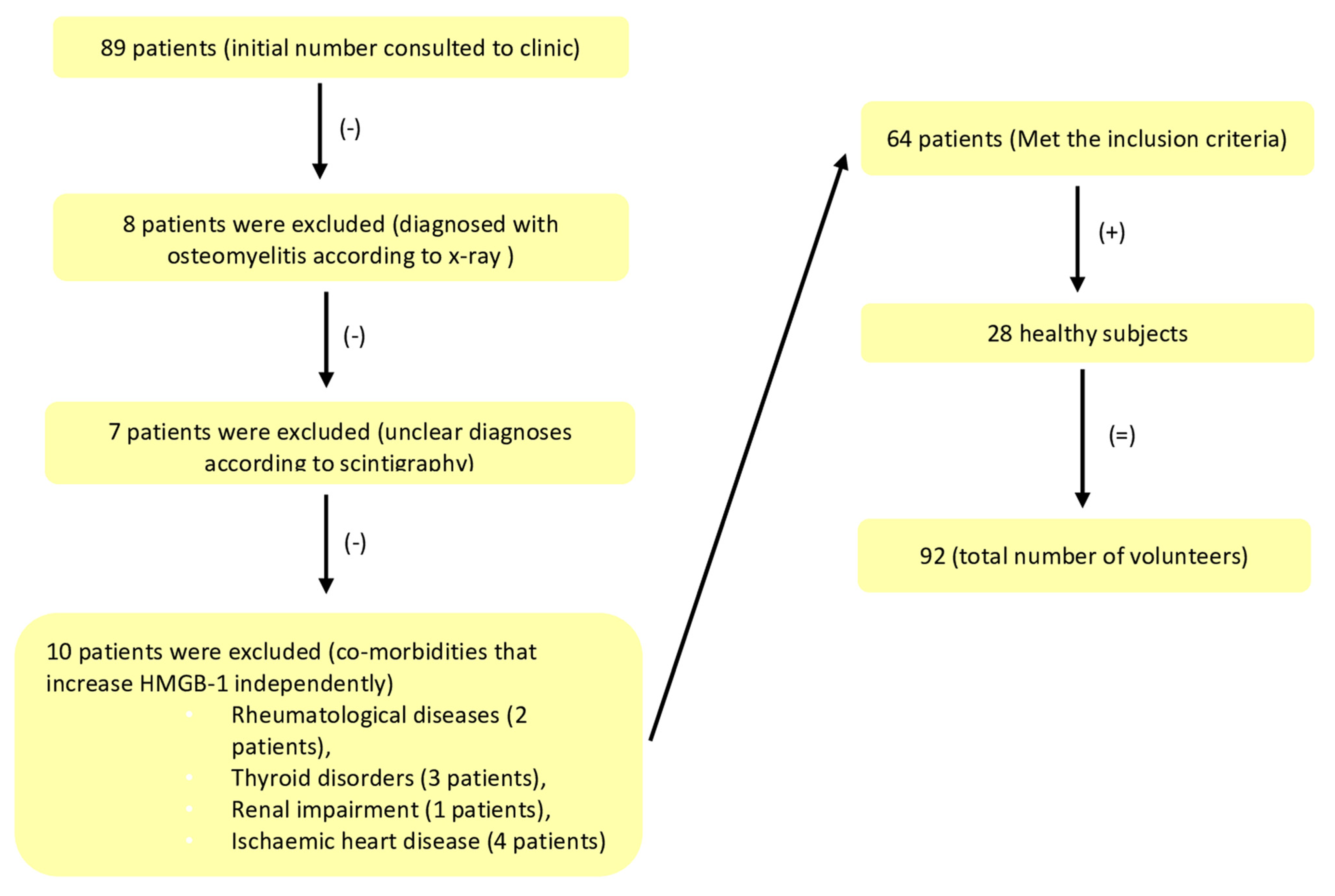
The data of 89 patients with suspicion of STI or DFO at the Orthopaedics and Traumatology clinic were consulted between November 2019 and March 2022, and 28 healthy volunteers, for the control group, were recorded prospectively (
Fig. 1). Examinations; radiographs of the foot; and blood tests including CRP, erythrocyte sedimentation rate, white blood cell counts, and 3 mL extra blood for the HMGB-1 test were subsequently obtained in all patients. No further investigation was performed for patients with signs of osteomyelitis on radiographs, such as periosteal reaction, regional osteopenia, focal bone lysis or cortical loss, sequestrum, and bone abscess (Brodie’s abscess). These patients were considered to have osteomyelitis, treated accordingly, and excluded from the study. Three-phase bone scintigraphy was performed in patients whose condition could not be differentiated between STI or DFO based on radiographs. Patients were divided into groups according to scintigraphy results. Group 1 comprised healthy subjects, and Group 2 and Group 3 comprised patients diagnosed with STI and DFO as a result of scintigraphy, respectively. Group 1 patients had only blood tests for CRP, erythrocyte sedimentation rate, white blood cell, and HMGB-1 measurements. No radiography or scintigraphy was performed.
Figure 1.
Flowchart showing case numbers and exclusion criteria.
Figure 1.
Flowchart showing case numbers and exclusion criteria.
Patients with rheumatologic disease (two patients), thyroid disorder (three patients), renal failure (one patient), and ischemic heart disease (four patients) were excluded because these conditions have been shown to independently increase HMGB-1 levels. In addition, patients with an unclear diagnosis based on scintigraphy (seven patients), and patients who were diagnosed with osteomyelitis based on radiographs (eight patients), were excluded (
Fig. 1).
Mean values of CRP, erythrocyte sedimentation rate, white blood cell, and HMGB-1 in the groups were analyzed. The role of HMGB-1 in differentiating healthy subjects, patients with STI, and those with DFO, and cut-off values between the three groups were determined. A three-phase bone scintigraphy was considered as the diagnostic method for differentiating STI and DFO, and the diagnostic significance of HMGB-1 was evaluated accordingly.
All participants were informed about the study and signed written informed consent before enrollment. The study was conducted in accordance with the principles of the Declaration of Helsinki and approved by the Sanko University Clinical Studies Ethics Committee.
Sampling
Blood samples required to measure the HMGB-1 level were collected prospectively, together with other blood tests, taken during the patient’s routine control. They were centrifuged for 15 min at 1,000 g within 1 hour of collection. The resulting sera were aliquoted into microtubes and immediately frozen at –80°C. These samples were placed into a refrigerator at 4°C one night before the measurements. Serum samples were kept at room temperature for 2 hours before operating with the ELISA method. The samples were then mixed using vortex and measurement procedures were applied.
Measurement
HMGB-1 serum levels were measured using Rel Assay (Rel Assay Diagnostics; Mega Tip Ltd, Ankara, Turkey) commercial kits and by complying with the manufacturer’s instructions. Analysis operations were performed by using the sandwich enzyme immunoassay technique and by repeating twice for each sample. All concentration/absorption graphic curves of the test and calculations regarding the results were performed on the program of the Biotek_ELx808 (Winooski, Vermont) device. The test was determined to have a sensitivity of 0.5 ng/mL and variation in intra- and inter-assay variability was 10% [
16].
Statistical Analysis
Statistical analyses were performed using SPSS for Windows 25.0 (IBM, Chicago, Illinois). The conformity of the variables to the normal distribution was examined using visual (histogram and probability graphs) and analytical methods (Kolmogorov-Smirnov/Shapiro-Wilk tests). Conditions with a P value above .05 in the Kolmogorov-Smirnov test were accepted as normal distribution. A one-way analysis of variance (ANOVA) test was used in the comparison between the three groups with normal distribution. When the P value was significant, pairwise comparisons were made with post hoc analysis to determine from which group the significance originated. Bonferroni correction was used in pairwise comparisons [Bonferroni value (P < .017)]. The cut-off values were determined using the Youden Index to find the point which maximizes the sum of sensitivity and specificity using the sensitivity+specificity-1. Chi-square test was used to compare qualitative variables. A P value less than .05 was considered statistically significant.
Results
A total of 92 volunteers, met the inclusion criteria, and were included in the study. Group 1 included 28 healthy subjects and was considered the control group. Group 2 comprised 35 patients diagnosed with STI, and Group 3 comprised 29 patients diagnosed with DFO (
Fig. 2). The distribution of the patients in the groups was similar in terms of age and sex (
Table 1).
Figure 2.
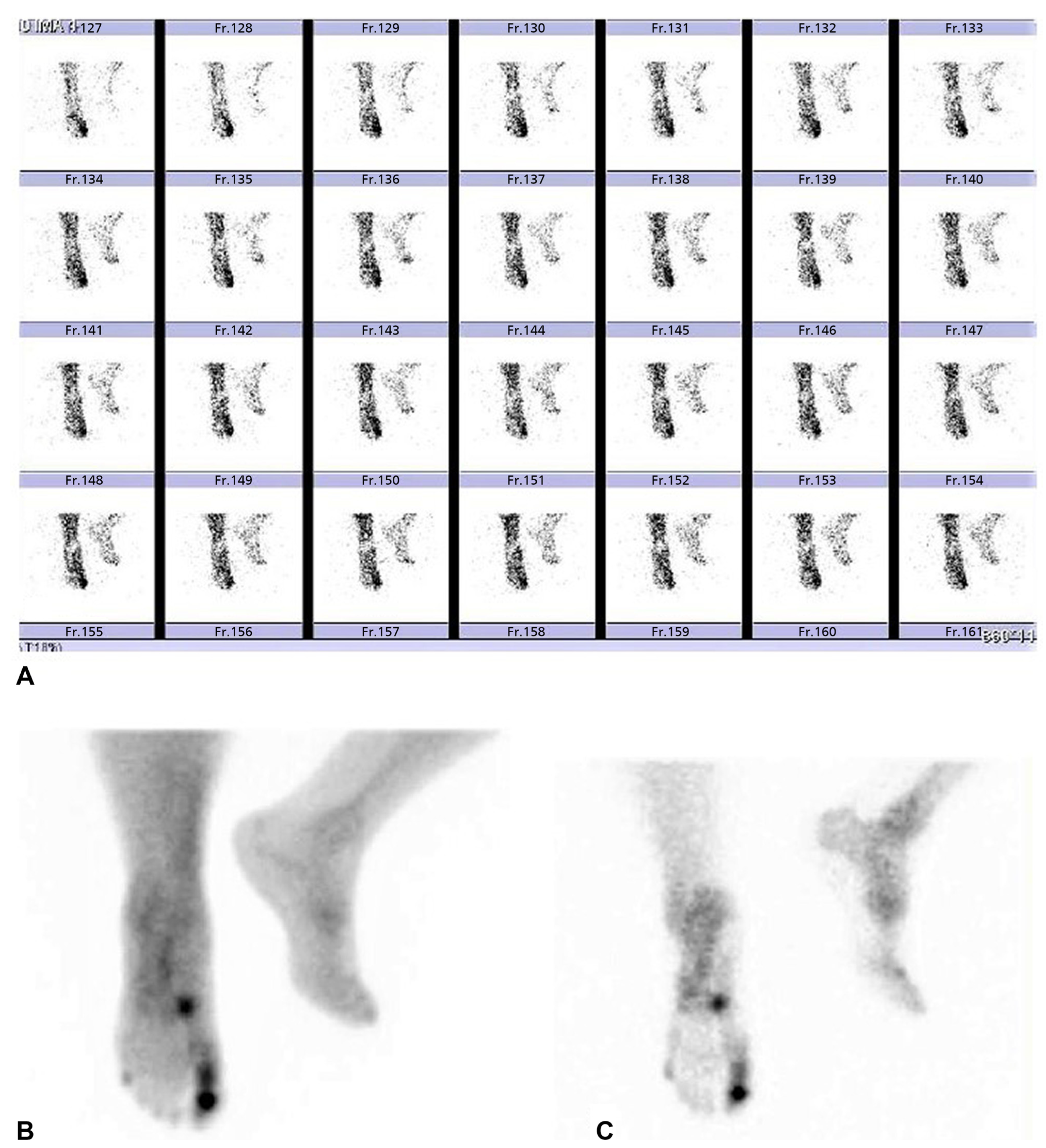
Diabetic foot osteomyelitis on three-phase bone scintigraphy scan study. A, Clearly increased blood flow in the left foot; B, Blood pool activity of 1. B, Phalanx on left foot. C, Intense accumulation same region.
Figure 2.
Diabetic foot osteomyelitis on three-phase bone scintigraphy scan study. A, Clearly increased blood flow in the left foot; B, Blood pool activity of 1. B, Phalanx on left foot. C, Intense accumulation same region.
Table 1.
Demographic and Clinical Characteristics of Study Participants
Table 1.
Demographic and Clinical Characteristics of Study Participants
Blood tests, including CRP, erythrocyte sedimentation rate, white blood cell count, and HMGB-1 are show in
Table 1 and
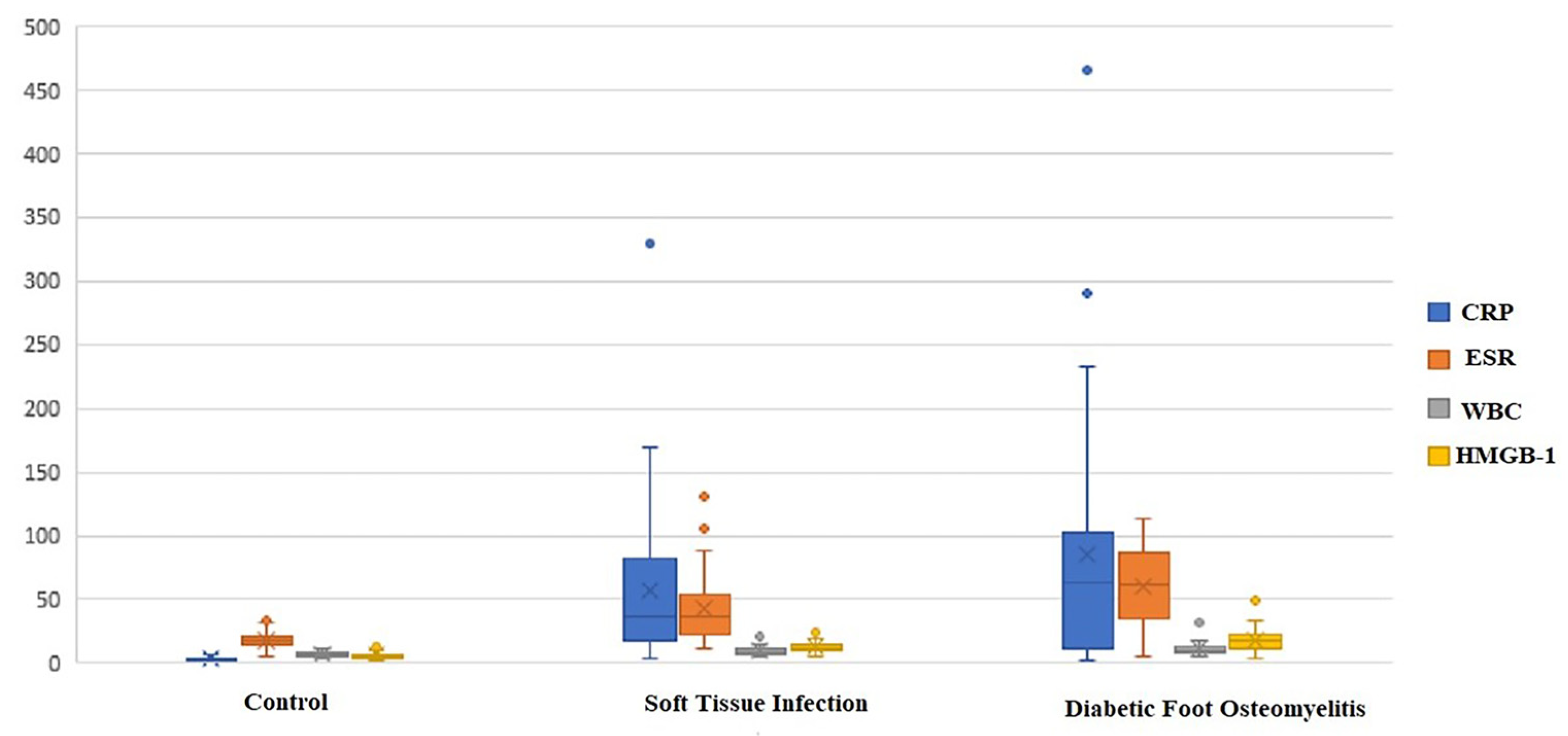
Figure 3 for the control, STI, and DFO groups. When the variables were compared among the three groups, a significant difference was observed in serum white blood cell, erythrocyte sedimentation rate, CRP, and HMGB-1 levels (
P < .001,
P < .001,
P < .001, and
P < .001, respectively) (
Table 1).
Figure 3.
Distribution of C-reactive protein, erythrocyte sedimentation rate, white blood cell count, and HMGB-1 values in the groups. Error bars, 95% Cl.
Figure 3.
Distribution of C-reactive protein, erythrocyte sedimentation rate, white blood cell count, and HMGB-1 values in the groups. Error bars, 95% Cl.
Pairwise comparisons were also made between the three groups for all variables. In the pairwise comparison of the control group and STI group, CRP, erythrocyte sedimentation rate, and HMGB-1 serum levels were significantly higher in the STI group compared to the control group (
P < .01,
P < .001 and
P < .001, respectively). However, there was no significant difference in serum white blood cell levels between the groups (
P = .03; Bonferroni correction:
P = .017) (
Table 2). When we looked at the pairwise comparison between the control group and the DFO group, CRP, erythrocyte sedimentation rate, white blood cell count, and HMGB-1 serum levels were significantly higher in the DFO group (
P < .001,
P < .001,
P < .001,
P < .001, and
P < .001, respectively) (
Table 2). In the pairwise comparison of STI group and DFO group, there was no significant difference between the groups in terms of CRP, erythrocyte sedimentation rate, and white blood cell counts (
P = .34,
P = .03 and
P = .16, respectively) (Bonferroni correction:
P = .017). However, unlike other parameters, HMGB-1 was significantly higher in the DFO group compared to the STI group (
P < .001) (
Table 2).
Table 2.
P Values of the Variables in Pairwise Comparisonsa
Table 2.
P Values of the Variables in Pairwise Comparisonsa
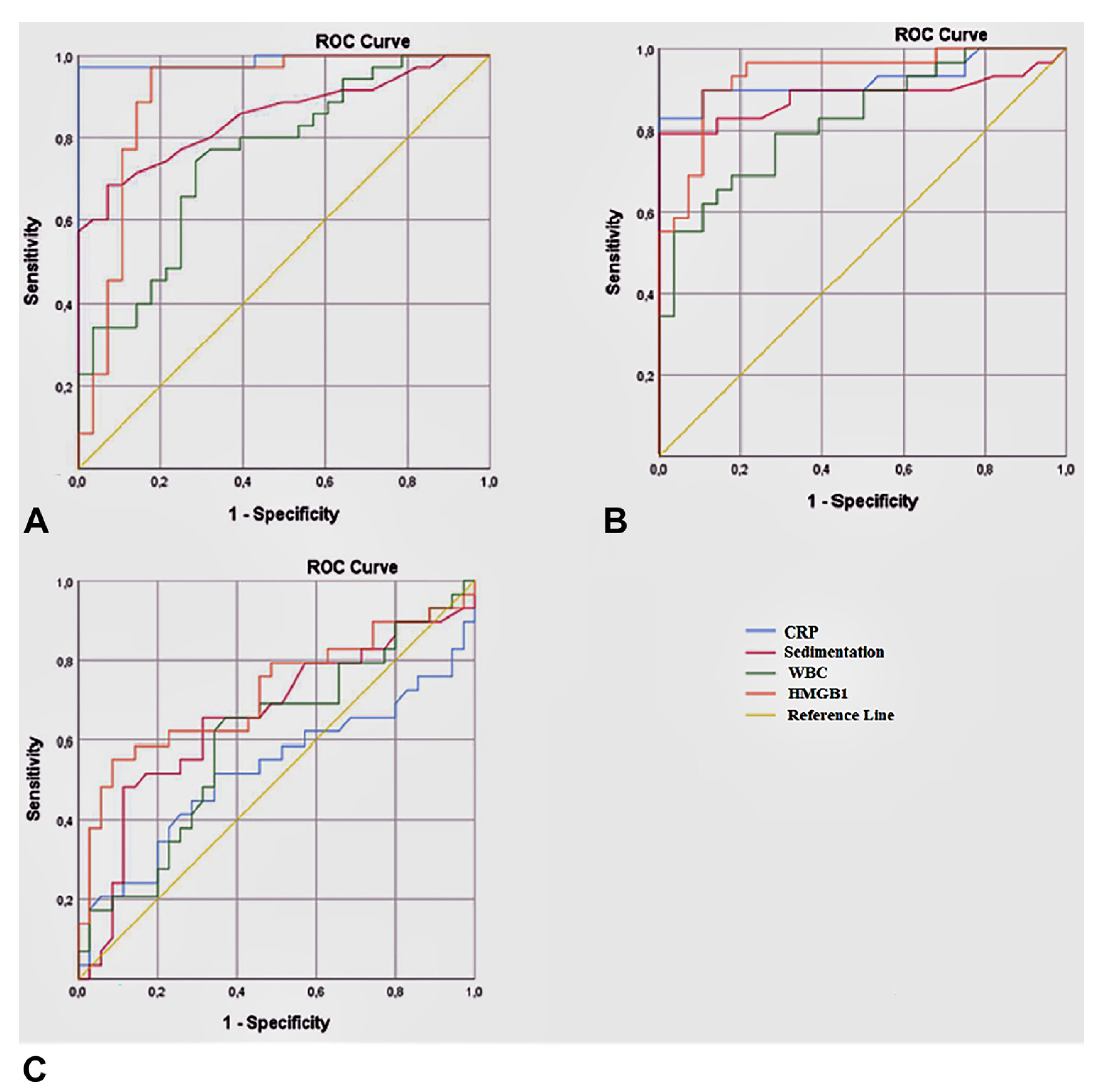
The area under the curve for HMGB-1 was 0.899 (95% CI, [0.808–0.990];
P < .001) in the receiver operating characteristic (ROC) analyses between the control group and STI group (
Fig. 4A), and 0.932 (95% CI, [0.867–0.998];
P < .001) between the control group and DFO group (
Fig. 4B), and 0.718 (95% CI, [0.585–0.852];
P = .003) between STI group and DFO group (
Fig. 4C).
Figure 4.
Receiver operating characteristic (ROC) curves for inflammatory markers. A, ROC analysis between the control group and STI group. The area under the curve for HMGB-1 was 0.899 (95% CI, [0.808–0.990]; P < .001).B, ROC analysis between control group and DFO. The area under the curve for HMGB-1 was 0.932 (95% CI, [0.867–0.998]; P < .001). C, ROC analysis between the STI and DFO groups. The area under the curve for HMGB-1 was 0.718 (95% CI, [0.585–0.852]; P = .003).
Figure 4.
Receiver operating characteristic (ROC) curves for inflammatory markers. A, ROC analysis between the control group and STI group. The area under the curve for HMGB-1 was 0.899 (95% CI, [0.808–0.990]; P < .001).B, ROC analysis between control group and DFO. The area under the curve for HMGB-1 was 0.932 (95% CI, [0.867–0.998]; P < .001). C, ROC analysis between the STI and DFO groups. The area under the curve for HMGB-1 was 0.718 (95% CI, [0.585–0.852]; P = .003).
The cut-off value of HMGB-1 was determined as 7.74 ng/mL between the control group and STI group, and 9.70 ng/mL between the control group and DFO group, and 16.97 ng/mL between the STI and DFO groups, respectively. Accordingly, the sensitivity, specificity and accuracy of HMGB-1 in differentiating between the control group and STI group were 97%, 82%, and 90%, respectively. The sensitivity, specificity, and accuracy in differentiating the control group from DFO were 90%, 89%, and 89%, respectively. The sensitivity, specificity, and accuracy in differentiating between STI and DFO were 55%, 94% and 77%, respectively (
Table 3).
Table 3.
Diagnostic Value of HMGB-1
Table 3.
Diagnostic Value of HMGB-1
Discussion
The mean value of HMGB-1 level was significantly higher in both the STI and DFO groups compared to the control group; a significant difference was also observed in the pairwise comparison of STI and DFO. Although there was no significant difference between STI and DFO groups in terms of mean values of CRP, erythrocyte sedimentation rate, and white blood cell counts, the difference in the mean value of HMGB-1 is promising in terms of the role of this biomarker in differential diagnosis.
Failure to differentiate STI from DFO certainly has undesirable consequences. Misdiagnosing osteomyelitis when only STI is present leads to prolonged antibiotic therapy, unnecessary surgery, and amputation [
17]. Long-term use of antibiotics can contribute to bacterial resistance, acute kidney damage, catheter infections, and gastrointestinal complications [
18,
19]. On the other hand, if the patient is treated for an STI when osteomyelitis is actually present, this misdiagnosis can lead to delayed wound healing, progression of infection, and tissue loss [
20,
21].
Many studies have been conducted on imaging modalities and inflammatory markers that can be used in the differential diagnosis of diabetic foot infections, and research is still ongoing. Radiography is an easily accessible and inexpensive examination that can be used in the first step for diagnosis. However, its sensitivity to STI and DFO is very low in the early stages of infection, especially in the first 4 weeks. Therefore, more advanced materials are needed for the diagnosis of DFO [
22,
23]. In the literature, variable sensitivity and specificity rates have been reported for various scintigraphy methods. The sensitivity of scintigraphy varies between 75% and 100%, while the specificity varies between 29% and 90% [
24–
26]. Scintigraphy may be useful as a screening test due to its high sensitivity, but it should be remembered that it still has low specificity [
27]. We preferred scintigraphy rather than magnetic resonance imaging (MRI) as the definitive test in our study.
Scintigraphy shows the blood perfusion of the infected area and provides clues about the efficacy of the treatment and thus the prognosis, as well as the diagnosis of STI/DFO. A site with good blood flow is expected to heal more easily than a site with poor or absent blood flow, whereas amputation is an expected consequence in sites with poor or absent blood flow [
28,
29] Baykal et al. [
30]. reported that a three-phase scintigraphy is a useful test to determine the level of amputation. Additionally, the other superiorities of scintigraphy are that whereas MRI only shows the infection in the scanned area, scintigraphy can detect occult infection in the other foot or in another part of the body. Scintigraphy is also cheaper than MRI, and MRI cannot be performed in patients with pacemakers or new stents [
31]. We are aware that scintigraphy is not the gold standard, so we excluded seven patients with questionable scintigraphy results. Thus, in the present study, the most accurate results were evaluated.
Ertugrul et al. [
32] found higher erythrocyte sedimentation rate and CRP levels in patients with DFO compared to patients without bone infection. Fleischer et al. [
8] identified higher levels of CRP and erythrocyte sedimentation rate at baseline in DFO patients compared to patients with STI. Another pilot study by Jeandrot et al. [
9] reported the diagnostic value of the combination of PCT with CRP (area under the curve = 0.947) in the identification of diabetic foot infections. Van Asten et al. [
6] compared the levels of inflammatory markers at diagnosis in patients with STI and DFO. Although there was no difference between CRP, erythrocyte sedimentation rate, and interleukin-6 levels, they found a significant difference between procalcitonin levels. They reported no adequate evidence to support any inflammatory marker used to diagnose or monitor the treatment for osteomyelitis [
6]. Mutluoğlu et al. [
33] reported no significant difference between procalcitonin levels in their study. Butalia et al. [
34] found that patients with osteomyelitis would most likely have an erythrocyte sedimentation rate above 70 mm/hr, which is highly specific for DFO but has a very low sensitivity (28%). Accordingly, the evidence for the adequacy of biomarkers in diagnosis and follow up is still insufficient.
Although biopsy is considered the gold standard, it may not always be accessible in clinical routine. In this study, we preferred scintigraphy rather than biopsy as the definitive diagnostic method. Only patients who could not be clearly diagnosed based on blood tests and scintigraphy underwent biopsy and were excluded from the study. The faster results of scintigraphy compared to biopsy allow the differential diagnosis of STI and DFO to be made earlier. Making the differential diagnosis as soon as possible gives the clinician clues about the prognosis and allows the determination of the duration and planning of treatment including surgical procedures. In all diabetic foot infections a primary consideration is whether or not surgical intervention is required [
35]. Because if DFO is diagnosed, surgical procedures should be performed, and interventions should be performed immediately in order to get better clinical outcomes [
36–
38]. Delayed diagnosis leads to further tissue damage and a higher risk of amputation [
39]. In fact, we give empirical antibiotics to all patients regardless of diagnosis, but the faster result obtained by scintigraphy helps to determine the duration and method of administration of empirical antibiotics. Whereas oral antibiotics are sufficient for 2 weeks in treating STI, parenteral antibiotics should be given for 6 weeks when treating DFO [
35,
40]. In our clinic, we started parenteral antibiotics empirically in patients who were considered to have DFO according to the scintigraphy and continued treatment with the appropriate antibiotic selection according to the culture result obtained during surgical debridement. Other advantages of scintigraphy are that it is inexpensive, easily accessible, and provides information about the blood perfusion of the area, which is one of the factors directly determining the success of treatment [
28,
29]. Furthermore, unfortunately, sometimes pathology results in an inadequate or unspecified sample due to clinician error during sampling, leaving the clinician with no data after waiting for the pathology result.
The differentiating rate of HMGB-1 between STI and DFO was calculated as 77% according to scintigraphy in the current study (
Table 3). Considering the advantages of HMGB-1, such as being a noninvasive, inexpensive, and rapid test, it may be an auxiliary test among the parameters that can be used for diagnosis and follow-up.
Limitations of our study were that we did not prefer biopsy as the definitive diagnostic method and the low number of patients. On the other hand, the prospective design of the study, exclusion of patients with unclear diagnoses according to scintigraphy, and inclusion of only patients with a definite diagnosis are the strengths of our study.
We concluded that serum HMGB-1 level measurement may be a noninvasive diagnostic method that can be used as an auxiliary test in addition to existing diagnostic methods in the differential diagnosis and follow-up of STI and DFO. The role of this marker in diagnosis may increase when multicenter studies with larger patient samples are performed.