Total contact casting (TCC) is the gold standard for plantar foot ulcers. Total contact casting works because it is irremovable and removes pressure from the ulcerated area. Armstrong [
1] showed with his instant TCC trial that an irremovable walking boot gives similar outcomes with a total contact cast. He concluded that an irremovable device is superior because it reduces patient noncompliance. A recent meta-analysis reaffirmed that irremovable offloading devices are superior to removable offloading devices [
2]. One major difficulty with heel offloading boots such as the pressure relief ankle foot orthosis device, multipodus boot, and Prevalon boot, is that they are frequently removed by patients and caregivers. An irremovable heel offloading device encourages increased compliance [
3].
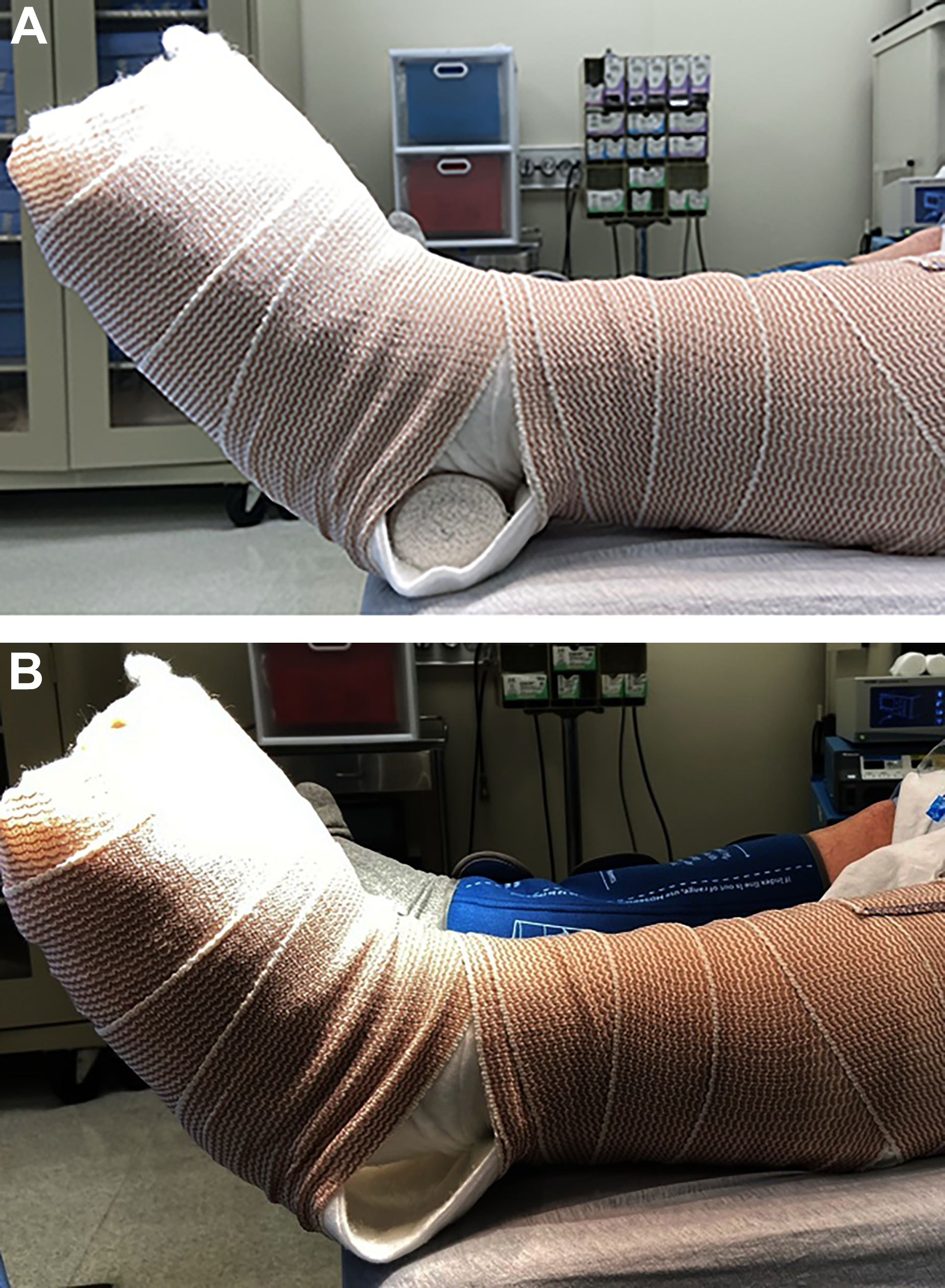
We have had positive experiences with the heel offloading posterior splint (HOPS). The HOPS is a posterior splint applied in a normal fashion but with offloading of the ulceration site. This is accomplished during the creation of the splint by applying padding, such as a roll of cast padding over the ulceration while the splint hardens. After the splint has sufficiently hardened, this extra padding is removed, creating an offloading pocket for the ulceration [
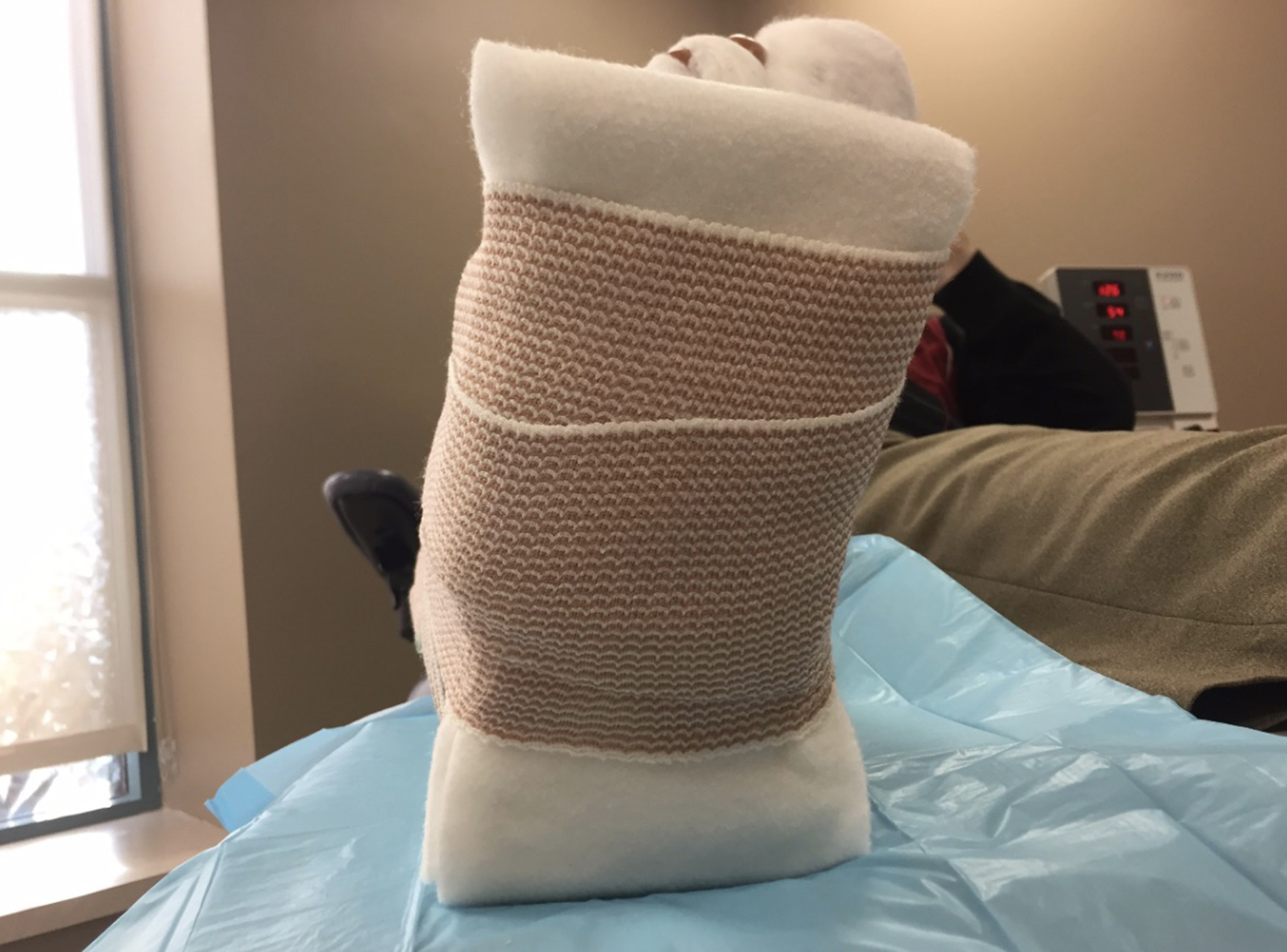
4]. Rather than pressure being applied to a single area at the heel ulceration site, pressure is distributed throughout the foot and calf. Our method differs from previously described splints, as we describe a method in which external or internal rotation of patient’s foot position can be accounted for.
The HOPS has multiple benefits. The splint is custom fitted to the patient, which reduces issues with sizing of an offloading boot. The location of posterior offloading can be controlled by placing padding over the ulceration while the splint is formed (
Fig. 1). In patients with external or internal rotation, the splint can be modified to prevent such rotation by crimping the corners of the splint at the heel to keep the foot in a rectus position and keeping the splint flat against the bed (
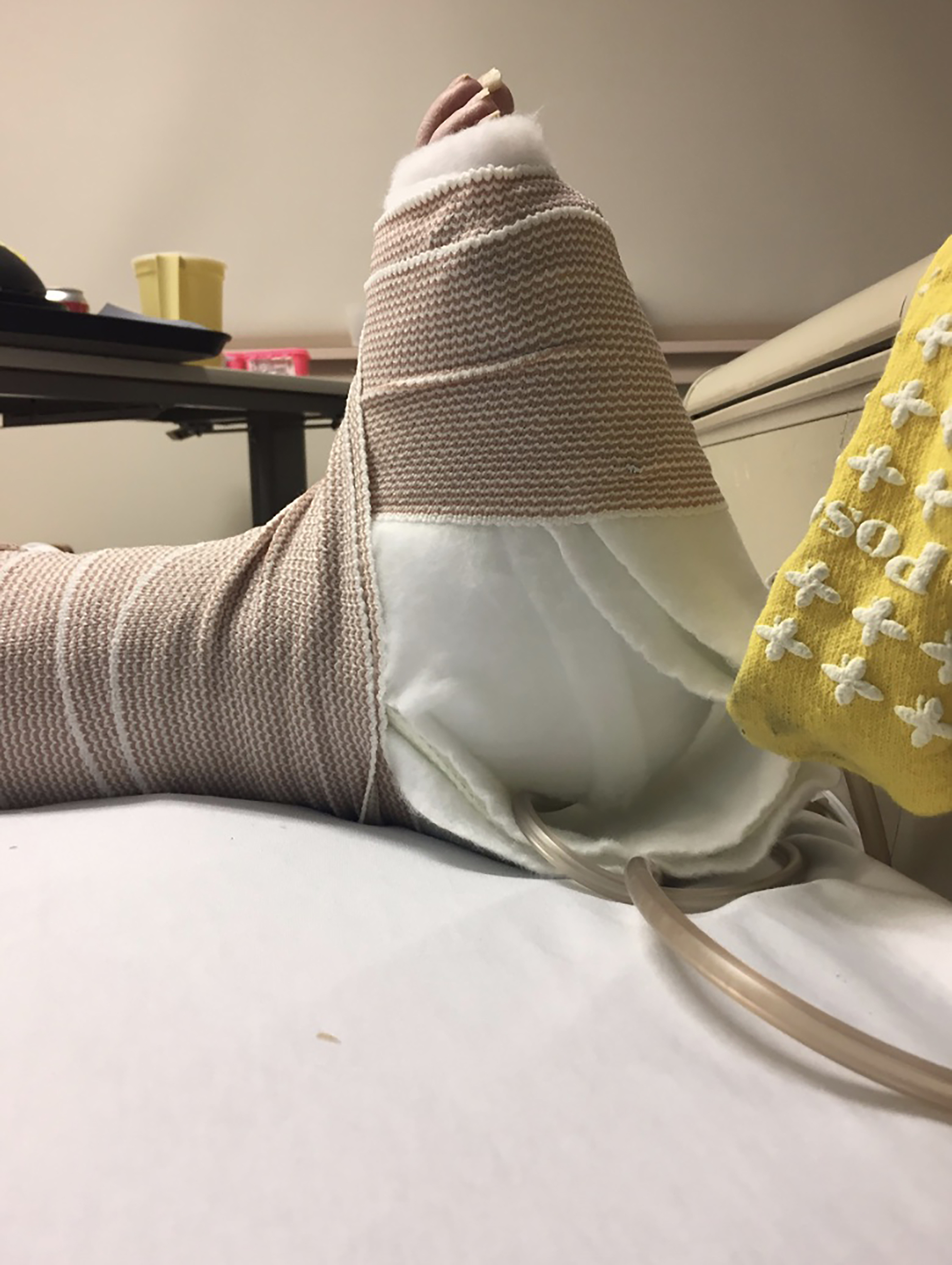
Fig. 2). Posterior splints are readily available in hospitals and clinics, are easy to apply, with doctors and ancillary staff already familiar with their application. The splint can be used in conjunction with negative pressure wound therapy devices and advanced tissue grafts (
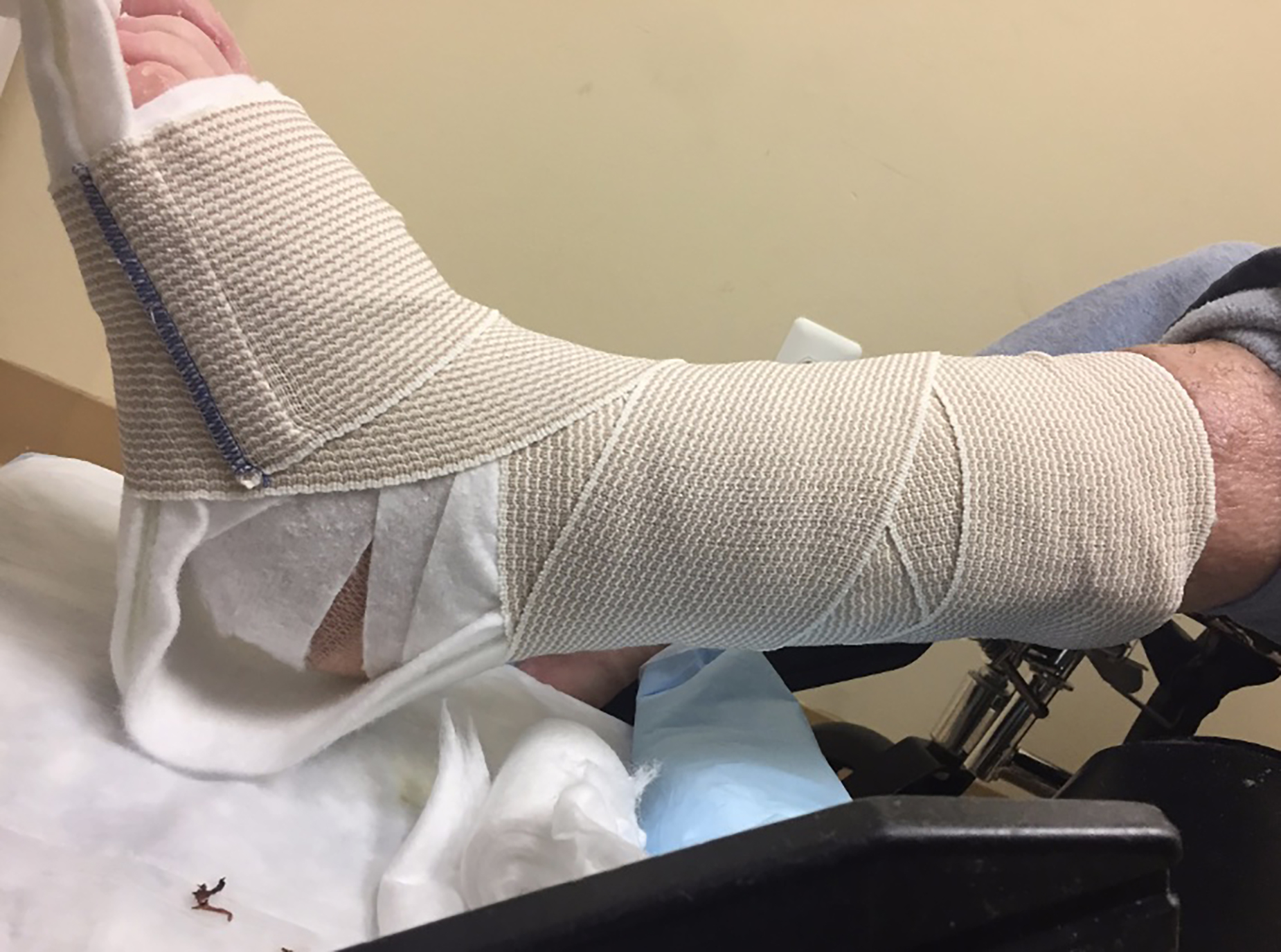
Fig. 3). The splint can also be used to protect infected ulcerations and osteomyelitis. Once created, the device can easily be removed by home nursing staff for dressing changes. This device is ideal for wheelchair-bound patients who rest their heel on the wheelchair or ground throughout the day (
Fig. 4). The splint can be applied in the operating room, which ensures compliance after surgery and eliminates the economic burden of obtaining a pressure relief ankle foot orthosis device.
Figure 1.
A, Padding placed at the heel. B, Padding is removed once the posterior splint is hardened.
Figure 1.
A, Padding placed at the heel. B, Padding is removed once the posterior splint is hardened.
Figure 2.
Heel offloading posterior splint (HOPS) used to prevent external rotation. By using a wider splint and keeping the splint flat at the angle, external and internal rotation can be prevented.
Figure 2.
Heel offloading posterior splint (HOPS) used to prevent external rotation. By using a wider splint and keeping the splint flat at the angle, external and internal rotation can be prevented.
Figure 3.
Heel offloading posterior splint (HOPS) used in a nonweightbearing patient with negative pressure wound therapy device following partial calcanectomy.
Figure 3.
Heel offloading posterior splint (HOPS) used in a nonweightbearing patient with negative pressure wound therapy device following partial calcanectomy.
Figure 4.
Heel offloading posterior splint HOPS used in a wheelchair-bound patient with a heel decubitus ulceration.
Figure 4.
Heel offloading posterior splint HOPS used in a wheelchair-bound patient with a heel decubitus ulceration.
The use of TCC for heel ulcers has been questioned. One study showed a 20% increase in pressure at the heel during gait in a TCC, which has led to hesitation using TCC with heel ulcers [
5]. In comparison to the total contact cast, the HOPS allows open access to the heel after application, which allows the medical staff to check that the ulceration is appropriately offloaded. The HOPS should also decrease iatrogenic complications. Some common complications of TCC include new ulcerations, maceration, and anterior leg abrasions [
6]. We expect fewer problems with new heel, malleolus, and toe ulcers due to less contact with rigid cast material; fewer complications from maceration due to more open construction; and fewer anterior leg abrasions as no hard material contacts the anterior leg. Because the HOPS can decrease pressure at the heel, it is logical to anticipate the method to positively aid in treatment, regardless of size and pressure ulcer grade [
7]. The HOPS, theoretically, should have fewer complications than TCC, especially when used in nonweightbearing patients.
The major limitation is that posterior splints are limited to patients who are nonweightbearing. Another limitation is that the splint likely has a shorter lifespan than a PRAFO. Although we have not observed iatrogenic ulcerations from using a posterior splint, theoretically this could place excess pressure on the Achilles tendon and develop an ulceration over the midsubstance of the tendon. There is also still a risk of contralateral limb abrasion.
Application of the splint for heel ulcers is similar to application of a splint for any other indication. A dressing of the physician’s choice can first be applied to the ulceration, including a negative pressure wound therapy device or cellular and/or tissue-based products for wounds. The leg and foot are then padded using cast padding. The posterior splint is then measured to size, accounting for extra material for the heel offloading portion. During application, any nearby material can be applied over the ulceration to offload the splint while the splint is drying. Common choices include extra rolls of cast padding or extra negative pressure wound therapy device sponge. The splint is then applied and wrapped with elastic bandage wrap. After the splint has sufficiently hardened, the extra material is removed from the offloaded area. Subsequent dressing changes do not necessitate a new posterior splint.
Conclusions
The optimal offloading device should be cost effective, accessible, time friendly, and easy to apply with minimal staff training. The HOPS accomplishes all of these and can help nonweightbearing patients heal ulcerations, prevent infection, and preserve limbs. We hope that this introduction can lead to higher level of evidence studies to examine the HOPS as a viable offloading device for the appropriate patient.