Venous leg ulcers are a costly health problem that cause significant morbidity, have a poor prognosis, and are associated with high health-care costs worldwide. In the United States, it is estimated that the prevalence of venous leg ulcers is 600,000 annually, with the loss of 2,000,000 working days per year [
1]. The overall prognosis for venous leg ulcers is poor. Only 50% of venous leg ulcers are expected to heal after 4 months, with 20% of the ulcers remaining open after 2 years and 8% at 8 years [
2]. It is estimated that the annual US payer burden is
$14.9 billion for venous leg ulcers [
3]. Thus, venous leg ulcers require a swift and coordinated plan of action.
The current standard of care for venous leg ulcers includes sharp surgical debridement, well-timed revascularization, venous ablation, infection control, off-loading, and compression [
4]. Despite these efforts, closure rates for chronic wounds range from 21% to 35%, with high recurrence rates [
4].
Acute wounds normally heal and progress smoothly with four phases of wound healing: hemostasis, inflammation, proliferation, and remodeling [
5]. Chronic wounds begin the healing process similarly but may have prolonged inflammatory, proliferative, or remodeling phases [
5,
6]. This results in tissue fibrosis and nonhealing wounds [
5,
6]. The process of wound healing is complex, and each stage of wound healing has certain milestones to progress in normal healing. The hemostasis begins immediately and consists of vascular constriction, formation of a platelet thrombus, propagation of the coagulation cascade, termination of clotting, and removal of the clot by fibrinolysis [
7]. The inflammatory phase aims to create a clean wound bed for the basis of further repair mechanisms [
7]. The proliferative phase usually occurs 3 to 21 days after the injury process and consists of angiogenesis, granulation tissue production, collagen deposition, and epithelialization, with the primary outcome being to fill the wound defect [
7]. The final stage of wound healing is the maturation phase, which includes cross-linking, remodeling, and wound contraction [
7]. Once the wound is healed, a scar is left behind.
In chronic wounds, biofilm is a significant obstacle to overcome in effective wound care. Chronic wounds are more susceptible to biofilm formation than are acute wounds. Previous studies have shown that 60% of chronic wounds contain biofilm, whereas only 6% of acute wounds contain biofilm in tissue samples [
8]. Biofilm can be defined as a microbial colony encased in a polysaccharide matrix that can become attached to a wound surface [
9]. Biofilms are regulated by a quorum-sensing system and a cell density–dependent gene expression mechanism that can protect the cells from antibiotics, antiseptics, and host immunity [
10]. Biofilms can also release planktonic bacteria, causing a persistent infection [
10]. Thus, removing biofilm is both difficult and integral. Strategies to remove biofilm without destroying the surrounding healthy tissue are constantly evolving.
Recently, debridement using ultrasonic waves was introduced as a new method for treating chronic wounds. Ultrasonic debridement devices work through acoustic streaming and cavitation. Acoustic streaming is a steady mechanical force delivered in fluid medium such as sterile saline [
11]. Cavitation is theorized to be the formation of gas bubbles in the fluid creating micro-shockwaves [
11]. This phenomenon is known to affect diffusion rate and membrane permeability and together “excites” or upregulates the whole cell [
12]. Ultrasonic debridement is thought to have clinical effects, including debridement of nonviable material, destruction of bacteria, and an ulcer-healing stimulator effect [
11]. Ultrasound systems can vary in frequency of signal transmission from the tip of the device in intensity or dosage, pulsed versus continuous delivery system, and contact versus noncontact with the tissue [
12]. Biofilm on the wound surface is affected depending on the frequency/power of ultrasound, fragmentation of the adherent necrotic fibrin, loose slough, and fragmentation of bacteria on the surface [
12,
13]. With contact ultrasound and irrigation, the ultrasound energy is delivered to the wound site and converts electrical signals to mechanical vibrations at the probe, causing disruption and fragmentation via cavitation and microstreaming [
12]. Once biofilm is removed and the wound bed is adequately prepared, human skin allografts and biological wound dressings may aid in healing.
TheraSkin (LifeNet Health, Virginia Beach, Virginia) is a cryopreserved split-thickness allograft produced from donated human skin [
14]. It is indicated for diabetic foot ulcers, venous leg ulcers, pressure ulcers, surgical dehiscence, necrotizing fasciitis, traumatic burns, and radiation burns [
15]. Human skin allografts have been used for decades, but improvements in the processing of cryopreserved human skin allografts have raised the standard by preserving the native structure and content [
14]. TheraSkin is different from acellular products from human skin that are decellularized. The decellularization process removes native growth factors and cytokines, and induces collagen scaffold cross-linking [
16].
This study highlights the use of tissue selective ultrasonic debridement combined with cryopreserved human skin allograft to successfully heal a chronic wound. Ultrasonic debridement and cryopreserved human skin allograft have been documented in the literature individually. This case presents the first reported use of operative debridement with the SonicOne device (Misonix Inc, Farmingdale, New York), and application of TheraSkin graft has not been documented in the literature.
Case Report
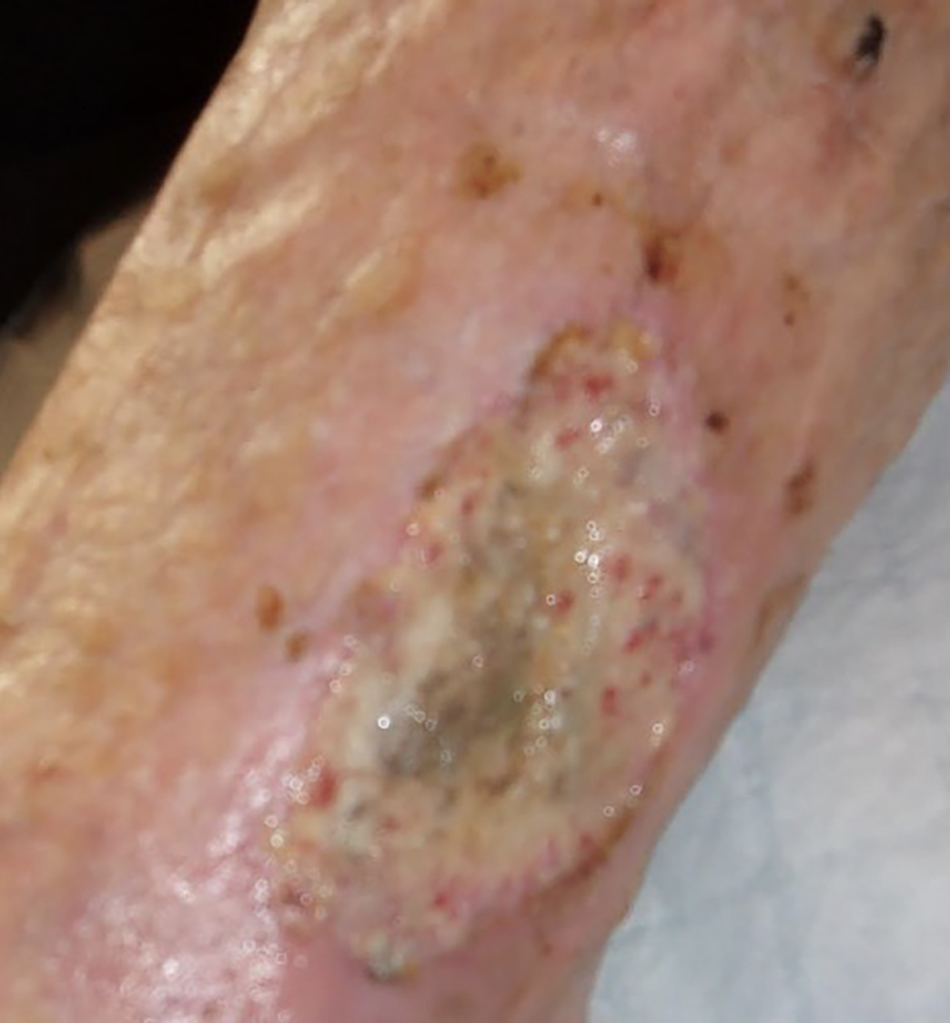
An 89-year-old woman with a history of hypertension, hyperlipidemia, gastroesophageal reflux disease, and chronic venous insufficiency presented with an ulcer that measured 6.4 × 4.6 × 0.1 cm at the lateral distal left leg (
Fig. 1). The wound was just proximal to the lateral malleolus and extended through the level of the subcutaneous tissue with fibrous slough. The wound had surrounding erythema. There was serous drainage from the wound, with no malodor. The wound did not probe to bone, tunnel, or undermine. She had 2+ pitting edema to the left leg and inflamed varicosities to the left leg. A multilayer compression dressing was used to reduce the edema and control the underlying venous disease. The patient was prescribed levofloxacin 500 mg due to suspected pseudomonal infection.
Figure 1.
Lateral wounds of the distal left leg, which were the patient’s first wounds. February 19, 2021.
Figure 1.
Lateral wounds of the distal left leg, which were the patient’s first wounds. February 19, 2021.
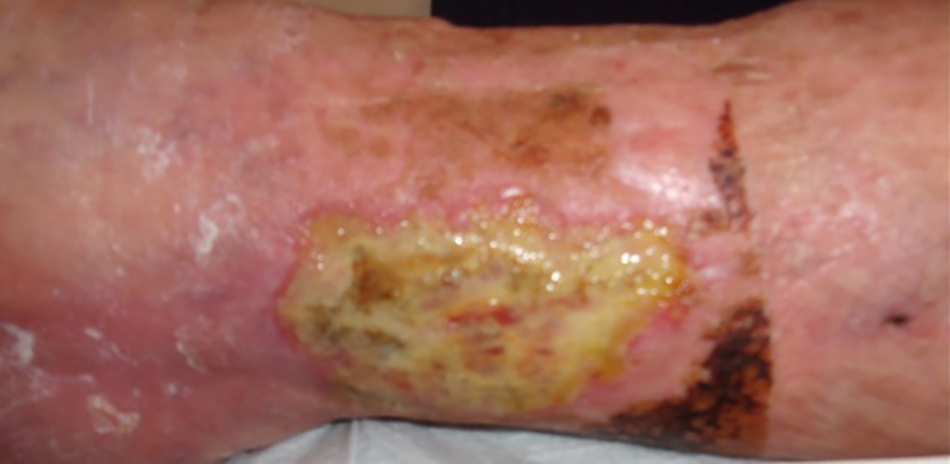
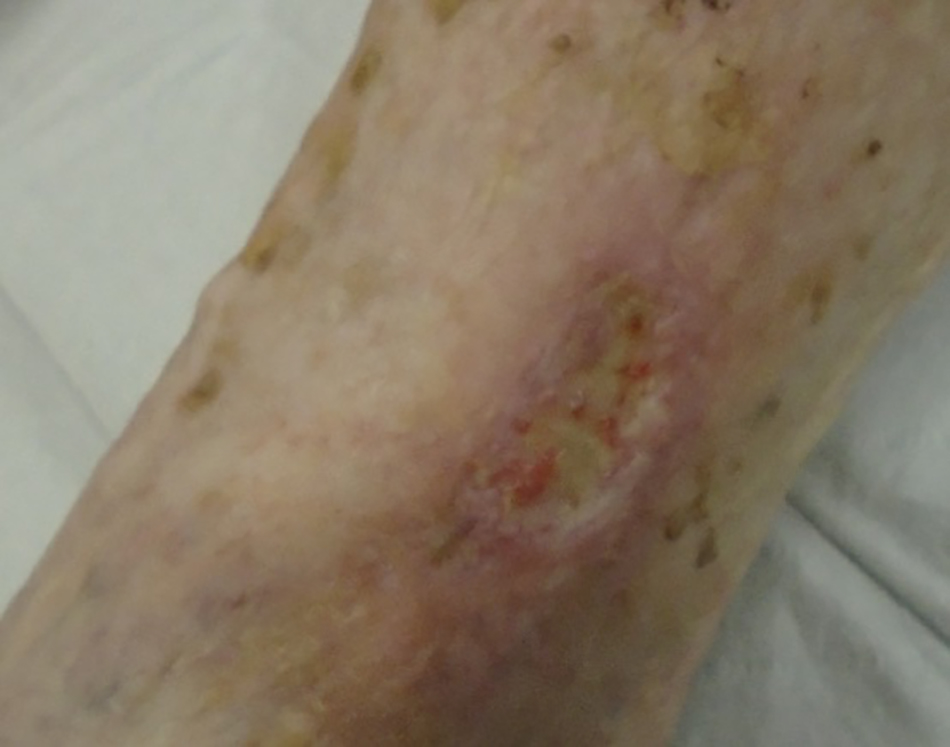
Treatment included weekly debridement at the wound care center with application of a multilayer compressive dressing consisting of a sterile enzymatic debriding ointment (Collagenase SANTYL Ointment; Smith+Nephew, Fort Worth, Texas), topical gentamycin, Cutimed Sorbact (BSN Medical, Charlotte, North Carolina), Drawtex (SteadMed, Fort Worth, Texas), abdominal pads, and nonsterile self-adherent elastic compression wrap (Coban; 3M, St. Paul, Minnesota). Elevation of the left leg was encouraged to reduce edema. She eventually refused multilayer compression and debridement due to pain. Treatment was continued for 1 month. There was no improvement in the wound, with persistent pain to the left leg (
Fig. 2). At this point, it was recommended that the patient undergo surgical debridement in the operating room under anesthesia with application of a biological graft.
Figure 2.
No improvements noted. March 12, 2021.
Figure 2.
No improvements noted. March 12, 2021.
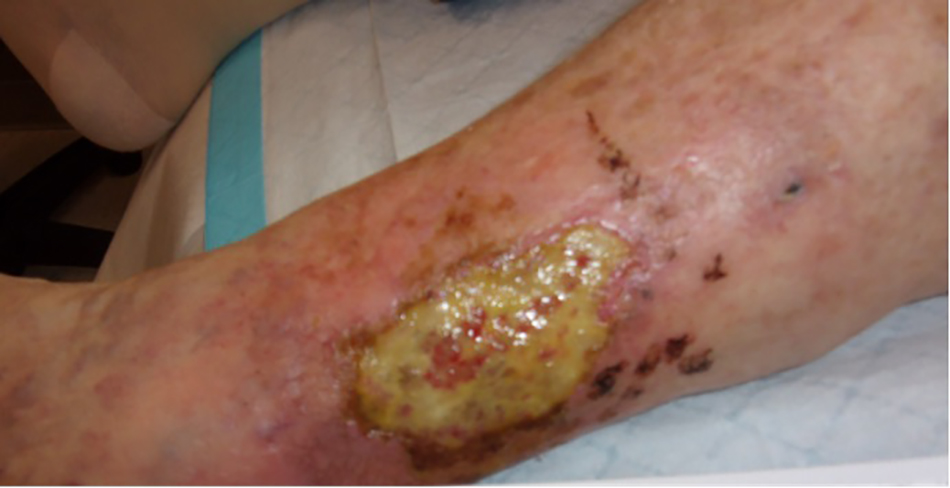
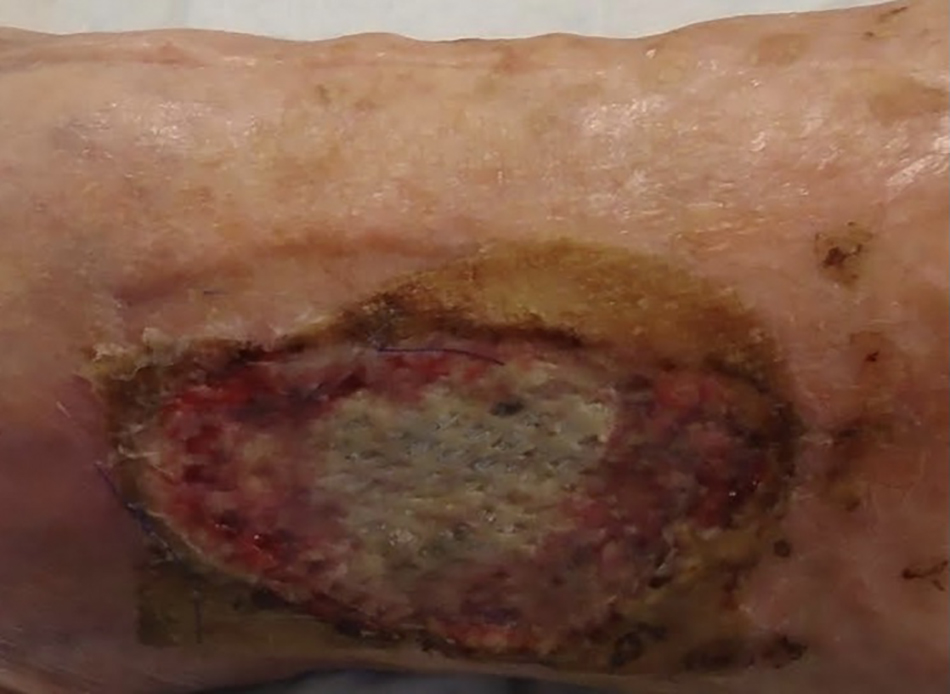
Operative findings included thick yellow fibrotic material across the wound bed. The ulceration measured 6 × 3.0 × 0.2 cm. Ultrasonic debridement was used to excisionally debride the ulceration down through the level of the subcutaneous tissue. The postexcisional debridement measurement was 7 × 3.5 × 0.3 cm. Due to the depth, a TheraSkin graft was applied to the area, which was secured in place with sutures (
Fig. 3). Dressing was applied with Adaptic (3M), 4 × 4 gauze, abdominal gauze pads, Webril, and Coban.
Figure 3.
Immediately after operating room visit. March 17, 2021.
Figure 3.
Immediately after operating room visit. March 17, 2021.
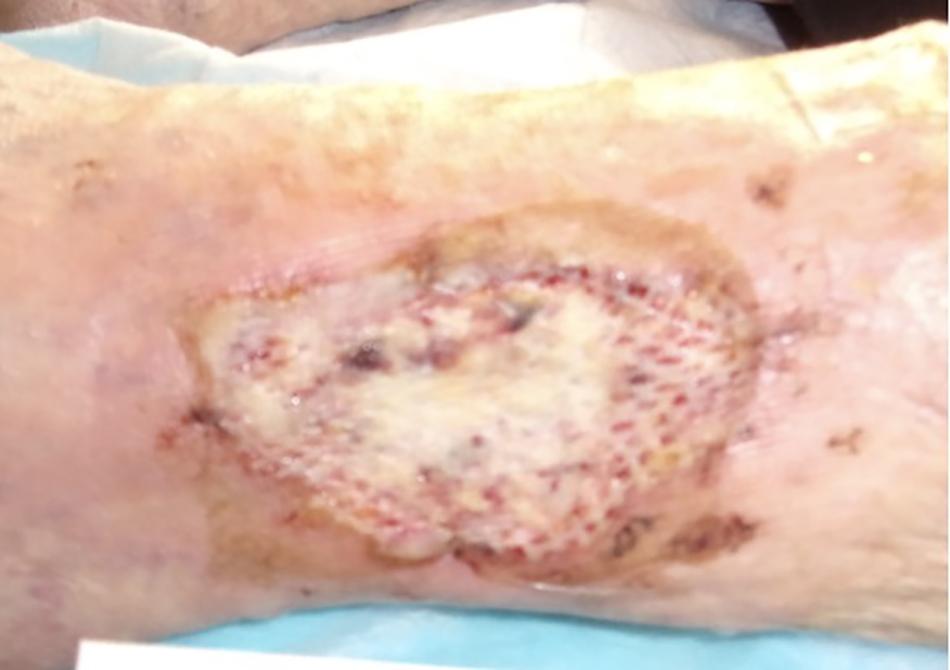
She continued to follow up at the wound care center with continued treatment. Two weeks postoperatively, the graft was removed and the wound was debrided (
Fig. 4). Four weeks later, a TheraSkin graft was reapplied to the wound (
Fig. 5). Three more applications of TheraSkin grafts were performed. The wound continued to decrease in size with continued treatment of debridement and multilayer compression (
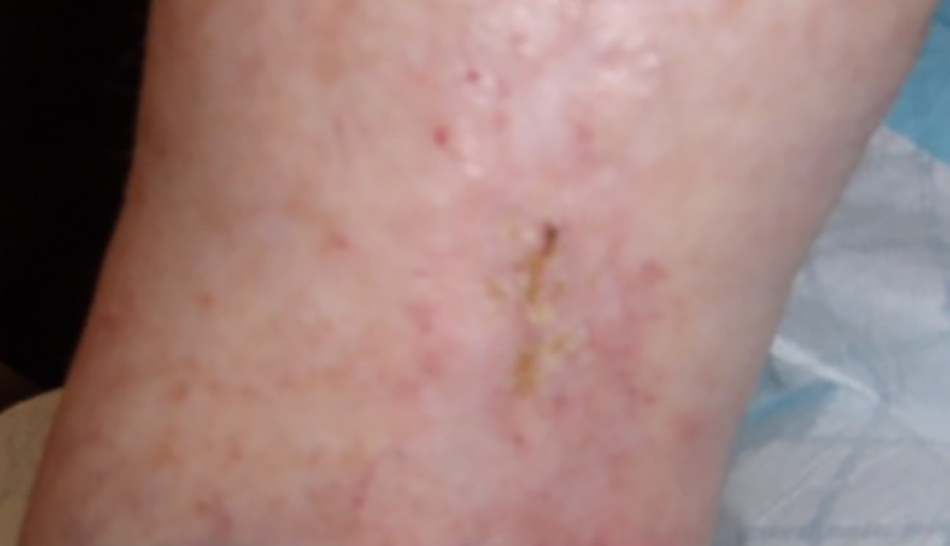
Fig. 6). Ten months after her initial visit, the wound was fully epithelialized (
Fig. 7).
Figure 4.
Two weeks postoperatively. April 2, 2021.
Figure 4.
Two weeks postoperatively. April 2, 2021.
Figure 5.
Presentation before TheraSkin was reapplied to the wound. April 30, 2021.
Figure 5.
Presentation before TheraSkin was reapplied to the wound. April 30, 2021.
Figure 6.
Wound continued to decrease in size. August 20, 2021.
Figure 6.
Wound continued to decrease in size. August 20, 2021.
Figure 7.
Full healing. December 17, 2021.
Figure 7.
Full healing. December 17, 2021.
Discussion
Lower-limb chronic ulceration is a frequently occurring disease. Venous leg ulcers are the most common wounds seen in patients [
17]. An important aspect of treating ulcers is to assess for infection and biofilm. Local care is the first step in the treatment of ulcers. Key elements to treatment include debridement of biofilm, elimination of serous infection, and moisture balance [
17]. Wound dressing selection is a very debated, but critical, part of treatment. The main treatment is compression application [
18]. The present patient presented with a venous wound at the lateral distal left leg. The wound showed clinical signs of infection and biofilm present. The patient was prescribed antibiotics for infection control, and multilayer compression was applied to reduce edema. In this specific case report, Coban was used. The compression allowed for waste product removal, decreased venous hypertension, increased arterial perfusion, and increased nutrient and oxygen delivery.
Debridement is considered a key element of wound healing and can be defined as the removal of nonviable material, foreign bodies, and poorly healing tissue from wounds [
19]. Although there are many methods of debridement, we initially started with sharp debridement and chemical debridement. The aim of the weekly debridements was removal of nonviable tissue and slough to reduce biofilm and enhance healing. The wound dressing of choice was Collagenase SANTYL Ointment, topical gentamycin, Cutimed Sorbact, Drawtex, abdominal pads, and Coban. Collagenase SANTYL Ointment contains enzymes to remove dead tissue and promote healing. Topical gentamicin was used due to signs of infection. Cutimed Sorbact is a bacteria-binding dressing, and Drawtex was used to manage wound exudate. In the present case, the patient noted pain and refused debridement. Without improvement for 1 month, ultrasonic debridement in the operating room was recommended.
The clinical effects of ultrasonic debridement as mentioned previously herein include debridement, a bactericidal effect, and an ulcer-healing stimulator effect [
11]. Several studies have compared ultrasonic debridement and sharp debridement. In a randomized, prospective, controlled trial, Alvarez et al [
20] showed that wound debridement for venous wounds with ultrasound healed faster and involved fewer procedures than sharp debridement. Other authors concluded that ultrasonic debridement is quick, painless, and clinically effective, and that a subgroup of wounds will go on to complete healing without the need for additional treatments [
21]. The goal with ultrasonic debridement was to disrupt biofilm. Once biofilm has been removed, wounds are still difficult to close by primary intention. When considering ultrasonic debridement, a wound closure plan should be highly examined. In the present study, we planned for multiple applications of grafts, specifically, TheraSkin.
The present case included debridement of an infected wound that was considered slow healing. We performed ultrasonic debridement and placement of graft. This allowed for an excellent source of wound bed preparation before placement of the graft. We decided to use TheraSkin owing to it being minimally manipulated, maintaining the natural extracellular matrices, native growth factors, and viable cells. In addition, the graft contains biological active products and viable cells that accelerate wound healing through generating growth factors and cytokines [
22]. Multiple applications of TheraSkin were used. The wound continued to decrease in size and eventually healed.
The present case report is the only reported case in the literature that we found in which the use of tissue selective ultrasonic debridement combined with cryopreserved human skin allograft successfully healed a chronic wound. We believe that this method can improve clinical efficacy and promote healing of chronic ulcerations. The results of this study are promising to wound healing and warrant further studies.
Conclusions
Venous leg ulcers are challenging and costly to treat. Wounds often become colonized with biofilm, inhibiting their ability to heal. Persistent pain may preclude the ability to perform debridement without anesthesia. Tissue selective ultrasonic debridement is one tool available to remove biofilm and prepare wounds for application of advanced tissues to optimize wound healing.