Next Article in Journal
Cross-Screw Fixation in Isolated Medial Malleolar Fractures
Previous Article in Journal
Management of Children with Megafoot Secondary to Proteus Syndrome: A Report of Three Cases with Long-Term Follow-Up
 
 
Journal of the American Podiatric Medical Association is published by MDPI from Volume 116 Issue 1 (2026). Previous articles were published by another publisher in Open Access under a CC-BY (or CC-BY-NC-ND) licence, and they are hosted by MDPI on mdpi.com as a courtesy and upon agreement with American Podiatric Medical Association.
Article

Antifungal Activity of Efinaconazole Compared with Fluconazole, Itraconazole, and Terbinafine Against Terbinafine- and Itraconazole-Resistant/Susceptible Clinical Isolates of Dermatophytes, Candida, and Molds

by
Ahmed Gamal
1,
Mohammed Elshaer
1,2,
Lisa Long
1,
Thomas S. McCormick
1,
Boni Elewski
3 and
Mahmoud A. Ghannoum
1,4,*
1
Center for Medical Mycology, and Integrated Microbiome Core, Department of Dermatology, Case Western Reserve University, Cleveland, OH
2
Clinical Pathology Department, Mansoura University Faculty of Medicine, Mansoura, Egypt
3
Department of Dermatology, University of Birmingham, Birmingham, AL
4
University Hospitals Cleveland Medical Center, Cleveland, OH
*
Author to whom correspondence should be addressed.
J. Am. Podiatr. Med. Assoc. 2024, 114(5), 22132; https://doi.org/10.7547/22-132
Published: 1 September 2024

Abstract

Background: Recently, an increasing number of resistant-to-terbinafine dermatophytosis cases have been reported. Thus, identifying an alternative antifungal agent that possesses broad-spectrum activity, including against resistant strains, is needed. Methods: We compared the antifungal activity of efinaconazole with that of fluconazole, itracona-zole, and terbinafine against clinical isolates of dermatophytes, Candida, and molds using in vitro assays. Minimum inhibitory concentration (MIC) and minimum fungicidal concentration (MFC) of each antifungal agent were quantified and compared. Susceptible and resistant clinical isolates of Trichophyton mentagrophytes (n = 16), Trichophyton rubrum (n = 43), Trichophyton tonsurans (n = 18), Trichophyton violaceum (n = 4), Candida albicans (n = 55), Candida auris (n = 30), Fusarium spp, Scedosporium spp, and Scopulariopsis spp (n = 15 for each) were tested. Results: Efinaconazole was the most active antifungal agent tested against dermatophytes, with MIC50 and MIC90 (concentrations that inhibited 50% and 90% of strains tested, respectively) values of 0.002 and 0.03 μg/mL, respectively. Fluconazole, itraconazole, and terbinafine showed MIC50 and MIC90 values of 1 and 8 μg/mL, 0.03 and 0.25 μg/mL, and 0.03 and 16 μg/mL, respectively. Against Candida isolates, efinaconazole MIC50 and MIC90 values were 0.016 and 0.25 μg/mL, respectively, whereas fluconazole, itraconazole, and terbinafine had MIC50 and MIC90 values of 1 and 16 μg/mL, 0.25 and 0.5 μg/mL, and 2 and 8 μg/mL, respectively. Against various mold species, efinaconazole MIC values ranged from 0.016 to 2 μg/mL versus 0.5 to greater than 64 μg/mL for the comparators. Conclusions: Efinaconazole showed superior potent activity against a broad panel of sus-ceptible and resistant dermatophyte, Candida, and mold isolates.

Superficial fungal infections are common and may involve the upper layer of the skin and/or its appendages, such as fingernails and toenails [1]. These infections may offer distinct clinical pre-sentations depending on the causative fungal spe-cies [2]. Dermatophytes mainly infect keratinized tissue and are the main cause of superficial fungal infections known as dermatophytosis [3]. Tricho-phyton rubrum is the most common species caus-ing dermatophytic infections [4]. Superficial fungal infections may also result from nondermatophytic fungi, including yeasts (eg, Candida albicans and non-albicans species such as Candida glabrata) and, less commonly, molds (eg, Scopulariopsis brevicaulis, Fusarium spp, and Aspergillus spp) [5,6,7].
Several factors play a significant role in treatment selection for superficial fungal infections. For example, localized infections are more likely to be treated with topical antifungal preparations such as azoles and ciclopirox [8]. Widespread and deep infec-tions (ie, infections extending into follicles or the dermis) are less likely to respond to topical treat-ments [8] and often require oral drugs such as terbina-fine, itraconazole, fluconazole, or griseofulvin [9]. The selection of an antifungal agent depends on the type and susceptibility pattern of the organism(s) cul-tured from the infected site [10,11,12].
Increasing resistance to commonly prescribed antifungal agents has become a challenging issue that physicians often encounter [13]. Such resistance has been observed in various fungal groups, includ-ing yeasts and molds [12,14,15,16], prompting the Centers for Disease Control and Prevention to issue a warn-ing regarding the alarming trend of resistance to commonly available antifungal agents [17]. This con-cern increased after the isolation of Candida auris, an emerging multidrug-resistant Candida species that demonstrated multidrug- as well as pan-resist-ance to different classes of marketed antifungal drugs [18,19].
In addition to C auris, there has been a reported increase in resistance to terbinafine and azoles among dermatophytes [20,21,22,23,24]. For example, in India, dermato-phytosis outbreaks resulting from resistant strains have been reported in numerous areas, and it has been categorized as an epidemic [25,26,27,28,29]. Although uncommon, resistance has also been increasing in frequency in the United States and demonstrates resistance to oral terbinafine or second-line systemic therapies (oral fluconazole or itraconazole) [30].
Efinaconazole is a triazole that inhibits fungal la-nosterol 14a-demethylase, thereby decreasing bio-synthesis of ergosterol [31]. Efinaconazole was first approved by the US Food and Drug Administration in 2014 as a topical treatment for onychomycosis caused by T rubrum and Trichophyton mentagro-phytes [32]. It has been previously reported that differ-ent azoles exhibit variable rates of lanosterol 14a-demethylase inhibition as shown by lower ergos-terol content in Candida cells in the presence of voriconazole compared with fluconazole [33]. We hypothesized that efinaconazole may be effective against isolates with known resistance against itra-conazole or terbinafine.
In this study, we compared the antifungal activ-ity of efinaconazole with that of fluconazole, itra-conazole, and terbinafine using terbinafine- and itraconazole-resistant and -susceptible dermato-phyte, yeast, and mold clinical isolates.

Materials and Methods

Fungal Species Tested

The following susceptible and resistant fungal strains were used in this study: the dermatophyte species T mentagrophytes (n = 16), T rubrum (n = 43), Trichophyton tonsurans (n = 18), and Trichophyton violaceum (n = 4); the yeast species C albicans (n = 55) and C auris (n = 30); and nondermatophyte mold Fusarium (n = 15), Scedosporium (n = 15), and Scopulariopsis (n = 15) spp.

Antifungal Agents

Four antifungal agents were evaluated: efinacona-zole, fluconazole, itraconazole, and terbinafine. Efinaconazole was provided by Bausch Health Pharmaceutical Co (Laval, Quebec, Canada). Fluco-nazole, itraconazole, and terbinafine were purchased from Sigma-Aldrich (St. Louis, Missouri).

Minimum Inhibitory Concentration

Minimum inhibitory concentration (MIC) testing was performed according to the Clinical and Laboratory Standards Institute microdilution meth-ods for yeasts (document M27Ed4E) and for derma-tophytes and nondermatophyte molds (document M38Ed3) [34,35]. Antifungal agents were dissolved in dimethyl sulfoxide (Sigma-Aldrich), and twofold se-rial dilutions were prepared in RPMI 1640 (Hardy Diagnostics, Santa Maria, California) and added to the wells of a 96-well microdilution plate. The inoc-ulate for dermatophytes, nondermatophyte molds, and yeasts were prepared in RPMI 1640 to concentra-tions of 1 to 3 × 10³, 0.4 to 5 × 10⁴, and 0.5 to 2.5 × 10³ colony-forming units (CFUs)/mL, respectively, and added to the drug dilutions in a 96-well plate. The MIC microdilution plates for dermatophytes, nonder-matophyte molds, and yeasts were incubated at 35˚C for 24, 48, and 96 hours, respectively. The MIC end point for dermatophytes was the lowest concentra-tion of antifungal exhibiting an 80% reduction in growth compared with the untreated growth control. The MIC end points for nondermatophyte molds and yeasts were recorded at 50% inhibition compared with growth control, except itraconazole versus molds, where the end point was 100% inhibition. The quality control isolates Candida parapsilosis (ATCC22019) and Candida krusei (ATCC 6258) were tested in parallel for each test series.

Minimum Fungicidal Concentration

Minimum fungicidal concentration (MFC) determi-nations were performed according to the method previously described by Isham and Ghannoum [36]. The total contents of each well showing no visible growth during the MIC assay were subcultured onto potato dextrose agar plates. To avoid antifungal car-ryover, the aliquots were allowed to soak into the agar, and the agar surface was streaked for isolation once dry, thus removing the cells from the drug source. Inoculated plates were then incubated at 35 °C for 24 hours for yeasts, 48 to 72 hours for molds, and 96 hours for dermatophytes. The number of CFUs was then determined. Fungicidal activity was defined as a 99.9% or more reduction in the number of CFUs per milliliter from the starting inoculum count. Fungistatic activity was defined as a less than 99.9% reduction.

Results

Activity of Antifungals Against Dermatophytes

Against combined dermatophyte isolates (n = 81), efinaconazole was the most potent antifungal agent, with MIC50 and MIC90 (concentrations that inhibited 50% and 90% of strains tested, respectively) values of 0.002 and 0.03 μg/mL, respectively. Fluconazole showed MIC50 and MIC90 values of 1 and 8 μg/mL, respectively, and the MIC50 and MIC90 values for itraconazole and terbinafine were 0.03 and 0.25 μg/mL and 0.03 and 16 μg/mL, respectively (Table 1).
In the present study, 27 dermatophyte isolates (22 T rubrum, four T mentagrophytes, and one T ton-surans) showed elevated MIC values against terbi-nafine, with a range of 0.5 to greater than 64 μg/mL, MIC50 value of 4 μg/mL, and MIC90 value of 32 μg/mL. Against these isolates, efinaconazole showed more potent activity compared with the other tested drugs, with an MIC range of 0.001 or less to 0.25 μg/mL, MIC50 value of 0.002 μg/mL, and MIC90 value of 0.03 μg/mL. For itraconazole and fluconazole, MIC50 and MIC90 values were 0.03 and 0.25 μg/mL and 0.5 and 8 μg/mL, respectively (Table 2).

Activity of Antifungals Against Yeasts

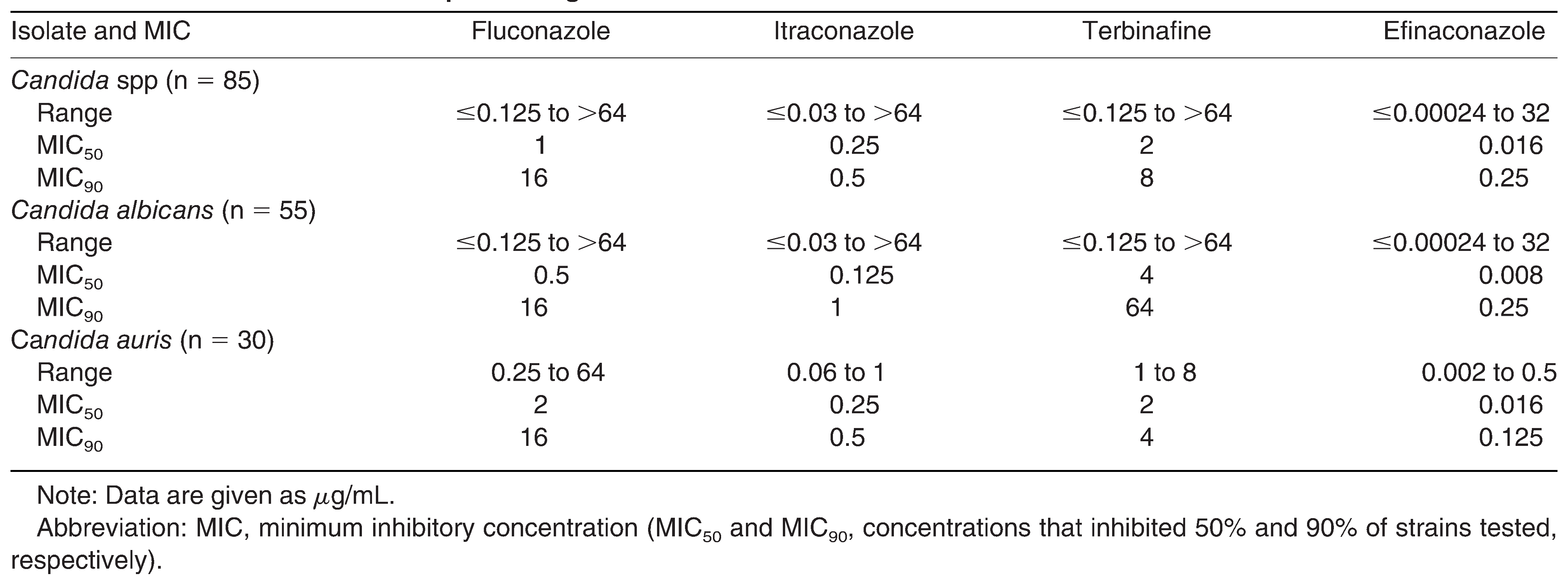
The MICs of the test compounds against Candida species are summarized in Table 3. The MIC50 and MIC90 values were 0.016 and 0.25 μg/mL, respec-tively for efinaconazole. The MIC50 and MIC90 values for fluconazole were 1 and 16 μg/mL, for itracona-zole were 0.25 and 0.5 μg/mL, and for terbinafine were 2 and 8 μg/mL, respectively. Interestingly, efi-naconazole was the most effective agent against C auris isolates tested in this study.
In the present study, four C albicans isolates had markedly elevated MICs when tested against terbi-nafine (range, 16 to .64 μg/mL), whereas efinaco-nazole had higher activity against the same isolates, with an MIC range of 0.008 to 2 μg/mL (Table 4). Furthermore, four isolates (C albicans and C auris) had an MIC range of 1 to greater than 64 μg/mL against itraconazole compared with a range of 0.5 to 32 μg/mL against efinaconazole. Finally, three C albicans isolates that exhibited elevated MIC val-ues against both terbinafine and itraconazole were more susceptible to efinaconazole (Table 4).

Activity of Antifungals Against Molds

Table 5 shows the antifungal activity against differ-ent types of molds. The MIC50 and MIC90 values for efinaconazole against Scedosporium, Fusarium, and Scopulariopsis spp were 0.06 and 0.125 μg/mL, 0.5 and 2 μg/mL, and 0.125 and 0.25 μg/mL, respec-tively. Furthermore, the MIC50 and MIC90 values for fluconazole against Scedosporium, Fusarium, and Scopulariopsis spp were 16 and 64 μg/mL, greater than 64 and greater than 64 μg/mL, and 64 and greater than 64 μg/mL, respectively.
Although, the MIC50 and MIC90 values for terbina-fine were elevated against Scedosporium spp (.64 μg/mL for both) at the 72-hour incubation period, relatively lower values were seen against Fusarium and Scopulariopsis strains tested (2 and 16 μg/mL and 1 and 2 μg/mL, respectively) at the 48-hour incubation period (Table 5).

Fungicidal Activity of Tested Antifungals

These data show that in general, none of the tested compounds showed fungicidal activity against iso-lates from different species. However, efinacona-zole demonstrated more fungicidal activity against T rubrum isolates compared with other antifungal agents, with an MFC range of 0.002 to greater than 0.5 μg/mL and an MFC50 value of 0.5 μg/mL.

Discussion

Recently, reports of terbinafine-resistant infections have been trending up across the globe, especially from patients in India [37,38,39,40,41,42]. In the present study, efi-naconazole demonstrated the highest inhibitory ac-tivity against dermatophytes compared with other antifungal agents, including 27 isolates that had elevated MICs against terbinafine. The observed results support data reported by Hur et al [43] in which efinaconazole had similar or higher activity com-pared with terbinafine. Although efinaconazole and terbinafine showed the most potent effect against dermatophytes (T rubrum and T mentagrophyte) compared with the other agents, efinaconazole had higher activity against ten of 63 T rubrum and eight of 59 T mentagrophyte isolates compared with ter-binafine (MIC values of 0.0005–0.125 μg/mL versus $1 μg/mL) [43]. Similarly, Rezaei-Matehkolaei et al44 also showed that efinaconazole demonstrated com-parable antifungal activity against T rubrum (n = 54), with an MIC range of 0.002 to 0.06 μg/mL com-pared with 0.004 to 0.06 μg/mL for terbinafine.
In a detailed study of 1,387 T rubrum and 106 T mentagrophytes isolates obtained from patients with onychomycosis in the United States, Canada, and Japan, the MICs for efinaconazole against T rubrum and T mentagrophytes ranged from 0.002 or less to 0.03 μg/mL and from 0.002 or less to 0.06 μg/mL, respectively, compared with 0.004 to 0.06 μg/mL and 0.004 to 0.5 μg/mL, respectively, for ter-binafine [45]. In addition, itraconazole inhibited fungal growth at relatively higher MICs, ranging from 0.015 to 0.125 μg/mL for T rubrum and from 0.03 to 0.25 μg/mL for T mentagrophytes. Interestingly, comparing the susceptibility profiles of ten isolates before treatment with efinaconazole versus after therapy (48 weeks) was associated with a minimal increase in the MIC values (the greatest change was from #0.002 to 0.008 μg/mL). This finding may suggest that development of antifungal re-sistance is less likely to occur with prolonged efi-naconazole therapy [45].
We also tested the antifungal activity of efinaco-nazole against other nondermatophyte fungi impli-cated in superficial fungal infections (Candida and molds). Efinaconazole was the most active com-pound against Candida species compared with the other antifungal agents tested, including isolates with elevated MIC values against itraconazole and terbinafine. A similar observation was reported by Jo Siu et al [45], who tested efinaconazole activity against 105 C albicans isolates. Efinaconazole MICs ranged from less than 0.0005 to greater than 0.25 μg/mL, with 50% of isolates being inhibited by 0.001 μg/mL after 24 hours of incubation compared with 0.06 to greater than 16 and 0.004 or less to greater than 2 μg/mL for terbinafine and itraconazole, respectively [45]. Along the same lines, the data pro-vided by Hur et al [43] also showed that efinaconazole had a lower mean MIC value for efinaconazole com-pared with itraconazole, terbinafine, amorolfine, and ciclopirox (0.001 versus 0.015, 64.041, 73.640, and 3.254 μg/mL, respectively).
In the present study, four C albicans isolates dem-onstrated markedly elevated MIC values against terbi-nafine (range, 16 to .64 μg/mL), another four isolates had elevated MICs against itraconazole (MIC range, 1 to .64 μg/mL) [46], and three C albicans isolates exhib-ited reduced susceptibility against both agents (MIC range, 64 to .64 μg/mL and 1 to 4 μg/mL, respec-tively). Efinaconazole, on the other hand, had lower MIC values against all of the isolates that were more resistant to terbinafine, which is not surprising because terbinafine has been widely reported to ex-hibit suboptimal activity against different Candida spp. [47]. In addition, against isolates resistant to itraco-nazole, efinaconazole had higher inhibitory activity. Note that the MIC values of both agents (itraconazole versus efinaconazole) differed by only 1 to 3 microdi-lutions. Given that cross-resistance between different azoles has been reported, the observed results are reasonable [48,49].
The mechanism by which triazole members, such as efinaconazole and itraconazole, may exhibit dif-ferent efficacy against the same isolates is still being investigated. However, different theories have been proposed, including that different triazoles inhibit lanosterol 14a-demethylase (the targeted enzyme) activity to variable degrees [33]. Others sug-gested that differences in resistance are largely the result of decreased susceptibility of 14a-demethylase to the inhibitory effects of a given tri-azole (eg, fluconazole) [50].
An interesting observation in this study is that efi-naconazole exhibited high activity against the multi-drug-resistant species C auris compared with the other tested agents; C auris is reported to demon-strate resistance against a wide range of commer-cially available antifungal drugs [18]. Furthermore, several studies have reported that C auris can colo-nize the skin and act as a nidus of infection in hospi-tal settings [51,52,53,54]. Given these reports, exploring the potential role of efinaconazole in the treatment of resistant C auris is a worthwhile strategy.
Keeping in mind that molds can also cause super-ficial fungal infections [55], we tested the effect of efi-naconazole against three of the common mold species reported to affect the skin (Scedosporium, Fusarium, and Scopulariopsis) compared with other antifungal agents. Although all of the isolates exhibited reduced susceptibility against the tested antifungals, efinaconazole had the highest antifun-gal activity. In agreement with this observation, in an additional study that included 21 Fusarium spe-cies, efinaconazole demonstrated an inhibitory effect at a concentration ranging from 0.03 to 2 μg/mL. On the other hand, itraconazole did not sup-press the growth of Fusarium, as indicated by an MIC range of 16 to greater than 32 μg/mL [45,55].
Note that the present results were generated using 50% growth inhibition as an end point because 100% cidal activity was not observed. However, although there was a difference in end point inhibi-tion between this study and previous reports (ie, 50% versus 100%), the present data demonstrate that efinaconazole has more potent in vitro activity against Fusarium spp compared with itraconazole and terbinafine.
Finally, it is important to mention that the data generated in this study were based on in vitro experiments. Thus, investigating the effect of efi-naconazole in the in vivo setting and in human sub-jects will provide more insight into the clinical activity of this antifungal agent.

Conclusions

Efinaconazole demonstrated high in vitro activity against a wide range of dermatophytes and nonder-matophyte (ie, mold and yeast) organisms commonly implicated in onychomycosis and tinea infections. Increased activity against a variety of isolates that exhibited elevated MIC values against terbinafine and itraconazole was observed, suggesting that efinaconazole may be a more efficacious treatment for more resistant organisms. In this same manner, efinaconazole has also shown good activity against C auris, where a large percentage of strains are known to exhibit high levels of resistance to anti-fungal treatments, warranting further investigation of efinaconazole as a potential therapeutic candi-date for C auris.

Funding

This project was partially supported by a contract with Bausch Health Companies Inc. The sponsors had no role in the design and conduct of the study; in the collection, analysis, and interpretation of the data; or in the preparation, review, or approval of the manuscript.

Conflicts of Interest

Dr. Ghannoum has received a research contract from and acted as an adviser for Bausch Health Companies Inc.

References

  1. WEITZMAN I, SUMMERBELL RC: The dermatophytes. Clin Microbiol Rev 8: 240, 1995.
  2. METIN A, DILEK N, DEMIRSEVEN DD: Fungal infections of the folds (intertriginous areas). Clin Dermatol 33: 437, 2015.
  3. KHURANA A, SARDANA K, CHOWDHARY A: Antifungal resist-ance in dermatophytes: recent trends and therapeutic implications. Fungal Genet Biol 132: 103255, 2019.
  4. ALY R: “Microbial Infections of Skin and Nails,” in Medical Microbiology, 4th Ed, ed by S Baron, University of Texas Medical Branch at Galveston, Galveston, 1996.
  5. Gupta AK, Summerbell RC, Venkataraman M, et al: Nondermatophyte mould onychomycosis. J Eur Acad Dermatol Venereol 35: 1628, 2021.
  6. KUHBACHER A, BURGER-KENTISCHER A, RUPP S: Interaction of Candida species with the skin. Microorganisms 5: 32, 2017.
  7. HAWKINS DM, SMIDT AC: Superficial fungal infections in children. Pediatr Clin North Am 61: 443, 2014.
  8. HAY R: Therapy of skin, hair and nail fungal infections. J Fungi (Basel) 4: 99, 2018.
  9. KOVITWANICHKANONT T, CHONG AH: Superficial fungal infec-tions. Aust J Gen Pract 48: 706, 2019.
  10. KYLE AA, DAHL MV: Topical therapy for fungal infections. Am J Clin Dermatol 5: 443, 2004.
  11. DIMOPOULOS G, ANTONOPOULOU A, ARMAGANIDIS A, ET AL: How to select an antifungal agent in critically ill patients. J Crit Care 28: 717, 2013.
  12. PERFECT JR: Antifungal resistance: the clinical front. Oncology (Williston Park) 18: 15, 2004.
  13. KONTOYIANNIS DP: Antifungal resistance: an emerging reality and a global challenge. J Infect Dis 216: S431, 2017.
  14. VANDEPUTTE P, FERRARI S, COSTE AT: Antifungal resistance and new strategies to control fungal infections. Int J Microbiol 2012: 713687, 2012.
  15. WIEDERHOLD NP: Antifungal resistance: current trends and future strategies to combat. Infect Drug Resist 10: 249, 2017.
  16. HENDRICKSON JA, HU C, AITKEN SL, ET AL: Antifungal resistance: a concerning trend for the present and future. Curr Infect Dis Rep 21: 47, 2019.
  17. FREIRE-MORAN L, ARONSSON B, MANZ C, ET AL; ECDC-EMA Working Group: Critical shortage of new antibiotics in development against multidrug-resistant bacteria: time to react is now. Drug Resist Updat 14: 118, 2011.
  18. ADEME M, GIRMA F: Candida auris: from multidrug re-sistance to pan-resistant strains. Infect Drug Resist 13: 1287, 2020.
  19. Ostrowsky B, Greenko J, Adams E, et al: Candida auris isolates resistant to three classes of antifungal medica-tions: New York, 2019. MMWR Morb Mortal Wkly Rep 69: 6, 2020.
  20. NOGUCHI H, MATSUMOTO T, HIRUMA M, ET AL: Tinea unguium caused by terbinafine-resistant Trichophyton rubrum successfully treated with fosravuconazole. J Dermatol 46: e446, 2019.
  21. KITAUCHI Y, KUMAGAI Y, INOUE-MASUDA Y, ET AL: Tinea corporis caused by terbinafine-resistant Trichophyton rubrum successfully treated with fosravuconazole. J Dermatol 48: e329, 2021.
  22. HIRUMA J, NOGUCHI H, HASE M, ET AL: Epidemiological study of terbinafine-resistant dermatophytes isolated from Japanese patients. J Dermatol 48: 564, 2021.
  23. KAKURAI M, HARADA K, MAEDA T, ET AL: Case of tinea corporis due to terbinafine-resistant Trichophyton interdi-gitale. J Dermatol 47: e104, 2020.
  24. HIRUMA J, KITAGAWA H, NOGUCHI H, ET AL: Terbinafine-resistant strain of Trichophyton interdigitale strain iso-lated from a tinea pedis patient. J Dermatol 46: 351, 2019.
  25. THAKUR R, KALSI AS: Outbreaks and epidemics of superfi-cial dermatophytosis due to Trichophyton mentagro-phytes complex and Microsporum canis: global and Indian scenario. Clin Cosmet Investig Dermatol 12: 887, 2019.
  26. SHARQUIE KE, JABBAR RI: Major outbreak of dermatophyte infections leading into imitation of different skin dis-eases: Trichophyton mentagrophytes is the main crimi-nal fungus. J Turk Acad Dermatol 15: 91, 2021.
  27. SHENOY M, JAYARAMAN J: Epidemic of difficult-to-treat tinea in India: current scenario, culprits, and curbing strategies. Arch Med Health Sci 7: 112, 2019.
  28. VERMA S, MADHU R: The great Indian epidemic of superfi-cial dermatophytosis: an appraisal. Indian J Dermatol 62: 227, 2017.
  29. NENOFF P, VERMA SB, VASANI R, ET AL: The current Indian epidemic of superficial dermatophytosis due to Trichophyton mentagrophytes: a molecular study. Mycoses 62: 336, 2019.
  30. GU D, HATCH M, GHANNOUM M, ET AL: Treatment-resistant dermatophytosis: a representative case highlighting an emerging public health threat. JAAD Case Rep 6: 1153, 2020.
  31. TATSUMI Y, NAGASHIMA M, SHIBANUSHI T, ET AL: Mechanism of action of efinaconazole, a novel triazole antifungal agent. Antimicrob Agents Chemother 57: 2405, 2013.
  32. Food and Drug Administration: Drug trials snapshot: Jublia (efinaconazole). Available at: https://www.fda.gov/drugs/drug-approvals-and-databases/drug-trials-snapshot-jublia-efinaconazole.
  33. SANATI H, BELANGER P, FRATTI R, ET AL: A new triazole, voriconazole (UK-109,496), blocks sterol biosynthesis in Candida albicans and Candida krusei. Antimicrob Agents Chemother 41: 2492, 1997.
  34. Clinical and Laboratory Standards Institute: Reference Method for Broth Dilution Antifungal Susceptibility Testing of Yeasts; Approved Standard—Third Edition, Clinical and Laboratory Standards Institute, Wayne, PA, 2008. CLSI document M27-A3 and Supplement S.
  35. Clinical and Laboratory Standards Institute: Reference Method for Broth Dilution Antifungal Susceptibility Testing of Filamentous Fungi; Approved Standard—Second Edition, Clinical and Laboratory Standards Institute, Wayne, PA, 2008. CLSI document M38-A2.
  36. ISHAM NC, GHANNOUM MA: Voriconazole and caspofungin cidality against non-albicans Candida species. Infect Dis Clin Pract 15: 250, 2007.
  37. MUKHERJEE PK, LEIDICH SD, ISHAM N, ET AL: Clinical Trichophyton rubrum strain exhibiting primary resist-ance to terbinafine. Antimicrob Agents Chemother 47: 82, 2003.
  38. SACHELI R, HAYETTE MP: Antifungal resistance in dermato-phytes: genetic considerations, clinical presentations and alternative therapies. J Fungi (Basel) 7: 983, 2021.
  39. SINGH A, MASIH A, KHURANA A, ET AL: High terbinafine re-sistance in Trichophyton interdigitale isolates in Delhi, India harbouring mutations in the squalene epoxidase gene. Mycoses 61: 477, 2018.
  40. Rudramurthy SM, Shankarnarayan SA, Dogra S, et al: Mutation in the squalene epoxidase gene of Trichophyton interdigitale and Trichophyton rubrum associated with allylamine resistance. Antimicrob Agents Chemother 62: e02522, 2018.
  41. KHURANA A, MASIH A, CHOWDHARY A, ET AL: Correlation of in vitro susceptibility based on MICs and squalene epoxidase mutations with clinical response to terbina-fine in patients with tinea corporis/cruris. Antimicrob Agents Chemother 62: e01038, 2018.
  42. BURMESTER A, HIPLER UC, HENSCHE R, ET AL: Point mutations in the squalene epoxidase gene of Indian ITS genotype VIII T. mentagrophytes identified after DNA isolation from infected scales. Med Mycol Case Rep 26: 23, 2019.
  43. HUR MS, PARK M, JUNG WH, ET AL: Evaluation of drug sus-ceptibility test for efinaconazole compared with conven-tional antifungal agents. Mycoses 62: 291, 2019.
  44. Rezaei-Matehkolaei A, Khodavaisy S, Alshahni MM, et AL: In vitro antifungal activity of novel triazole efina-conazole and five comparators against dermatophyte isolates. Antimicrob Agents Chemother 62: e02423, 2018.
  45. JO SIU WJ, TATSUMI Y, SENDA H, ET AL: Comparison of invitro antifungal activities of efinaconazole and currently available antifungal agents against a variety of patho-genic fungi associated with onychomycosis. Antimicrob Agents Chemother 57: 1610, 2013.
  46. PFALLER MA, ESPINEL-INGROFF A, CANTON E, ET AL: Wildtype MIC distributions and epidemiological cutoff val-ues for amphotericin B, flucytosine, and itraconazole and Candida spp. as determined by CLSI broth micro-dilution. J Clin Microbiol 50: 2040, 2012.
  47. SHI Y, ZHU Y, FAN S, ET AL: Molecular identification and antifungal susceptibility profile of yeast from vulvovagi-nal candidiasis. BMC Infect Dis 20: 287, 2020.
  48. TEO JQ-M, LEE SJ-Y, TAN A-L, ET AL: Molecular mechanisms of azole resistance in Candida bloodstream iso-lates. BMC Infect Dis 19: 63, 2019.
  49. COWEN LE, SANGLARD D, HOWARD SJ, ET AL: Mechanisms of antifungal drug resistance. Cold Spring Harbor Perspect Med 5: a019752, 2014.
  50. Orozco AS, Higginbotham LM, Hitchcock CA, et al: Mechanism of fluconazole resistance in Candida kru-sei. Antimicrob Agents Chemother 42: 2645, 1998.
  51. PIATTI G, SARTINI M, CUSATO C, ET AL: Colonization by Candida auris in critically ill patients: role of cutane-ous and rectal localization during an outbreak. J Hosp Infect 120: 85, 2022.
  52. PROCTOR DM, DANGANA T, SEXTON DJ, ET AL: Integrated genomic, epidemiologic investigation of Candida auris skin colonization in a skilled nursing facility. Nat Med 27: 1401, 2021.
  53. ROSSOW J, OSTROWSKY B, ADAMS E, ET AL: Factors associated with Candida auris colonization and transmission in skilled nursing facilities with ventilator units, New York, 2016-2018. Clin Infect Dis 72: e753, 2021.
  54. UPPULURI P: Candida auris biofilm colonization on skin niche conditions. mSphere 5: e00972, 2020.
  55. TUPAKI-SREEPURNA A, JISHNU BT, THANNERU V, ET AL: An assessment of in vitro antifungal activities of efinacona-zole and itraconazole against common non-dermato-phyte fungi causing onychomycosis. J Fungi (Basel) 3: 20, 2017.

Table 1. MIC Values of Efinaconazole and Comparators Against Dermatophyte Isolates.
Japma 114 22132 i001
Table 2. MIC Values of Efinaconazole and Terbinafine Against Less Susceptible Dermatophyte Isolates (n = 27).
Japma 114 22132 i002
Table 3. MIC Values of Tested Compounds Against Candida Isolates.
Japma 114 22132 i003
Table 4. Activity of Efinaconazole Against Candida Strains with High MIC Values Against Terbinafine and Itraconazole.
Japma 114 22132 i004
Table 5. MIC Values of Test Compounds Against Mold Isolates.
Japma 114 22132 i005