The Ponseti technique is the current standard modality of treatment for idiopathic clubfoot [
1–
4]. It involves manipulation and casting, which is performed weekly, leading to gradual correction. Recent evidence has suggested that the stretching of the soft tissues, which occurs during the manipulation in infants, is possibly associated with pain and abnormal physiologic responses [
5]. The resultant child may become irritable and fussy and the casting experience is unpleasant for both caregivers and care receivers. It is also known that when painful stimuli are repeated, they can have potential long-term behavioral and neurologic consequences [
6,
7].
Because the Ponseti technique mandates repeated manipulation and casting over multiple sessions, several queries arise. Does the child experience pain despite the gentle Ponseti technique? If yes, what are the quantitative values? Is this pain response similar at each session or are there any variations between sessions? What is the status of physiologic responses that often accompany pain? The current study was therefore planned to investigate these parameters as the casting progressed.
Methods
The short-term study (March–October of 2021) was conducted at a tertiary care pediatric superspecialty hospital. The study was part of a larger research wherein the pain responses and physiologic parameters during clubfoot casting were investigated. Ethical approval for the study was obtained from the institutional ethics committee. The study included children aged 15 days to 6 months with idiopathic clubfoot deformity where primary treatment for the abnormality was started at our institute. We excluded children with syndromic, complex, or surgically intervened clubfeet. Also excluded were children who missed regularly scheduled weekly Ponseti casting session until bracing was prescribed.
In children with bilateral clubfeet, the right foot was casted first and was the only foot included for observation. We followed the classic Ponseti technique, in which the foot was manipulated and casted at weekly intervals. Achilles tenotomy was offered if ankle dorsiflexion was less than 10°. The children were casted either on the couch or in the mother’s lap.
For the purpose of uniformity, video recording of each casting session was performed 1 minute before casting, during casting, and after 1 minute of casting. The videos were used for objective scoring using Neonatal Infant Pain Score (NIPS) by blinded trained personnel [
8–
10]. The NIPS consists of the following components: facial expression, cry, breathing patterns, arm movement, leg movement, and state of arousal. Cry has three response categories (0, 1, and 2); all other behaviors have two (0 and 1). The total score ranges from 0 to 7, with a higher score more likely indicating pain. The cast session involving Achilles tenotomy (if required) was excluded from measurements, as it involved an additional intervention. Heart rate (HR) and oxygen saturation (SpO
2) was recorded by using a pulse oximeter (Nellcor Bedside SpO
2 patient monitoring system; Medtronic, Minneapolis, Minnesota) which was placed on the right palm of the child and secured using an adhesive tape at the above-described observation points.
Statistical Analysis
The quantitative variables were expressed as the mean ± standard deviation (SD). Neonatal Infant Pain Score values before, during, and after the casting of the first and last casts (before tenotomy) were compared using the Kruskal-Wallis test. The responses for HR and SpO2 before, during, and after the casting of the first and last casts (before tenotomy) were compared using the one-way analysis of variance test. A value of P < .05 was considered significant.
Results
Thirty-five children with idiopathic clubfoot were originally enrolled during the study period. These patients gave consent and satisfied inclusion criteria. One child defaulted from the study because he missed the weekly casting protocol. Therefore, at the time of final analysis after a duration of 8 months, the study had 34 children (boys, n = 26; bilateral, n = 19). The mean age ± SD of enrolled children was 42.5 ± 39.2 days. Among the unilateral cases (n = 15), the left side was involved in 9 children. The mean number of casts applied ± SD was 4.7 ± 1.3. One child did not require tenotomy and proceeded directly to brace application.
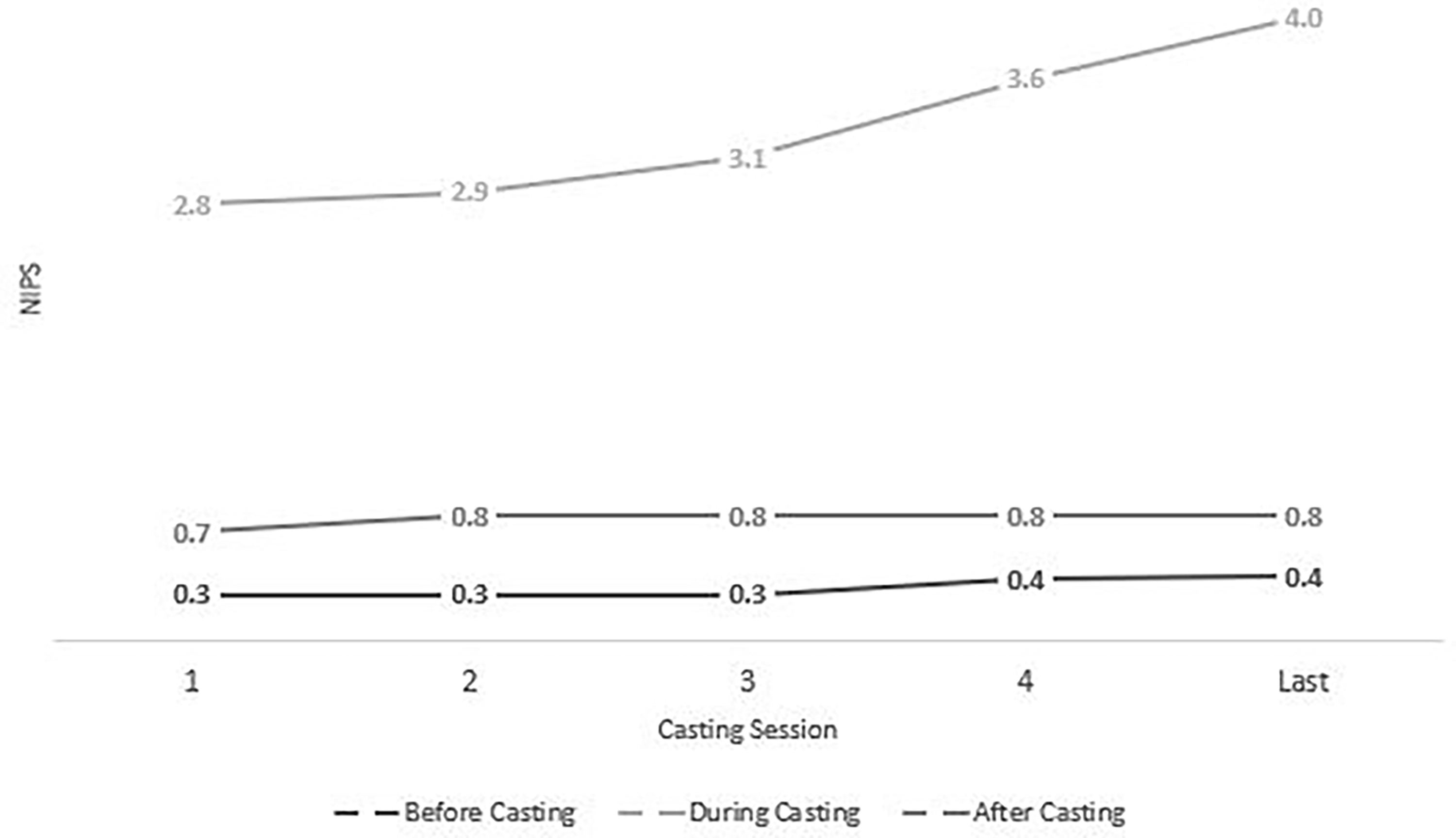
The Ponseti manipulation and casting evoked pain and abnormal physiologic responses starting from the first session. The median NIPS was 3 (interquartile range [IQR], 3.25) during the first cast, indicating a moderate pain response on the NIPS scale of 7 (
Table 1). There was progressive increase in pain response; in the last casting session, it was recorded as NIPS of 4 (IQR, 1) (
P = .02479) (
Fig. 1). The pain response, however, settled soon after casting was over, with no significant statistical differences obvious between the first and the last casts at this time frame (after casting: NIPS first cast, 0 [IQR, 1.25]; last cast, 0 [IQR, 2];
P = .7316).
Figure 1.
Illustrative diagram showing the gradual increase in pain response as casting progressed.
Figure 1.
Illustrative diagram showing the gradual increase in pain response as casting progressed.
Table 1.
Study Parameters During First and Last Casts (n = 34)
Table 1.
Study Parameters During First and Last Casts (n = 34)
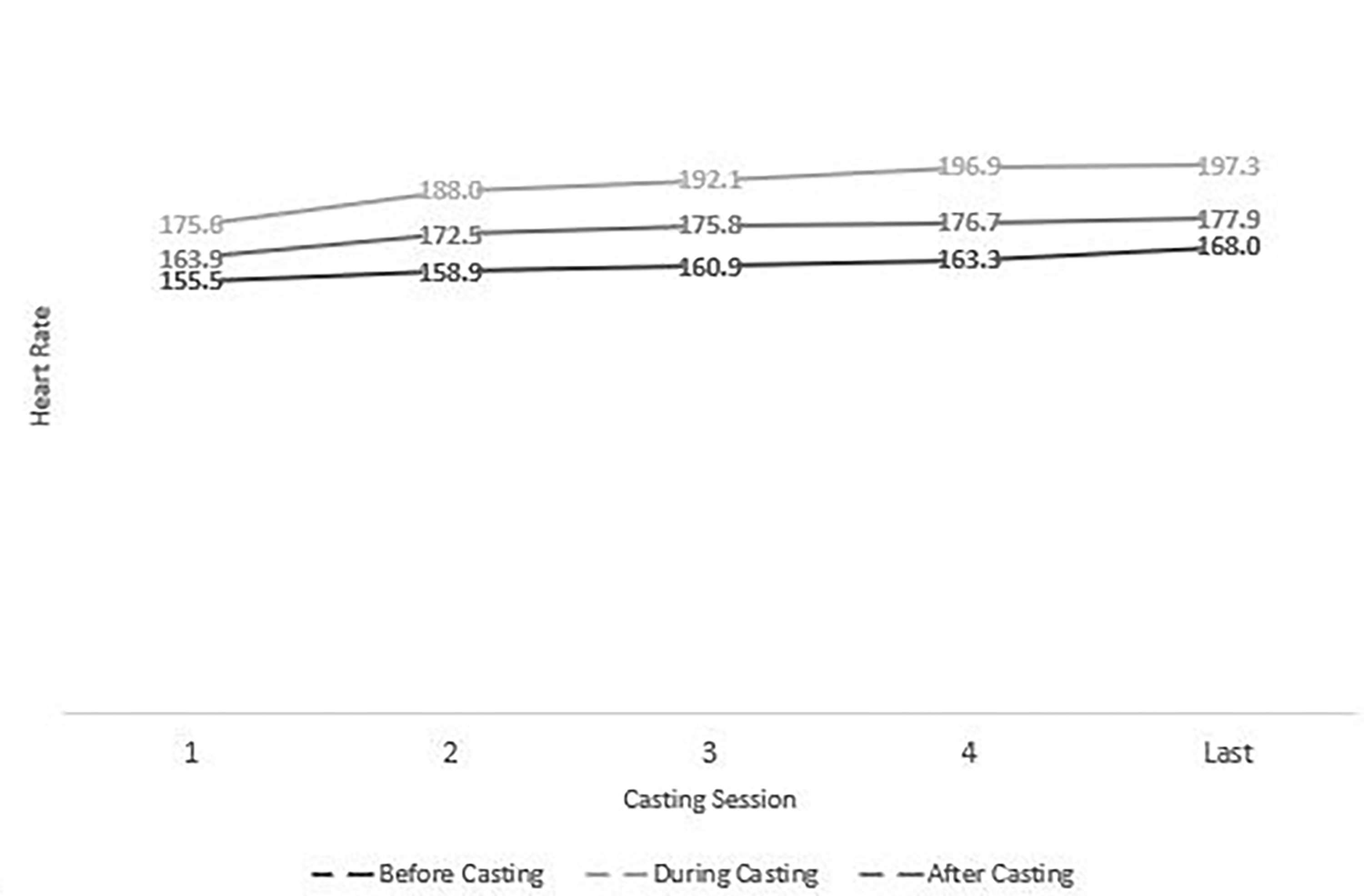
The mean ± SD HR during first cast session was 175.5 ± 27.2/min. It increased to a mean ± SD of 197.3 ± 18.9/min in the last cast (
Table 1). The change was statistically significant (
P = .000282). A similar trend was observed for precast HR (
P = .0246) (
Fig. 2). Even after the casting was over, the child took longer to settle HR when first cast was compared to the last (after casting: mean HR first cast, 163.9 ± 26.6/min; last cast, 177.9 ± 23.8 min;
P = .0049). For the third parameter (SpO
2), no differences were observed between the first and last casts.
Figure 2.
Illustrative chart showing the gradual increase in mean heart rate as casting progressed.
Figure 2.
Illustrative chart showing the gradual increase in mean heart rate as casting progressed.
Discussion
The Ponseti technique has now become the preferred method of treating clubfoot. The technique involves gradual correction of deformity through manipulation and casting generally carried out at weekly sessions [
3]. With increasing experience on the subject, several new aspects of the treatment have become known. One such entity is the pain response during the casting [
5]. This study evaluated pain on the basis of NIPS, HR, and SpO
2. Pain in neonates can be assessed broadly by two groups of parameters: behavioral and physiologic [
11]. The NIPS assesses the behavioral response to pain, whereas HR and SpO
2 assess the physiologic response to pain. The Premature Infant Pain Profile and Bernese Pain Scale for Neonates are scales other than the NIPS used in clinical studies to assess neonatal pain during nonorthopedic procedures [
6,
12].
Traditionally, Ponseti casting has always been considered a gentle procedure. A recent study by a Mayo Clinic group nonetheless produced data contrary to the above supposition [
5]. The investigators in this study conducted a double-blind, randomized, controlled trial on 33 children and assessed NIPS, HR, and SpO
2 before, during, and after the casting. The pain-relieving agents used were water, milk, and oral 20% sucrose solution. During casting, the mean pain score for water was significantly more than the other two agents (ie, milk [
P = .0005 and sucrose [
P < .0001]). The pain score matched for milk and sucrose (
P = .33) during intergroup comparison. For the postcasting period, the mean pain score was highest for milk and least for sucrose. Milk and water postcasting pain scores were comparable (
P = .28). The study concluded that milk and sucrose solution effectively reduced the pain response elicited during casting sessions. The pain relief extended into the postcasting period after sucrose solution administration. There were no changes in physiologic parameters (HR and SpO
2) during or after casting by the pain-relieving agents used in this study.
This research investigated the pain parameters during Ponseti casting on a novel dimension. We serially evaluated the pain and physiologic response (HR and SpO
2) starting with the first and ending with the last cast used for deformity correction (excluding the tenotomy cast). The clubfoot child started experiencing moderate pain beginning at the first cast. The pain response increased steadily as the casting progressed (
Fig. 1). At the last cast, the pain was significantly more than at the primary levels. The possible explanations are stretching of the soft tissues, especially the tough ligaments and musculotendinous units of the posterior and medial ankle, to achieve deformity correction. Furthermore, the hyperabduction element added toward the end of casts may have contributed to the overall pain component. The postcast pain levels, however, matched for the first and last casts, indicating that the child made a fast recovery after each session. The clubfoot child probably became aware of the clinic surroundings and succeeding procedure as the sessions advanced. The same was reflected as a significantly increased precast HR at the last cast when compared to the first (
P = .0246). At casting, HR also increased over sessions (
P = .000282) (
Fig. 2). The tachycardia likewise took longer to settle at the last cast (
P = .0049). There were no observed changes in SpO
2 measurements between the first and last casts, reflecting an overall stable child in relation to peripheral circulation.
The study by Milbrandt et al [
5] provided some evidence that nonpharmaceutical agents may be effective for pain relief during casting. Our study provided further insights into the pain responses occurring during Ponseti casting. Although the current study arm did not specifically investigate the pain relief agents proposed in the above-referenced study, safe analgesics/analgesia methods may be considered for the moderate pain response and its demonstrated further rise during progressive casting. The analgesics can help soothe the child, lessen physiologic responses attributable to repeated stimuli, and make the overall sessions pleasant for both providers and guardians. The analgesia dose may require titration toward the end casts. Having said that, it is prudent to add that investigations of pain response during Ponseti casting are still in the preliminary stage. It should also be noted that the pain parameters may be influenced by factors such as the level of child alertness and circumstances involved during application of the cast. These circumstances may include but are not limited to the environment control, sound, and light ambience and presence of other infants and parents in the clinic. The child’s overall health and hunger status and parental involvement in the casting process can be other potential influencers. The cast applicator and the assistance characteristics may also alter the pain status of the child.
Conclusions
This study was limited by its small sample size and the absence of any control group. The effect of drugs on the observed pain response and changes seen in the physiologic parameters were not investigated in this study arm. The host of possible confounders influencing casting process are mentioned above. Having said that, the present research does alert the clinicians to the possibility of cumulative pain response during Ponseti cast sessions. Further validation in larger patient groups and multicenter trials is warranted.