Angioleiomyoma is a benign soft-tissue tumor that arises from the smooth muscle cells in the tunica media of the blood vessels [
1]. Although the most common location for these neoplasms is the uterine wall, they can also originate from lower limbs, in subcutaneous tissues or deeper within the skeletal muscle [
2]. Altogether, these neoplasms account for 1.7% of all benign soft-tissue tumors in the lower limb [
2,
3] and in particular for 0.2% of all those located in the foot and ankle region [
1]. Angioleiomyomas typically present as slow-growing, firm and solid nodules that can be either asymptomatic or be responsible for pain and discomfort [
3–
5]. Although rare, malignant degeneration has been reported in literature [
5,
6]. The reason for their low incidence and their potential paucity of signs and symptoms is that it is common for angioleiomyomas to be diagnosed with delays of several months, and a large share of cases come to the correct diagnosis only after the surgical excision of the whole neoplastic mass [
1]. Differential diagnoses can include among the others lipomas, fibromas, schwannomas, angiolipomas, glomus tumors, and giant cell tumors of the tendon sheath [
1].
Accurate imaging investigations are mandatory to obtain a better comprehension of the nature of newfound nodules in the foot and ankle region [
2–
5], thereby orientating physicians toward the most accurate diagnosis. At the magnetic resonance imaging (MRI) evaluation, angioleiomyoma generally presents as a well-defined oval mass, isointense to muscle on T1-weighted images and a heterogeneous signal on T2-weighted/short tau inversion recovery. Enhancement with contrast agents could range from diffuse to heterogeneous [
7–
9]. However, despite the prominent role of imaging, definitive diagnosis can only be made after histologic examination.
Surgical approach is therefore necessary to confirm the diagnosis by providing the specimen to pathologists, and to allow the complete removal of the neoplastic mass. Surgeons are called to remove the whole tumor and minimize the risk of local recurrence, but should simultaneously be conservative on the surrounding healthy tissues. As a consequence, surgery can be challenging, especially in an anatomical district with a complex tridimensional anatomy such as the foot and ankle region.
Because of their rarity, angioleiomyomas of the foot are poorly reported in literature and, to this date, documentations regarding their treatment and the subsequent outcomes are mainly limited to case reports and small case series [
1–
3,
10–
21]. In this study, we report our experience with the surgical management of angioleiomyomas of the foot, evaluating the effectiveness of surgical treatment in terms of clinical recovery and functional outcomes on a midterm follow-up.
Methods
This single-center retrospective study was performed in accordance with the ethical standards laid down in the 1964 Declaration of Helsinki and its later amendments. All patients gave their written consent. Our study consisted of a review of all the patients who were diagnosed and treated surgically for angioleiomyoma of the foot in our institution between January of 2017 and January of 2022.
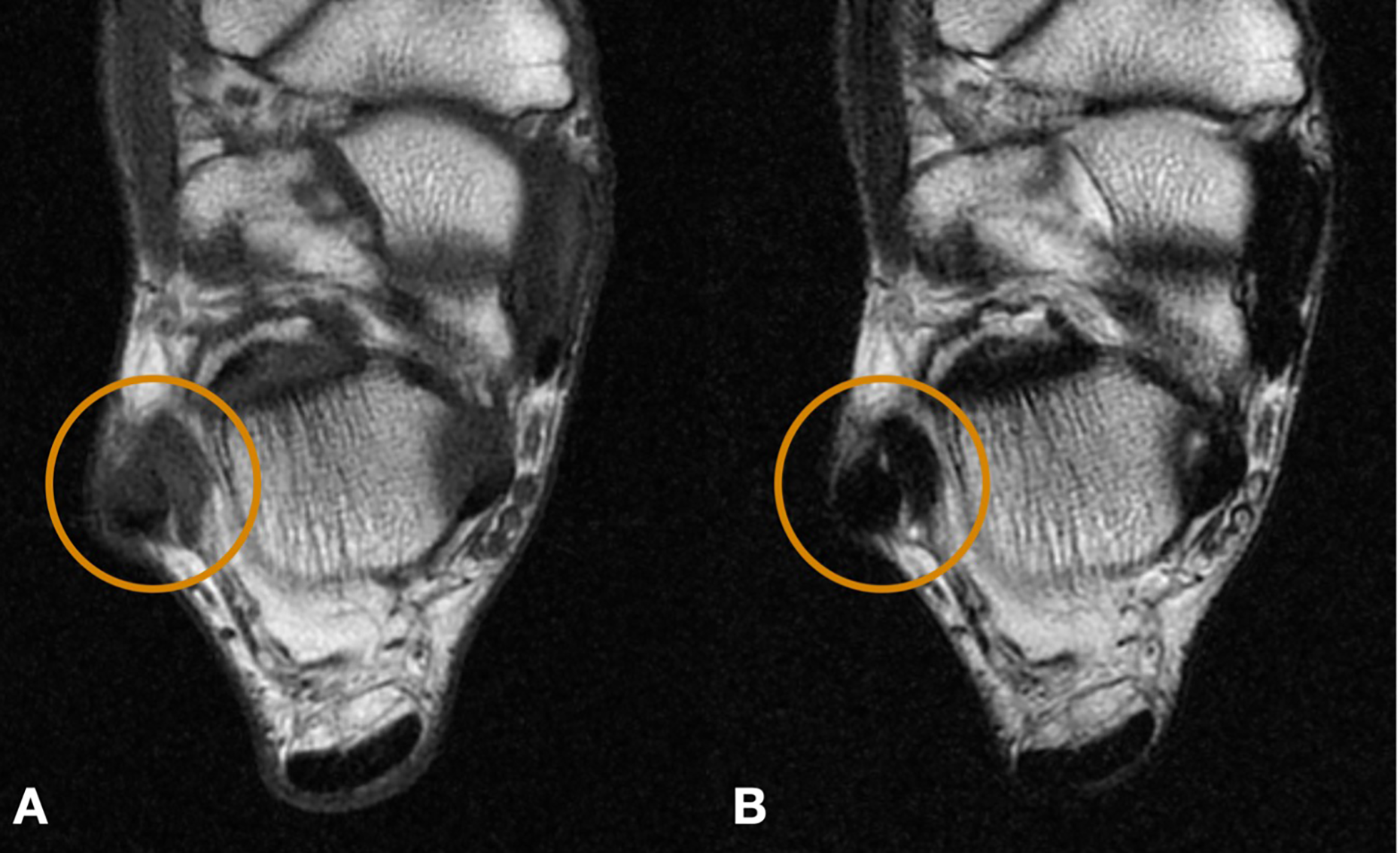
For each patient, we collected data regarding their age, gender, and symptoms along with the date on which the tumor was diagnosed. Preoperative and postoperative functional status of our patients were assessed with both the American Orthopedic Foot and Ankle Society Score (AOFAS) and the Musculoskeletal Tumor Society Score (MSTS), at the moment of their hospitalization before surgery and at the moment of their latest follow-up, respectively. For each patient, preoperative MRI scans were taken and used to correctly locate masses, orientate diagnosis, aid surgical planning, and estimate tumor size (
Fig. 1).
Figure 1.
T1 (A) and T2 (B) weighted images of a medial angioleiomyoma of the hindfoot (within the orange circle).
Figure 1.
T1 (A) and T2 (B) weighted images of a medial angioleiomyoma of the hindfoot (within the orange circle).
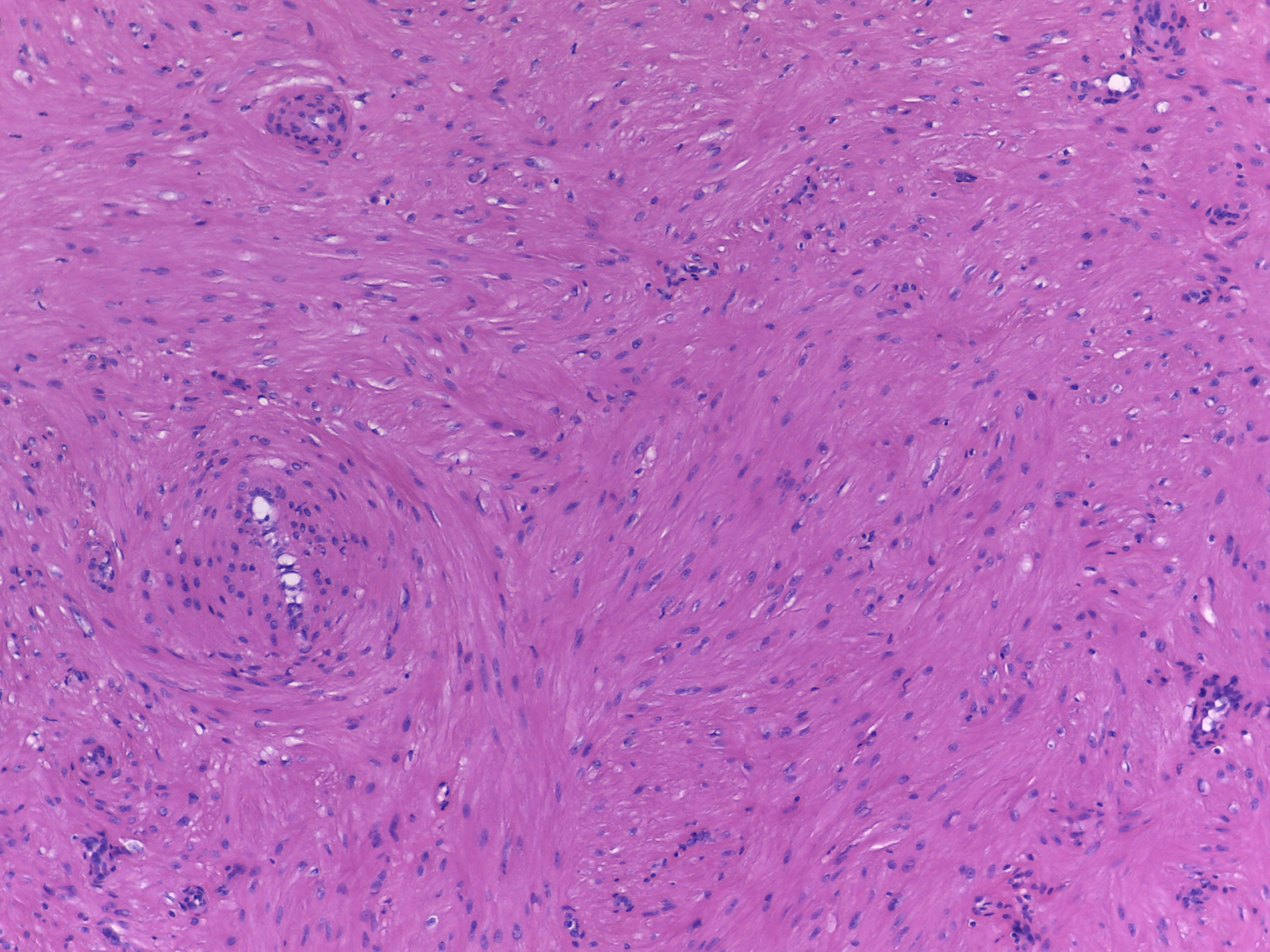
The date and type of operations performed were recorded for all patients. Surgical excision was performed with wide macroscopic margins of resection. Each surgical specimen underwent histologic examination by a pathologist to confirm the diagnosis of angioleiomyoma (
Fig. 2).
Figure 2.
Histologic sample of one of our angioleiomyomas
Figure 2.
Histologic sample of one of our angioleiomyomas
Postoperative follow-up consisted of several office visits, clinical evaluations, and postoperative MRI scans. Cases were routinely visited 1, 3, and 9 months after surgery, and subsequent visits were scheduled depending on the needs of every single individual. MSTS and AOFAS were calculated according to the combination of data observed and reported by the patients. Each complication with grade II or higher according to the Clavien-Dindo classification was recorded.
Statistical Analysis
Statistical analysis was performed using Stata SE 13 (StataCorp LLC, College Station, Texas). Statistical significance was set at .05 for all endpoints.
Results
Thirteen patients suffering from angioleiomyoma of the foot underwent surgery in our institution between January of 2017 and January of 2022. They were eight women and five men, with a mean age at surgery of 58.6 years (range, 40–83 years).
None of our cases had an accidental diagnosis, as every case was brought to medical attention because of the onset of symptoms directly attributable to the disease. On average, histologic diagnosis was established 47.7 months (range, 4–240 months) after the onset of the first symptoms, which were pain in six cases (46%) and a palpable nodularity in the remaining seven cases (54%). At least mild pain was experienced by all of our cases at the moment of their hospitalization. Preoperative pain was described to be mild in four cases, moderate in six cases, and severe in the remaining three cases.
The overall preoperative performances of the affected lower limb was evaluated using the MSTS, with a mean score of 22.1 (range, 10–28). The functionality of the foot and ankle were also evaluated with the AOFAS, obtaining a mean preoperative score of 76.8 (range, 45–97).
Preoperative clinical and functional characteristics of our population are summarized in
Table 1. According to patients’ preoperative MRI scans, the mean tumor size, intended as larger diameter, was 17.7 mm (range, 8–30 mm).
Table 1.
Pre- and Postoperative Summary of Study Cohort
Table 1.
Pre- and Postoperative Summary of Study Cohort
All our cases underwent complete excision of their neoplasm with wide margins. Excision did not require the sacrifice of tendons, major vessels, or nerves, or the complete resection of the main ligamentous structures belonging to the ankle or the intrinsic articulations of the foot. In each case, the diagnosis of angioleiomyoma was confirmed by histologic evaluations on surgical specimens. The mean postoperative follow-up of our population was 36.1 months (range, 12–60 months).
None of our patients suffered from major intraoperative or postoperative complications (grade II or higher according to the Clavien-Dindo classification). At their latest follow-up, all our patients were continuously disease free, as none had local recurrences. Patients’ mean postoperative MSTS and AOFAS were 29.5 points (range, 24–30 points) and 98.8 points (range, 84–100 points), respectively. After surgical treatment, the mean MSTS had increased by 7.5 points (range, 3–20 points), whereas the mean AOFAS had grown by 21.9 points (range, 3–55 points). Both MSTS and AOFAS increased for each case after surgery. At their latest clinical evaluation, all but one (case 12) obtained the highest scores according to both scoring systems. According to two-tailed Student
t tests, our patients’ mean MSTS and AOFAS functional scores differed and had a significant increment after surgery (
P < .001 for both tests). Postoperative clinical and functional results of our population are summarized in
Table 1.
Discussion
Angioleiomyomas of the foot are extremely rare and poorly described in literature [
1–
3,
10–
21]. Their diagnosis could theoretically be either incidental during a diagnostic procedure performed for other reasons or consequential to the onset of localized pain and swelling [
3–
5]. In our patients, pain and localized swelling had an almost equal incidence as their outbreak symptom. Even though each of our cases had at least a symptom at the moment of their hospitalization, all of them came to our attention several months after the onset of pain or nodularity. A mean diagnostic delay of almost 48 months suggests that more attention should be paid among general practitioners and orthopedics in general on the diagnosis of soft-tissue tumors of the foot. The recognition of a painful nodularity, in particular, should orientate toward a potential tumor and suggest carrying out the appropriate examinations to allow a correct diagnosis and exclude malignancy. An accurate evaluation of imaging evidence and a correct anamnestic evaluation are necessary to guide differential diagnosis toward a benign lesion such as leiomyoma rather than locally aggressive masses such as giant cell tumors or malignant lesions such as soft-tissue sarcomas.
Once the diagnosis is established, surgical intervention represents the main therapeutic option for angioleiomyomas localized in the distal segments of the lower limb, particularly in case of pain and functional impairment. Surgery should consist of a radical excision of the tumor mass, dovetailing the acquisition of wide margins and the respect of the nearby intact structures of the foot. Wide margins of resection are necessary to avoid residues of neoplastic cells remaining in the surgical field. This aspect plays a pivotal role in minimizing the risk of postoperative local recurrence. This is true in case the histologic diagnosis of angioleiomyoma is confirmed, and becomes even more crucial in case of malignant degeneration. Although local recurrences for leiomyomas have been described in literature, their incidence has been reported to be low according to modern literature. In 1984, Hachisuga et al [
5] reported the clinicopathologic characteristics of 562 cases of angioleiomyoma, of which 276 were located in the foot. Only two of their cases (0.36%) suffered from local recurrence after surgery. Later, in 2016, Zhang et al [
19] had no local recurrence among their population of 141 angioleiomyomas. The absence of local recurrences in our population is therefore in line with what had already emerged from previous literature, providing further evidence that the risk of local recurrence of the disease after a careful excision with wide margins is extremely low.
The preservation of major nerves, vessels, tendons, and ligaments, for its part, is fundamental to preserve and restore patients’ foot functionality in the months and years that come after surgery [
22]. As emerged in our population, leiomyomas of the foot can be associated with the onset of pain and significant functional impairment that could limit or even preclude patients’ activities of daily living and reduce their quality of life. In contrast, we demonstrated good curative outcomes with surgical excision. In fact, at their latest follow-up, all our patients showed symptoms relief and good functional outcomes, testified to by their improvements in both MSTS and AOFAS compared with preoperative evaluations. Surgery should be performed by an experienced surgeon in a referral center for orthopedic oncology, to provide the best standard of care for each patient in terms of both surgical procedure and pathologic evaluation, mandatory to confirm the diagnosis and exclude malignancy [
23].
We acknowledge our study had some limitations. The rarity of these tumors did not allow us to operate on wider populations, which partially limited the statistical significance of some of the data associations we wanted to investigate at the beginning of our research. Another limitation is represented by the retrospective nature of our study, which did not allow a perfect standardization of the postoperative follow-up procedures for each patient.
Our results, although obtained on a small population, do not find matching situations in literature, in part because of the rarity of the neoplasm and the consequential paucity of studies on this topic. Previous studies gave little or no attention to the evolution of treated patients’ lower limb functionality before and after surgery; our outcomes may represent a first attempt to put the spotlight not only on the anatomical, pathologic, and imaging characteristics of these neoplasms, but also on the affects of these tumors and their treatment on the patient’s everyday life.
Conclusions
In conclusion, although further studies with larger populations might be necessary, our results suggest that surgical approach with tumor resection should be considered a safe and reliable treatment for foot angioleiomyomas considering the extremely low risk of local recurrence and the good postoperative pain relief and functional restoration that can be obtained after the treatment.