Acquired flatfoot is very common worldwide and may be seen unilaterally or bilaterally.[
1,
2]
It has been characterized as decreased medial arch height, talus adduction and medial rotation, calcaneal eversion, and forefoot abduction.[
3,
4]
The causes of acquired flatfoot include dysfunction of the posterior tibial tendon, arthritis, trauma, Charcot’s foot, neuromuscular disorders, or tumors of the foot.[
5]
It has been reported to result from loss of the normal interplay between the bones of the foot, and these alterations of the foot posture interfere with normal foot function.[
1,
6]
As a result of this process, the pelvic and spinal alignment may be altered.[
7,
8,
9]
The proper alignment of the weightbearing segments creates a good posture.[
10]
The pelvis and spine are identified as key segments of appropriate postural alignment. The pelvis provides a connection with the lower extremities, and the spine provides anatomical connection and force transmission between the lower and upper parts of the body.[
11]
If the ideal alignment and connection are disrupted, compensatory postural alterations of spinopelvic alignment occur.[
12]
The biomechanical process of alteration of the pelvic and spinal alignment (via foot pronation) was explained with a reduction in limb length. Adduction of the talus and eversion of the calcaneus results in internal rotation of the lower limb and, consequently, reduction in limb length.[
8,
9]
Bilateral calcaneal eversion may lead to lower-limb internal rotation and, consequently, result in pelvic anteversion and lumbar hyperlordosis.[
7,
9]
Gurney [
8]
reported that unilateral calcaneal eversion may cause a functional limb-length alteration and may produce pelvic obliquity and, consequently, scoliosis. Angulation of the pelvis from the transverse in the coronal plane is termed pelvic obliquity by the Scoliosis Research Society and is broadly defined as the malalignment between the spinal and pelvic structures in the coronal, sagittal, or transverse plane.[
13]
The leg-length alteration, contractures about the hip, spinal asymmetries, or a combination of these were reported as causes of pelvic obliquity.[
14]
There is still a lack of evidence about the influence of increases in foot pronation on pelvic and spinal alignment. Also, the possible changes in spinopelvic alignment due to unilateral or bilateral flatfoot need to be clarified. Therefore, the aim of this study was to present the influence of unilateral and bilateral flatfoot on coronal spinopelvic alignment in asymptomatic young healthy males.
Materials and Methods
The hypothesis of this study was that pelvic obliquity and spinal asymmetry would be influenced more in individuals with unilateral flatfoot than in individuals with bilateral flatfoot.
Participants
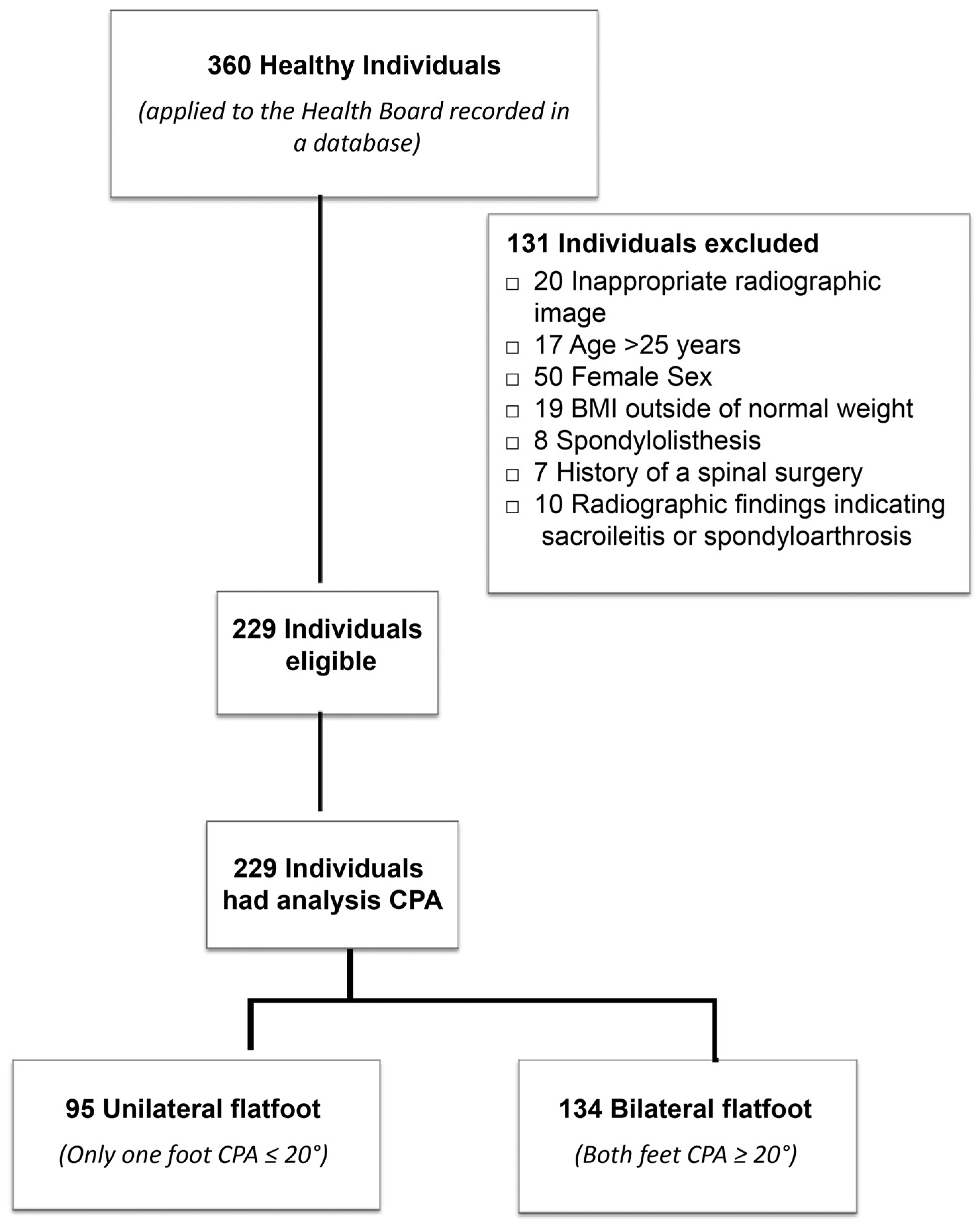
A cross-sectional retrospective study was performed by extracting the medical reports of 360 healthy individuals who applied to the National Health Board to work in positions requiring physical fitness between January 1, 2018, and January 1, 2019 (Figure 2). These medical examinations by the National Health Board routinely include a detailed physical examination and plain radiographs of both feet, the pelvis, and the spine. The participants were selected from young and healthy males by means of convenience and opportunistic or emergent sampling. Inclusion criteria for all of the participants were a body mass index (BMI [calculated as weight in kilograms divided by height in meters squared]) ranging from 18.5 to 24.9 (accepted as normal weight by the World Health Organization), age ranging from 18 to 25 years, and male sex. Participants were excluded if they 1) were older than 25 years; 2) had a BMI outside of normal weight according to the World Health Organization; 3) were female; 4) had a history of spinal trauma/surgery; 5) had spinal disorders such as spondylolisthesis, spondylodiscitis, etc; 6) had chronic inflammatory arthritis, especially spondyloarthrosis (ie, ankylosing spondylitis, psoriatic arthritis, etc); 7) had vertebral fracture; 8) had aseptic necrosis of the vertebra; or 9) had radiographs with inappropriate image qualities.
Outcome Measures
Lateral spinal asymmetry and pelvic obliquity were analyzed with imaging software (RadiAnt DICOM Viewer, Version 5.5; Medixant, Poznan, Poland) using the Cobb method by a single examiner (E.C.) on the standing full-length posteroanterior radiograph. All of the radiography was performed following the same conventional protocol: All of the participants were asked to stand in a comfortable position, facing forward, without rotation of the feet, with arms resting to the side of the body during radiography. To diagnose flatfoot (via the calcaneal pitch angle [CPA]), weightbearing lateral plain radiographs were analyzed with the same software and by the same examiner, an experienced orthopedic surgeon (E.C.). The same conventional protocol was followed for lateral radiography of the foot: All of the participants were asked to stand in a comfortable position with their weight equally distributed to both feet.
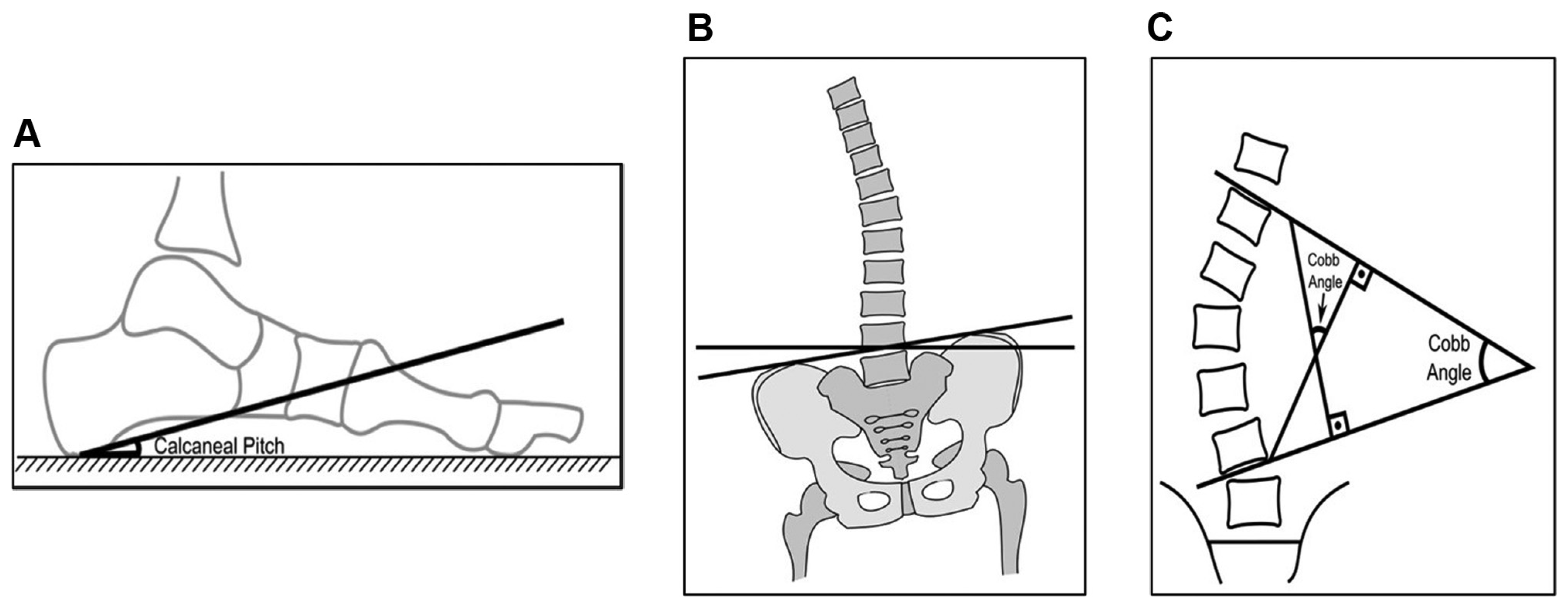
The CPA is defined as the angle between a line drawn from the inferior of the calcaneocuboid joint to the inferior border of the calcaneus and a second line drawn from the inferior aspect of the sesamoid bones to the inferior border (Figure 1A).[
15]
The interrater reliability of the CPA was .948 (for digital) and .955; the intrarater reliability of the CPA was .977 to .980. The CPA for both feet (right and left) was evaluated from all of the plain radiographs in this study, and angles equal to or less than 20˚ were accepted as flatfoot. Pelvic obliquity was measured by transverse pelvic obliquity according to the method of Osebold et al.[
16]
from a posteroanterior radiograph. The angle between a line drawn between the most proximal points on the iliac crest and a line drawn parallel to the lower end of the radiograph was recorded (Figure 1B). The intrarater and interrater reliability of the Osebold pelvic obliquity measurement were reported to be .955 and .954, respectively, in neuromuscular scoliosis. The Cobb angle is a gold standard measurement for identifying the magnitude of spinal curves.[
17]
Spinal curvature was measured from the standing full-length posteroanterior radiograph. The angle of the curve is measured as the angle between the perpendiculars of the lines parallel to the upper border of the upper vertebral body and parallel to the lower border of the lowest vertebral body of the curve (Figure 1C).[
18]
Straight or symmetrical spines in the coronal plane were accepted as normal, curves less than 10˚ were accepted as spinal asymmetry, and curves of 10˚ or more were accepted as scoliosis.[
19]
The intrarater and interrater reliability of the Cobb angle were reported to be .93 and .96, respectively. Spinal curve patterns in coronal planes were classified according to the Scoliosis Research Society classification. If the curve exists through the thoracic or lumbar spine it is classified as a single-thoracic or single-lumbar curve. If it exists in both the middle thoracic and lumbar spine it is classified as a double curve. If the double curve is accompanied by the upper thoracic spine, it is classified as a triple curve.[
20]
Statistical Analysis
Statistical tests were performed with a statistical software program (IBM SPSS Statistics for Windows, Version 22.0; IBM Corp, Armonk, New York). The Kolmogorov-Smirnov test was used to recognize a normal distribution. Descriptives are presented as mean ± SD and 95% confidence of interval (CI). The proportions of the spinal curve patterns in the coronal plane are presented using cross-tabulation. The x 2 test was used to compare these proportions, followed by the Bonferroni-corrected post-hoc comparisons. The differences between the two groups were analyzed using the Student t test. The effect sizes (to emphasize the size of difference) of the comparisons with statistically significant differences were also calculated, and Cohen d was cited. The effect size was considered small if d = 0.20, medium if d = 0.50, and large if d = 0.80. The level of significance for all tests was set at P < .05.
Results
Of 360 individuals identified from the electronic database, 229 healthy males who met the inclusion criteria were included in this study. After all of the analyses were completed, participants were divided into two groups: unilateral (n = 95, 41.5%) or bilateral (n = 134, 58.5%) flatfoot, depending on the CPA measurements (Figure 2). The demographic characteristics of the participants are shown in Table.1. There was no significant difference in age (P = .609). However, the unilateral flatfoot group showed slightly higher values in terms of BMI, with a significant difference (P = .01).
The proportions of the spinal curve patterns in the coronal plane are shown in Table 2. The curve patterns identified in this study were single-thoracic, single-lumbar, and double (one curve exists through thoracic and lumbar). Overall significant differences among the four groups were found (P < .001). Results of post-hoc analyses suggest that males without spinal asymmetry were more likely to have unilateral flatfoot (
Table 3).
Table 1.
Demographic and Outcome Measures of the Participants by Group.
Table 1.
Demographic and Outcome Measures of the Participants by Group.
Table 2.
Cross-tabulation of Spinal Curve Patterns Between Groups.
Table 2.
Cross-tabulation of Spinal Curve Patterns Between Groups.
Table 3.
Post-hoc Analyses (Bonferroni-Corrected Post hoc Comparisons).
Table 3.
Post-hoc Analyses (Bonferroni-Corrected Post hoc Comparisons).
Figure 2.
Flow diagram for study participants. BMI, body mass index; CPA, calcaneal pitch angle.
Figure 2.
Flow diagram for study participants. BMI, body mass index; CPA, calcaneal pitch angle.
There were significant differences between groups in pelvic obliquity and Cobb angle (
P < .05). The effect size was found to be small to medium for pelvic obliquity and medium to large for Cobb angle (
Table 1).
Discussion
In this study, statistically significant differences were found with a small-to-medium effect size for pelvic obliquity and a medium-to-large effect size for spinal asymmetry between individuals with bilateral and unilateral flatfoot. The results of this study suggest that individuals with bilateral flatfoot have increased pelvic obliquity and spinal asymmetry.
Although alterations in foot biomechanics and their effects on whole-body mechanics have recently become a prominent topic, there is still a lack of evidence about possible changes in spinopelvic alignment due to unilateral or bilateral flatfoot. Pinto et al.[
7] reported that alterations in calcaneal eversion and foot arches resulted in alteration of pelvic alignment, for example, increases in pelvic anteversion and pelvic obliquity. Furthermore, it was shown that changes in pelvic alignment affect lumbar lordosis and may lead to the occurence of scoliosis via the anatomical relationship between the pelvis and the lumbar spine.[
8,
21] Also, Khamis and Yizhar[
9] reported that these alterations in the body can occur even if the foot alterations are temporary.
In contrast to the present results, Pinto et al.[
7] reported that unilaterally increased foot pronation generates a significant increase in pelvic obliquity. In previous studies, it was shown that the unilateral increase in foot pronation causes pelvic obliquity due to lower-limb discrepancy. This limb-length difference is expressed as functional but results in pelvic obliquity in the coronal plane.[
8,
22,
23]
Abdel-Raoof et al.[
22] investigated the influence of flatfoot on spinal and pelvic mechanics in young females. Similar to previous studies, they found no change in pelvic obliquity. For researchers, the reason for this result is that all the included participants had bilateral flexible second-degree flatfoot.[
22] However, the inclusion of young male participants in the present study may explain the difference in results. Also, differences in lower-extremity and spinopelvic alignment have been reported between men and women in previous studies.[
24]
The present study also demonstrates that young males with bilateral flatfoot have more increased spinal asymmetry compared with those unilaterally affected. Legaye et al.[
21] attributed their results to the anatomical relationship between the pelvis and the lumbar spine. Indeed, this anatomical relationship can be explained by the connection between the pelvic girdle and the lumbar spine at the sacroiliac joint via strong fibrous tissue.[
25] Levine et al.[
27] found a strong correlation between pelvic and lumbar positions. Also, it is stated that alterations in spinal alignment have effects on the trunk area either internally or externally.[
22]
In contrast, in some studies not in agreement with the previous ones, Betsch et al.[
26] and Duval et al.[
25] similarly reported that although they found alterations in pelvic position due to foot pronation and supination, no significant changes in the spinal curvature occurred. On the other hand, these results can be derived from the inclusion of participants with minimal changes of foot position and short follow-up.
We believe that the results of this study may have derived from bilaterally increased foot pronation that affects the kinematic chain of the lower-limb and spinopelvic alignment more than unilateral increases. In other words, bilateral foot postural alterations can produce more reactive forces and cause more changes to the pelvic girdle and spine.
The cross-sectional design of the present study limits the ability to generalize the results to other age groups and sex because of the inclusion of young male participants only. Another limitation may have been the BMI difference between groups, which may have caused alterations in the loading response of the foot and in the entire alignment of the lower limb and spine.
In conclusion, young males with bilaterally increased foot pronation demonstrate more increased pelvic obliquity and spinal curvature. The results of this study suggest that more attention should be given to evaluating the patient’s whole posture rather than focusing only on the foot posture.