Next Article in Journal
Management of Chronic Exertional Compartment Syndrome of the Foot: A Report of 3 Cases
Previous Article in Journal
Arthrodesis of the Fourth and Fifth Tarsometatarsal Joints in a Sensate Patient with Post-Traumatic Arthritis: A Case Report and Surgical Technique
 
 
Journal of the American Podiatric Medical Association is published by MDPI from Volume 116 Issue 1 (2026). Previous articles were published by another publisher in Open Access under a CC-BY (or CC-BY-NC-ND) licence, and they are hosted by MDPI on mdpi.com as a courtesy and upon agreement with American Podiatric Medical Association.
Article

Precalcaneal Congenital Fibrolipomatous Hamartomas

by
Lauren Yi
*,
Jack Lee
,
Howard J. Zlotoff
and
Barrett J. Zlotoff
Department of Dermatology, University of Virginia Health System, 1221 Lee St, Charlottesville, VA 22903
*
Author to whom correspondence should be addressed.
The author is retired.
J. Am. Podiatr. Med. Assoc. 2023, 113(2), 21093; https://doi.org/10.7547/21-093
Published: 1 March 2023

Abstract

Precalcaneal congenital fibrolipomatous hamartomas are rare benign lesions that present in infancy. Lesions typically appear as unilateral or bilateral skin-colored asymptomatic subcutaneous nodules on the precalcaneal plantar heel. Diagnosis is clinical, and operative intervention is not indicated unless lesions are symptomatic. We report two cases of subcutaneous plantar nodules diagnosed as precalcaneal congenital fibrolipomatous hamartomas. The aim is to raise awareness of this rare diagnosis and emphasize its benign nature and conservative management.

Precalcaneal congenital fibrolipomatous hamartomas (PCFHs) are benign subcutaneous masses presenting at birth or shortly after.[1] Typical lesions are either unilateral or symmetrical skin-colored nodules located on the medial aspects of the heel, just anterior to the calcaneus.[1] They are generally asymptomatic and tend to increase in size proportionally to the child’s growth.[1,2,3] It is likely that PCFH is underreported in the literature, and the exact prevalence is unknown, although its incidence in newborns and infants was stated to be 5.9% and 39.4%, respectively.[1,4]
Larralde de Luna et al[5] first described PCFH in 1990 as “pedal papules of the newborn.” In 1996, Larregue et al[6] coined the term precalcaneal congenital fibrolipomatous hamartoma and further described five additional cases. Congenital fibrolipomatous hamartomas have also been reported in retrocalcaneal locations[7] and on the palms.[8]
The pathophysiology of PCFH is not yet understood.[9] Proposed mechanisms include developmental alteration during late pregnancy when the fibroconnective trabecular system of the sole is developing, incomplete regression of fetal tissue, and herniation of adipose tissue through defects in the plantar fascia.[9] Precalcaneal congenital fibrolipomatous hamartoma was reported across multiple generations in one family[10] and among half-brothers,[11] suggesting a possible genetic basis for the condition.
The differential diagnosis of PCFH includes piezogenic papules, juvenile fibromatosis, focal dermal hypoplasia, nevus lipomatosus, and lipoma.[9] Piezogenic papules usually manifest after ambulation due to pressure and most commonly occur in overweight or obese women representing acquired herniations of fat into the dermis and appearing on the lateral rather than medial aspects of the heel.[9,12] Juvenile fibromatosis is more indurated, whereas PCFH lesions tend to be softer due to their lipomatous component.[9] Focal dermal hypoplasia can also present with dermal nodules, but other features, such as sparse or absent hair, nail changes, and dental anomalies, are also expected.[13] Nevus lipomatosis usually appears on the thighs or hips rather than on the plantar heel.[9] Lipomas are benign tumors of adipocytes that similarly present with subcutaneous nodules.[14] However, lipomas tend to present in adulthood between the fourth and sixth decades of life and more commonly are located on the trunk rather than on the hands and feet.[14]

Case Reports

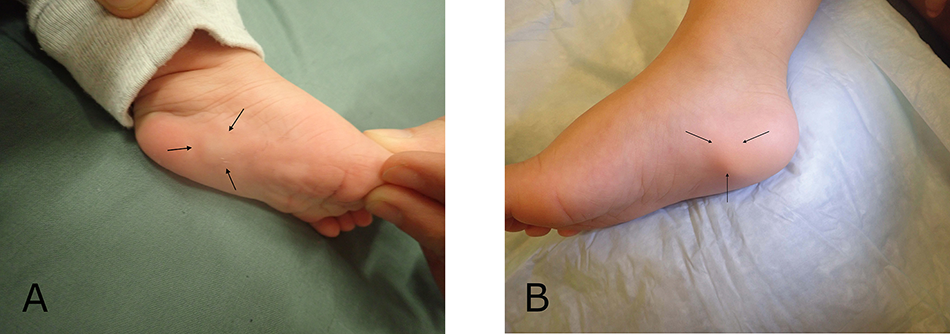
The first case was a 3-month-old boy born early term via spontaneous vaginal delivery without any pertinent medical history who presented for evaluation of bilateral nodules on his feet. The nodules had been present and growing slowly since shortly after birth. His mother noted that the nodules did not seem to bother him. Physical examination was remarkable for bilateral, nontender, symmetrical, subcutaneous masses located on the medial heels in the precalcaneal region. The nodules were flesh-colored, rubbery in consistency, and approximately 1 cm in diameter, consistent with a diagnosis of precalcaneal congenital fibrolipomatous hamartomas (Fig. 1A). The patient’s mother was reassured of the benign nature of these lesions. Since his initial presentation in December 2019, the patient has been followed clinically every 3 to 6 months without evolution of his lesions.
Figure 1. Clinical appearance of precalcaneal congenital fibrolipomatous hamartomas (arrows) in a 3-month-old boy (A) and a 2-year-old boy (B).
Japma 113 21093 g001
The second case was a 2-year-old boy with no medical history who presented to the dermatology clinic with a nodule on his right foot that had been present since birth. His mother recently noticed that he occasionally took his shoes off and toe-walked to avoid bearing weight on the lesion. Clinical examination revealed a 1.5 × 1.0-cm, flesh-colored, subcutaneous mass in the precalcaneal region of the right medial heel (Fig. 1B). Based on the examination findings, a diagnosis of precalcaneal fibrolipomatous hamartoma was made and the patient’s mother opted for conservative management and observation. The patient was subsequently lost to follow-up.

Discussion

In the correct clinical context and with physical examination, PCFH can be a clinical diagnosis that does not require biopsy or imaging.[1,4,10,11,15,16,17,18,19] If biopsied, histopathology would show mature adipose tissue surrounded by collagen fibers.[1] If imaged, ultrasonography would generally be obtained,[12] which would display nonspecific findings of hypoechoic areas representing mature adipose tissue and hyperechoic areas corresponding to collagen fibers.[7,12] Other imaging modalities, such as plain film radiographs and computed tomography, would expose the patient to unnecessary ionizing radiation, and magnetic resonance imaging would require anesthesia in a young patient, and these techniques would not alter clinical decision making.
The natural history of PCFH has not been well described in the literature. The longest reported outcome of PCFH was 12 years after diagnosis without functional impairment.[2] Spontaneous regression has been reported.[1,2] In the first case described herein, the patient is now aged 20 months and has been followed without evolution of his lesions since age 3 months. These case reports further contribute to the evidence that invasive biopsies are unnecessary to make a diagnosis of PCFH given that both cases followed the typical clinical course, matched the description of PCFH, and did not otherwise interfere with the patients’ development. Furthermore, the first case also increases our understanding of the natural history of PCFH and its benign nature. Also of note is the unilateral presentation in the second case.
Most PCFHs do not require any intervention; however, if they become symptomatic from footwear irritation or weightbearing activities, they may be surgically excised.[1] The surgical technique uses a simple linear incision exposing the PCFH. The lesions are well defined and easily removed with blunt dissection from the surrounding normal tissues. Primary repair is layered closure of the subcutaneous and skin layers. Applying a compressive dressing and being nonweightbearing for 7 to 10 days postoperatively will reduce the risk of hematoma and hypertrophic, painful scarring.

Conclusions

Often, PCFH goes unrecognized by many health-care practitioners and patients. This may lead to unnecessary referrals, subjecting the patient to unnecessary biopsies, imaging, and surgeries. Imaging studies such as computed tomography and magnetic resonance imaging carry risks associated with exposure to ionizing radiation and sedation, respectively, and are recommended only if the lesion is not classic in appearance, consistency, or behavior. Similarly, obtaining a biopsy sample in a pediatric patient is unnecessarily invasive. It is important to recognize this usually benign condition and reassure families accordingly.

Financial Disclosure

None reported.

Conflict of Interest

None reported.

References

  1. Jakhar D, Kaur I, Singal A, : Precalcaneal congenital fibrolipomatous hamartoma: rare or under-reported? J Cutan Pathol 46: 277, 2019.
  2. Ortega-Monzó C, Molina-Gallardo I, Monteagudo-Castro C, : Precalcaneal congenital fibrolipomatous hamartoma: a report of four cases. Pediatr Dermatol 17: 429, 2000.
  3. Tremaine AM, Paik AS, Metz B: Soft subcutaneous plantar masses—quiz case. Arch Dermatol 148: 1073, 2012.
  4. Greenberg S, Krafchik BR: Infantile pedal papules. J Am Acad Dermatol 53: 333, 2005.
  5. Larralde de Luna M, Ruiz LJ, Cabrera HN: Pápulas podálicas en el recién nacido. Med Cutan Ibero Lat Am 18: 9, 1990.
  6. Larregue M, Vabres P, Echard P, : Precalcaneal congenital fibrolipomatous hamartoma. Paper presented at: the Fifth International Congress of Pediatric Dermatology, Rotterdam, the Netherlands, 1996.
  7. Rodríguez Bandera AI, Saylor DK, Beato MJ, : Cutaneous fibrolipomatous hamartoma: report of 2 cases with retrocalcaneal location. Pediatr Dermatol 35: 498, 2018.
  8. Rotunno R, Diociaiuti A, Giancristoforo S, : Fibrolipomatous hamartomas not only on the soles. Pediatr Dermatol 36: 728, 2019.
  9. Yang J, Park O, Kim J, : Precalcaneal congenital fibrolipomatous hamartoma. Ann Dermatol 23: 92, 2011.
  10. Meyer P, Soennichsen K, Buchenau W: Autosomal dominant precalcaneal congenital fibrolipomatous hamartoma. Pediatr Dermatol 22: 355, 2005.
  11. Fangman W, Prose N: Precalcaneal congenital fibrolipomatous hamartomas: report of occurrence in half-brothers. Pediatr Dermatol 21: 655, 2004.
  12. Chiaradia G, Fiss RC, Silva CM : Precalcaneal congenital fibrolipomatous hamartoma: report of 2 cases. J Pediatr Surg 46: e11, 2011.
  13. Bostwick B, Van den Veyver IB, Sutton VR: “Focal Dermal Hypoplasia,” in GeneReviews [Internet], ed by MP Adam, HH Ardinger, RA Pagon, , University of Washington, Seattle, 2008.
  14. Kolb L, Yarrarapu SNS, Ameer MA, : “Lipoma,” in StatPearls [Internet], StatPearls Publishing, Treasure Island, FL, 2021.
  15. Flann S, Munn SE: Precalcaneal congenital fibrolipomatous hamartoma. Clin Exp Dermatol 34: 495, 2009.
  16. Cambiaghi S, Galloni C, Restano L, : Precalcaneal congenital fibrolipomatous hamartoma. Int J Dermatol 45: 1202, 2006.
  17. Corella F, Dalmau J, García Muret MP, : Precalcaneal congenital fibrolipomatous hamartoma: a discussion of two cases. Int J Dermatol 46: 947, 2007.
  18. Rubio-Flores C, López-Barrantes González O, Garrido-Gutiérrez C, : Precalcaneal congenital fibrolipomatous hamartoma. Actas Dermosifiliogr 103: 651, 2012.
  19. Rodríguez Bandera AI, Sebaratnam DF, Rodríguez MF, : Cutaneous ultrasound and its utility in pediatric dermatology: part I. Lumps, bumps, and inflammatory conditions. Pediatr Dermatol 37: 29, 2020.