Fractures and sprains are both common in the ankle, which is one of the most frequently injured parts of the body [
1]. Several studies have investigated the etiologic factors and biomechanical aspects of ankle injuries and have established associations with the energy level, age, body mass index, injury mechanism, activity level, previous ankle fracture, and regional bone density [
2,
3,
4,
5]. However, the mechanism of ankle trauma is still not well understood, leading to controversy in our understanding of the factors and mechanisms contributing to ankle injury [
6,
7].
The structural characteristics of the ankle joint, especially the degree of bony constraint, may be a contributing factor to the outcome of the type of fracture [
8,
9]. It was hypothesized that compared with a lateral ankle sprain, defined as a ligament injury to one or more of the anteroposterior talofibular or calcaneofibular ligaments, a lateral malleolar fracture would show a greater degree of bony constraint in the ankle joint.
The aim of this study was to investigate the relationship between the radiographic bone morphology of the ankle and the observed fracture type.
Materials and Methods
This retrospective study was approved by the Umraniye Education and Research Hospital institutional review board. Adult patients who visited the emergency department of Department of Orthopedics and Traumatology, Umraniye Education and Research Hospital with ankle injuries between June 1, 2012, and July 31, 2018, were included in the study. All of the patients underwent standard anteroposterior, mortise, and lateral ankle radiographs according to the Department of Orthopedics and Traumatology, Umraniye Education and Research Hospital institutional protocol that helps in detecting subtle bony injuries or ligamentous injuries with ankle mortise widening. Informed consent was obtained from all of the patients who agreed to participate in this study.
Patients were excluded if they were 1) younger than 18 years or older than 65 years; 2) had previous lower-extremity surgery, infection, tumor, trauma, or any other condition that could have altered the ankle anatomy; 3) had a trimalleolar fracture; 4) had inadequate radiographs (ie, >3 mm of superimposition of the talar trochlear on the lateral view); 5) had a tibial pilon fracture; 6) had a talus fracture; and 7) had an avulsion fracture of the lateral malleolus (ie, the small bony fragment at the tip of the fibula). Patients with recurrent ankle sprains were recruited based on the latest injury to avoid duplication of data.
All of the patients were treated with open reduction and internal fixation. Patients were categorized into two groups based on fracture pattern. Group 1 consisted of isolated lateral malleolar fractures, and group 2 comprised bimalleolar fractures. Group 1 was further divided into subgroups A and B based on their classification into Weber type B and C fractures, respectively.
Radiographic Evaluation
Radiographic images were digitally obtained using a picture archiving and communication system (PACS) (Ankara, Turkey), and radiographic indices were measured using the PACS software. Radiographic indices evaluating the anatomical structures of the ankle were retrieved from a literature review, and those that were considered to represent bony constraint of the ankle joint were selected based on a consensus of two orthopedic surgeons (S.G.B and O.P). Anatomical reduction was performed, and the injured sides of the ankles were selected and included in the data analysis according to the surgeons. All of the patients were operated on with standard surgical technique. Medial malleolar fractures were treated with two percutaneous screws, and open reduction plate fixation was performed for lateral malleolar fractures.
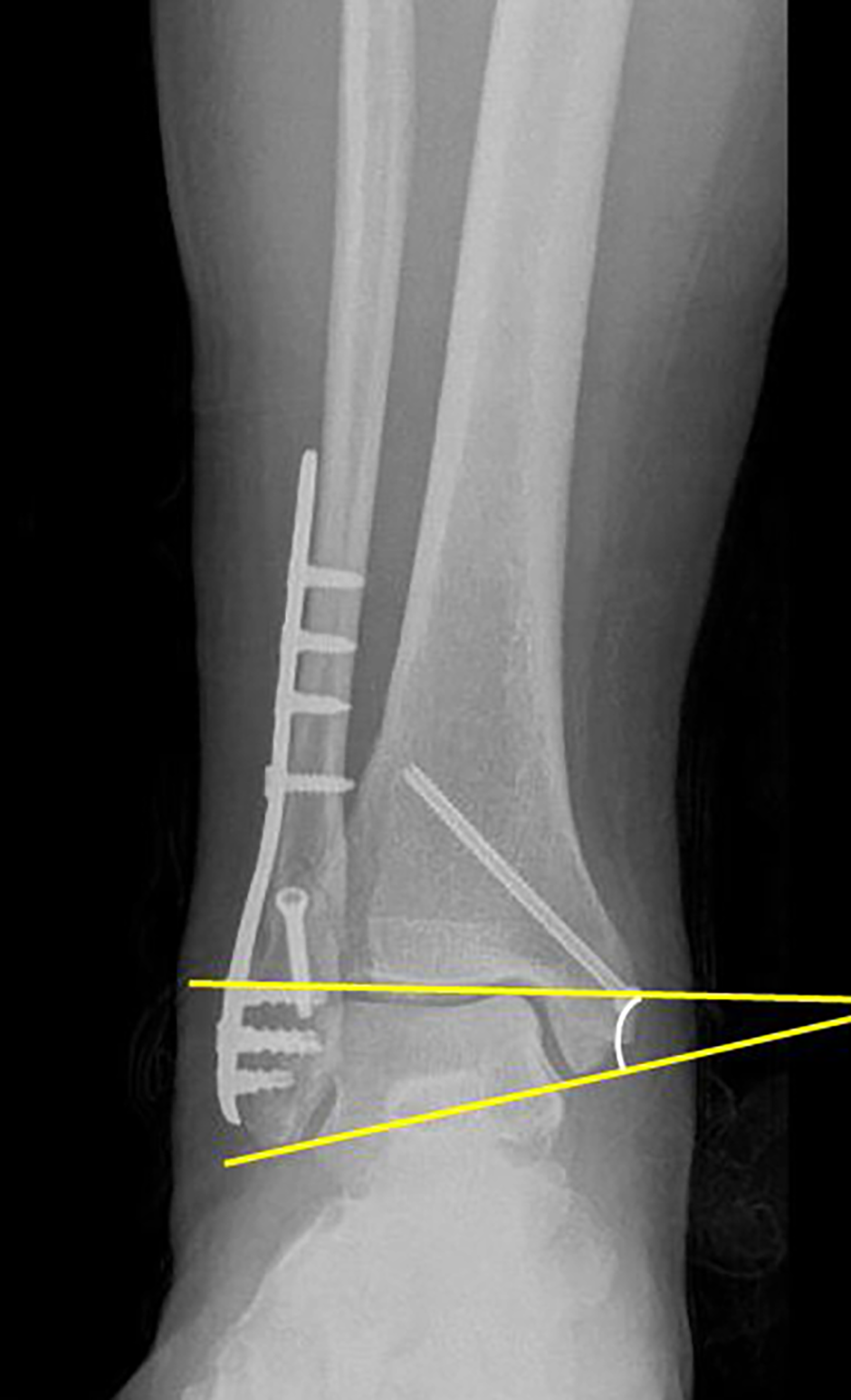
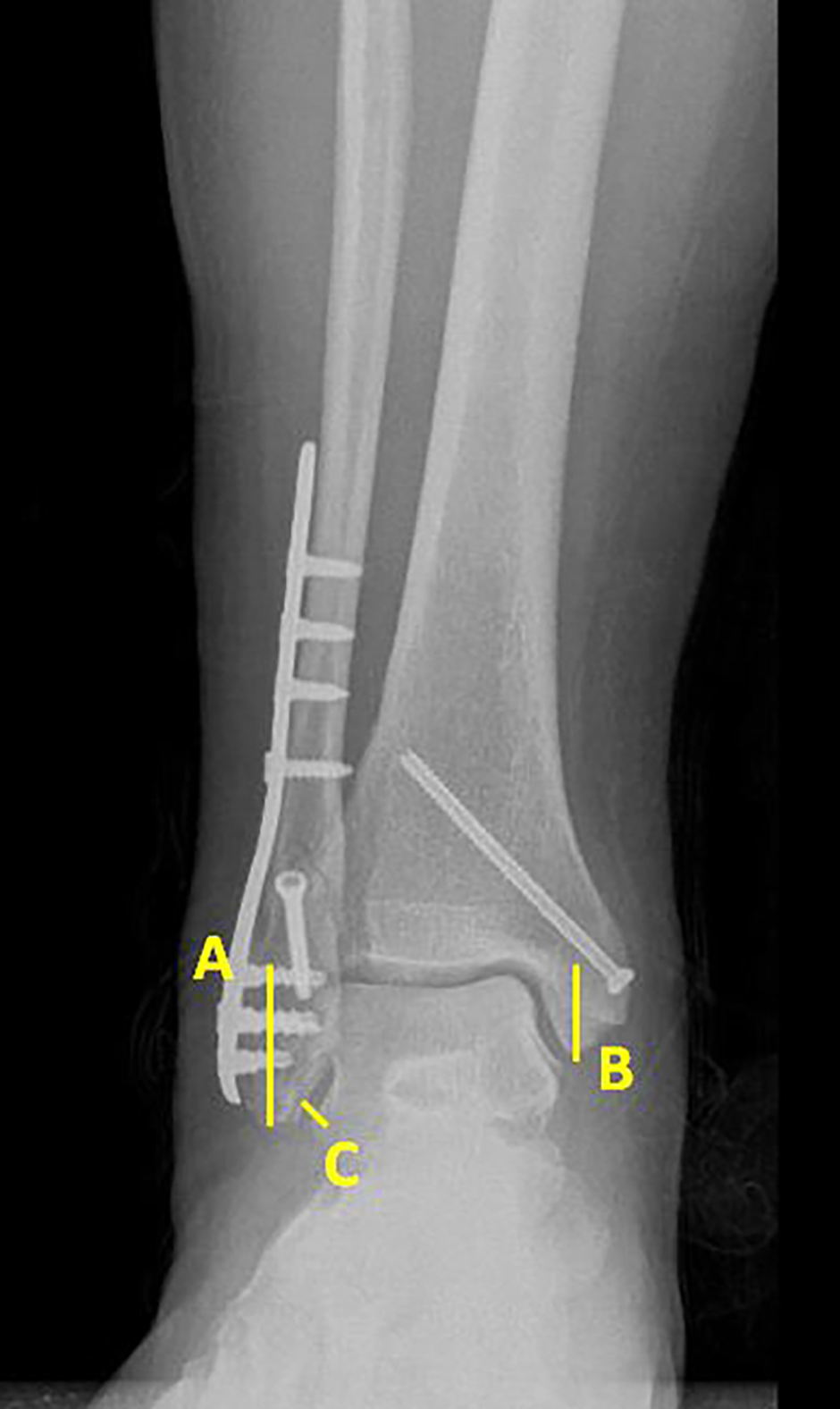
Four radiographic parameters were measured postoperatively on a standing whole-leg anteroposterior view of the ankle: talocrural angle (TCA), medial malleolar relative length (MMRL), lateral malleolar relative length (LMRL), and the distance between the talar dome and distal fibula. The TCA is the angle between the longitudinal axis of the tibia and a line connecting the tips of the lateral and medial malleoli (
Fig. 1). The LMRL is the ratio of the length of the lateral malleolus to the width of the talar dome, where the lateral malleolar length is the perpendicular distance between the lateral malleolar tips to the continuous line of the distal tibial articular surface (
Fig. 2, line A). The MMRL is the ratio of the length of the medial malleolus to the width of the talar dome, where the medial malleolar length is the perpendicular distance between the medial malleolar tip and the continuous line of the distal tibial articular surface (
Fig. 2, line B). The distance between the tip of the distal fibula and the talar process was also measured (
Fig. 2, line C).
Statistical Analyses
A statistical software program (IBM SPSS Statistics for Windows; IBM Corp, Armonk, New York) and a spreadsheet program (Microsoft Excel; Microsoft Corp, Redmond, Washington) were used for data analyses. Statistical significance was accepted at P < .05. Descriptive statistical methods (mean ± SD, median, frequency, ratio, and range) were used to evaluate the study data. The quantitative data were evaluated for normal distribution by Kolmogorov-Smirnov and Shapiro-Wilk tests and graphical evaluations. Student t and Mann Whitney U tests were used for comparison of two groups of quantitative data with and without normal distribution, respectively.
Results
A total of 374 patients were finally included. In the bimalleolar fracture group (group 2), the mean ± SD age of the 168 patients (112 men, 56 women) was 40.95 ± 15.9 years. In the lateral malleolar group (group 1), there were 117 and 89 patients in subgroups 1-A and 1-B with mean ± SD ages of 42.44 ± 16.43 and 39.3 ± 12.51 years, respectively. There was no significant difference between the groups (P = .66).
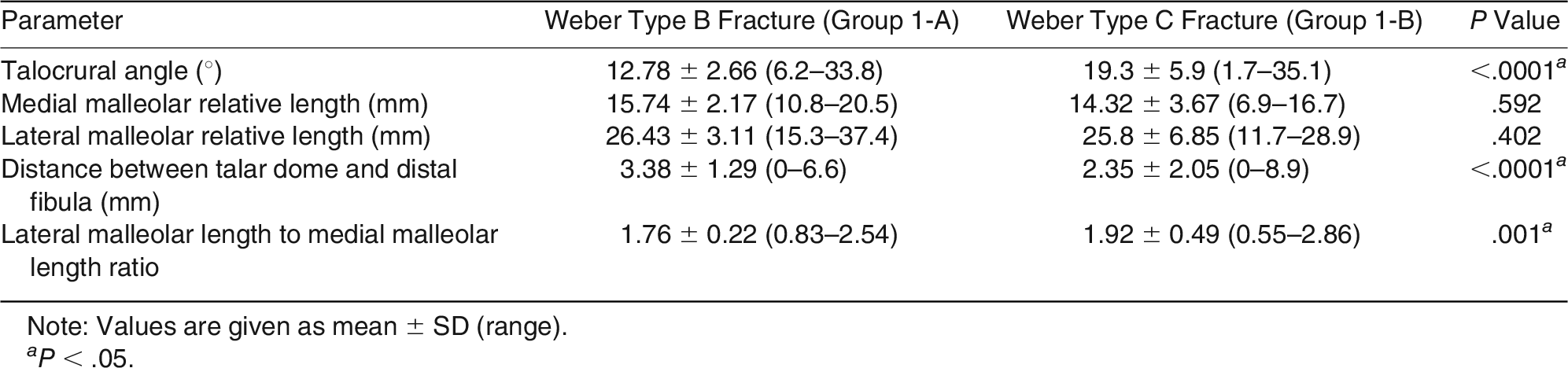
The mean ± SD values of the measured parameters in groups 1 and 2, respectively, were as follows: TCA, 12.68° ± 2.96° and 16.72°± 2.56°; MMRL, 11.47 ± 2.46 mm and 15.3 ± 2.88 mm; LMRL, 27.78 ± 3.2 mm and 26.2 ± 3.74 mm; and the distance between the tip of distal fibula and talar process, 2.94 ± 1.74 mm and 2.76 ± 2.2 mm. The mean ± SD lateral malleolar length to medial malleolar length ratio was 1.84 ± 0.35 in group 1 and 1.75 ± 0.18 in group 2 (
Table 1).
The values for TCA and MMRL were significantly higher in group 2 than in group 1 (P = .002 and P = .007, respectively). Lateral malleolar length to medial malleolar length ratio was significantly different between the two groups (P = .0096). There were no significant differences between the groups in terms of LMRL (P = .267) and the distance from the tip of the distal fibula and talar process (P = .452).
The mean ± SD values of the parameters in subgroups 1-A and 1-B, respectively, were as follows: TCA, 12.78° ± 2.66° and 19.3° ± 5.9°; LMRL, 26.43 ± 3.11 mm and 25.8 ± 6.85 mm; and MMRL, 15.74 ± 2.17 mm and 14.32 ± 3.67 mm. There were no significant differences in LMRL and MMRL between subgroups 1-A and 1-B (
P = .402 and
P = .592, respectively). However, there was a significant difference between the two groups in terms of TCA (
P < .0001). The mean ± SD lateral malleolar length to medial malleolar length ratio was 1.76 ± 0.22 in subgroup 1-A and 1.92 ± 0.49 in subgroup 1-B, and the difference was statistically significant (
P = .001). The distance between the tip of the distal fibula and talar process was significantly higher in subgroup 1-A (3.38 ± 1.29 mm) than in subgroup 1-B (2.35 ± 2.05 mm;
P < .0001) (
Table 2).
Discussion
Although risk factors in lateral radiographic measurements associated with ankle instability have been reported in the literature [
10,
11,
12,
13], limited studies have investigated the same for the measurements in the anteroposterior plane [
7,
9] Lee et al [
7] examined the difference between the radiographic measurements of sprains and lateral malleolar fractures. As the fibular length increased, an increased risk of fracture was observed. In the present study, there was no difference in the fibular length between groups A and B. This may be attributed to the fact that, contrary to the study by Lee et al [
7], we examined only patients with ankle fractures. In the same study, when the TCA was evaluated, they observed a difference between the lateral malleolar fracture and the sprain groups. Shorter length of the medial malleolus and longer length of the fibula were associated with higher risk of lateral malleolar fracture. In the present study, a relationship between medial malleolar length and medial malleolar fracture was found.
In a study evaluating the relationship between the distal tibia and distal fibula by Lee et al [
6], ligamentous injury was found to be related to the TCA. Similarly, we found a relationship between fracture and TCA in groups 1 and 2 and in subgroups 1-A and 1-B. Elise et al [
14] reported that the ratio between the lateral and medial malleolar length was a contributing factor for foot dislocation. In the present study, there was a significant difference regarding the length ratios between groups 1 and 2 and between subgroups 1-A and 1-B. We believe that there is a difference between the TCA and length ratio and the possibility of inversion instability of the talus after an ankle sprain.
Morphological studies have been performed for fifth metatarsal fracture of the foot. The relationship between metatarsal channel diameter, four to five metatarsal angles, metatarsal length, and fracture risk has been demonstrated. With this method, suitable shoe and orthosis planning can be made for athletes at risk [
15,
16]. By using the values obtained in the present study, we think that the use of shoes and orthotic devices can be improved according to the risk of ankle fracture.
Panchbhavi et al [
8] measured the distance between the lateral process of the talus and the tip of the distal fibula. In the radiographic evaluation, the distal tip of the fibula was proximal to the process. Similarly, we determined that the distal tip of the fibula was proximal to the lateral process of the talus. We also found that there was a significant difference between the lateral malleolar type B and C fractures in terms of the distance between the tip of the fibula and the talar process. Consequently, we think that the ligamentous strains between the talus and fibula are different after an ankle sprain. However, further biomechanical studies are needed to explore this subject. In the study by Sugimoto et al [
17], lateral ankle instability increased with TCA. We observed that the angles between groups 1 and 2 were significantly different. This may be attributed to the higher TCA in group 1 that led to higher risk of lateral instability.
To our knowledge, studies on the relationship between fracture pattern and ankle morphology are not available. In the present study, we aimed to overcome this gap in the literature. One of the missing aspects of this study is the fact that body mass index, neurologic deficits, and injury mechanisms were not evaluated because of the retrospective nature of the study. Moreover, biomechanics of the ankle that should be evaluated in three planes were evaluated in only the anteroposterior plane. In addition, trimalleolar and Weber type A fractures were not included in the study.
This is the first study to demonstrate that ankle morphology affects fracture pattern. We think that there is a need for clinical and biomechanical studies on standing computed tomography with larger sample sizes. Relationships among fracture formation mechanism, ligament damage, and morphology can be investigated, and studies on the relationship between osteochondral lesions of the talus and morphology are also needed.
Conclusions
In this study, we found TCA, MMRL, and lateral malleolar length to medial malleolar length ratio to be significantly higher in patients with bimalleolar fractures than in patients with isolated lateral malleolar fractures. Although patients with Weber type C fractures had significantly higher TCAs and lateral malleolar length to medial malleolar length ratios than patients with Weber type B fractures, the latter had significantly larger distances between the tip of the distal fibula and the talar process than patients with Weber type C fractures.