Hallux valgus is a common and disabling condition of the forefoot, characterized by lateral deviation of the great toe and medial deviation of the first metatarsal head. The most common clinical symptom is a painful bunion impinging against the shoe. Although over 100 open surgical techniques have been described for the treatment of hallux valgus, there is no consensus on the best method [
1].
The use of a minimally invasive surgical technique for hallux valgus is still controversial. Currently, minimally invasive distal metatarsal osteotomy is preferred by patients and surgeons because of the theoretical advantages, including reduced operative time, less postoperative pain, lower risk of wound complications, and cost-effectiveness [
2]. Minimally invasive distal metatarsal osteotomy for hallux valgus with fixation by a Kirschner wire was originally introduced by Bösch et al [
3]. Since then, other physicians have reported a high rate of good clinical and radiographic outcomes with their own modifications of the original technique [
2,
4–6]. Furthermore, some authors demonstrated that the clinical outcomes of modified Bösch osteotomy with a distal soft-tissue procedure for moderate to severe hallux valgus were comparable to those of other traditional procedures [
7,
8]. Conversely, other authors showed an unacceptably high rate of radiographic recurrence of deformity after using this percutaneous technique [
9,
10]. However, these previous reports did not use a validated patient-reported outcome measure (PROM). Therefore, it remains unclear whether this radiographic outcome after minimally invasive surgical technique is related to improved pain and daily functioning in patients with hallux valgus deformity.
The aim of the present study was to evaluate the clinical results of a modified Bösch osteotomy, or distal linear metatarsal osteotomy (DLMO), [
8,
11]. in the reconstruction of hallux valgus, using a validated PROM and the radiographic results of this procedure. The primary outcome was the difference in PROM score between before surgery and at the final follow-up. Secondary outcomes included the relationship between improvements in PROM score and radiographic corrections for hallux valgus deformity.
Materials and Methods
All patients provided written, informed consent as approved by the review board of our institution before surgery. The work has been approved by the appropriate ethical committees related to the institution where it was performed. A total of 140 consecutive patients (177 feet) who underwent DLMO between November of 2015 and September of 2019 at our hospital for symptomatic hallux valgus refractory to conservative treatment were prospectively enrolled. The exclusion criteria consisted of rheumatoid arthritis (n = 9), a history of previous surgery or trauma in the operated or contralateral forefoot (n = 19), incomplete questionnaires before surgery (n = 3), primary correctional operations for contralateral hallux valgus during the follow-up period (n = 16), and missing questionnaires at the more than 1 year after surgery follow-up (n = 23). After applying the exclusion criteria, 70 patients (97 feet) were included in the analysis. Mean patient age and body mass index at the time of operation were 60.2 years (range, 21–83 years) and 21.8 kg/m2 (15.2–33.2 kg/m2), respectively. Sixty-five patients were female and five patients were male. The mean follow-up duration was 20.3 months (range, 12–37 months). Twenty-seven patients (54 feet) received bilateral treatment simultaneously. Forty feet had distal open lateral soft-tissue release by means of a dorsal mini-incision. Metatarsal shortening osteotomies for dislocation or subluxation of the metatarsophalangeal joint (MPJ) in lesser toes were concomitantly performed in 24 feet.
Operative Technique
All operations were performed under general anesthesia. The mean operative time was 19.5 minutes (range, 7–67 minutes). Modified Bösch osteotomy was performed as described in the literature [
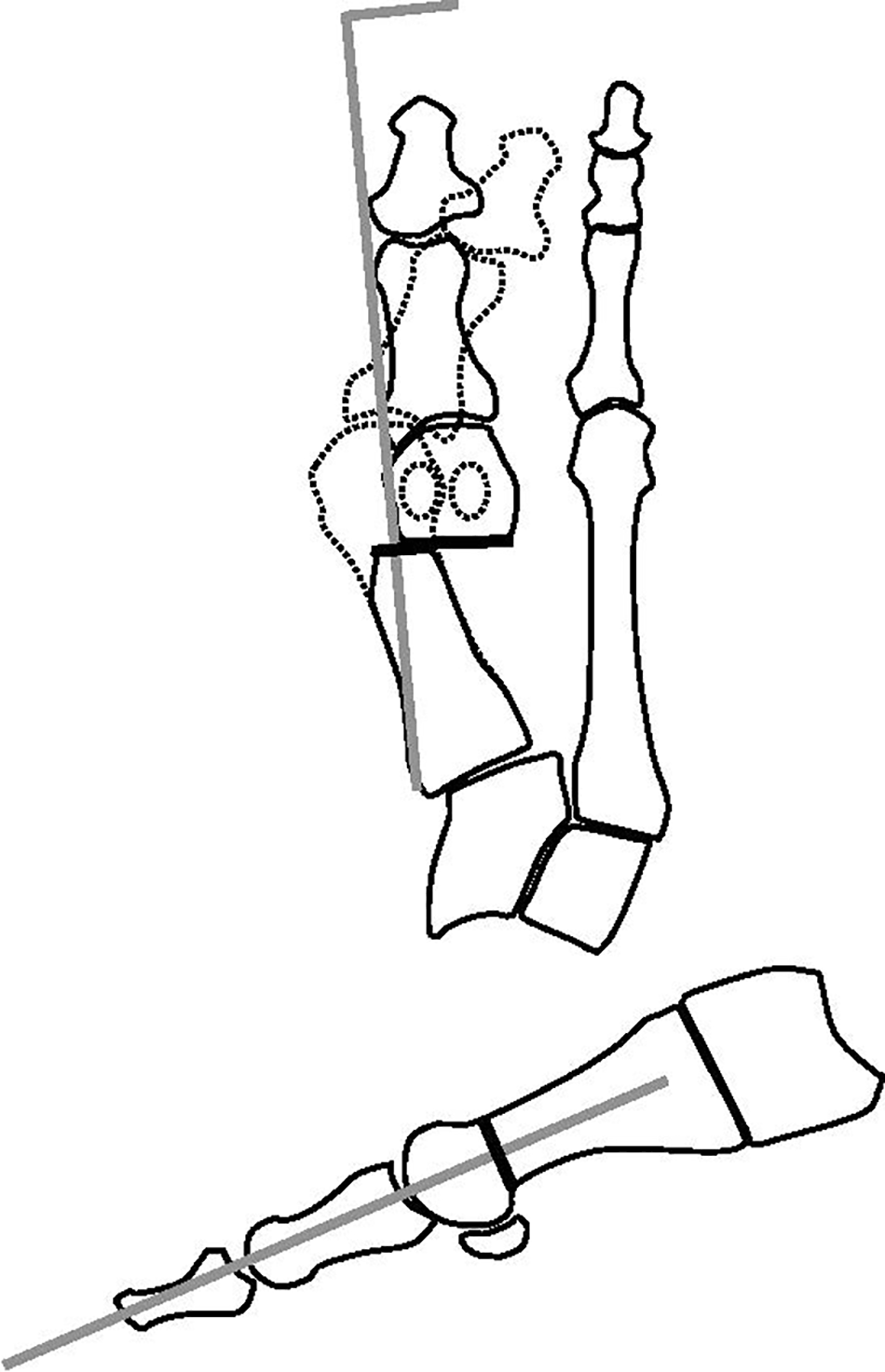
8]. All operations were performed by one of the two surgeons (H.S. or Y.S.). Distal lateral soft-tissue release around the first MPJ was performed at the same time for cases with severe lateral contracture around the first MPJ. Then, a 2-cm medial incision was made at the proximal level of the metatarsal head, and a 2.0-mm Kirschner wire was inserted under the skin in an antegrade direction. The osteotomy was performed using an oscillating saw and a chisel at the level of the first metatarsal neck, perpendicular to the shaft axis of the second metatarsal bone. After distal metatarsal osteotomy, the metatarsal head was shifted laterally, with simultaneous abduction of the proximal metatarsal fragment. Then, a Kirschner wire was inserted into the proximal fragment in a retrograde direction, so that it penetrated the medial cortex of the proximal metatarsal fragment. The prominence of the medial metatarsal shaft at the osteotomy site was trimmed by an oscillating saw before skin closure (
Fig. 1). Additional procedures were performed to address dislocation or subluxation of the MPJ in the lesser toes, including distal oblique shortening osteotomy of the metatarsal bone [
12]. with a 1.2-mm Kirschner wire for intramedullary metatarsal fixation.
Figure 1.
Distal linear metatarsal osteotomy. Broken line, preoperative bone margin; solid line, postoperative bone margin; thick solid line, osteotomy line; gray solid line, 2.0-mm Kirschner wire.
Figure 1.
Distal linear metatarsal osteotomy. Broken line, preoperative bone margin; solid line, postoperative bone margin; thick solid line, osteotomy line; gray solid line, 2.0-mm Kirschner wire.
Patients were allowed to walk on the day after surgery, using postoperative shoes that transferred weightbearing to the hindfoot. Ambulation on the entire plantar aspect of the foot without the operative shoes, and active range-of-motion exercises of the great toe, were commenced 4 weeks after surgery when the wire was removed. Normal ambulation and a passive range of motion were allowed from 8 weeks after surgery.
Measurements
Objective clinical outcomes and patient-centered clinical outcomes were assessed using the Japanese Society of Surgery of the Foot (JSSF) hallux scale [
13,
14]. and the Self-Administered Foot Evaluation Questionnaire (SAFE-Q), [
15,
16]. respectively. The JSSF score and the SAFE-Q were evaluated for their validity, reliability, and responsiveness by Niki et al [
14–16]. The SAFE-Q consists of 34 questionnaire items that assess scores on five subscales (1, pain and pain-related; 2, physical functioning and daily living; 3, social functioning; 4, shoe-related; and 5, general health and well-being, excluding the sports activity subscale). In patients who underwent bilateral simultaneous operations for bilateral hallux valgus deformities, the JSSF and SAFE-Q were evaluated for both feet separately and together, respectively. The JSSF hallux scale and the subscale scores of the SAFE-Q are scored from 0 to 100, respectively, with higher scores indicating better clinical outcomes.
The hallux valgus angle (HVA) and first intermetatarsal angle (IMA) were measured on weightbearing anteroposterior plain radiographs preoperatively and at the final follow-up. The longitudinal axis of the first metatarsal was defined as the line connecting the center of the metatarsal head with the proximal articulation [
17]. Recurrence was defined as the presence of an HVA greater than 20 degrees [
18]. Hallux varus was defined as the presence of an HVA less than 0 [
19]. The position of the tibial sesamoid was noted to be displaced if 75% of the sesamoid was lateral to the longitudinal axis of the first metatarsal [
18]. Subluxation of the first MTP joint (joint subluxation) was identified by deviation of the lateral border of the proximal articular surface of the proximal phalanx relative to the lateral border of the distal articular surface of the first metatarsal [
20]. All cases and feet were divided into three groups according to the type of HVA at the final follow-up: group N (without recurrence or hallux varus), group R (with recurrence), and group V (with hallux varus). There were no cases with both recurrence and hallux varus at the final follow-up among cases that simultaneously received bilateral treatment.
Statistical Analyses
The differences between preoperative and final variables were analyzed by the paired
t test for continuous variables and Fisher’s exact test for categorical variables. The values of effect size of SAFE-Q subscale scores were calculated by dividing the mean change between the preoperative score and the final follow-up score by the standard deviation of the preoperative score [
16]. Differences between the three HVA groups at the final follow-up were analyzed using nonrepeated one-way analysis of variance for continuous variables and Fisher’s exact test for categorical variables. Post hoc multiple comparisons were performed to assess differences between groups by the Tukey method for continuous variables and the Bonferroni method for categorical variables. All tests were two-sided, with a level of significance of
P < .05. Statistical analyses were performed using EZR (Saitama Medical Center, Jichi Medical University, Saitama, Japan), which is a graphic user interface for R (The R Foundation for Statistical Computing, Vienna, Austria). More precisely, it is a modified version of R Commander designed to add statistical functions frequently used in biostatistics [
21].
Results
Final follow-up JSSF hallux valgus scores (mean, 92.4; range, 59–100) showed a significant improvement over preoperative scores (mean, 62.2; range, 30–88) (
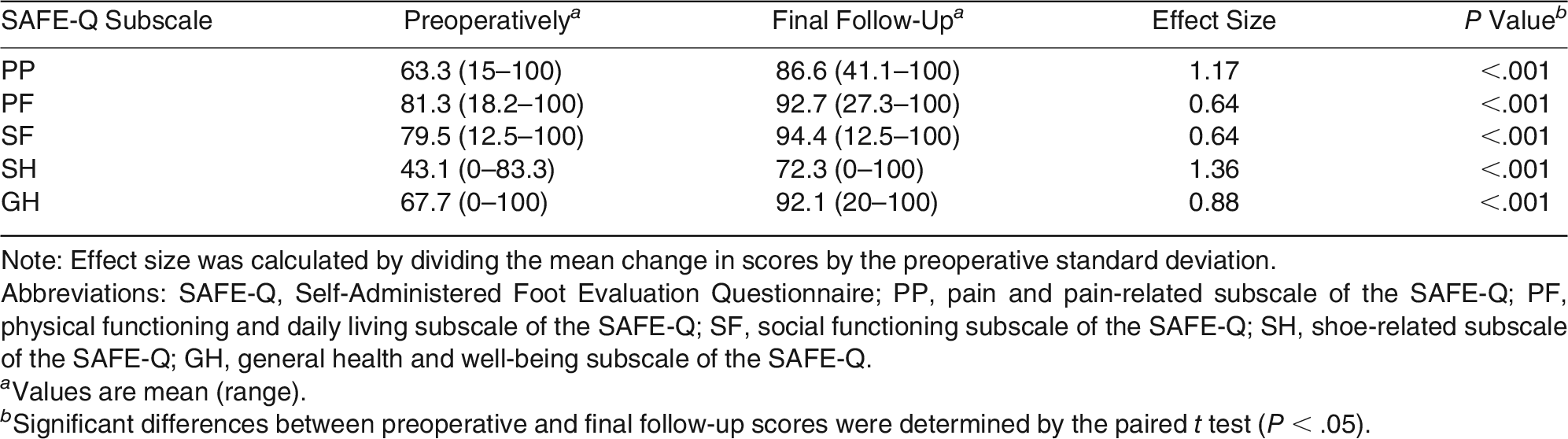
P < .001). All the SAFE-Q subscale scores were significantly improved at the final follow-up (
Table 1).
Table 1.
Self-Administered Foot Evaluation Questionnaire Scores Evaluated Preoperatively and at the Final Follow-Up (70 Cases)
Table 1.
Self-Administered Foot Evaluation Questionnaire Scores Evaluated Preoperatively and at the Final Follow-Up (70 Cases)
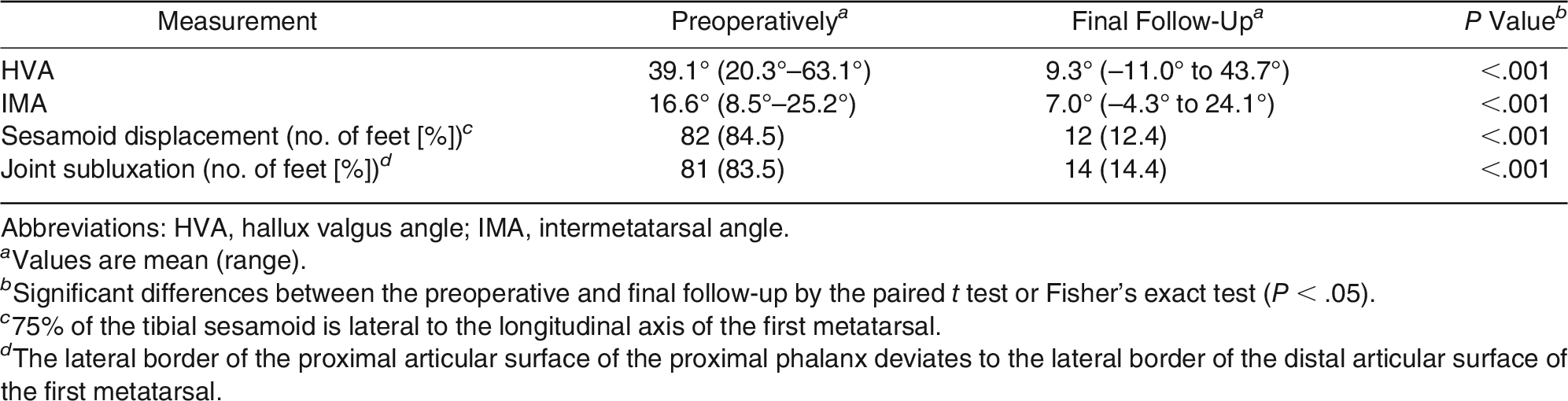
All feet showed decreases in HVA and IMA, corresponding with improvement of hallux valgus (
P < .001) (
Table 2). Recurrence of hallux valgus (range, 22.9°–43.7°) was observed in nine feet (9.3%), and hallux varus (range, –11.0° to –0.6°) occurred in 15 feet (15.5%).
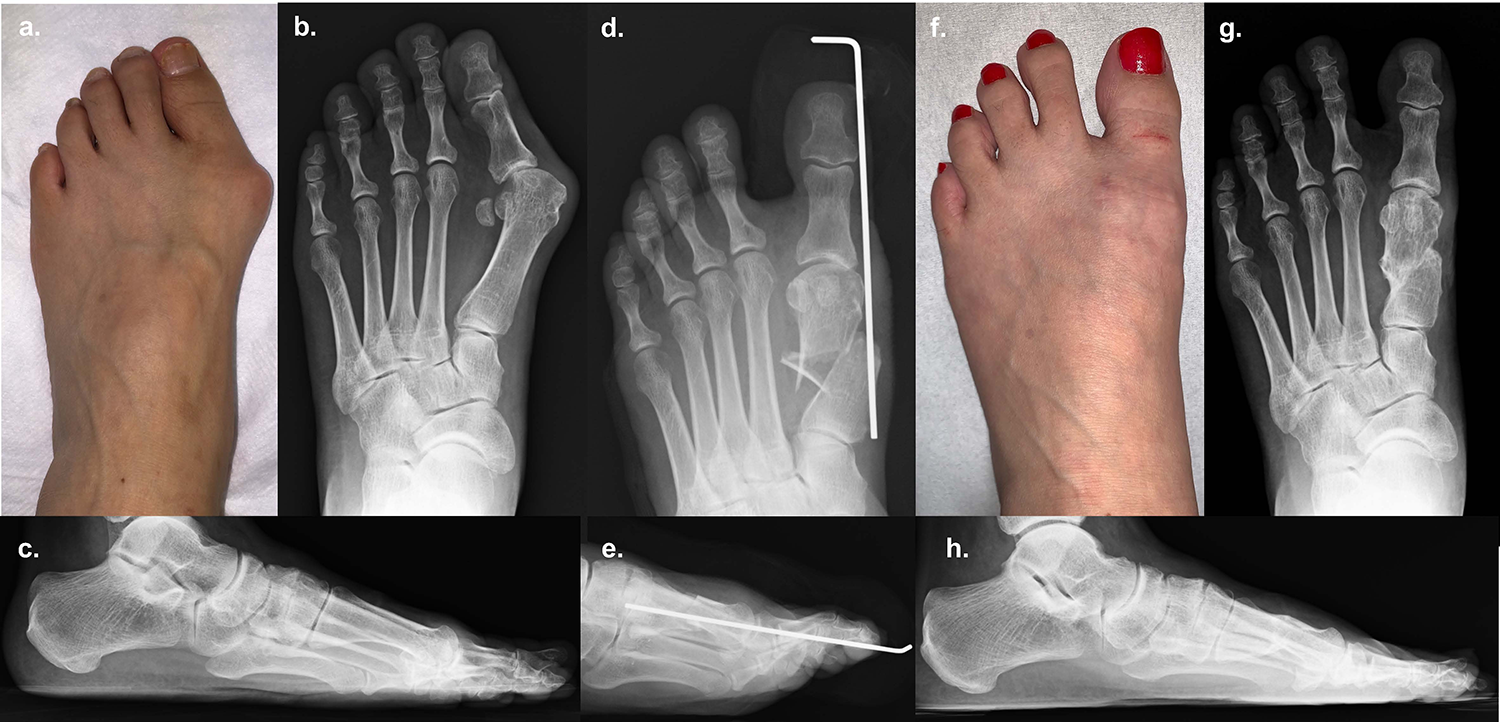
Figure 2 (A, B, and C) shows the preoperative, postoperative, and final follow-up radiologic appearances of a representative case with hallux varus after DLMO.
Figure 2.
Severe hallux valgus in a 50-year-old woman treated with distal linear metatarsal osteotomy showing preoperative appearance, dorsoplantar and lateral weightbearing radiographs (A–C). Postoperative dorsoplantar and lateral radiographs (D and E). Dorsoplantar and lateral weightbearing radiographs at the final follow-up (1 year) (F–H).
Figure 2.
Severe hallux valgus in a 50-year-old woman treated with distal linear metatarsal osteotomy showing preoperative appearance, dorsoplantar and lateral weightbearing radiographs (A–C). Postoperative dorsoplantar and lateral radiographs (D and E). Dorsoplantar and lateral weightbearing radiographs at the final follow-up (1 year) (F–H).
Table 2.
Radiographic Measurements (97 Feet)
Table 2.
Radiographic Measurements (97 Feet)
Two feet (2.1%) required revision surgery for recurrence with DLMO at 1 year after the primary surgery because of bunion pain. In two feet (2.1%) with postoperative metatarsalgia, shortening osteotomies of the second and third metatarsals for transfer metatarsalgia were performed 1 year after the primary surgery. The clinical and radiographic outcomes at the final follow-up in these cases were evaluated before the revision operations. In two feet (2.1%), skin irritations were observed around the medial prominence at the distal end of the proximal metatarsal fragment of the first metatarsal, and the residual part was excised under local anesthesia. Radiographic nonunion at the final follow-up occurred in two feet (2.1%). Both cases with nonunion had mild pain after walking a long distance and were treated using insoles. Nerve irritation occurred in one foot (1.0%). Postoperative osteoarthritis of the first MPJ was observed in two feet (2.1%). Complaints of nerve irritation and osteoarthritis were typically mild and required no treatment. Fatigue fractures of the fourth metatarsal or the talus bone occurred at 3 to 4 months after the surgery in three feet (3.1%). In all cases, pain at the fracture site disappeared and bone union was seen on radiographs obtained at 6 months after the surgery. None of the patients had avascular necrosis of the metatarsal head, infection, or delayed wound healing.
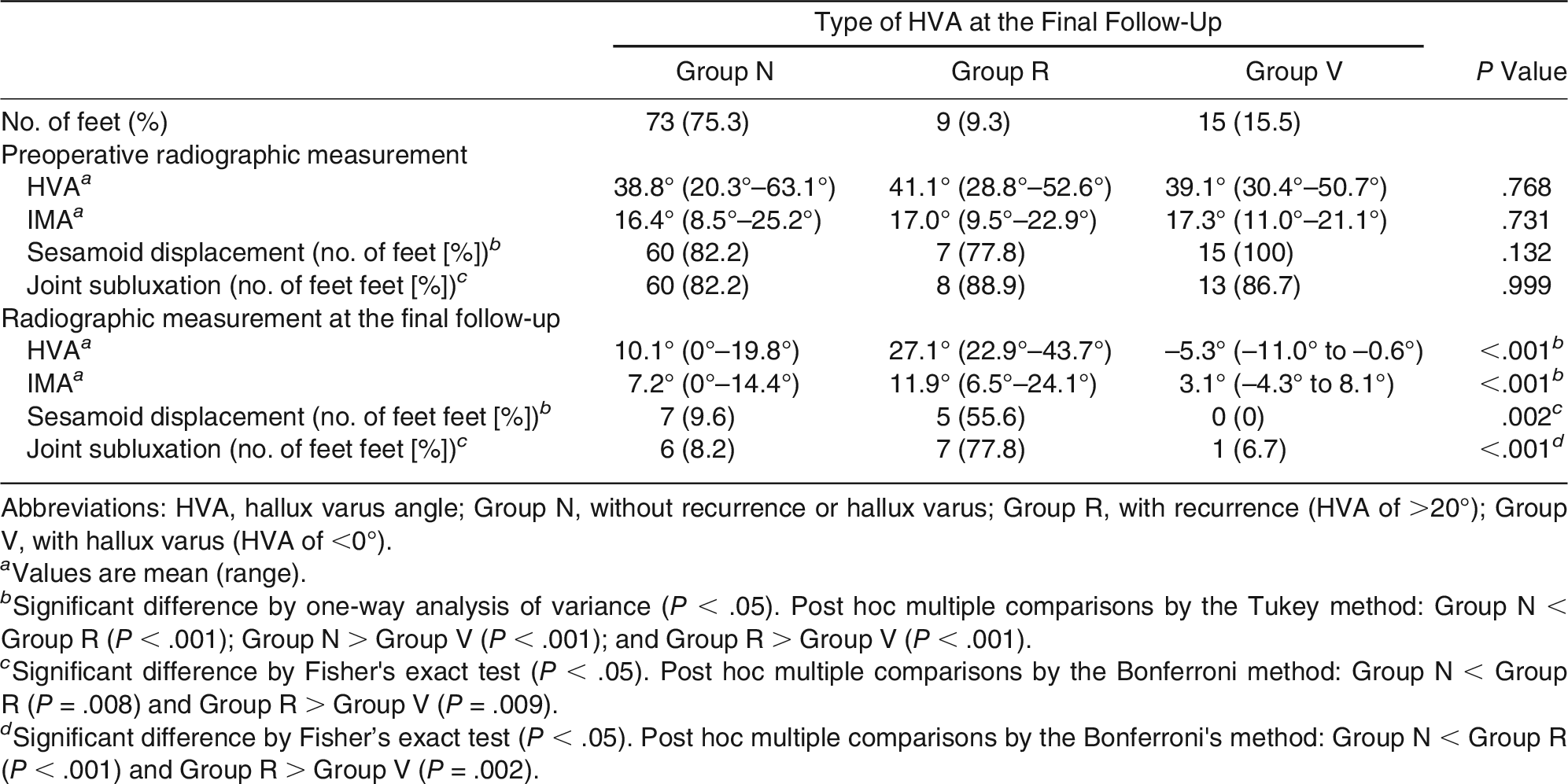
Differences in preoperative radiographic parameters between the three HVA groups at the final follow-up were not significant (
Table 3). Based on the analysis of the three groups, all SAFE-Q subscale scores, except for the physical functioning and daily living subscale, were significantly improved for patients in group V. The general health and well-being subscale score at the final follow-up was significantly higher in those with no recurrence and those with hallux varus than in those with recurrence (
Table 4).
Table 3.
Radiographic Data Stratified by the Type of Hallux Valgus Angle at the Final Follow-Up (97 Feet)
Table 3.
Radiographic Data Stratified by the Type of Hallux Valgus Angle at the Final Follow-Up (97 Feet)
Table 4.
Self-Administered Foot Evaluation Questionnaire Scores Preoperatively and at the Final Follow-Up Stratified by the Type of Hallux Valgus Angle at the Final Follow-Up (70 Cases)
Table 4.
Self-Administered Foot Evaluation Questionnaire Scores Preoperatively and at the Final Follow-Up Stratified by the Type of Hallux Valgus Angle at the Final Follow-Up (70 Cases)
Discussion
The Bösch procedure [
3]. and its modifications [
2,
5,
6]. are some of the major minimally invasive surgical techniques for treating hallux valgus [
22]. In previous studies, the DLMO procedure, which is a modification of the technique, was associated with good clinical results for mild to severe hallux deformities [
4,
8,
11]. Using the SAFE-Q as a validated PROM, the present study showed that DLMO enables successful achievement of improvement of pain and shoe-related disorders in patients with hallux valgus deformity. Furthermore, despite the fact that the rate of radiographic hallux varus after performing DLMO was not negligible, most of these hallux varus cases were not severe and had good congruity of the first MPJ. In fact, four of the five SAFE-Q subscale scores significantly increased postoperatively even in patients with hallux varus. As far as we know, this is the first study to demonstrate improvements in a validated PROM after the Bösch procedure and its modifications for hallux valgus deformity.
Distal linear metatarsal osteotomy resulted in a large effect size for all the SAFE-Q subscale scores in our study. Niki et al [
16]. investigated the responsiveness of the SAFE-Q among 100 patients assessed before and after hallux valgus surgery in a multicenter survey. In their report, the effect sizes for SAFE-Q subscale scores among 51 patients who responded with “much better” on an anchor question were calculated, respectively, as follows: pain and pain-related, 1.25; physical functioning and daily living, 0.67; social functioning, 0.73; shoe-related, 1.80; and general health and well-being, 0.96. The values of effect sizes for all the subscale scores in the present study were almost equal to these values. Several authors have reported in comparative studies between modified Bösch osteotomies and conventional open osteotomies, such as distal chevron osteotomy and scarf osteotomy, that the minimally invasive modified Bösch osteotomy provides objective clinical outcomes comparable to conventional techniques for the reconstruction of hallux valgus, with shorter operative time and less implant failure [
2,
5,
7]. Our findings indicated that the patient-reported clinical outcomes of the DLMO were equivalent to other techniques. In particular, we confirmed sufficient improvement of the shoe and shoe-related subscale score after DLMO in this study. We believe that a reason for the adequate improvement of this subscale score with DLMO is that capsulotomy of the first MPJ and excision of the medial bunion were not performed, leading to decreased stiffness of the MPJ and an easier fit of footwear or shoes.
Conversely, the radiographic correction of HVA in our study was unstable, as were those in previous reports on minimally invasive modified Bösch osteotomies for hallux valgus correction. Distal osteotomy has a limited ability to correct the IMA, because the deformity is corrected mainly by lateral translation of the metatarsal head. Therefore, distal osteotomy is typically indicated in patients with mild to moderate hallux valgus [
1]. Thus, most previous studies used modified Bösch osteotomies to treat mild to moderate hallux valgus (HVA less than approximately 40°; mean preoperative HVA range, 25°–32°) [
2,
4–6,
9,
10]. In contrast, the mean preoperative HVA in the present study (39.1°) was relatively high, because our indication for performing DLMO included severe hallux valgus. Only a few reports have expanded the indications of modified Bösch osteotomies to severe hallux valgus [
7,
8]. Ianno et al [
23]. reported a recurrence rate of 18.8% (mean preoperative HVA, 34.7°) and Chiang et al [
7]. reported a rate of 15.7% (mean preoperative HVA, 37.2°). Although the recurrence rate in our series (9.3%) was relatively lower than those of their studies, these radiographic results suggested that it is difficult to achieve a strict correction for severe hallux valgus deformities using our techniques. Considering the outcome of the PROM, a strict correction of HVA may not necessarily be necessary to improve the PROM.
In our study, SAFE-Q subscale scores were improved even in patients who developed hallux varus after DLMO. Postoperative hallux varus has only been reported in association with release of soft tissue combined with modified Bösch osteotomy [
7,
8]. The rate of hallux varus in the present study was relatively high (15.5%). This might be because of excessive resection of lateral soft tissue of the first MPJ. Postoperative hallux varus might cause patients to complain of cosmetic deformity, shoe-related issues, and pain [
19]. However, previous authors noted that the acquired hallux varus deformity is well tolerated by patients over the long term, and that only a higher degree of hallux varus deformity (16°–24°) is clinically troublesome [
24]. The values of effect size for SAFE-Q subscale scores, except for the physical functioning and daily living subscale, in patients with hallux varus in our study were almost equal or substantially higher compared with the values of effect size reported by Niki et al [
16]. The hallux varus in the present study was mild (range, 0.6°–11.0°) and did not include subluxation of the first MPJ in most of the feet. Mild hallux varus with congruity of the first MPJ might not be directly linked to pain of the hallux or shoe-related disorders. Indeed, previous studies showed that radiographic corrections did not correlate well with patient-centered clinical outcomes in hallux valgus surgery [
25]. Therefore, in the future, we should place increased emphasis on clinical results assessed using a validated PROM, and not only radiographic results.
There are several limitations to the present study. First, the present sample was relatively small because of the difficulty in obtaining complete survey responses both preoperatively and more than 1 year postoperatively from a number of patients. Second, the present study included cases that simultaneously underwent additional surgery for deformities of the other toes, which might have affected the results.
Conclusions
In conclusion, the present study investigating patient-reported outcomes of DLMO for hallux valgus by using a validated PROM (SAFE-Q) demonstrated that the DLMO procedure provided satisfactory improvement in patient-based clinical scores. In addition, although a relatively high rate of postoperative hallux varus was observed, the degree of hallux varus in these cases was not severe (at most, 11.0°) and good congruity of the first MPJ was obtained in almost all these cases. In fact, patients who developed varus showed a substantial improvement, similar to those who did not. Future work should consider what radiographic complications contribute to the best and worst patient-reported outcomes after hallux valgus surgery.