Surgical treatment of tibia pilon fractures continues to be quite challenging, considering the various different surgical approaches, the ongoing debates about the necessity of single or staged surgery protocols, and the presence of many factors affecting the clinical and radiologic results (eg, quality of reduction, duration of surgery, and appropriate soft-tissue coverage) [
1–6]. Although it has been shown in the literature that the most important parameter affecting the results of tibia pilon fractures is the reduction quality, there are many other parameters affecting fracture healing and its clinical projection [
1,
4,
6,
7]. The effects of fracture crack width or displacement degree on fracture healing and functional results have previously been investigated in different fracture types [
8]. Jiang et al. [
9]. have investigated the relationship between fracture displacement and nonunion rates in subtrochanteric femur fractures and have found a significant correlation between the two. Rakonjac and Brdar [
10]. have stated that initial fracture crack width is associated with stability, risk of secondary dislocations, and choice of treatment in pediatric humerus supracondylar fractures. De Iure et al, [
11]. in their study of 121 thoracolumbar burst fractures, have found that vertebral body spread is an objective indicator for posterior construct failure. In contrast, to our knowledge, the relationship between fracture crack width or displacement and clinical outcomes in tibia pilon fractures has not been investigated before in the literature. Our objective was to investigate the effect of initial fracture crack width and displacement degree on clinical functional results in tibia pilon fractures.
Methods
After institutional review board approval, patients who were operated on for tibia pilon fractures between 2017 and 2019 were examined. Patients with open fractures, previous lower extremity fractures, and coexisting tibial shaft fractures, and patients who were treated with staged surgery protocols or who were lost to follow-up, were excluded from the study. Considering the exclusion criteria, 40 patients were evaluated.
All patients were operated on with open reduction and internal fixation using the extensile anteromedial approach, as defined in the literature [
5]. Fractures of the distal fibula, if available, were treated with open reduction and internal fixation with a second incision, using the standard lateral approach [
12]. All operations were conducted by the same surgical team. Weightbearing was not allowed postoperatively for the first 6 weeks; afterward, controlled weightbearing was initiated. Full weightbearing was not approved before 2 months and appropriate bone healing was observed on radiography.
The demographic data of the patients, injury mechanisms, fracture type, reduction quality, clinical results, and postoperative complications were recorded. Fracture type was classified according to the Arbeitsgemeinschaft für Osteosynthesefragen and Orthopaedic Trauma Association classification [
13]. The Ovadia-Beals Score (OBS) was used to evaluate the reduction quality by means of the radiographs taken postoperatively, using the criteria of displacement of malleolus, mortise widening, and talar tilt; and qualified as good, fair, or poor, in line with the literature [
14,
15]. To evaluate clinical outcomes, the Maryland Foot Score (MFS) was used [
16]. During their last follow-up, using the subscales of pain and function and assessing the gait, limp, stability, and need for support, patients were qualified as excellent, good, average, or poor, according to this scoring system [
16,
17].
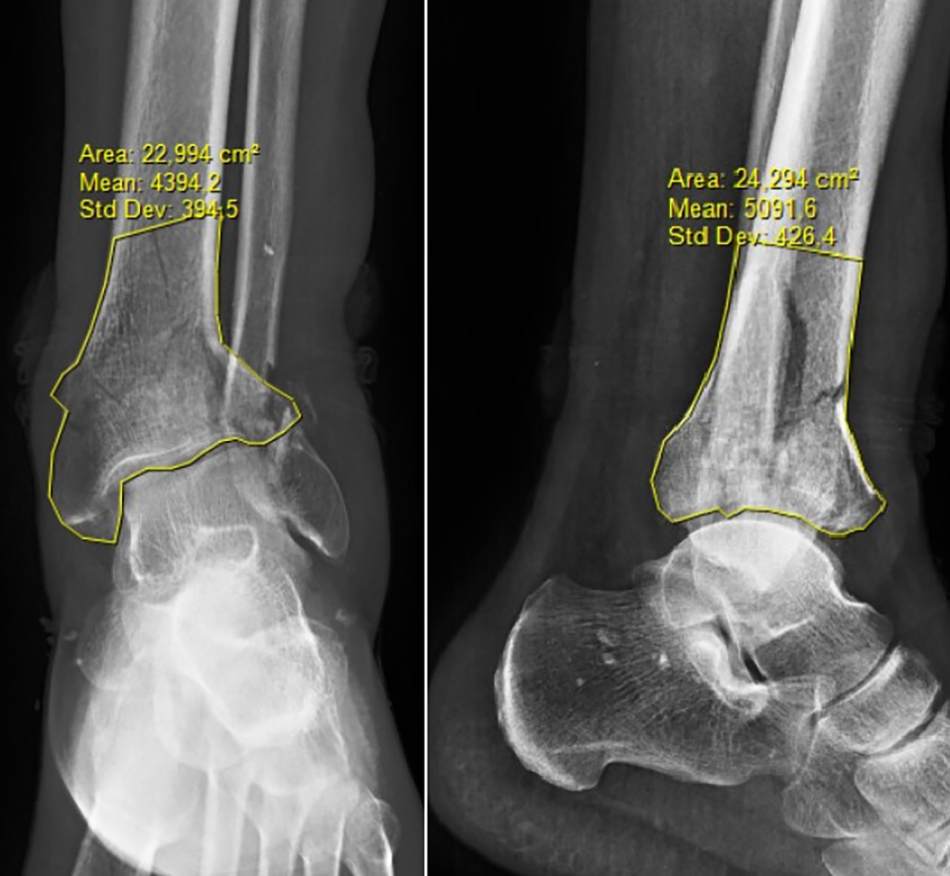
To evaluate the objective quantity of initial fracture crack width and displacement, a new parameter was defined: “fracture area.” Fracture area measurements were conducted by a single surgeon (B.G.), using the feature from a picture archiving and communication system (PACS), on anteroposterior and lateral radiographs obtained separately in standard fashion, taken from a source image receptor distance of 100 cm [
18,
19]. Measurements were carried out by determining the fracture line of the tibia pilon and adhering to the borders of the fracture fragments, and by drawing an imaginary line that connects the borders proximally where the fracture line ends, parallel to the distal tibia joint surface (
Fig. 1). Measurements made in this way were intended to cover the width of cracks of the fracture fragments (
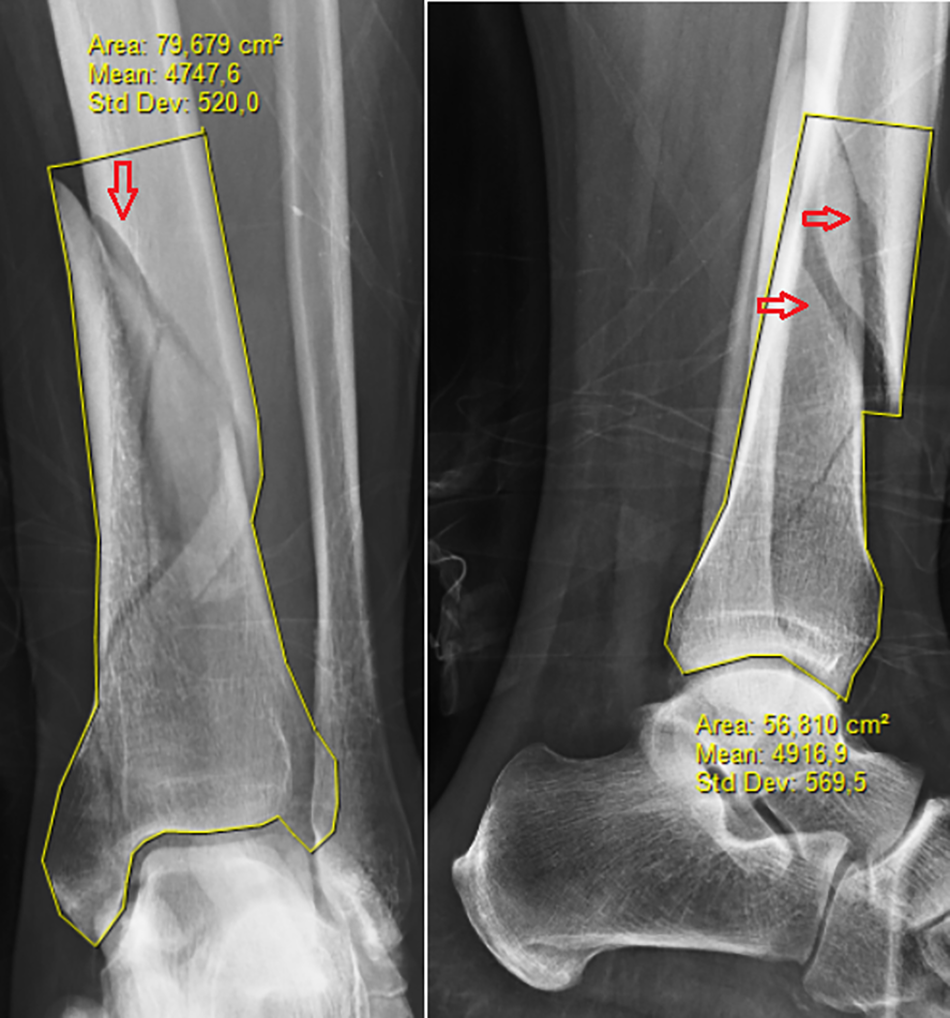
Fig. 2). All measurements were carried out from radiographs taken immediately after the patients were admitted to the emergency department and were considered as centimeters squared, according to the PACS. Total fracture area was calculated by summing the measurements made according to the anteroposterior and lateral radiographs.
Figure 1.
Anteroposterior and lateral preoperative radiographs of a 22-year-old male patient. The fracture area is measured as 22.99 cm2 on the anteroposterior radiograph and 24.29 cm2 on the lateral radiograph using the standard feature of the picture archiving and communication system. As seen in the figure, the upper limit of the fracture area was determined as the end point of the fracture line and parallel to the joint line.
Figure 1.
Anteroposterior and lateral preoperative radiographs of a 22-year-old male patient. The fracture area is measured as 22.99 cm2 on the anteroposterior radiograph and 24.29 cm2 on the lateral radiograph using the standard feature of the picture archiving and communication system. As seen in the figure, the upper limit of the fracture area was determined as the end point of the fracture line and parallel to the joint line.
Figure 2.
Anteroposterior and lateral preoperative radiographs of a 35-year-old male patient. It is seen that the measured fracture area covers the crack width between fracture fragments.
Figure 2.
Anteroposterior and lateral preoperative radiographs of a 35-year-old male patient. It is seen that the measured fracture area covers the crack width between fracture fragments.
Statistical analyses were performed using IBM SPSS Version 26.0 software (IBM Corp, Armonk, New York). The compliance of the variables to normal distribution were examined by visual (histogram and probability graphs) and analytical (Kolmogorov-Smirnov and Shapiro-Wilk tests) methods. Median and interquartile range were used as descriptive statistics for skewed distributed variables, whereas mean and standard deviation were used for the normally distributed variables. The paired samples t test and the Wilcoxon signed ranks test were used for comparing noncategorical variables. The χ2 test was used to compare categorical data. When the observed values did not meet the χ2 assumption, Fisher’s exact test was used. Cases in which P < .05 were considered significant.
Results
With an average follow-up period of 29.2 months (range, 24–40 months), 34 patients (85%) had excellent or good results, whereas only two patients (5%) had poor clinical results. All patient characteristics, recorded complications, and other demographic data are shown in
Table 1.
Table 1.
Demographic Profile of the Patients
Table 1.
Demographic Profile of the Patients
Age, injury mechanism, and reduction quality have a significant relationship with Maryland Foot Score (
P < .001,
P < .037, and
P < .001, respectively). Detailed analysis regarding factors affecting MFS are shown in
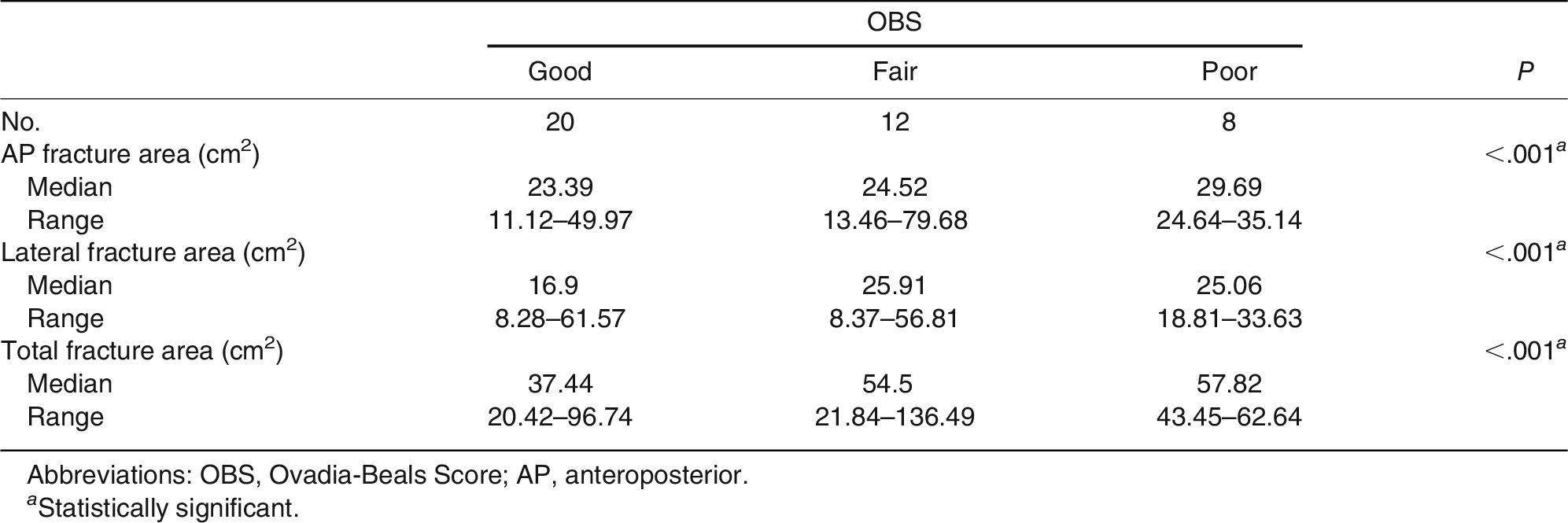
Table 2. Preoperative fracture area, measured in both anteroposterior and lateral views, are significantly related with both OBS and MFS (
P < .001 for each) (
Tables 3 and
4).
Table 2.
Factors Affecting the Maryland Foot Score
Table 2.
Factors Affecting the Maryland Foot Score
Table 3.
Relationship Between Fracture Area and Ovadia-Beals Score
Table 3.
Relationship Between Fracture Area and Ovadia-Beals Score
Table 4.
Relationship Between Fracture Area Measurement and Maryland Foot Score
Table 4.
Relationship Between Fracture Area Measurement and Maryland Foot Score
Among the 40 patients, 10 (25%) had skin necrosis and three (7.5%) had superficial infections. Soft-tissue problems were treated with serial dressing changes, close wound-site follow-up, and administration of intravenous and local antibiotic therapy. None of the patients required any debridement or secondary operations. During the follow-up period, one patient (2.5%) had deep vein thrombosis, treated with anticoagulant therapy at therapeutic dose, in accordance with the guidelines. No other complications were observed in any patients.
Discussion
Covering 1% of all fractures, tibia pilon fractures are associated with high complication rates, decreased quality of life, and gait and balance problems in mid- and long-term results [
4,
15,
20–22]. Mauffrey et al. [
23]. reported that only 28% of patients with treated tibia pilon fractures could return to their pain-free daily life in the long term. Considering all this information, although many factors such as reduction quality and soft-tissue coverage have been identified, researchers continue to investigate the factors that affect healing in tibia pilon fractures. Although there are several studies investigating the relationship between fracture healing and the initial degree of displacement or fracture crack width, to the best of our knowledge, there is no study in the literature investigating the relationship between these parameters and clinical results of tibia pilon fractures. This is the main strength of our study. Our most important finding was that initial fracture area had a significant relationship with not only OBS but also MFS (
P < .001 for each). Furthermore, we have found a significant relationship between MFS and age, injury mechanism, and reduction quality (
P < .001,
P = .033, and
P < .001, respectively).
We have found a significant relationship between increased preoperative anteroposterior, lateral, and total fracture area and MFS (
P < .001 for each). Given that fracture area is related directly to initial crack width, it is a plausible hypothesis that crack width is related to the clinical outcomes in tibia pilon fractures. Our findings are consistent with the literature. Jiang et al. [
9]. have concluded that fracture displacement more than 2.2 cm is correlated with nonunion in subtrochanteric femur fractures. Rakonjac and Brdar [
10]. have emphasized that fracture crack width more than 2.5 mm is correlated with instability and secondary dislocations in pediatric humerus supracondylar fractures [
10]. A meta-analysis, conducted by Santolini et al. [
8]. has revealed that initial fracture displacement degree and fracture crack width are correlated with fracture union [
8]. There are many parameters that can explain this relationship. First and foremost, as a result of the increased fracture area, reduction becomes more difficult and the reduction quality diminishes (
Table 3). According to the literature, reduction quality plays a key role in the healing of tibia pilon fractures [
4,
24]. Consistent with the literature, a significant relationship was found between the OBS and MFS of the patients in our study (
P < .001). Therefore, the increased fracture area may have an impact on clinical outcomes by making reduction difficult and reducing the quality of reduction. Second, as the displacement, crack width, and amount of fragmentation of the fracture increases, the medial and lateral supports of the fracture weaken and the stress on the implant increases, which affects fracture healing [
9]. Moreover, increased fracture area may also be associated with a prolonged inflammatory process and, consequently, delayed fracture healing. Finally, considering that one of the most important factors in fracture healing is adequate blood supply to the fracture site, factors related to local blood flow, such as disruption of the anatomy caused by increased crack width and fragmentation, directly affect fracture healing [
15].
High-energy injury mechanisms, which results in the fracture comminution and soft-tissue problems, play an important role in healing of tibia pilon fractures [
2,
5,
15,
25,
26]. Our study consisted of 18 basic falls (45%) and 22 high-energy injuries (55%), with a significant difference found between them in terms of clinical functional results (
P = .033). Furthermore, we have found a significant relationship between older age and poor clinical results (
P < .001). Our findings are consistent with the literature, considering advanced age is an important systemic parameter in fracture healing [
26].
Although tibia pilon fractures are associated with lateral malleolus fractures at a rate of 75% to 85%, isolated tibia pilon fractures with an intact fibula may occur if the ankle is at neutral or varus position during the injury [
27]. Barei et al. [
28]. have reported that tibia pilon fractures with fibular fractures are more severe than isolated tibia pilon fractures in radiologic terms. In our study, 31 patients (77.5%) had lateral malleolus fractures, treated with distal fibula locking plates, whereas nine patients (22.5%) had isolated tibia pilon fractures, and no significant relationship was found between the existence of lateral malleolus fracture and clinical functional results (
P = .249).
Wound closure defects, skin necrosis, and superficial infections are the most feared complications after tibia pilon fracture operations, with an incidence of 0% to 55% [
15,
29]. Carbonell-Escobar et al, [
24]. in their study of 92 tibia pilon fractures, have reported 12 (13%) soft-tissue infections and seven (7.6%) skin necroses. In their study of 41 tibia pilon fractures, Baser et al. [
15]. have reported two patients (4.8%) with skin necrosis and three patients (7.3%) with superficial infections. In our study, 10 patients (25%) had skin necrosis and three patients (7.5%) had superficial infections. Our relatively higher rate of skin necrosis may be explained by our preference of surgical approach, considering the significant relationship between skin necrosis and the extensile anteromedial approach [
5,
24]. In contrast, exclusion of open fractures may have affected our infection rates.
There are several limitations in our study. First and foremost, there are too many confounding factors regarding fracture healing that we did not take into account, such as nutrition, comorbidities, and smoking. Further studies containing larger sample sizes and detailed subgroup analyses, taking all factors into account, may yield better results. Second, different treatment protocols such as staged operations or the choice of different surgical approaches may have different effects on clinical results. Finally, all fracture areas were measured from the direct radiographs, using the feature of the PACS. Alas, it is not possible to evaluate the quantity of axial displacement with only anteroposterior and lateral radiographs. Advanced imaging studies that can also evaluate axial alignment and displacement and make more objective measurements, such as three-dimensional computed tomographic modules, may reveal different results.