Next Article in Journal
Letter to the Editor
Previous Article in Journal
An Unusual Pediatric Manifestation of the Herpes Simplex Virus
 
 
Journal of the American Podiatric Medical Association is published by MDPI from Volume 116 Issue 1 (2026). Previous articles were published by another publisher in Open Access under a CC-BY (or CC-BY-NC-ND) licence, and they are hosted by MDPI on mdpi.com as a courtesy and upon agreement with American Podiatric Medical Association.
Article

Heel Spur and Radiotherapy: Case Report and Systematic Literature Review

by
Antonio Piras
1,
Luca Boldrini
2,3,
Calogero Rinaldi
4,
Antonella Sanfratello
5,
Andrea D’Aviero
2,*,
Angelo Toscano
6,
Tommaso Angileri
7,
Massimiliano Spada
8 and
Antonino Daidone
1
1
Unità Operativa Radioterapia Oncologica, Villa Santa Teresa, Bagheria, Palermo, Italy
2
Unità Operativa Complessa Radioterapia Oncologica - Fondazione Policlinico Universitario Agostino Gemelli IRCCS, Dipartimento di Diagnostica per immagini, Radioterapia Oncologica ed Ematologia, Rome, Italy
3
Università Cattolica del Sacro Cuore, Rome, Italy
4
Unità Operativa Fisica Sanitaria, Villa Santa Teresa, Bagheria, Palermo, Italy
5
kUniversità degli Studi di Palermo, Radioterapia Oncologica, Palermo, Italy
6
General Orthopaedic Surgery, Rizzoli-Sicilia Department, Rizzoli Orthopaedic Institute, Bagheria, Palermo, Italy
7
Unità Operativa Radiologia, Villa Santa Teresa, Bagheria, Palermo, Italy
8
Unità Operativa Oncologia, Fondazione Istituto G. Giglio, Cefalù, Palermo, Italy
*
Author to whom correspondence should be addressed.
J. Am. Podiatr. Med. Assoc. 2022, 112(4), 21090; https://doi.org/10.7547/21-090
Published: 1 July 2022

Abstract

Heel spur is a chronic inflammatory condition causing pain and other typical symptoms. Therapeutic recommendations include the use of several drug or orthotic/physical therapies, performed alone or in combination. Surgery is usually reserved for refractory conditions. Radiotherapy has been shown to ensure good clinical outcomes in this clinical setting. A systematic review was performed to describe the feasibility and effectiveness of radiotherapy in the treatment of heel spur, evaluating its role in alleviating pain and consequently ensuring a better quality of life. A case report of 45-year-old patient treated for refractary right hindfoot pain was reported. A single fraction of 6 Gy RT was delivered with symptomatic complete response at 2 months observed. A systematic database search was conducted according to PRISMA (Preferred Reporting Items for Systematic Reviews and Meta‐Analyses) guidelines. The systematic review included studies describing heel spur treatment and providing complete information about radiotherapy. Fifteen articles published between 1996 and 2020 were reviewed. Study characteristic analysis resulted in seven prospective randomized studies and eight retrospective studies. Radiotherapy of painful heel spur seems to be safe and effective, with high response rates even at low doses and with an overall favorable toxicity profile. Predictive parameters and modern tailored treatment should be investigated with further studies.

Radiotherapy (RT) has been historically applied with benefit to several benign conditions. Nevertheless, due to the risk of secondary cancer development, particularly in young patients, its use in benign settings has progressively been abandoned even if it continues to be routinely used in some countries, such as the United States, the Czech Republic, and Germany [1–5].
Despite the scarce current literature data, the impetuous technological development of RT to date allows better dose conformation solutions, reducing treatment-related toxicities and the risk of radiation-induced secondary tumors. Furthermore, recent innovations in surgical techniques and systemic therapies could lead to lowering the need for RT, resulting in widening the possibility of RT application in benign pathologic conditions with a more acceptable risk profile. A recent British review updated the evidence about the effectiveness of RT for benign diseases and recommended specific treatment protocols [6].
The increasing scientific interest in this unusual topic is proved by the growing number of publications about the RT management of benign conditions such as keloids, acoustic schwannomas, and heterotopic ossifications [7–9]. Among others, the use of stereotactic ablative RT for cardiac arrhythmias represents one of the most innovative and recent benign RT applications [10–12].
The rationale of using RT for benign conditions relies on two different mechanisms: antiproliferative and anti-inflammatory. For example, the antiproliferative effect may reduce the risk of heterotopic ossification after hip replacement, and the anti-inflammatory effect can successfully treat inflammatory soft-tissue conditions such as Graves eye disease or arthritis [6]. Theoretically, both mechanisms may be associated with the benefits observed with RT of heel spur (HS).
The origin of HS is thought to be related to repetitive traumas that produce micro lacerations in the plantar fascia, specifically at its attachment with the HS. The attempted repair mechanisms then lead to the onset of a subchronic inflammatory status, causing pain and other typical symptoms [13,14].
Therapeutic recommendations include the use of orthotic devices, corticoid infiltrations, systemic or local administration of anti-inflammatory drugs, and ultrasound or laser physical therapy, all considered alone or in a wide range of combinations.
Surgical procedures are burdened by the possibility of serious adverse effects such as impaired walking, numbness of the back of the foot, or wound dehiscence that can lead to higher risks of calcaneus fractures and should, therefore, be reserved only for cases refractory to conservative treatment [13,15–20].
A systematic review of the literature in PubMed and EMBASE was performed using the search terms heel spur AND radiotherapy. Papers published between January 1990 and January 2021 were included in the analysis. Prospective and retrospective clinical studies, case reports, and case series describing HS treatment and providing complete information about RT were included.
Articles were excluded that did not focus on HS management or exclusive RT, did not report enough details of the RT, or were written in languages other than English and/or published before 1990. The search was performed following PRISMA (Preferred Reporting Items for Systematic Reviews and Meta‐Analyses) guidelines [21].
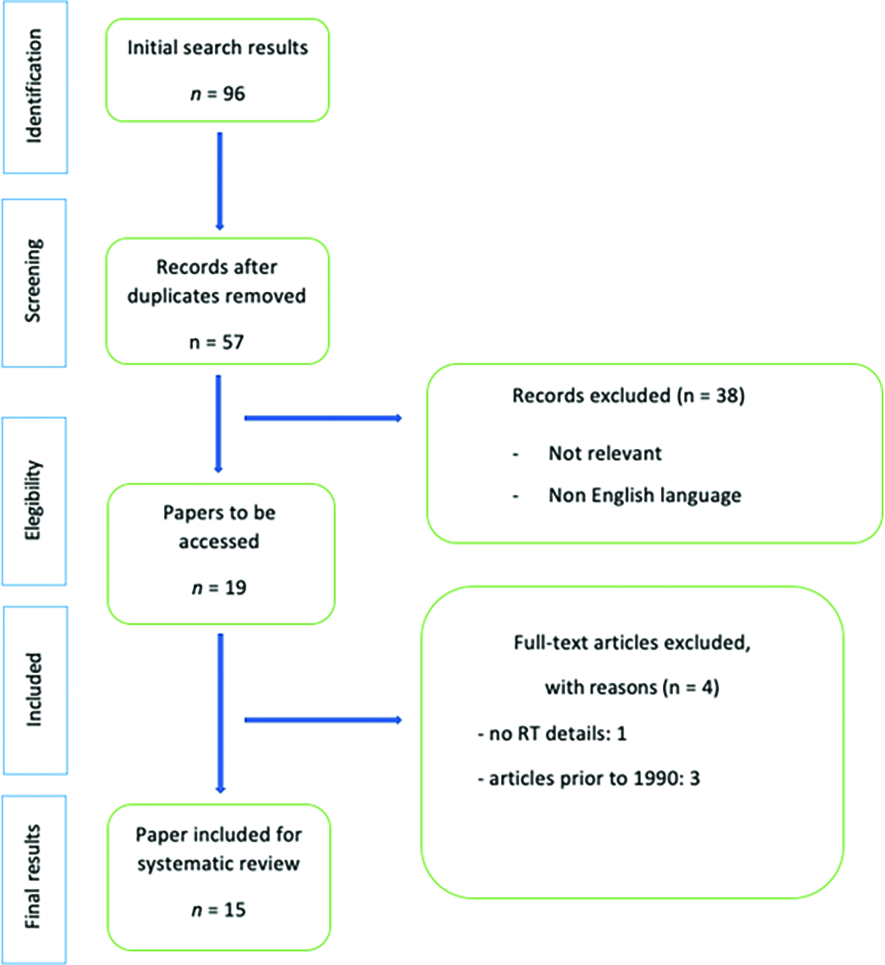
Of 96 articles initially collected, 39 were duplicates and were excluded and 57 were further analyzed. At first-level screening, 38 papers were excluded because the title and abstract were considered not relevant to HS RT or the articles were not written in the English language. Of the 19 articles selected for extensive analysis, four were excluded because they did not report RT details (one article) or were published before 1990 with obsolete therapeutic procedures (three articles). The PRISMA flowchart (Fig. 1) describes the applied review workflow.
Figure 1. PRISMA (Preferred Reporting Items for Systematic Reviews and Meta-Analyses) flowchart.
Japma 112 21090 f1
Having fulfilled the inclusion criteria, the remaining 15 articles were reviewed (Table 1). The selected studies were published between 1996 and 2020: six were prospective randomized studies, one of which had two updates at different follow-up months [3,20,22–25,34]. The remaining eight studies were retrospective [26–33]. All of the evaluated studies are reported in chronological order.
Table 1. Characteristics of the 15 Included Studies
Japma 112 21090 t1
Seegenschmiedt et al [29] retrospectively analyzed 141 patients with refractory painful plantar HS (a total of 170 heels due to bilateral disease presentation) treated with RT. Different dose schedules were used: 12 Gy in 1-Gy fractions, 3 Gy in 0.3-Gy fractions, and 5 Gy in 0.5-Gy fractions. The best results were achieved with the 5 Gy total RT dose [29].
Mücke et al [30] performed a retrospective analysis of 117 patients treated between 1996 and 2000 with low-dose RT. Ten fractions of 0.5 Gy were delivered up to a total dose of 5 Gy. Symptomatic benefit was observed in more than 80% of the patients, suggesting that RT should start during the first 6 months of symptoms [30].
Micke et al [26] performed an interesting patterns-of-care study in all of the RT institutions in Germany, administering a standardized structured questionnaire aiming to describe the applied RT approaches. The participating institutions were reported to annually treat a total of 3,621 patients with painful HS. The total dose of RT ranged from 2.5 to 18.75 Gy (median, 6 Gy), with single fractions ranging from 0.3 to 1.5 Gy (median, 1 Gy). Pain reduction was reported in 65% of the treated patients, persisting for at least 3 months in 70% of the cases [26].
Schneider et al [24] analyzed 62 patients with 72 painful plantar HSs treated in a prospective study. All of the patients were treated with a total dose of 5 Gy in seven fractions given twice a week, with a single-dose sequence of 0.25-0.25-0.5-1.0-1.0-1.0-1.0 Gy. Pain relief was observed in more than 80% of the patients [24].
In 2006, Surenkok et al [31] evaluated both treatment efficacy and relative carcinogenesis risk in patients with HS treated with RT. Between 1974 and 1999, 20 patients received a mean 8.16-Gy dose in two fractions, with valid pain relief in all of them and no clinically evidence secondary cancer after maximum follow-up of 32 years [31].
Muecke et al [27] retrospectively analyzed 502 patients treated between 1990 and 2002 with low-dose RT for painful HS. The dose schedules were ten fractions of 0.5 Gy, five fractions of 1.0 Gy, and six fractions of 1.0 Gy. No adverse effects were observed, confirming that RT is a valid treatment choice for this indication, especially when delivered within the first 6 months of symptom onset [27].
Heyd et al [20] prospectively randomized 130 patients into two groups: a low-dose group (n = 65 heels) receiving a total dose of 3.0 Gy administrated in two weekly fractions of 0.5 Gy and a high-dose group (n = 65 heels) receiving two weekly fractions of 1.0 Gy administered over 3 weeks (total dose = 6.0 Gy). Equivalent efficacy of both fractionation schedules was observed, suggesting that the whole RT course should not exceed 3.0 Gy [20].
In a prospective study by Niewald et al [3] in 2012, 66 patients were randomized to receive RT either with a total dose of 6.0 Gy applied in six fractions of 1.0 Gy twice per week (standard dose) or with a total dose of 0.6 Gy applied in six fractions of 0.1 Gy twice per week (low dose). This study confirmed the superior analgesic effect of the 6-Gy schedule and time frames longer than 1 year [3].
The trial by Koca et al [25] analyzed 62 patients treated with a cobalt-60 unit with a total dose of 8 Gy. The authors concluded that the technical ease of the treatment, the reasonable cost, and the absence of adverse effects confirmed RT as one of the most safe, convenient, and effective treatment modalities for painful HS management [25].
Because several authors reported applying RT a second or third time, mainly due to recurrent pain or partial or absent response after the first RT course, Hautmann and colleagues [32] first systematically investigated the role of repeated irradiation for painful HS syndrome. Three patient subgroups were identified (3 Gy in 0.5-Gy fractions, 6 Gy in 1-Gy fractions, and 5 Gy in 1-Gy fractions), achieving good response to repeated irradiation for at least 24 months and supporting the use of repeated irradiation as an effective and safe treatment [20,29,30,32].
Uysal et al [28] retrospectively analyzed 450 patients undergoing RT for painful HS. A total dose of 8 Gy was delivered using two fractions over two consecutive days with anteroposterior and posteroanterior fields. A total of 97.8% of the patients had satisfactory pain relief with a single course of RT [28].
In another prospective study, Niewald and colleagues [22] compared the analgesic effect of 1.0- and 0.5-Gy fractions for a total dose of 6 Gy. No statistically significant difference between the two arms was observed, and no relevant acute adverse effects were recorded [22]. Notably, these results were also confirmed by the follow-up study after 48 weeks [23].
Kędzierawski et al [33] retrospectively investigated 47 patients with HS previously treated with RT and with follow-up ranging from 1 to 129 months. The use of low doses resulted in pain relief in all of the patients, reaching a complete response in 96% of the patients, with the analgesic effect persisting for years [33].
Last, Zahnreich et al [34] conducted a prospective study to investigate the radiation-induced DNA double-strand breaks after RT by γH2AX immunostaining in peripheral leukocytes of patients affected by painful HS. Twenty-two patients received two fractions of 0.5 Gy per week administered with two lateral opposing fields and up to a total dose of 3 Gy. Radiotherapy was associated with very modest radiation exposures and showed efficacious, comparable analgesic effectiveness. The authors claimed that low-dose RT for painful HS with orthovoltage radiographs or a 6-MV linear accelerator is an effective treatment option associated with a very low and comparable radiation burden to the patient, as confirmed by biodosimetric measurements [34].
In the following section, we report a case of painful HS, resistant to several other treatments, that was successfully treated with a single session of RT.

Case Report

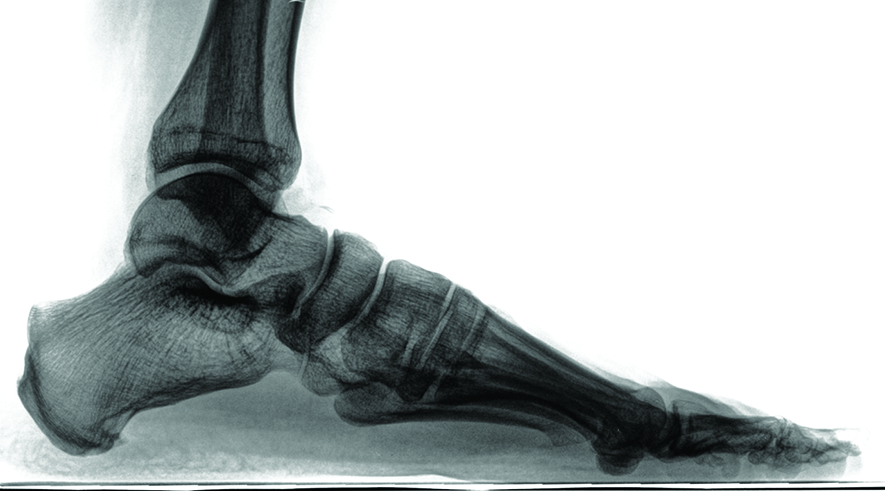
A 45-year-old white man with a medical history of essential hypertension came to our attention in September 2020 for refractory right hindfoot pain that had started 2 years earlier. He had multiple podiatric medical, orthopedic, and physiatric physician visits and was diagnosed as having a calcaneal spur, as confirmed by radiographic examination (Fig. 2).
Figure 2. Radiograph of a calcaneal spur.
Japma 112 21090 f2
In the previous 2 years he underwent several therapies: nonsteroidal anti-inflammatory drug therapy was associated with very limited benefit, and a personalized silicone heel did not provide any benefit. The patient also underwent cortisone and lidocaine infiltrations in the right heel and performed ten sessions of decontracting massage therapy, followed by ten sessions of laser and ultrasound therapy.
Despite all of the aforementioned therapies, the patient continued to experience pain and functional impairment. Surgery, therefore, was suggested by the attending orthopedic surgeon, but the patient refused.
At the first evaluation, the patient presented a pain intensity of 7 on the numeric rating scale. The symptom was described as being located at the level of the foot sole, intermittent, more intense when standing or walking, and resembling stabbing or needle sticking. When walking, the patient leaned more on the contralateral foot, even if right ankle and joint motion was normal. On examination, the right foot did not present significant deformities.
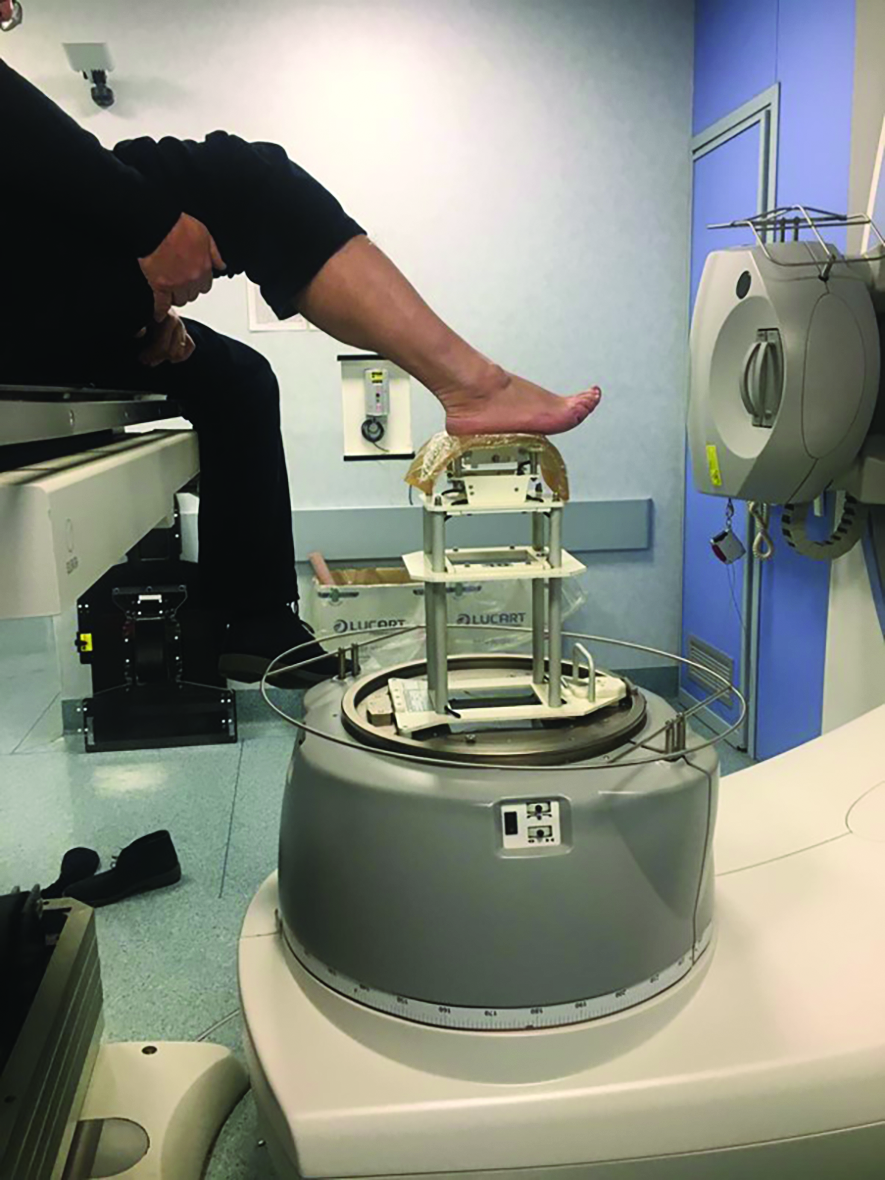
The patient underwent a new radiographic examination that confirmed the HS associated with plantar fasciitis. After acquiring informed consent, we decided to deliver RT, and a single fraction of 6 Gy was prescribed. The patient was treated with a linear acceleration system (Synergy; Elekta AB, Stockholm, Sweden) with a direct field of electrons of nominal energy of 6 MeV.
With the patient in the sitting position, the right foot was placed on a rectangular applicator (6 × 10 cm) covered by a 1-cm-thick tissue-equivalent bolus. The gantry angle was positioned at 180°, the collimator and couch angles at 0°. Source-to-surface distance was 95 cm (Fig 3).
Figure 3. Patient receiving radiotherapy.
Japma 112 21090 f3
At an evaluation visit 2 months after irradiation, no toxic effects were observed, pain had completely disappeared, and walking abilities were fully recovered. The patient currently has regular follow-up visits every 6 months.

Discussion

This study described a patient with a painful HS successfully treated with a single session of RT. The patient no longer has pain, and he experienced no adverse effects.
Although no randomized trials evaluating the impact of RT against a control population are available, the results of this review suggest that RT for painful HS is safe and effective, characterized by high response rates even at low doses and with an overall favorable toxicity profile. These findings confirmed the excellent outcome in the present case report. Furthermore, several studies have analyzed the risk of developing secondary radiation-induced tumors, suggesting that this is negligible [31,34].
Regarding this outcome, Jansen et al [35] estimated the carcinogenic risk of RT applications for benign diseases from shoulder to heel, observing that the three organs at risk that get most exposed after foot sole irradiation are the skin, bone surface, and red bone marrow. The average attributable lifetime risk for induction of a secondary tumor was, therefore, estimated to be approximately 1 in 1,000 patients, further reducing with increasing age [35].
The favorable exposure profile has also been confirmed by Dufek et al, [2] who described an effective dose of less than 1 mSv for 1-Gy treatment fractions, a level of exposure that is comparable with basic diagnostic radiographic procedures. Despite the collected evidence, the most appropriate dose prescription and schedule for HS irradiation is still unclear. In the present case report we delivered a single fraction of 6 Gy, and in the literature review we found several fractionation schemes. It is anyway advisable to deliver a total dose of 3 to 6 Gy, also considering the event of a following repeated irradiation.
More advanced studies aiming to identify predictive clinical or imaging parameters (ie, radiomics) and other artificial intelligence or omics-guided variables for treatment personalization may add innovative information and further enhance treatment efficacy and safety [36].

Funding

None reported.

Conflicts of Interest

None reported.

References

  1. McKeown SR, Hatfield P, Prestwich RJ, et al: Radiotherapy for benign disease; assessing the risk of radiation-induced cancer following exposure to intermediate dose radiation. Br J Radiol 88: 20150405, 2015.
  2. Dufek V, Zackova H, Kotik L, et al: Results of Czech national study of radiation exposure from radiotherapy of non-malignant diseases, in particular of heel spurs. Radiat Prot Dosimetry 186: 386, 2019.
  3. Niewald M, Seegenschmiedt MH, Micke O, et al: Randomized, multicenter trial on the effect of radiation therapy on plantar fasciitis (painful heel spur) comparing a standard dose with a very low dose: mature results after 12 months’ follow-up. Int J Radiat Oncol Biol Phys 84: e455, 2012.
  4. Micke O, Seegenschmiedt MH; German Working Group on Radiotherapy in Germany: Consensus guidelines for radiation therapy of benign diseases: a multicenter approach in Germany. Int J Radiat Oncol Biol Phys 52: 496, 2002.
  5. Lahaniatis JE, Farzin F, Brady LW, et al: Radiation treatment for benign disease: a survey of current treatment programs. Front Radiat Ther Oncol 35: 1, 2001.
  6. Faculty of Clinical Oncology, The Royal College of Radiologists: A Review of the Use of Radiotherapy in the UK for the Treatment of Benign Clinical Conditions and Benign Tumours, The Royal College of Radiologists, London, England, 2015.
  7. Hu Z-H, Chen W, Sun J-N, et al: Radiotherapy for the prophylaxis of heterotopic ossification after total hip arthroplasty: a systematic review and meta-analysis of randomized controlled trails. Med Dosim 46: 65, 2021.
  8. Hsueh W-T, Hung K-S, Chen Y-C, et al: Adjuvant radiotherapy after keloid excision: preliminary experience in Taiwan. Ann Plast Surg 82: S39, 2019.
  9. Kalogeridi M-A, Kougioumtzopoulou A, Zygogianni A, et al: Stereotactic radiosurgery and radiotherapy for acoustic neuromas. Neurosurg Rev 43: 941, 2020.
  10. Cuculich PS, Schill MR, Kashani R, et al: Noninvasive cardiac radiation for ablation of ventricular tachycardia. N Engl J Med 377: 2325, 2017.
  11. Fiorentino A, Gregucci F, Bonaparte I, et al: Stereotactic ablative radiation therapy (SABR) for cardiac arrhythmia: a new therapeutic option? Radiol Med 121: 155, 2021.
  12. Narducci ML, Cellini F, Placidi L, et al: Case report: a case report of stereotactic ventricular arrhythmia radioablation (STAR) on large cardiac target volume by highly personalized inter- and intra-fractional image guidance. Front Cardiovasc Med 7: 565471, 2020.
  13. Agyekum EK, Ma K: Heel pain: a systematic review. Chin J Traumatol 18: 164, 2015.
  14. McCarthy DJ, Gorecki GE: The anatomical basis of inferior calcaneal lesions. a cryomicrotomy study. JAPA 69: 527, 1979.
  15. Landorf KB, Keenan A-M, Herbert RD: Effectiveness of different types of foot orthoses for the treatment of plantar fasciitis. JAPMA 94: 542, 2004.
  16. Genc H, Saracoglu M, Nacir B, et al: Long-term ultrasonographic follow-up of plantar fasciitis patients treated with steroid injection. Joint Bone Spine 72: 61, 2005.
  17. Basford JR, Malanga GA, Krause DA, et al: A randomized controlled evaluation of low-intensity laser therapy: plantar fasciitis. Arch Phys Med Rehabil 79: 249, 1998.
  18. Hyer CF, Vancourt R, Block A: Evaluation of ultrasound-guided extracorporeal shock wave therapy (ESWT) in the treatment of chronic plantar fasciitis. J Foot Ankle Surg 44: 137, 2005.
  19. Hoffman SJ, Thul JR: Fractures of the calcaneus secondary to heel spur surgery. An analysis and case report. JAPMA 75: 267, 1985.
  20. Heyd R, Tselis N, Ackermann H, et al: Radiation therapy for painful heel spurs: results of a prospective randomized study. Strahlenther Onkol 183: 3, 2007.
  21. Moher D, Liberati A, Tetzlaff J, et al: Preferred Reporting Items for Systematic Reviews and Meta-Analyses: the PRISMA statement. BMJ 339: b2535, 2009.
  22. Niewald M, Holtmann H, Prokein B, et al: Randomized multicenter follow-up trial on the effect of radiotherapy on painful heel spur (plantar fasciitis) comparing two fractionation schedules with uniform total dose: first results after three months’ follow-up. Radiat Oncol 10: 174, 2015.
  23. Prokein B, Holtmann H, Hautmann MG, et al: Radiotherapy of painful heel spur with two fractionation regimens: results of a randomized multicenter trial after 48 weeks’ follow-up. Strahlenther Onkol 193: 483, 2017.
  24. Schneider O, Stückle CA, Bosch E, et al: Effectiveness and prognostic factors of radiotherapy for painful plantar heel spurs. Strahlenther Onkol 180: 502, 2004.
  25. Koca T, Aydın A, Sezen D, et al: Painful plantar heel spur treatment with Co-60 teletherapy: factors influencing treatment outcome. Springerplus 3: 21, 2014.
  26. Micke O, Seegenschmiedt MH; German Cooperative Group on Radiotherapy for Benign Diseases. Radiotherapy in painful heel spurs (plantar fasciitis): results of a national patterns of care study. Int J Radiat Oncol Biol Phys 58: 828, 2004.
  27. Muecke R, Micke O, Reichl B, et al: Demographic, clinical and treatment related predictors for event-free probability following low-dose radiotherapy for painful heel spurs: a retrospective multicenter study of 502 patients. Acta Oncol 46: 239, 2007.
  28. Uysal B, Beyzadeoglu M, Sager O, et al: Role of radiotherapy in the management of heel spur. Eur J Orthop Surg Traumatol 25: 387, 2015.
  29. Seegenschmiedt MH, Keilholz L, Katalinic A, et al: Heel spur: radiation therapy for refractory pain: results with three treatment concepts. Radiology 200: 271, 1996.
  30. Mücke R, Schönekaes K, Micke O, et al: Low-dose radiotherapy for painful heel spur: retrospective study of 117 patients. Strahlenther Onkol 179: 774, 2003.
  31. Surenkok S, Dirican B, Beyzadeoglu M, et al: Heel spur radiotherapy and radiation carcinogenesis risk estimation. Radiat Med 24: 573, 2006.
  32. Hautmann MG, Neumaier U, Kölbl O: Re-irradiation for painful heel spur syndrome: retrospective analysis of 101 heels. Strahlenther Onkol 190: 298, 2014.
  33. Kędzierawski P, Stando R, Macek P: Retrospective evaluation of the effectiveness of radiotherapy in patients with plantar fascitis (heel spurs). Rep Pract Oncol Radiother 22: 209, 2017.
  34. Zahnreich S, Rösler H-P, Schwanbeck C, et al: Radiation-induced DNA double-strand breaks in peripheral leukocytes and therapeutic response of heel spur patients treated by orthovoltage X-rays or a linear accelerator. Strahlenther Onkol 196: 1116, 2020.
  35. Jansen JTM, Broerse JJ, Zoetelief J, et al: Estimation of the carcinogenic risk of radiotherapy of benign diseases from shoulder to heel. Radiother Oncol 76: 270, 2005.
  36. Boldrini L, Bibault J-E, Masciocchi C, et al: Deep learning: a review for the radiation oncologist. Front Oncol 9: 977, 2019.