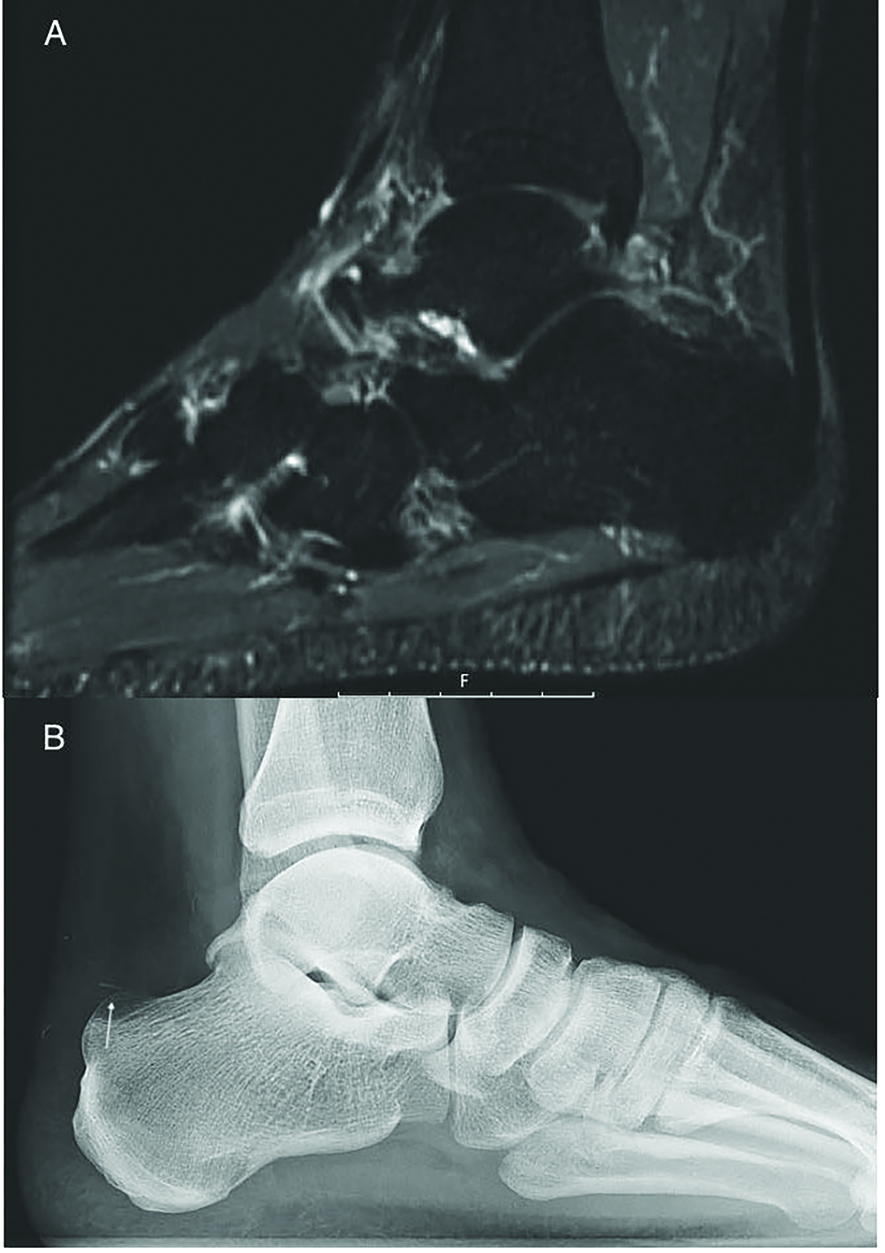
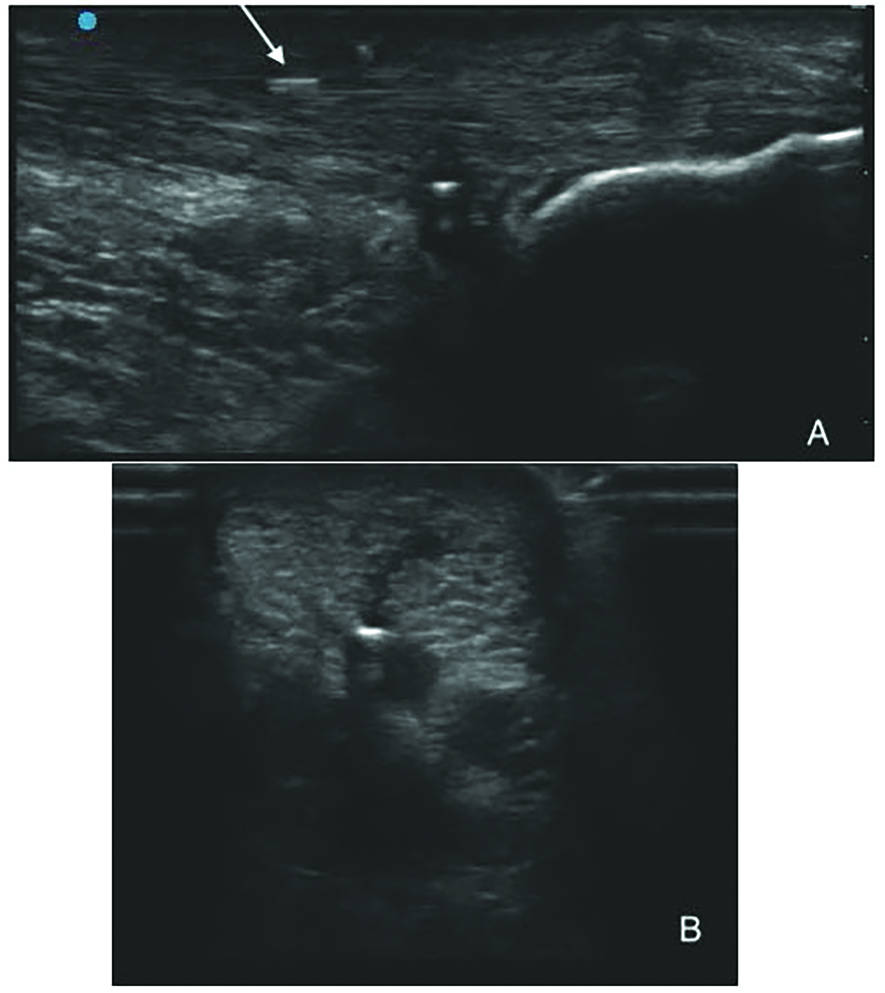
A 43-year-old man presented to a physiatry clinic with low back pain and left Achilles pain. His left low back pain resolved with treatment. However, the Achilles tendon pain increased and was sharp and intermittent, with soreness, swelling, and stiffness, and was exacerbated by weightbearing activity and improved with rest. His best, worst, and average pain scores were 3, 8, and 5, respectively, on a scale from 0 to 10, with no weakness or numbness. Physical examination revealed mildly antalgic gait and neurologically intact, clinically normal strength and stability, except for pain-limited left ankle plantarflexion (4+/5). Results of Thompson and Homan tests were negative. He reported stepping on a long-spined sea urchin 3 months earlier while on vacation in the Caribbean and received medical care there to remove sea urchin spines. Bedside ultrasound of the mid-portion and insertional aspect of the Achilles tendon revealed three small linear foreign bodies related to a sea urchin spine on the superficial surface of the tendon (
Fig. 1). Surgical consultation was advised, and imaging studies were ordered. Magnetic resonance imaging demonstrated mild Achilles insertional tendinosis, peritendinitis, and foci of low signals possibly related to retained foreign bodies (
Fig. 2A). Radiography revealed approximately nine foreign bodies and thickening of the Achilles tendon (
Fig. 2B). The patient had a surgical consultation with a foot and ankle specialist, who noted a 5-mm nodule at the base of the Achilles and tenderness to palpitation. He was provided with patient education on self-care, such as proper footwear and activity modification. His symptoms resolved with time, and surgical intervention was not needed.
Figure 1.
Ultrasound images of the ankle using a high-frequency linear transducer in the long axis showing one of many sea urchin spines (arrow) (A) and in the short axis (B).
Figure 1.
Ultrasound images of the ankle using a high-frequency linear transducer in the long axis showing one of many sea urchin spines (arrow) (A) and in the short axis (B).
Figure 2.
A, Sagittal fat-suppressed magnetic resonance image of the left ankle showing mild Achilles tendinosis, peritendinitis, and fluid in the retrocalcaneal bursa. B, Lateral radiograph of the left ankle. The arrow depicts one of many sea urchin spines.
Figure 2.
A, Sagittal fat-suppressed magnetic resonance image of the left ankle showing mild Achilles tendinosis, peritendinitis, and fluid in the retrocalcaneal bursa. B, Lateral radiograph of the left ankle. The arrow depicts one of many sea urchin spines.
The Achilles tendon joins the gastrocnemius and soleus muscles and plays multifunctional roles in hindfoot inversion and knee and foot plantarflexion [
1]. Achilles tendinopathy is common, afflicting active and inactive individuals [
2]. It is postulated that overuse, muscle imbalance, insufficient flexibility, and decreased blood supply may play a role in its etiology. Herein we presented an unusual case of Achilles tendinopathy secondary to a sea urchin spine injury that occurred in the Caribbean. There are various sea urchin species in the Caribbean, including
Echinometra viridis,
Echinometra lucunter,
Tripneustes ventricosus, and
Diadema antillarum [
3,
4]. Most published cases involving sea urchin spine injuries affect the hand, although cases in the foot also exist [
5]. Literature reviews revealed no published cases with injuries to the Achilles tendon. Sea urchin spine injuries usually present as primary or secondary (delayed/granulomatous) cutaneous reactions. Primary reactions consist of pain, burning, inflammation, edema, and erythema, with symptoms subsiding after removal of the spines. Secondary reactions occur as spines remain in the skin, which may form granuloma that can manifest as nodules or papules, arthritis, and synovitis. Patients can experience delayed-onset periarticular swelling, stiffness, pain, and impaired movement at the site of sea urchin spine penetration for up to 1 year after injury [
6,
7]. We believe that on initial consult, the patient was in the primary reaction stage, but his symptoms were partially masked by his low back pain. Pain and swelling gradually resolved, which from our perspective suggested progression through the secondary reaction stage. Unlike the bottom of the foot, which is weightbearing and a common site for sea urchin spine debridement, surgical intervention may have been avoided in the Achilles due to its location and nonweightbearing state. This case highlights the unique circumstances surrounding sea urchin spines causing Achilles tendinopathy and the use of bedside ultrasonography as a valuable diagnostic tool.