Onychomycosis is a progressive fungal infection of the nail bed, matrix, or plate that may lead to destruction and deformity of the toenails or fingernails [
1,
2]. It is caused by dermatophytes, yeasts, or nondermatophytic molds [
3]. The dermatophytes
Trichophyton rubrum,
T mentagrophytes, and
Epidermophyton floccosum are the main causative pathogens, responsible for approximately 90% of cases [
3].
Although not life threatening, it may negatively affect a person’s self-esteem and quality of life because of the reaction of others to their visible nail dystrophy or the perception that others find it to be unsightly or associated with poor personal hygiene [
4–6]. Toenail onychomycosis is particularly challenging to treat because of slow nail growth, and the physical properties of the nail unit that impede topical drug penetration [
7,
8]. Both topical and oral agents are available for the treatment of fungal nail infection, but have had relatively limited therapeutic success, particularly long-term. Historically, oral medications such as terbinafine and itraconazole have been recommended as first-line therapy, especially in severe disease, but are associated with high recurrence rates and are not suitable for many patients because of drug interactions and systemic side effects, including headache, gastrointestinal disturbance, and hepatotoxicity [
9,
10]. Topical treatments may be preferable to patients, as they reduce the likelihood of side effects and/or the requirement for laboratory monitoring, but are typically only recommended for mild to moderate cases [
11,
12]. However, the treatment paradigm is changing [
13]. Newer topical therapies have been shown by network meta-analysis to improve the odds ratio of mycologic cure—defined as negative potassium hydroxide test and negative culture [
14,
15]. The efficacy of these new agents was also noted by a 2015 joint podiatric medicine–dermatology roundtable and previously reported in this journal [
16]. One of the newer antifungal options, efinaconazole topical solution 10% (Jublia; Ortho-Dermatologics; Bridgewater, New Jersey) is a topical imidazole active against both dermatophytes and yeasts. Its low affinity for keratin and low surface tension enable it to better penetrate the nail plate and selectively target pathogenic fungi [
17]. An in vitro study demonstrated that a single dose of efinaconazole 10% solution achieved a mycologic eradication rate of 42.9%. This study also showed no difference in the concentrations seen in normal or affected nails or in the concentrations measured in the first and second toenails, suggesting that transungual delivery and accumulation is not influenced by either presence of fungal disease or nail thickness [
18]. Studies have also shown that efinaconazole can penetrate the nail following the application of nail polish, resulting in concentrations similar to those seen in control specimens free of polish [
19,
20].
The safety and efficacy of once-daily use of efinaconazole for the treatment of toenail onychomycosis was evaluated in two prospective, multicenter, randomized, double-blind, clinical trials in patients aged 18 years and older [
21]. Patients were treated with active agent or vehicle for 48 weeks. Complete cure, defined as 0% involvement of the target toenail, and mycologic cure were assessed at week 52.
In study 1, complete cure was achieved in 117 of 656 efinaconazole-treated subjects (17.8%) versus seven of 214 subjects (3.3%) treated with vehicle. Mycologic cure was achieved in 362 of 656 of efinaconazole-treated subjects (55.2%) versus 36 of 214 subjects (16.8%) treated with vehicle.
In study 2, complete cure was achieved in eight of 580 efinaconazole-treated subjects (15.2%) versus 11 of 201 subjects (5.5%) treated with vehicle. Mycologic cure was achieved in 310 of 580 efinaconazole-treated subjects (53.4%) versus 34 of 201 subjects (16.9%) treated with vehicle.
It is worth noting that none of the subjects in these two studies had more than 50% involvement of the target toenail. Overall, 74.8% of subjects were graded as having a moderate severity at baseline, and 25.8% had a severity rating of mild.
A 2019 study looked at long-term (72-week) treatment with efinaconazole. Of the 219 subjects, 80 (36.5%) had more than 50% clinical involvement of the target nail. Complete cure rate at the final assessment in the patient population with clinical nail involvement of more than 50% was 38.8% versus 69.9% in patients with 20% to 50% involvement (n = 139) [
22].
However, an extensive literature search failed to elicit any studies or even prior case reports on the use of efinaconazole in patients with total dystrophic onychomycosis [
12]. This form of onychomycosis is a late stage of the chronic subungual dermatophyte infection that may take years to develop. It is not only the most difficult stage to clear but is also the type with the highest risk of associated subungual ulceration, secondary bacterial infection, and possible gangrene [
23].
With the arrival of coronavirus disease of 2019 (COVID-19) and stay-at-home orders instituted across the country, many podiatrists—this author included—pivoted to telemedicine as a way to remain engaged with patients. Although telehealth and podiatry may not seem to go hand in hand, the reality is, they are perfectly matched. Through virtual and asynchronous consultations with real-time, audio-video communication, I was able to connect with both new and existing patients, some from geographically remote locations, and whereas the global COVID-19 pandemic caused some people to delay seeking non–COVID-19–related care [
24–26], it afforded others, including the patient described in this report, the opportunity to seek care for chronic conditions that they had been hitherto ignoring.
Case Report
The patient is a healthy 26-year-old woman, with no significant medical history and currently on no medications. She presented for a virtual telemedicine consultation in May of 2020, during the COVID-19 pandemic, with bilateral 100% totally opaque great toenails. She had been diagnosed with onychomycosis 5 years earlier by a podiatrist in New York City, based on an in-office periodic acid-Schiff stain that revealed the dermatophytic fungus T rubrum. At that time, she was treated with topical ciclopirox nail lacquer 8% but became noncompliant after the treatment failed to elicit any response over a period of 5 months.
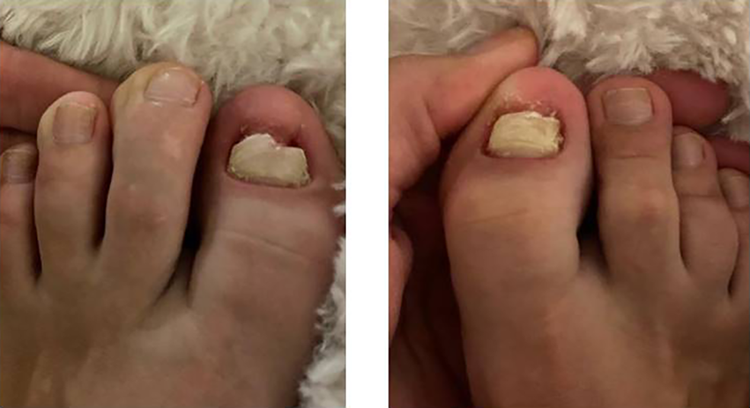
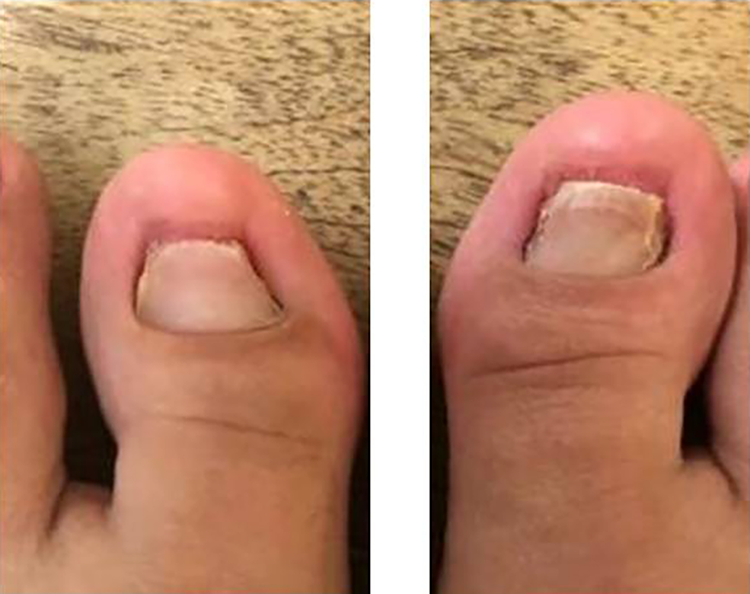
Virtual visual examination revealed thickened, crumbling, opaque nails on her great toes, with no involvement of other toenails or tinea pedis (
Fig. 1). There was no evidence of subungual hyperkeratosis or detachment of the nail from the nail bed (onycholysis). However, the involvement of the entire nail apparatus, the diffuse thickening, and the friability of her nails was suggestive of the most severe clinical subtype—total dystrophic onychomycosis [
27]. In addition, erythema of the surrounding skin suggested development of a secondary bacterial infection.
Figure 1.
Baseline, day 1.
Figure 1.
Baseline, day 1.
Differential diagnoses, including nail psoriasis, lichen planus, pachyonychia congenita, and the “disappearing nail bed” (ie, onycholysis secondary to onychomycosis in which the nail bed appears to shrink, become keratinized, and produce dermatoglyphics [
28]) were considered, but the totality of the patient’s history and the examination findings supported the presumptive diagnosis. Overall, the nails appeared well maintained by the patient. A focused history revealed that she typically covered them with toenail polish to hide her embarrassment about the disease process. She denied pain or paresthesia, but admitted to some discomfort when wearing dress shoes.
A discussion ensued that covered all aspects of the treatment choices available to the patient. This included surgical, oral, and topical treatment plans. Because of her previous noncompliance, adherence to any of these treatment plans was an issue that was discussed at length.
As she was concerned about the potential for side effects of systemic treatment, it was determined that efinaconazole would be in the patient’s best interests at this time. The decision was made with the patient fully aware of the scientific data and that the severity of her condition fell outside of the previously studied treatment parameters for this product.
She was instructed to apply efinaconazole to the affected toenails once per day for 48 weeks, at least 10 min after showering, bathing, or washing, in accordance with the manufacturer’s package instructions. To prevent recurrence, she was advised to trim her great nails as they grew out, dry her feet completely after showering and swimming, and to wear shoes in public areas. In addition, she was taught how to tape her affected toes, starting at the point where the nail meets the skin distally, down and around the plantar pulp of the toe, to encourage the skin to flatten and allow the nail to grow over the skin as recommended by Vlahovic et al [
28].
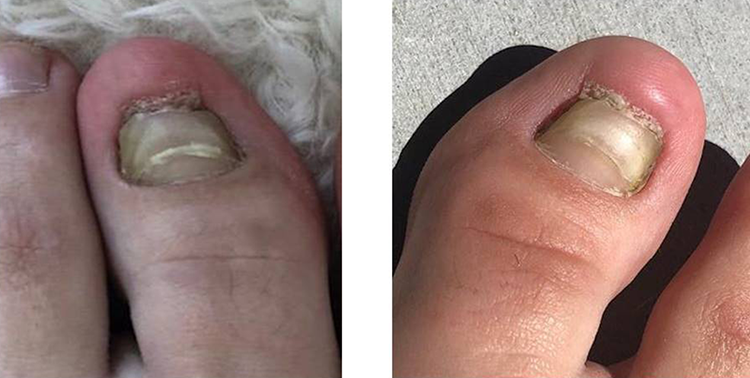
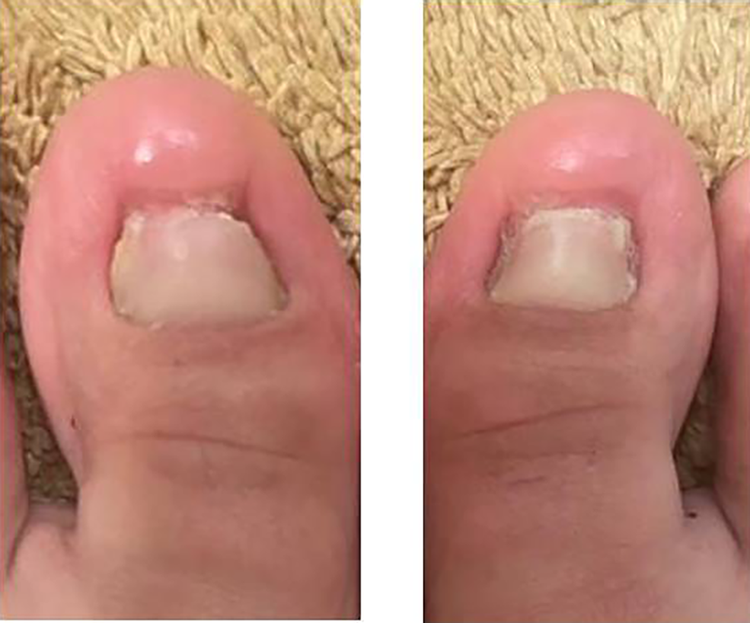
At a virtual follow-up consultation 30 days after starting efinaconazole, there was significant improvement in the appearance of her toenails and the surrounding skin (
Fig. 2). The change in clinical involvement can be calculated using the following formula: Changes in clinical involvement = clinical involvement at baseline – clinical involvement after application of efinaconazole.
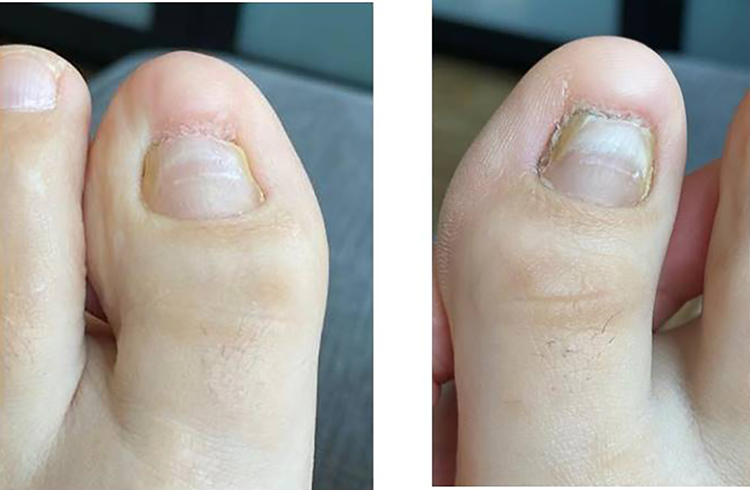
At 30 days, the change in clinical involvement was calculated to be 30%; at 60 days (8.5 weeks), 55% (
Fig. 3); at day 120 (17 weeks), 80% (
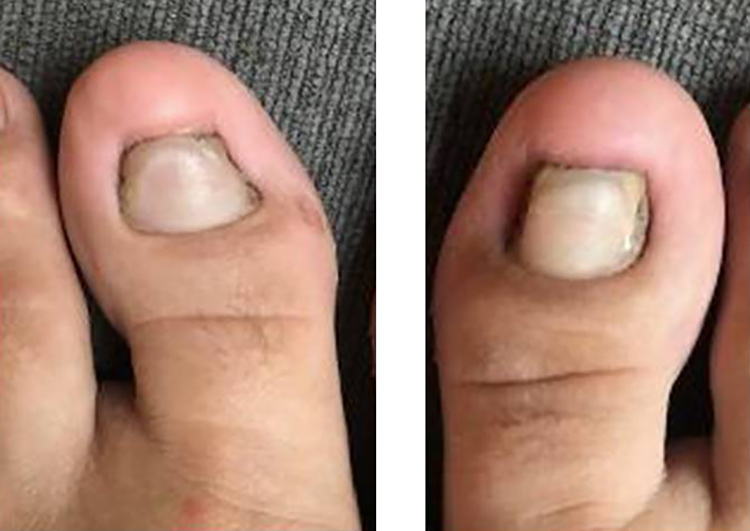
Fig. 4); at day 150 (21.4 weeks), 90% (
Fig. 5); and at day 210 (30 weeks), 100%, which represents complete clinical cure (
Fig. 6).
No adverse drug reactions have been reported during treatment. The patient rated treatment satisfaction as 100% and noted dramatic improvement in confidence and social interactions. She will continue to treat to 48 weeks.
Discussion
Onychomycosis is one of the conditions most frequently encountered by podiatrists. Although this patient and many others seek onychomycosis treatment primarily for cosmetic purposes, it is critical that it is successfully treated to prevent cross-contamination to close personal contacts, secondary complications such as tinea pedis, and decreased quality of life because of embarrassment about the aesthetic appearance of their nails.
Before the COVID-19 pandemic, clinical examination, dermoscopy, and mycologic examination were considered standard of care for all patients with suspected onychomycosis, followed by a discussion of appropriate treatment options. However, since the emergence of COVID-19, prepandemic guidelines are no longer applicable. Many patients have had to deal with lockdowns, stay-at-home orders, quarantine, or isolation. Some podiatrist offices closed, whereas for others, nonurgent in-person visits were replaced by telemedicine. The latter solution proved ideal for this tech-savvy, young patient who had prior mycologic confirmation of her condition. It allowed for accessible and quality care, an initial consultation devoid of the usual embarrassment associated with onychomycosis, and more frequent follow-up video visits, all while limiting the risk for COVID-19 transmission. As toenails grow approximately 1 mm/month, I normally perform follow-up on patients being treated with topicals every 3 months, which allows the degree of proximal clear nail to be measured. However, given the convenience of telemedicine and the patient’s history of treatment nonadherence, following her every 30 days contributed, at least partially, I suspect, to the successful outcome.
The efficacy can more directly be attributed to the fact that efinaconazole both inhibits the fungal cytochrome P450 enzyme and blocks fungal membrane ergosterol biosynthesis, thereby disrupting the membrane integrity and growth of fungi [
29], and has relatively low binding to keratin, which enables nail penetration [
17,
18,
30]. The rapid and sustained improvement experienced by this patient treated with the triazole antifungal efinaconazole is consistent with that seen in previous controlled clinical studies of mild and moderate toenail onychomycosis [
17,
21,
22]. The absence of systemic or local side effects in this patient is also consistent with the findings from a pooled analysis of phase III clinical trial participants that revealed that treatment-related side effects were similar to vehicle and limited to local site reactions (2%) [
31]. However there appear to be no studies or other publications of efinaconazole in patients with total dystrophic onychomycosis.
Conclusions
Although systemic therapy is generally considered the standard of care in severe fungal toenail disease, this case, treated by telemedicine, during the COVID-19 pandemic, suggests that there may be a role for efinaconazole in total dystrophic onychomycosis. Further studies would be needed to confirm this.