Diabetic foot ulcers (DFUs) are estimated to occur in up to 25% of the world’s estimated 451 million patients with diabetes [
1,
2]. Given the immense scale and cost of the problem, prevention and treatment of DFUs has become a focus of the global health-care community [
3,
4]. In particular, prevention has been recognized as the far more cost-effective and humane option for individuals and health-care systems [
5]. Regarding DFU prevention, providers are encouraged to educate diabetic patients on proper daily foot care as well as diligent control of their diabetes. Patients are counseled to wear appropriate shoes, seek prompt medical care for suspected problems, and undergo comprehensive foot examinations once or twice per year [
6]. Because diabetic peripheral neuropathy (DPN) has been acknowledged as one of the essential precursors of DFUs (along with peripheral artery disease, foot deformities, and abnormal biomechanics), providers perform neurologic screening tests for the purposes of risk stratification [
7,
8]. Ideally, this input guides preventive efforts such as specialist referrals, extra-depth and custom shoe prescriptions, orthotic device fabrication, and prophylactic foot surgery.
Among the most commonly performed neurologic tests are the 5.07 Semmes-Weinstein monofilament (SWM) test for loss of protective sensation and the 128-Hz tuning fork test for loss of vibration sense. Moreover, vibration testing has been identified as a valuable adjunct to SWM testing because vibration sense is often lost earlier than protective sensation in patients with diabetes [
9]. Several studies have confirmed the value of performing these screening tests in the prevention of diabetic foot complications [
10–13].
An alternative approach to vibration testing is the timed vibration test (TVT) [
14–16]. This test uses a tuning fork and stopwatch to time how long a patient senses vibration. In patients with diabetes, this is usually performed on the dorsum of the hallux. Although the diagnostic value of this technique has been established, its use is not widespread owing to lack of standardization and the ergonomic challenges of implementation at the point of care. Recently, an electronic tuning fork (ETF) has become available to provide a standardized, quantitative method of performing the TVT [
17–19]. A proof-of-concept study by O’Brien and Karem [
17] using this approach found that the sensitivity and specificity of neuropathy detection for the ETF were 0.953 and 0.761, respectively, using conventional tests as reference standards.
The primary objective of this study was to assess the utility of TVTs performed with the ETF singly and in combination with the SWM test in the prediction of DFUs. It is hypothesized that these two tests together would be a better predictor of DFUs than a single test. The secondary objective was to determine the most clinically advantageous TVT cutoff time in the prediction of DFUs.
Methods
Ethics Approval
This study did not require institutional review board or ethics committee approval because it was a noninterventional, retrospective medical record review. Although one author (T.O.) had full access to the medical records, only anonymous, deidentified data were shared with the other author (J.K.).
Patients
A retrospective, cross-sectional study was conducted through an electronic medical record search performed on patients attending a central Maine community health center spanning a 39-month interval. Patients were selected from the primary author’s (T.O.) podiatric medical clinic with the following inclusion criteria: diabetes and/or DFU diagnosis, complete documentation of SWM testing and TVT at least 3 months before ulcer appearance, and hemoglobin A1c (HbA1c) levels within 3 months of ulcer onset. The exclusion criteria were no diabetes diagnosis, lack of complete SWM test and TVT results at least 3 months before ulcer presentation, and lack of available HbA1c levels within 3 months of ulcer presentation. For this study, patients with ulcers were considered for analysis as opposed to individual foot ulcers. Because these patients were seen by the same provider (T.O.), consistent care was provided, including performance of neurologic screening tests.
SWM Testing
A 5.07 SWM (Touch Test; North Coast Medical, Morgan Hill, California) was applied using standard technique as described previously by O’Brien and Karem [
17]. The integrity of monofilament force application was periodically tested with a miniature electronic scale. Underperforming monofilaments were discarded. Test results were documented for each foot as either normal or abnormal (1 or 0). Any deficit at any location was recorded as abnormal. Other than laterality, specific anatomical test locations were not recorded. Patients without great toes were tested at the first metatarsal head.
Timed Vibration Testing
All of the TVTs were performed with an ETF (ETF128; O’Brien Medical, Orono, Maine). The ETF is a handheld, battery-powered device used much the same as the traditional 128-Hz tuning fork. While the ETF was in descending vibration mode (decreasing vibrations similar to the traditional tuning fork), it was applied perpendicularly to the dorsal aspect of the distal phalanx of the hallux. The device was then started and the patient asked to denote when the receding vibrations faded beyond perception (vibration perception disappearance). The elapsed time was then recorded for each foot. A time of 0 sec indicated that the patient did not feel any vibrations during the test. Patients without great toes were tested at the first metatarsal head.
Regarding the choice of TVT cutoff times used in this study, note that all continuous variable times from 0 sec to less than 1 through less than 14 sec were evaluated for sensitivity, specificity, and positive predictive value (unpublished data, Todd O’Brien and Joseph Karem, 2020). Times of 0, less than 4, and less than 7 sec were found to have the best combination of descriptive statistics for the prediction of DFU and were subsequently chosen for inclusion in the results.
Statistical Analysis
Statistical software (MedCalc, Version 19.1.5; MedCalc Software Ltd, Ostend, Belgium) was used for statistical analysis. Demographic parameters and test results for ulcerated and nonulcerated individuals were compared through
t tests (means) and χ
2 tests (proportions). Data collected for the SWM test were nominal. The TVT data were parametric. No transformation of data was performed for these analyses. The total number of abnormal SWM results in the ulcerated and nonulcerated individuals were compared by the Fisher’s exact test. Comparisons were also made among SWM testing, combined SWM/TVT, and TVT at various cutoff values regarding prediction of DFU occurrence using conventional two-by-two contingency tables for diagnostic test evaluation. Receiver operating characteristic area under the curve calculations for the SWM/TVT data were generated by the methods of DeLong et al [
20]. For this study, true-positive results were achieved only when an abnormal test value was obtained before ulceration (ulcer group only) of the specific foot involved.
Results
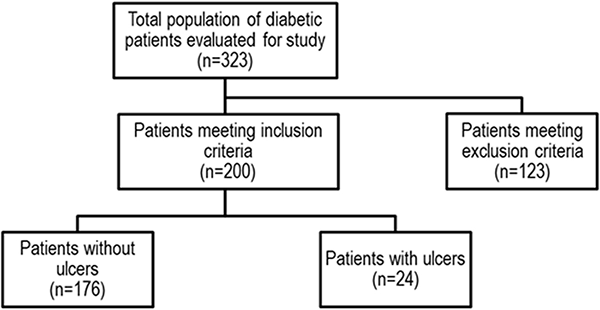
Two hundred patients meeting the inclusion criteria were selected from a pool of 323 patients (
Fig. 1). Patient demographic characteristics are given in
Table 1. Twenty-four patients (12%) developed DFUs during the study. Ulcers were noted in the following locations: seven (29.2%) beneath the metatarsal heads, seven (29.2%) beneath the hallux, five (20.8%) involving lesser digits, three (12.5%) at the heel, and two (8.3%) beneath the midfoot. Patients with ulcers tended to be younger (55 versus 65 years old;
P = .001) with higher HbA
1c levels (8.5% versus 7.4%;
P < .001) The ulcerated group also demonstrated more advanced neuropathy as indicated by shorter TVT times (2.7 versus 7.8 s;
P < .001) and a higher proportion of patients with abnormal SWM test results (19 of 24 [79.2%] versus 45 of 176 [25.6%];
P < .001). All of the differences between groups achieved significance (
P < .05).
Figure 1.
Flowchart delineating patient medical record selection from an electronic medical record search of diabetic patients treated between January 1, 2017, and March 31, 2020. Exclusion criteria were no diabetes diagnosis, lack of complete 5.07 Semmes-Weinstein monofilament test and timed vibration test results at least 3 months before ulcer presentation, and lack of available hemoglobin A1c levels within 3 months of ulcer presentation.
Figure 1.
Flowchart delineating patient medical record selection from an electronic medical record search of diabetic patients treated between January 1, 2017, and March 31, 2020. Exclusion criteria were no diabetes diagnosis, lack of complete 5.07 Semmes-Weinstein monofilament test and timed vibration test results at least 3 months before ulcer presentation, and lack of available hemoglobin A1c levels within 3 months of ulcer presentation.
Table 1.
Demographic Characteristics of the Total Study Population, Nonulcerated Patients, and Ulcerated Patients
Table 1.
Demographic Characteristics of the Total Study Population, Nonulcerated Patients, and Ulcerated Patients
Comparisons between TVT cutoff times of 0, less than 4, and less than 7 sec regarding prediction of DFUs are shown in
Table 2. Sensitivity, specificity, and positive predictive value were calculated for each test. The cutoff time of less than 4 sec resulted in the highest combination of favorable statistics for the prediction of future ulceration. For this reason, it was chosen as the best option to pair with the SWM in the combined test analysis.
Table 2.
Selected Statistical Results for Prediction of Ulceration Using the TVT at Various Cutoff Times
Table 2.
Selected Statistical Results for Prediction of Ulceration Using the TVT at Various Cutoff Times
Comparisons among the SWM test, the TVT, and the combined SWM/TVT regarding prediction of DFUs are given in
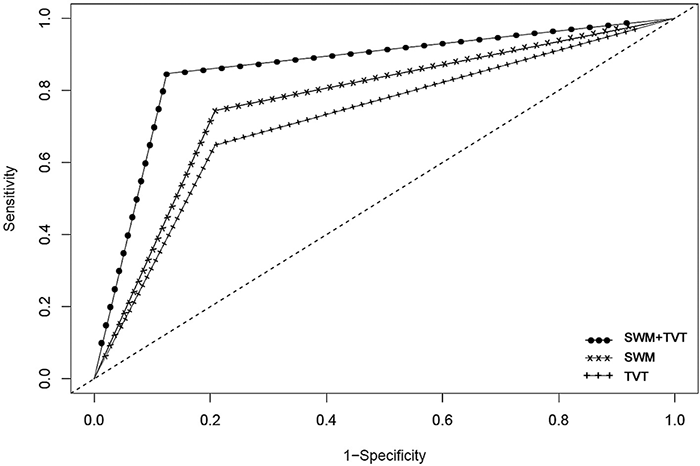
Table 3. Standard diagnostic statistics were calculated for each test with the addition of the receiver operating characteristic area under the curve (
Fig. 2).
Figure 2.
Receiver operating characteristic curves comparing ability to predict ulcers for the 5.07 Semmes-Weinstein monofilament (SWM) test, the timed vibration test (TVT), and the combined SWM/TVT.
Figure 2.
Receiver operating characteristic curves comparing ability to predict ulcers for the 5.07 Semmes-Weinstein monofilament (SWM) test, the timed vibration test (TVT), and the combined SWM/TVT.
Table 3.
Selected Statistical Results for Prediction of Ulceration Using the SWM Test, the TVT, and the Combined SWM/TVT
Table 3.
Selected Statistical Results for Prediction of Ulceration Using the SWM Test, the TVT, and the Combined SWM/TVT
Discussion
Neurologic screening tests have long played a role in stratifying ulcer risk in patients with diabetes. The SWM test has become the most ubiquitous of these tests despite some known drawbacks, including monofilament fatigue, temperature/humidity effects, improper user technique, and ambiguous test results [
21–25]. Even so, many individual providers and health-care systems rely solely on this method to assess DFU risk. This practice has become firmly established even though it might not provide adequate risk stratification. The present results suggest that adding another testing method to the SWM does provide a better method of gauging DFU risk.
Several previous studies are similar in design to this one. In particular, the present findings mirror those of Pham et al [
13]. In their more comprehensive, prospective study, it was found that a combination of the SWM and the neuropathy disability score (ankle reflexes, cold, touch, pain, and vibration sensation) was most effective in predicting DFUs. Although this combination was optimal, the neuropathy disability score, with its battery of five tests, might prove too time-consuming for busy providers. Similar to the present study, it was also found that the combination of SWM and vibration perception threshold (VPT) testing administered by a biothesiometer enhanced the predictive value for DFUs.
In particular, the VPT test is similar in nature to the TVT used in the present study [
19]. In addition, the VPT cutoff value of greater than 25 V used to indicate DFU risk is equivalent to the 3 sec mark on the ETF. This may explain why the TVT cutoff time of less than 4 sec was found to be most effective in the present study.
An unexpected finding noted in the comparison of TVT cutoff times was that the 0 sec cutoff time (no vibration sensation) did not score as well as the 4 sec cutoff time. This finding could impact practice patterns because absent tuning fork sensation is often cited as a positive finding indicating DFU risk. The present data suggest that the cutoff time of less than 4 sec confers a higher diagnostic yield for DFU prediction in agreement with findings in a similar TVT study by Oyer et al [
14].
Several limitations of this study are apparent. The retrospective design is an inherent weakness. The patient population studied was also a relatively homogenous group seen by one provider in one facility. Although this provided consistency, a more diverse population across multiple sites would have resulted in a stronger study. However, note that the expected trend toward a higher HbA
1c level (>8.0%) in the ulcer group was consistent with other multicenter studies [
4,
13,
26]. The overall ulcer prevalence of 12% was also in agreement with ranges noted elsewhere [
27]. Herein, the ulcer group skewed significantly younger than the nonulcer group. It is unclear whether this is a unique local characteristic or reflects a general trend toward earlier type 2 diabetes diagnosis and subsequent DPN signs [
28–31].
Another limitation is that small fiber testing was not included in the analysis. This fact might explain why certain patients who tested normal on both tests nonetheless developed ulcers. Unfortunately, a rapid, noninvasive, quantitative small fiber test is not yet available for testing small nerve fiber function.
Last, no other known risk factors, such as peripheral artery disease, microvascular dysfunction, foot deformities, or other comorbidities (smoking history, body mass index, lower-extremity edema, etc), were considered [
32–34]. Although DPN is a major predictor of ulcer risk, it is not the only one. An example from the present study was one patient with an ischemic ulcer who tested normal on the SWM test and the TVT, reinforcing the multifactorial nature of the risks associated with the diabetic foot.
Conclusions
This study demonstrated that when combined, the SWM test and the TVT can more effectively predict DFUs than either test alone. It was also found that a TVT cutoff time of less than 4 sec had a higher diagnostic yield than other cutoff times. In light of these findings, a positive result for either the SWM test or the TVT of less than 4 sec should be viewed as actionable data used to inform aggressive patient education and medically directed preventive measures aimed at reducing DFU risk.