Next Article in Journal
Knee Pain Reduction Using a Shock-Absorbing Sole
Previous Article in Journal
The Effects of Different Screw Combinations on the Initial Stability of Ankle Arthrodesis. A Biomechanical Study
 
 
Journal of the American Podiatric Medical Association is published by MDPI from Volume 116 Issue 1 (2026). Previous articles were published by another publisher in Open Access under a CC-BY (or CC-BY-NC-ND) licence, and they are hosted by MDPI on mdpi.com as a courtesy and upon agreement with American Podiatric Medical Association.
Review

Fungal Lung. The Risk of Fungal Exposure to Nail Care Professionals

by
Aditya K. Gupta
1,2,* and
Emma M. Quinlan
2
1
Division of Dermatology, Department of Medicine, University of Toronto, Toronto, Ontario, Canada
2
Mediprobe Research Inc, London, Ontario N5X 2P1, Canada
*
Author to whom correspondence should be addressed.
J. Am. Podiatr. Med. Assoc. 2021, 111(6), 20269; https://doi.org/10.7547/20-269
Published: 1 November 2021

Abstract

Foot and nail care specialists spend a great portion of their day using nail drills to reduce nail thickness and smooth foot calluses. This process generates a large amount of dust, some of which is small enough to breathe in and deposit into the deepest regions of the respiratory tract, potentially causing health problems. Foot and nail dust often contains fungi, from both fungus-infected and healthy-appearing nails. Although the majority of healthy individuals can tolerate inhaled fungi, the immune systems of older, immunocompromised, and allergy-prone individuals often react using the inflammatory T helper cell type 2 pathway, leading to mucus overproduction, bronchoconstriction, and, in severe cases, lung tissue damage. To protect vulnerable podiatry professionals, wearing a surgical mask, using a water spray suppression system on nail drills, installing air filtration systems, and considering drilling technique can help reduce exposure to nail dust.

For foot and nail care specialists, discussions of occupational health and safety often revolve around skin contact with chemicals and the dangers of a bad posture; respiratory health is rarely discussed. Both aesthetic and clinical care of the feet often involve reduction of nail thickness and removal of foot calluses and corns, much of which is accomplished using high-speed, gritted drills. These drills disseminate nail and skin material into the air, some of which is subsequently inhaled. Not only are the small dust particles themselves dangerous, especially those produced when sculpting fake nails, but this dust can sometimes harbor infectious fungal elements, even in nails that appear healthy. Because of this dust, nail and foot specialists often complain of allergies and other respiratory symptoms, sometimes at higher rates than the average population. This review summarizes the current research on this rarely discussed topic in an attempt to raise awareness and encourage all who work with feet and nails to consider implementing some of the described safety precautions.

Health Concerns in Foot and Nail Care Professions

The incidence of respiratory illnesses and allergies in foot and nail care professions varies depending on the year, the personal protective equipment (PPE) worn by the professional, and other extraneous factors. In 2000, Millar [1] reported that podiatrists in the United Kingdom exhibited four times the national prevalence of asthma, with 39 percent of podiatrists surveyed also reporting allergies.[2] Twelve years later in Ireland, Coggins and associates [3] reported that 32 percent of surveyed podiatrists had respiratory conditions, with asthma being most prevalent; however, this was about the same prevalence as the national average. In contrast, nail salon technicians in the United Kingdom reported experiencing work-related nasal symptoms, cough, and chest tightness at higher rates (21, 10, and 11 percent, respectively) compared with office-based controls (3, 2, and 2 percent, respectively).[4] These conditions could be caused by exposure to nail and foot dust produced by drilling; they could also be caused by exposure to toxic material (eg, the abrasive chemicals used to create and shape fake nails).[2,5] Because of the lack of recent data and the conflicting existing data, it is difficult to create an overarching picture of the current risk of respiratory illnesses in foot and nail care specialties.
Contrary to the data on respiratory illnesses, the risk of fungal exposure in podiatric care professions appears conclusively higher than average. Onychomycosis is the most common nail condition, affecting approximately 5.5 percent of the global population[6,7]; signs include thickened, yellowed nails and crumbling nail bed.[8] Individuals with onychomycosis may look to nail technicians to trim and file down their hardened nails, which is often performed using an electric nail drill. Podiatrists may also file down the nail plate, not only to treat the symptoms of onychomycosis, but to increase the effectiveness of oral and topical antifungals as well.[9,10,11,12] In fact, some clinics may spend up to 1.5 hours per day reducing onychomycotic nails.[3] Interestingly, podiatrists have a higher prevalence of antibodies compared to the general population for Trichophyton rubrum, which is the most common species to cause onychomycosis.[8,13] Podiatrists were also more likely than the control population to have Aspergillus fumigatus in their nostrils, a nondermatophyte mold that commonly causes onychomycosis.[14,15]
Nail care specialists from many professions are trained to recognize and safely handle onychomycotic nails; however, sources of fungal exposure may also come from normal-appearing nails and feet. Nail dust samples from Australian podiatry medical patients were all positive for fungi, including dermatophytes (86 percent), Aspergillus species (94 percent), and Scopulariopsis species (40 percent), another nondermatophyte mold that commonly causes onychomycosis.[15,16] Fungal microorganisms, including Candida and dermatophyte species, have also been isolated from the air in podiatric offices.[2] In cosmetic salons in Poland, skin and nail dust samples were taken from customers not suspected of having a fungal infection: 36.36 percent were positive for fungi using direct microscopy and 46.75 percent were fungal culture positive.[17] Therefore, fungi appear to be ubiquitous in nail and skin dust, even from healthy patients and customers.

Characteristics of Nail and Skin Dust

Using drills to grind or sand nails and skin creates an aerosol that remains in the air from minutes to hours after completion of the procedure, depending on the size and shape of the particles; one-third of all particles produced by drilling nails are smaller than 10 μm and flake- or plate-like in shape, and they “float” in the air up to 10 hours after the procedure.[2,18,19] Particulate matter (PM) this size (<10 μm) is respirable and can be deposited in different regions of the respiratory tract: PM 5 to 10 μm in diameter is deposited in nasopharyngeal areas; PM between 1 and 5 μm is deposited lower in the respiratory tract in the bronchi and bronchioles; particles smaller than 1 μm are deposited in the alveolar regions (the microscopic regions of gas exchange between the air and the bloodstream).[20,21]
Simply inhaling fine-sized PM (<2.5 μm) on a continuous basis may have negative health effects, such as lung inflammation in older or immunocompromised individuals, as these particles are deposited deep within the lungs, whereas inhaling nanosize (<0.1 μm) particles made of toxic material (such as acrylic) may incite local and systematic toxicity, or even cause pneumoconiosis.[22,23,24,25] The addition of fungal material to the inhaled dust further complicates the risk to one's health: fungal spores are 1 to 2 μm in size, and thus have the potential to reach deep into the lungs if inhaled.[26]

Health Risks of Chronic Inhalation of Fungi

In healthy, immunocompetent people, inhaled fungal material often produces little to no negative health effects.[27] In fact, similar to how certain bacteria colonize the gastrointestinal tract in a symbiotic relationship with the host, certain fungal species can be found in the respiratory tracts of “healthy” individuals. Health issues occur only when there is a disruption to the balance of fungal species such as continuous introduction of environmental fungi; if the host immune response becomes dysregulated, this can initiate a cycle of inflammation, which can harm pulmonary tissue in the long run.[28] Primary fungal pathogens that cause systemic disease in healthy individuals include Blastomyces dermatitidis, Coccidioides species, Cryptococcus gatti, and Histoplamsa species, many of which are environmental fungi not commonly found on human feet and nails.[29] Fungal species that are commonly found in onychomycotic nails, such as Aspergillus, Alternaria, and Trichophyton species, have instead been implicated in mostly allergic-type immune responses.[8,30,31]
Fungi can perpetuate asthma, characterized by hyperresponsive bronchi constriction and variable airflow obstruction, through aberrant (ie, allergic) or appropriate immune response (ie, sensitization).[32] Fungal sensitization involves an immune response without inflammation, but with elevated fungus-specific immunoglobulin E (IgE) (the class of immunoglobulins specific for extracellular parasites and allergic responses). Fungal allergy involves inflammation with associated pulmonary tissue damage.[33,34,35] Allergic bronchopulmonary aspergillosis (ABPA) is a well-characterized form of fungal asthma involving hypersensitivity to Aspergillus fumigatus; individuals with ABPA experience uncontrolled asthma, recurrent bronchiectasis, and elevated IgE and eosinophils. Allergic bronchopulmonary mycosis is a similar uncontrolled asthma condition caused by non-Aspergillus fungal species.[35,36,37]

Immune Response to Fungal Pathogens

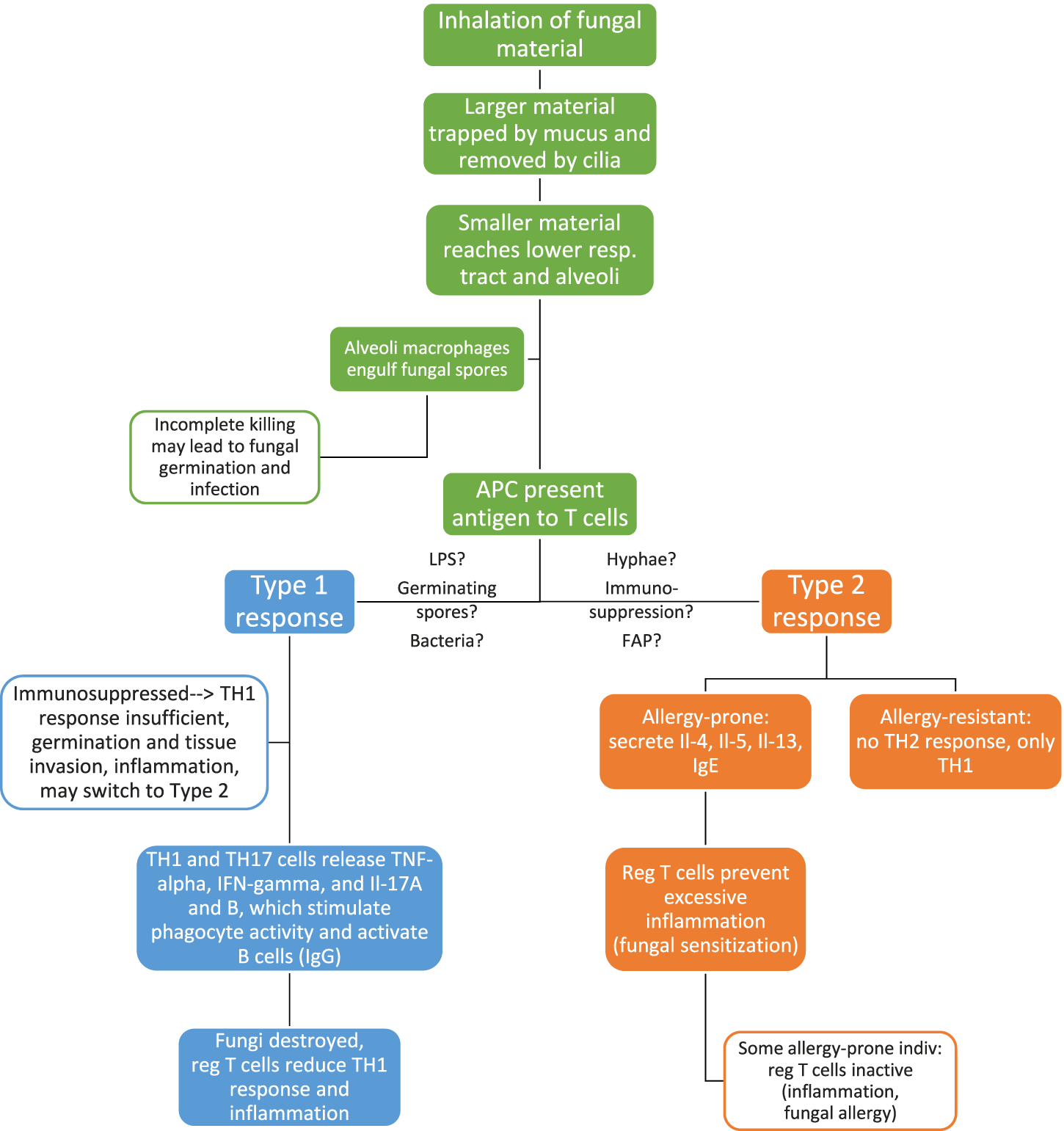
As mentioned previously, in healthy individuals, the occasional inhalation of fungal material causes few negative health effects. The upper respiratory tract contains mucus and cilia, which trap and push larger inhaled fungi particles up and out of the nose and mouth, assisted by sneezing or coughing [38] (Fig. 1). Deeper in the respiratory tract (bronchiole and alveolar regions), lung-resident white blood cells such as macrophages engulf smaller fungal material (such as spores or conidia), which is then destroyed in an oxidase-dependent manner.[22,39] Some fungal material is phagocytosed by dendritic cells, which then process the fungal antigens and present them to CD4-positive T cells.[40] These CD4-positive T cells are then differentiated into type 1 or type 2 T helper cells (TH1 and TH2, respectively), which initiate two different types of immune response (Fig 1).
Figure 1. Immune response to inhaled fungal material. Solid squares, common immune reaction; outlined squares, uncommon/rare immune reaction; green squares, innate immune response/cells; blue squares, type 1 response; orange squares, type 2 response; Resp., respiratory; APC, antigen-presenting cell; LPS, lipopolysaccharides; FAP, fungal-associated allergenic proteinase; TH1, T helper cells type 1; TH2, T helper cells type 2; Il, interleukin; IFN, interferon; TNF, tumor necrosis factor; reg, regulatory; indiv, individuals.
Japma 111 20269 f01
The TH1 pathway is considered protective, and is the “normal” immune response to fungal infection.[41] Activated TH1 and TH17 cells release tumor necrosis factor alpha, interferon gamma, and interleukins (IL) 17A and 17B, which stimulate further phagocyte activity, and activate B cells. B cells activated in this manner produce G-class antibodies (IgG), which are the most effective at clearing fungal infections.[41] The fungi are subsequently destroyed, and regulatory T cells specific to the same fungi reduce TH1 effects and inflammation[42] (Fig 1).
The TH2 pathway is the main cause of fungi sensitization and allergy, and is mostly activated in allergy-prone individuals. Interestingly, allergen-specific TH2 cells from allergy-resistant individuals do not proliferate in response to said allergen in vitro, suggesting that they are thus protected from this proinflammatory immune pathway.[43] In allergy-prone individuals exposed to fungal allergen, their alveolar-resident dendritic cells stimulate naive CD4-positive T cells into TH2 cells that secrete Il-4, IL-5, and IL-13, and activate B cells into IgE-producing plasma cells. The TH2 pathway can cause excessive mucus production, constriction of the airways, and inflammation.[41,44,45] In healthy individuals, regulatory T cells suppress exaggerated inflammation and effector TH2 cells, allowing innate immune cells (eg, macrophages) and TH1 cells (if active) to fight the infection.[46,47] In some allergy-prone individuals, the T-regulatory cells are inefficient, inactive, or diminished in number, allowing the TH2 response to go unchecked, leading to fungal allergies and, in extreme cases, conditions such as ABPA[48,49] (Fig. 1).
How the immune system is directed toward the TH1 or TH2 pathways remains uncertain. The hygiene hypothesis proposes that previous exposure to bacteria in the respiratory system, which is normally met with a TH1 response, primes the immune response toward the TH1 pathway when confronted with fungi.[50] Absence in fungi of something present in bacteria (eg, lipopolysaccharide) could default the immune system to a TH2 response; however, this is currently debated.[51] In contrast, something innate to fungi, such as hyphal elements, may be responsible for TH2 pathway initiation.[52] The life cycle status of the fungus may also affect immune response. A fungal cell wall carbohydrate, β-glucan, becomes more exposed when formerly-dormant spores germinate and is recognized by a C-type lectin pattern recognition receptor, dectin-1. Dectin-1–positive dendritic cells that come into contact with β-glucan signal T helper cells to become TH1 cells.[53] Fungal-associated allergenic proteinase may induce the TH2 pathway in a similar fashion using different receptors[54] (Fig. 1).
The above is a simplified explanation of the immune response to fungal infection. In a great majority of the population, inhaled fungi are mainly ignored by the immune system.[49] A variety of factors have to come together to promote fungal allergy and severe immune reactions to inhaled fungi, such as type of fungus, advanced age, immunosuppression, lung-affecting comorbidities, diminished regulatory T-cell efficacy, and/or allergy-prone status. That being said, we are as of yet unable to determine who will develop fungal sensitization or allergy. Furthermore, respirable dust lacking fungus still has harmful characteristics. Therefore, professionals in foot and nail care specialties are encouraged to consider taking measures to reduce and prevent exposure to nail and skin dust.

How to Reduce Lung Exposure to Dust

Personal protective equipment against dust inhalation varies among professions and workplaces. Surveyed podiatrists in Ireland in 2012 reported that although 73.3 percent of them always wore sterile gloves when performing nail procedures, only 35 percent always wore a dust mask.[3] In 2016, nail salon technicians in the United States reported that 37 percent of them wore gloves during manicures and pedicures, and although 74 percent wore a mask while applying artificial nails, only 41 percent always wore masks during manicures and pedicures.[55] The filtration efficacy of the mask depends on the type of mask and how it is worn. Many podiatrists and pedicurists use a surgical face mask, which has a 99.6 percent filtration efficacy against particles larger than 300 nm and a 76 percent efficacy against particles smaller than 300 nm; however, these efficacies drop to 44 percent and 50 percent, respectively, in ill-fitting surgical masks with gaps. These efficacies are similar to those of properly fitted N95 masks, whereas ill-fitting N95 masks have worse efficacies at 12 percent and 34 percent for particles greater and less than 300 nm, respectively.[56] Therefore, a properly fitted surgical mask is sufficient to protect the wearer from a majority of nail dust created when using a drill.
To reduce the amount of dust expelled by a nail drill while in use, dust extractors such as vacuums and water sprays can be attached to the drill. Water sprays were found to be most effective at 91.6 percent, compared to vacuums, which were 24 percent effective at reducing expelled dust.[19,57,58] Air filtration systems installed in the workplace can also reduce overall air contaminants.[2,59,60] A combination of water spray suppression and air filtration systems can likely improve the quality of air inside the workplace and help reduce the exposure to nail dust.
Proper maintenance of PPE, drill bits, dust suppression systems, and filtration systems can ensure these protections remain effective. Nail care professionals can also consider their drilling technique to reduce dust expulsion. Reducing speed while increasing torque can help remove larger particles of nail while also reducing the velocity at which dust particles are expelled by the drill. Furthermore, using a coarser bur at the start of the procedure will remove larger particles of nail that are nonrespirable and quicken the procedure, before moving onto finer drill burs.[2] Of course, this technique requires an experienced and careful user, to avoid damage to the nail.

Conclusions

Although most healthy, immunocompetent foot and nail care professionals will not experience respiratory ailments attributable to their work, those predisposed to allergies or with a compromised immune system may have an increased risk of respiratory disorders because of inhalation of fungal and chemical elements in nail and skin dust. Appropriate PPE such as a surgical mask, adequate ventilation, and careful drilling technique can greatly reduce exposure to potentially harmful fine dust and fungus particles.
Financial Disclosure: None reported.
Conflict of Interest: None reported.

References

  1. McLarnonNA:The ocular risks of human nail dust in podiatry. PhD thesis, Caledonian University, Glasgow,2000, as cited in Burrow and McLarnon, Occup Environ Med63: 713, 2006.
  2. BurrowJGMcLarnonNA:World at work: evidence based risk management of nail dust in chiropodists and podiatrists. Occup Environ Med63: 713, 2006.
  3. CogginsMAHoganVJKellyM: Workplace exposure to bioaerosols in podiatry clinics. Ann Occup Hyg56: 746, 2012.
  4. Harris-RobertsJBowenJSumnerJ: Work-related symptoms in nail salon technicians. Occup Med (Lond)61: 335, 2011.
  5. HiipakkaDSamimiB:Exposure of acrylic fingernail sculptors to organic vapors and methacrylate dusts. Am Ind Hyg Assoc J48: 230, 1987.
  6. GuptaAKVersteegSGShearNH:Onychomycosis in the 21st century: an update on diagnosis, epidemiology, and treatment. J Cutan Med Surg21: 525, 2017.
  7. LipnerSRScherRK:Onychomycosis: clinical overview and diagnosis. J Am Acad Dermatol80: 835, 2019.
  8. GuptaAKStecNSummerbellRC: Onychomycosis: a review. J Eur Acad Dermatol Venereol34: 1972, 2020.
  9. GuptaAKPaquetM:Improved efficacy in onychomycosis therapy. Clin Dermatol31: 555, 2013.
  10. SumikawaMEgawaTHondaI: Effects of foot care intervention including nail drilling combined with topical antifungal application in diabetic patients with onychomycosis. J Dermatol34: 456, 2007.
  11. AngeloTBorgheti-CardosoLNGelfusoGM: Chemical and physical strategies in onychomycosis topical treatment: a review. Med Mycol55: 461, 2017.
  12. ElkeebRAliKhanAElkeebL: Transungual drug delivery: current status. Int J Pharm384: 1, 2010.
  13. DaviesRGandertonMASavageMA:Human nail dust and precipitating antibodies to Trichophyton rubrum in chiropodists. Clin Allergy13: 309, 1983.
  14. TinleyPDEddyKCollierP:Contaminants in human nail dust: an occupational hazard in podiatry?J Foot Ankle Res7: 15, 2014.
  15. GuptaAKDrummond-MainCCooperEA: Systematic review of nondermatophyte mold onychomycosis: diagnosis, clinical types, epidemiology, and treatment. J Am Acad Dermatol66: 494, 2012.
  16. HainsworthSHamblinJFVanniasinkamT:Isolation of dermatophytes (and other fungi) from human nail and skin dust produced by podiatric medical treatments in Australia. JAPMA105: 111, 2015.
  17. NowickaDNawrotUWłodarczykK: Detection of dermatophytes in human nail and skin dust produced during podiatric treatments in people without typical clinical signs of mycoses. Mycoses59: 379, 2016.
  18. LaratoDCRuskinPFMartinA: Effect of a dental air turbine drill on the bacterial counts in air. J Prosthet Dent16: 758, 1966.
  19. DonaldsonCLCarlineTBrownDM: Toenail dust particles: a potential inhalation hazard to podiatrists?Ann Occup Hyg46: 365, 2002.
  20. GustafssonÅKraisAMGorzsásA: Isolation and characterization of a respirable particle fraction from residential house-dust. Environ Res161: 284, 2018.
  21. GutarowskaBSzulcJNowakA: Dust at various workplaces—microbiological and toxicological threats. Int J Environ Res Public Health15: 877, 2018.
  22. BormPJASchinsRPFAlbrechtC:Inhaled particles and lung cancer, part B: paradigms and risk assessment. Int J Cancer110: 3, 2004.
  23. IliadiAKoletsiDEliadesT: Particulate production and composite dust during routine dental procedures. A systematic review with meta-analyses. Materials (Basel)13: 2513, 2020.
  24. DelfinoRJSioutasCMalikS:Potential role of ultrafine particles in associations between airborne particle mass and cardiovascular health. Environ Health Perspect113: 934, 2005.
  25. ChoudatDTriemSWeillB: Respiratory symptoms, lung function, and pneumoconiosis among self-employed dental technicians. Br J Ind Med50: 443, 1993.
  26. AbramsonCWiltonJ:Nail dust aerosols from onychomycotic toenails. Part II. Clinical and serologic aspects. 1984. JAPMA82: 116, 1992.
  27. LiZLuGMengG:Pathogenic fungal infection in the lung. Front Immunol10: 1524, 2019.
  28. RichardsonMBowyerPSabinoR:The human lung and Aspergillus: you are what you breathe in?Med Mycol57(suppl 2): S145, 2019.
  29. BrownGDDenningDWGowNAR: Hidden killers: human fungal infections. Sci Transl Med 4: 165rv13,2012.
  30. KnutsenAPBushRKDemainJG: Fungi and allergic lower respiratory tract diseases. J Allergy Clin Immunol129: 280, 2012.
  31. WoodfolkJAWheatleyLMPiyasenaRV: Trichophyton antigens associated with IgE antibodies and delayed type hypersensitivity. Sequence homology to two families of serine proteinases. J Biol Chem273: 29489, 1998.
  32. PorterPCOngeriVLuongA: Seeking common pathophysiology in asthma, atopy and sinusitis. Trends Immunol32: 43, 2011.
  33. AgarwalRDhooriaSAggarwalAN: Guidelines for diagnosis and management of bronchial asthma: joint ICS/NCCP (I) recommendations. Lung India32(suppl 1): S3, 2015.
  34. WoolnoughKFairsAPashleyCH: Allergic fungal airway disease: pathophysiologic and diagnostic considerations. Curr Opin Pulm Med21: 39, 2015.
  35. AgarwalRSehgalISDhooriaS: Challenging cases in fungal asthma. Med Mycol57(suppl 2): S110, 2019.
  36. DenningDWPashleyCHartlD: Fungal allergy in asthma—state of the art and research needs. Clin Transl Allergy4: 14, 2014.
  37. ChowdharyAAgarwalKKathuriaS: Allergic bronchopulmonary mycosis due to fungi other than Aspergillus: a global overview. Crit Rev Microbiol40: 30, 2014.
  38. FahyJVDickeyBF:Airway mucus function and dysfunction. N Engl J Med363: 2233, 2010.
  39. Ibrahim-GranetOPhilippeBBoletiH: Phagocytosis and intracellular fate of Aspergillus fumigatus conidia in alveolar macrophages. Infect Immun71: 891, 2003.
  40. VermaAWüthrichMDeepeG: Adaptive immunity to fungi. Cold Spring Harb Perspect Med5: a019612, 2014.
  41. KaoCHananiaNAParulekarAD:The impact of fungal allergic sensitization on asthma. Curr Opin Pulm Med27: 3, 2021.
  42. ShohamSLevitzSM:The immune response to fungal infections. Br J Haematol129: 569, 2005.
  43. WambreEBajzikVDeLongJH: A phenotypically and functionally distinct human TH2 cell subpopulation is associated with allergic disorders. Sci Transl Med 9: eeam9171,2017.
  44. BoonpiyathadTSözenerZCSatitsuksanoaP: Immunologic mechanisms in asthma. Semin Immunol46: 101333, 2019.
  45. KitaH:ILC2s and fungal allergy. Allergol Int64: 219, 2015.
  46. HadebeSBrombacherF:Environment and host-genetic determinants in early development of allergic asthma: contribution of fungi. Front Immunol10: 2696, 2019.
  47. BacherPHeinrichFStervboU: Regulatory T cell specificity directs tolerance versus allergy against aeroantigens in humans. Cell167: 1067, 2016.
  48. KnutsenAPSlavinRG:Allergic bronchopulmonary aspergillosis in asthma and cystic fibrosis. Clin Dev Immunol2011: 843763, 2011.
  49. BacherPScheffoldA:The effect of regulatory T cells on tolerance to airborne allergens and allergen immunotherapy. J Allergy Clin Immunol142: 1697, 2018.
  50. RenzHBlümerNVirnaS: The immunological basis of the hygiene hypothesis. Chem Immunol Allergy91: 30, 2006.
  51. AllardJBRinaldiLWargoMJ: Th2 allergic immune response to inhaled fungal antigens is modulated by TLR-4-independent bacterial products. Eur J Immunol39: 776, 2009.
  52. AllardJBPoynterMEMarrKA: Aspergillus fumigatus generates an enhanced Th2-biased immune response in mice with defective cystic fibrosis transmembrane conductance regulator. J Immunol177: 5186, 2006.
  53. PamerEG:Immune responses to commensal and environmental microbes. Nat Immunol8: 1173, 2007.
  54. KissAMontesMSusarlaS: A new mechanism regulating the initiation of allergic airway inflammation. J Allergy Clin Immunol120: 334, 2007.
  55. ShendellDGGraberJMMilichLJ: Assessing acute symptoms related to occupational exposures among nail salon technicians. J Occup Environ Med60: 343, 2018.
  56. KondaAPrakashAMossGA: Aerosol filtration efficiency of common fabrics used in respiratory cloth masks. ACS Nano14: 6339, 2020.
  57. HarveyC:Comparison of the effectiveness of nail dust extractors. JAPMA83: 669, 1993.
  58. BlairJBurrowJMillarN: Efficiency and effectiveness of dust extraction systems of podiatric nail drills. Br J Podiatr Med2: 53, 1999.
  59. McLarnonNBurrowGMaclarenW: The use of an air filtration system in podiatry clinics. Int J Environ Health Res13: 215, 2003.
  60. McLarnonNAEdwardsGBurrowJG: The efficiency of an air filtration system in the hospital ward. Int J Environ Health Res16: 313, 2006.
  61. GraudenzGSDegobbiCSaldivaPH:SARS-CoV-2. Long distance airborne transmission and its public health implications. Clinics (Sao Paulo)75: e2343, 2020.
  62. DumontIJ:Diagnosis and prevalence of onychomycosis in diabetic neuropathic patients: an observational study. JAPMA99: 135, 2009.