Acquired digital fibrokeratoma (ADFK) is a rare, benign, fibrous tumor, usually arising from the distal extremities [
1]. Since its first description in 1968 [
2], few subsequent cases have been reported in the medical literature. The typical clinical aspect is a dome-shaped, well-defined, horn-like growth, with a collarette of slightly raised skin as a distinguishing feature [
1]. The diagnosis requires a careful pathologic evaluation because this tumor can be easily misdiagnosed as another common benign abnormal growth. Its location on the plantar surfaces of the feet and toes has been rarely recorded and may raise several clinical issues. Although ADFK is usually asymptomatic, a plantar location may affect the patient's mobility and daily activities [
3]. In this article, we report a new case of this rare tumor with an unusual location.
Case Report
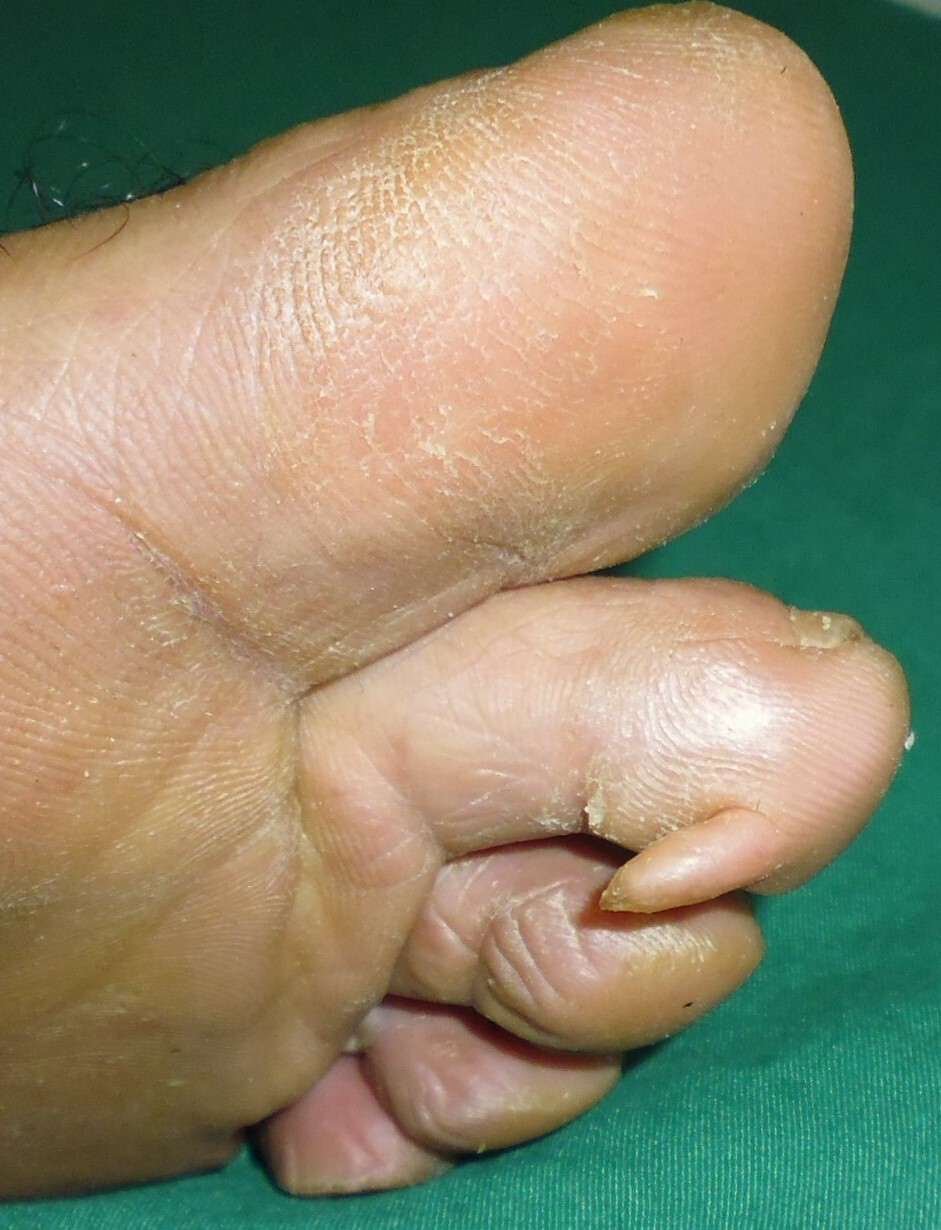
A 45-year-old male patient, with no medical history, was referred to the outpatient department for a painful, long-standing lesion of the toe, which had evolved over 1 year. The lesion was affecting the patient's mobility and his daily activities (eg, wearing shoes). Examination found a solitary, skin-colored, dome-shaped, horn-like projection arising from the ventral surface of the second right toe. The tumor was well-demarcated, measuring approximately 1 cm in length, with a collarette of slightly raised skin and with an elastic and hard consistency (
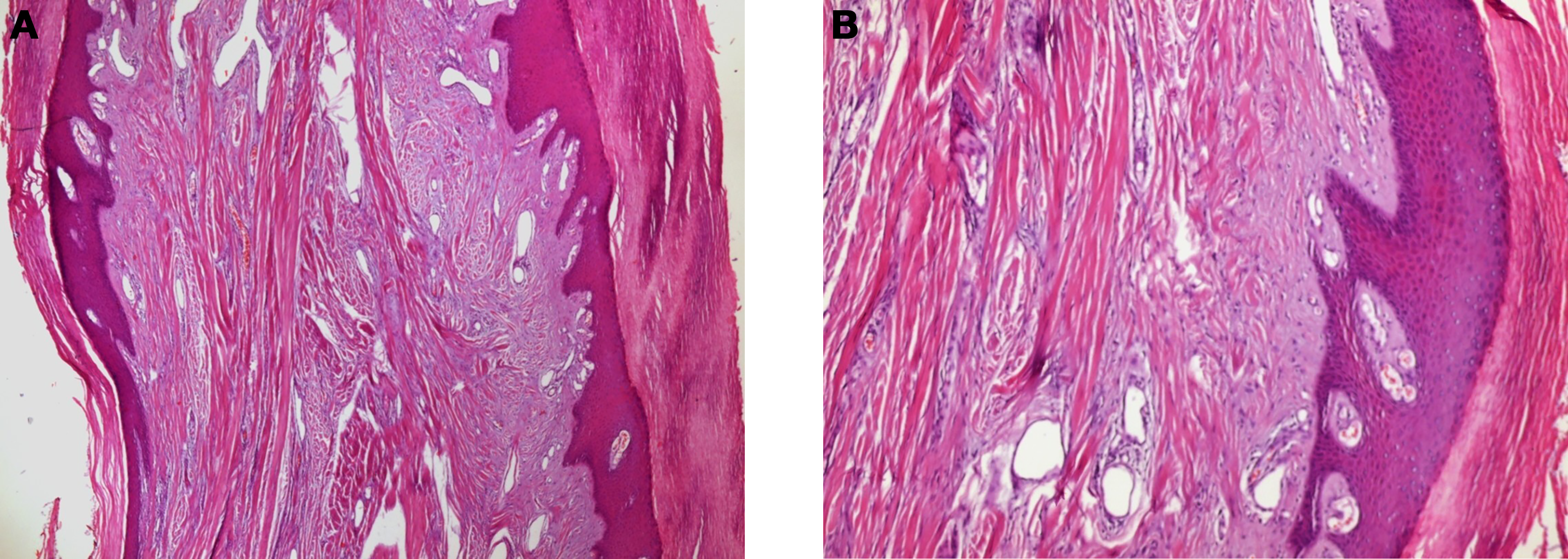
Fig. 1). There were hyperkeratotic changes at the distal extremity. The patient did not recall any history of a preceding trauma. Histopathologic assessment of a 4-mm punch biopsy specimen revealed a central core of mature and thick collagen bundles oriented perpendicular to the vertical axis of the dermis. There were sparse elastic fibers, with some stellate fibroblasts and small blood vessels. Neuroid structures were absent. The overlying epidermis showed acanthosis with hyperkeratosis (
Fig. 2). The diagnosis of an ADFK of the second right toe was made, and the patient was referred to the plastic surgery department. The tumor was completely excised along with the basal attachments under general anesthesia. At follow-up at 6 months, excellent functional recovery was noted, with no recurrence or residual scarring.
Figure 1.
A skin-colored, dome-shaped keratotic tumor, smaller than 1 cm, with a collarette of slightly raised skin, arising from the ventral surface of the second toe.
Figure 1.
A skin-colored, dome-shaped keratotic tumor, smaller than 1 cm, with a collarette of slightly raised skin, arising from the ventral surface of the second toe.
Figure 2.
(A) Histopathologic examination (H&E, ×200) demonstrated a dome-shaped tumor. The core of the lesion consisted of mature thick collagen bundles oriented along the vertical axis with some fibroblasts and small blood vessels; the epidermis showed acanthosis with hyperkeratosis. (B) Histopathologic examination (H&E, ×400) demonstrated a dome-shaped tumor. The core of the lesion consisted of mature thick collagen bundles oriented along the vertical axis with some fibroblasts and small blood vessels; the epidermis showed acanthosis with hyperkeratosis.
Figure 2.
(A) Histopathologic examination (H&E, ×200) demonstrated a dome-shaped tumor. The core of the lesion consisted of mature thick collagen bundles oriented along the vertical axis with some fibroblasts and small blood vessels; the epidermis showed acanthosis with hyperkeratosis. (B) Histopathologic examination (H&E, ×400) demonstrated a dome-shaped tumor. The core of the lesion consisted of mature thick collagen bundles oriented along the vertical axis with some fibroblasts and small blood vessels; the epidermis showed acanthosis with hyperkeratosis.
Discussion
This report illustrates a rare case of an ADFK arising from the plantar surface of the second right toe, causing pain and the so-called footwear problem. The clinical presentation was typical, with a characteristic collarette of raised skin. Acquired digital fibrokeratoma is usually located on the fingers [
1]. Its location on the soles and toes, such as in our case, is uncommon and may cause major pain during walking and thus affect the patient's mobility. According to the literature, there have been few recorded cases with such a localization [
3,
4,
5,
6,
7,
8,
9], and the tumor was predominantly noted to arise from the great toe (lateral side, nailfold, plantar surface). The pathogenesis is not clearly elucidated. A preceding trauma had been suggested to be a predisposing factor [
3]. Qiao et al [
8] reported a case of an ADFK of the great toe, developing after ciclosporin therapy. Our patient denied any drug intake and did not report any history of a preceding trauma.
This plantar tumor was recorded because it may closely mimic other benign conditions possibly arising from the plantar surface. The main differential diagnoses that could be discussed in our situation include supernumerary rudimentary digit, common wart, eccrine poroma, and neurofibroma [
1]. Thus, a definite diagnosis relies mainly on histologic assessment, which can identify subtle specific features for each tumor. In fact, the pathologic evaluation of ADFK shows a core of thick collagen bundles, in continuity with the underlying dermal connective tissue, oriented in the direction of the vertical axis of the lesion, with variable cellularity, vascular supply, and absence of neuroid structures [
1]. In our case, a supernumerary digit was excluded because the tumor was lacking prominent neural bundles in the dermis. Also, a supernumerary digit is usually bilateral, located on the bases of the fifth digits, and may have been present since birth [
1]. A common wart shows on biopsy, along with marked acanthosis with papillomatosis and hyperkeratosis. Vacuolated cells and viral inclusion bodies are characteristic features [
1]. Eccrine poroma was excluded in this case because we did not find anastomosing bands with cuboidal basaloid cells connected to the epidermis [
1]. The diagnosis of neurofibroma was easily ruled out because the proliferation was not associated with thin fascicles of cells with a spindle-shaped nucleus [
1].
In our patient, surgical excision of the tumor was performed under general anesthesia, and there were no signs of recurrence at follow-up. In fact, surgical excision is the mainstay of treatment because ADFK does not show spontaneous regression [
3]. Bofelli and Abben [
9] described a new surgical technique for an ADFK of the hallux, termed “the trap door flap,” which uses a portion of the tumor to close the defect after mass excision.
Conclusions
In summary, we present an additional case of ADFK with an uncommon location. The diagnosis can be challenging and requires a critical pathologic evaluation. A timely diagnosis and surgical management may allow a total functional recovery. Because this tumor has been noted to occur in areas other than digits, we suggest that an appropriate designation would be “acquired fibrokeratoma.”