Subungual exostosis (SE) describes a benign, relatively uncommon exophytic bony growth protruding from the dorsal or dorsomedial surface of the tip of the distal phalanx without continuity to underlying bone. These lesions grow distally and away from the epiphysis; the base is pedunculated or sessile; and the tip of the exostosis can be flattened, cupped, or dome-shaped [
1]. It was reported that the incidence of SE was 4.6% among all bone tumors [
2]. DaCambra et al [
3] reviewed 287 cases from 13 studies, and noticed that the majority of cases of SE occurred in young patients, with an average age of 25.7 years at the time of diagnosis, with 55% of them being younger than 18 years. Male and female patients were equally affected (1:1). The hallux was most frequently involved (80%), followed by the second (6%), third (7%), fourth (5%), and fifth toes (2%) [
3]. Clinically, SE presents as either a protruded or nonprotruded mass beneath the nail plate, with symptoms including local pain and nail dystrophy [
4], and needs to be differentiated from other benign bony lesions. Subungual exostosis is diagnosed mainly by radiography, which shows an exophytic bone projection from the dorsomedial or dorsolateral surface of the distal phalanx. Complete surgical excision is the standard treatment, with a success rate of more than 90% [
5]. The protruded mass is surgically removed by the dorsal incision approach. Nonprotruded SE is excised through a “fish-mouth” type incision on the tip of the toe [
4,
6]. Both techniques achieved excellent outcomes [
4]. Insufficient mass excision accounts for 53% of recurrence [
1]. The pathogenesis of SE is not yet clear. It is believed that constant mechanical friction, previous trauma, or infection is associated with the development of SE [
3]. The translocation t(X;6)(q22, q13-14), the regions harboring the collagen genes
COL12A1 and
COL4A5 in chromosome bands 6q13-14 and Xq22, respectively, was demonstrated in a substantial number of cases of SE [
7,
8]. These data suggest that SE is a true neoplasm rather than a mere reactive response to traumatic events or infections, which deserves the attention of podiatrists and orthopedic surgeons. We therefore describe the clinical manifestation, radiography, surgical excision, and histopathology in a male teenager with SE.
Case Report
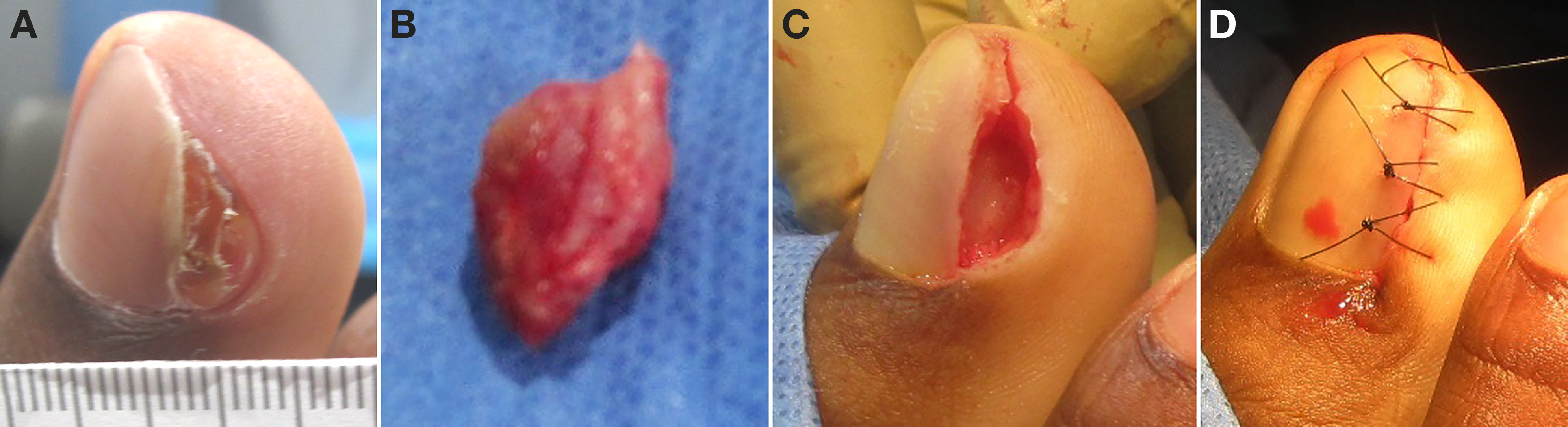
A 15-year-old boy presented with a complaint of a painful growth on his right great toe of 6 months' duration. Over the preceding 2 weeks, his pain had gradually increased to 8 on a pain scale ranging from 0 to 10. The pain was aggravated by footwear and weightbearing and was not relieved by anything. Systemic review was unremarkable. The patient's medical history included depression, anxiety disorder, and bipolar disorder, and he was treated with fluoxetine hydrochloride. No obvious social and family histories were found. Inspection and palpation of the skin of the right great toe revealed a solid, erythematous, rough, irregular mass, 1 cm in diameter, penetrating through the skin, along the dorsolateral nail bed of the right hallux, deforming some of the lateral nail plate, but not extending to the proximal nail fold (
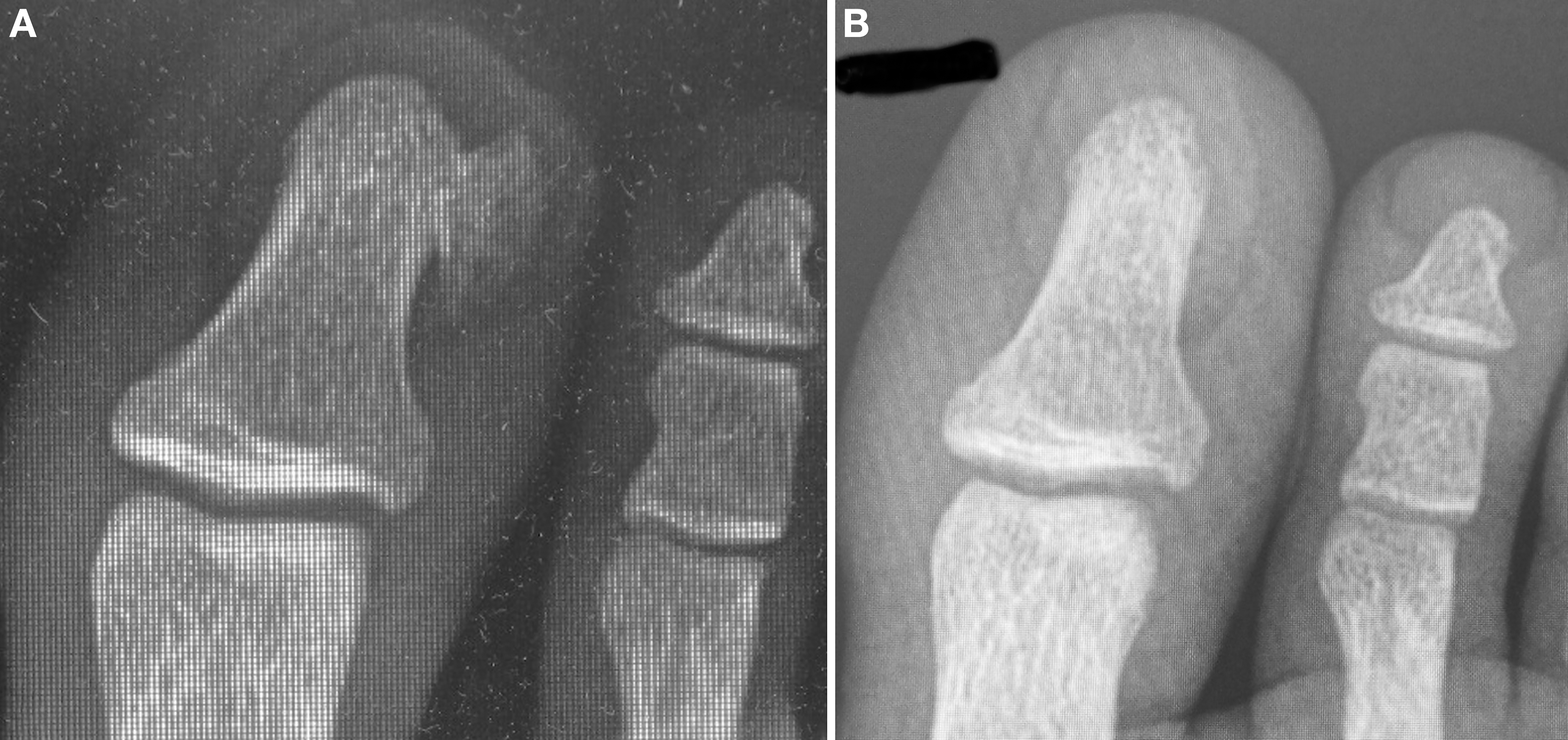
Fig. 1A). Radiographs showed an elevated, calcified growth over the distal phalanx of the right hallux located more dorsolaterally (
Fig. 2A). Detailed treatment options were discussed with the patient and his parents. They opted for surgical excision. At the time of surgery, the patient's right toe was locally anesthetized with 2% lidocaine and a tourniquet was applied to the base of the right great toe. A nail splitter was used to remove more of the lateral nail plate (≥3 to 4 mm) to expose the rest of the lesion that extended under the nail plate. The extending bony lesion and nail bed were circumscribed with a No. 64 scalpel blade directly down to the bone of the distal phalanx of the hallux. A double-action bone cutter was used to create a plane and then a Freer elevator was used to remove the lesion from the bone (
Fig. 1B). The remaining bone was debrided with a curette and a rongeur to remove any possible remnant of the lesion. The removed portion of bone was immediately fixed in 10% neutral buffered formalin and was later submitted for pathologic analysis. The wound was irrigated with saline solution and the incision was closed with simple interrupted sutures through the nail plate and into the skin with 4-0 nylon (
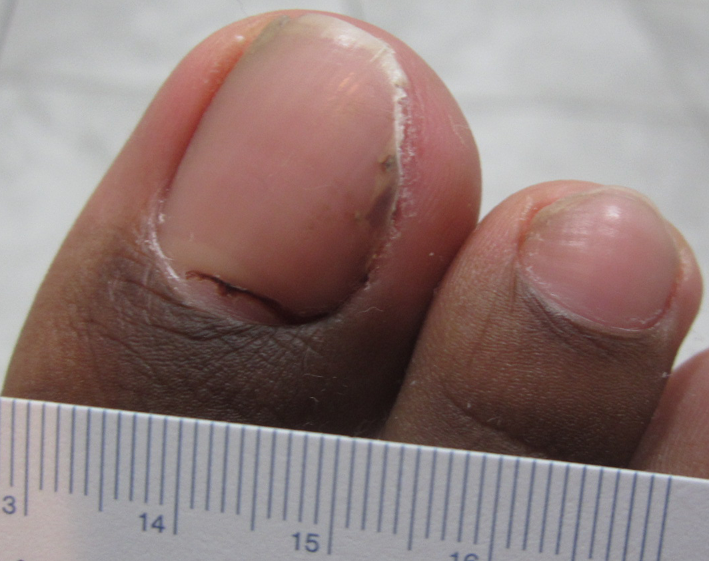
Fig. 1 C and D). The tourniquet was released and there was good hemostasis with immediate capillary refill to the toe. The area was dressed with Adaptic (3M, St. Paul, Minnesota), povidone-iodine gauze, and a dry, sterile dressing. The patient was placed in a stiff rocker-soled surgical shoe and was instructed to limit activities for the next few days and keep dry. He was seen 3 days after surgery for a dressing change, and then the sutures were removed 7 days later, with the toe healing well. The patient was instructed to begin a gradual return to wearing shoes as tolerated at 3 weeks after surgery. Two months after surgery, the patient's right toenail had a normal appearance without any deformity (
Fig. 3). The patient returned to normal activity thereafter. No recurrence was noticed on radiographs at 6-month follow-up (
Fig. 2B). The patient had no relapse or recurrence at a total follow-up of 18 months.
Figure 1.
Clinical presentation and demonstration of surgical excision of subungual exostosis on the right hallux. A, A solid, erythematous, rough, irregular nodule protruding beneath the nail plate. B, A bony mass dissected out surgically. C, Cavity after mass was surgically excised. D, Closed incision with simple interrupted sutures through the nail plate and into the skin.
Figure 1.
Clinical presentation and demonstration of surgical excision of subungual exostosis on the right hallux. A, A solid, erythematous, rough, irregular nodule protruding beneath the nail plate. B, A bony mass dissected out surgically. C, Cavity after mass was surgically excised. D, Closed incision with simple interrupted sutures through the nail plate and into the skin.
Figure 2.
Preoperative and postoperative radiographs of the subungual exostosis on the right hallux. A, Anteroposterior radiograph showing an exophytic calcified projection from the distal dorsolateral phalanx of the right hallux. B, Anteroposterior radiograph showing no recurrence of subungual exostosis on the phalanx of the right hallux at 6-month postoperative follow-up.
Figure 2.
Preoperative and postoperative radiographs of the subungual exostosis on the right hallux. A, Anteroposterior radiograph showing an exophytic calcified projection from the distal dorsolateral phalanx of the right hallux. B, Anteroposterior radiograph showing no recurrence of subungual exostosis on the phalanx of the right hallux at 6-month postoperative follow-up.
Figure 3.
Normal appearance of right toenail at 2-month postoperative follow-up.
Figure 3.
Normal appearance of right toenail at 2-month postoperative follow-up.
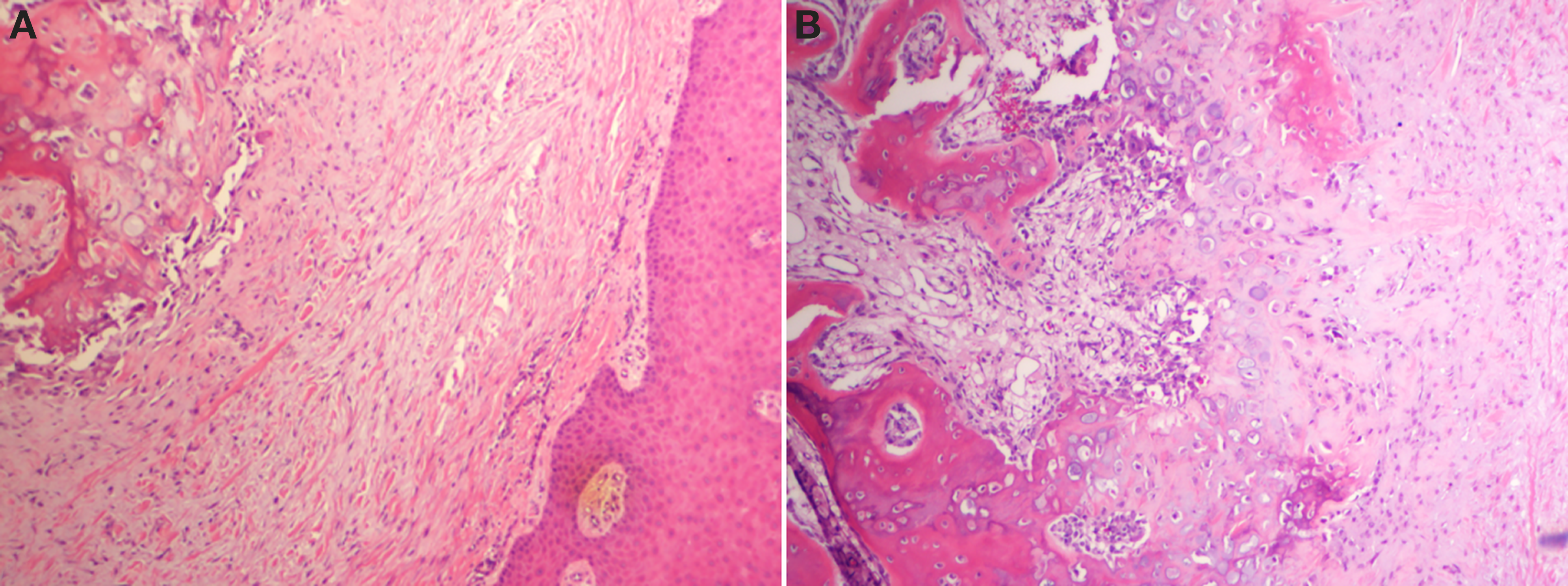
Gross examination of the tissue showed a 1.7 × 1.1 × 0.8-cm bony tissue (
Fig. 1B). The tissue was trisected, decalcified, and entirely submitted for tissue processing. Histologic evaluation revealed a fibrocartilaginous cap underneath the hyperkeratotic and acanthotic epidermis (
Fig. 4A), which is in transition to mature trabecular bone (
Fig. 4B).
Figure 4.
Histopathology of the subungual exostosis on the right hallux. A, A fibrocartilaginous cap beneath the hyperkeratotic and acanthotic epidermis. B, The fibrocartilaginous cap in transition to mature trabecular bone derived from fibrous tissue.
Figure 4.
Histopathology of the subungual exostosis on the right hallux. A, A fibrocartilaginous cap beneath the hyperkeratotic and acanthotic epidermis. B, The fibrocartilaginous cap in transition to mature trabecular bone derived from fibrous tissue.
Discussion
In our case, the protruded mass was resected from the dorsolateral surface of the phalangeal bone with a double-action bone cutter that created a plane, and further curetted and rongeured to removing any remnants of the lesion. Similar tactics were described by De Berker and Langtry [
9]. A “saucer-like defect” into normal trabecular bone created by using a curette was also reported [
10]. The patient returned to normal daily activity and had no recurrence at follow-ups of 6 and 18 months.
Subungual exostosis needs to be differentiated from other lesions including bizarre parosteal osteochondromatous proliferation, myositis ossificans, fibro-osseous pseudotumor, osteochondroma, and enchondroma, because of their similarities in clinical and radiographic presentations. Clinical and histologic evaluation of these lesions will be helpful to make a final diagnosis (
Table 1).
Table 1.
Clinical and Histopathologic Characteristics of Subungual Exostosis, Bizarre Parosteal Osteochondromatous Proliferation, Myositis Ossificans, Fibro-Osseous Pseudotumor, Osteochondroma, and Enchondroma.
Table 1.
Clinical and Histopathologic Characteristics of Subungual Exostosis, Bizarre Parosteal Osteochondromatous Proliferation, Myositis Ossificans, Fibro-Osseous Pseudotumor, Osteochondroma, and Enchondroma.