Approximately 30 million people in the United States have diabetes, encompassing 9.4% of the population.[
1] Diabetic patients are at a lifetime risk of 25% to develop a diabetic foot ulcer (DFU),[
2] a form of diabetic foot disease associated with diabetes mellitus that is characterized as the presentation of deep lesions of tissues intermingled with neurologic disorders and peripheral vascular disease of the lower limbs.[
3] Diabetic foot ulcers have been associated with neuropathy, peripheral artery disease, and deformities of the foot related to motor neuropathy and minor foot trauma.[
2] They are a significant predisposing factor for diabetic foot infections (DFIs), defined as the presence of an inflammatory response and tissue injury. Diabetic foot infections are implicated in more than 20% of moderate infections and 50% to 60% of severe infections (including osteomyelitis) and are related to more than 50% of nontraumatic lower-extremity amputations.[
2,
4]
The current standard of care for diabetic wounds consists of dressing the wound, elimination of harmful bacteria, debridement of devitalized and callous tissue, and negative pressure therapy for chronic wounds. For DFUs that fail to demonstrate greater than 50% wound area reduction after a minimum of 4 weeks of standard therapy, adjunctive therapies may be explored, such as biologics, hyperbaric oxygen therapy, or bioengineered skin substitutes.[
5,
6,
7,
8,
9] Generally, diabetic foot disease is a major US health-care financial burden, ranging from
$9 billion to
$13 billion annually.[
10] Specifically, health-care costs attributed to DFUs are twice that of diabetes management alone.[
2] Therapies such as bioengineered skin substitutes and a full course of hyperbaric oxygen therapy can cost up to
$30,000 and
$200,000, respectively.[
8,
11,
12,
13,
14,
15,
16] In addition to the financial ramifications, DFUs lead to an increase in mortality, with up to 70% of DFU-related amputations leading to patient death within 5 years of amputation.[
2,
17]
The pH of the wound bed is thought to affect many aspects of the wound-healing process.[
18,
19,
20] Chronic wounds tend to have an alkaline pH at which various proteases that break down the extracellular matrix and function optimally, toxinproducing bacteria are able to thrive, and oxygen perfusion necessary for wound healing is impaired.[
19,
20,
21,
22] Altering the pH of a wound to fall outside the known optimal range for the infecting organism can synergistically improve current antibiotic therapy and promote wound closure. This literature review provides an overview of the current state of knowledge regarding the role of pH in wound chronicity and healing.
Methods
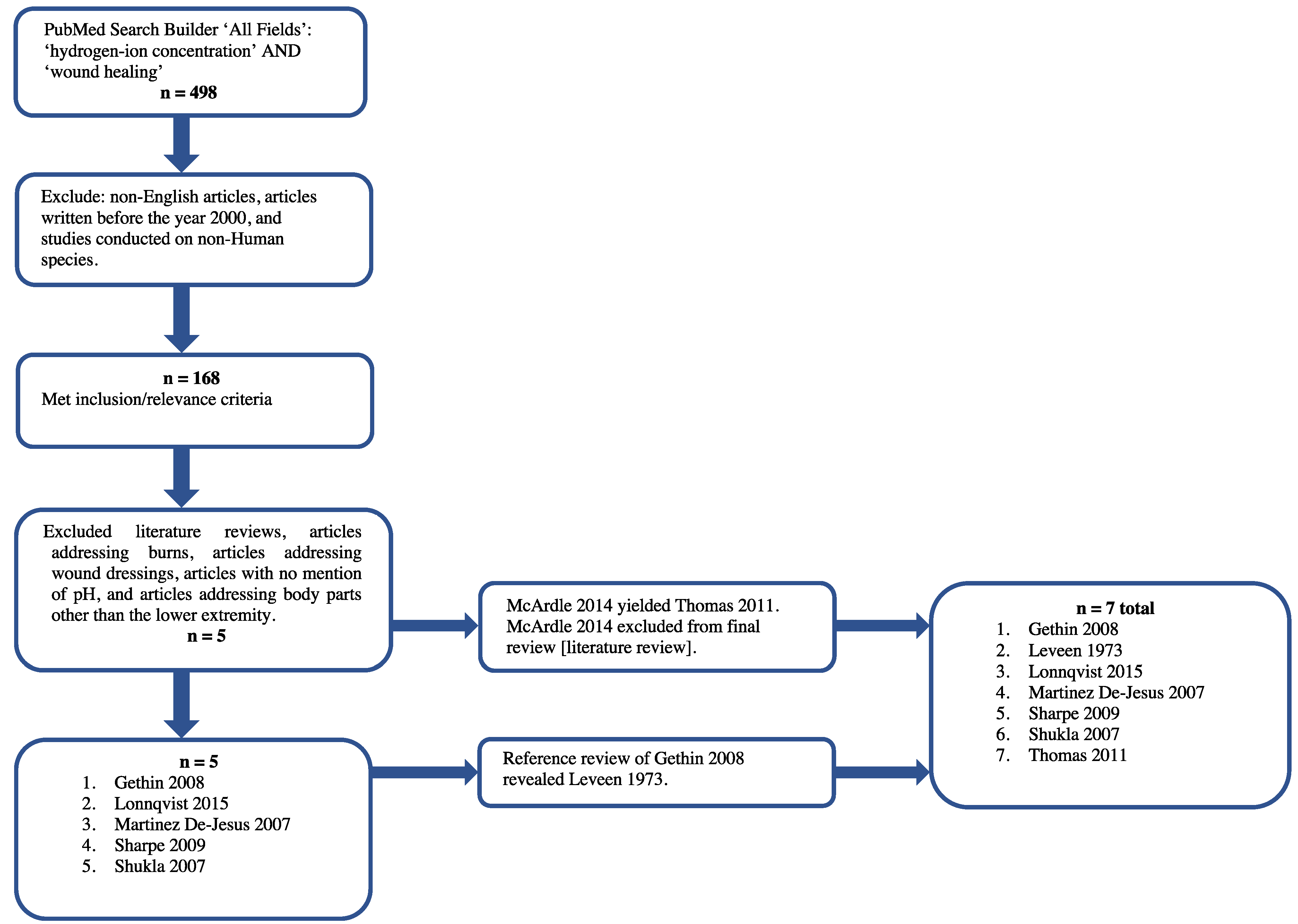
A search for relevant literature was performed of the PubMed database in March 2019 (
Fig. 1). As a baseline for the evaluation and treatment of DFUs, the most recent (2016) Society for Vascular Surgery Clinical Practice Guidelines on Managing the Diabetic Foot was included in this review.[
7] We used the advanced search option using the “all fields” builder and the Boolean operator “AND.” Articles were included that mentioned hydrogen ion concentration and progression of wound healing.
Figure 1.
Flowchart of the literature review process.
Figure 1.
Flowchart of the literature review process.
1. Builder: “All Fields”' hydrogen ion concentration AND wound healing
This search yielded 498 results when sorted by “best match.” These results were further narrowed down by implementing the following PubMed filters: English articles written between January 1, 2000, and March 1, 2019, and only studies evaluating the human species were included. After application of these filters, there were 168 results remaining.
A manual review of the 168 articles yielded five relevant articles. These articles all contain direct mention of hydrogen ion concentration or pH and its effect on the rate of wound healing. Upon review of Gethin et al, we included Leveen et al for historical context although it did not fall within the inclusion date range. Upon review of McArdle et al, the authors referenced Thomas et al; we included this article to demonstrate the physiology of pH on antibiotic sensitivity.
Results
Seven sources were retrieved for review and discussion using the methods outlined previously herein.
Shukla et al[
23] measured wound pH with litmus paper strips weekly and found that 47 of the 50 patients had wound pH greater than 8.5 at baseline (day 1). Wound origin included acute (52%), acute trauma (22%), chronic (48%), chronic trauma (26%), cellulitis (16%), idiopathic (14%), diabetes (14%), tuberculosis (2%), chronic venous insufficiency (2%), and Hansen's disease (4%). Wounds were further classified based on location, with 78% on the lower extremity, 6% on the upper extremity, 12% on the trunk, and 4% on the face. Wounds were characterized by condition, discharge, and pH on days 1, 7, and 15 after presentation. All of the wounds were treated with the same protocol (daily dressing changes and saline irrigation after baseline sharp debridement). Significant differences were found in wound discharge on day 15 and in wound pH and wound condition on days 7 and 15. Wounds with discharge on day 1 were significantly improved by day 15, with 84% progressing to serosanguinous or absent by day 15. Wound pH was assessed at each interval and was found to be greater than 8.5 in 94% of wounds on day 1; pH was significantly reduced on day 7 (88% with pH 8–9) and day 15 (78% with pH <8.5). The study by Shukla et al[
23] found a relationship between reduction in wound pH and improvement in wound condition. In addition, their study represents a fast and inexpensive method to evaluate pH through litmus strips.
Leveen et al[
24] sought to examine the effect of pH alteration on wound healing and potentially increasing the availability of oxygen to tissues via the Bohr effect. pH was measured using pH litmus strips or a glass electrode. Leveen et al showed a relationship between wound pH and availability of oxygen. There was a fivefold increase in oxyhemoglobin for every 0.9 pH-unit decrease. Alkalinity of the wound results in a left Bohr shift, lowering the available oxygen needed for healing, whereas the acidification of the wound leads to a right Bohr shift, leading to a greater amount of available oxygen. The toxicity of ammonia on tissues was studied through three sets of experiments. Hemolysis of human erythrocytes by ammonia was highly dependent on the pH of the solution used to deliver the ammonia rather than on the concentration of ammonia itself; ammonia at concentrations lower than clinically seen hemolyzed erythrocytes in an alkaline solution but failed to do so even at high concentrations in an acidic solution. In a mouse model, it was determined that doses of ammonia injection as low as 30 mg% result in skin necrosis.
Lonnqvist and colleagues[
25] studied keratinocyte function in vitro and reepithelialization in an in vitro model of human skin to investigate the effects of acidic pH on the regeneration phase of wounds. Keratinocyte migration and viability were studied using scratch assays and MTT assays, respectively. Quantitative real-time polymerase chain reaction was used to quantify expression of genes related to wound healing and environmental impairment, and immunohistochemical staining allowed investigation of cell-to-cell interaction in cultures after subjecting keratinocytes to altered conditions. An in vitro human full-thickness wound-healing model was used to examine reepithelialization. It was found that at pH 6.0 and pH 5.0 keratinocytes displayed a decreased ability and inability, respectively, to repopulate in the scratch assay. MTT assays showed viability of keratinocytes to be decreased with increasing acidic culture milieus, with 33.2% viability at pH 6.0 and 10% at pH 5.0. At pH 6.0 there was an upregulation of all genes investigated, and at pH 5.0 only matrix metallopeptidase 1 and tissue inhibitor of metallopeptidase 1 were upregulated, and protein tyrosine kinase 2 and 27-kDa heat shock protein 1 were downregulated. Cell-to-cell interaction was disrupted at pH 5.0 compared with controls, and at pH 6.0 deviation was observed but still in a similar localization pattern compared with controls. In the in vitro model no wounds presented reepithelialization at pH 5.0, whereas minor, but not full, reepithelization occurred in 50% of wounds at pH 6.0.
The efficacy of a neutral pH superoxidized aqueous solution (NpHSS) in combating infection, odor, and damage to surrounding skin and tissue of infected DFUs was assessed in a randomized, single-blind clinical trial conducted by Martinez-De Jesus et al.[
26] The study included 45 consecutive patients with type 2 diabetes mellitus and infected, deep DFUs. Intervention and control groups underwent similar treatment protocols wherein the intervention group differed only in terms of an additional 15 to 20 foot soaks in NpHSS after debridement weekly or biweekly, use of NpHSS instead of saline solution to remove gauze, and NpHSS spray applications throughout the 20-week study. Patients who used NpHSS displayed vastly greater improvements compared with controls in various study outcomes, including odor reduction, cellulitis reduction, wound outcome improvement, periwound conditions, and skin and tissue damage around ulcers.
Sharpe et al[
27] sought to investigate the optimal pH ranges for keratinocyte and fibroblast migration, proliferation, and attachment, as well as which keratinocyte phenotypes (K1 and K5) are more prevalent in certain pH conditions. Optimal keratinocyte migration from ex vivo skin explants was observed at pH 8.55. Keratinocytes were found to be proliferating actively between pH 7.58 and 8.55, whereas fibroblasts proliferated actively between pH 7.21 and 8.34. The optimal pH for attachment of keratinocytes and fibroblasts to tissue culture plastic was 8.06 and 8.30, respectively. K1 and K5 phenotype expression did not change significantly in response to pH when quantified through real-time polymerase chain reaction.
Gethin and colleagues[
28] investigated the efficacy of manuka honey in creating an acidic wound environment and decreasing the size of nonhealing chronic superficial ulcers. The study consisted of 20 lower-leg wounds in 17 individuals (eight males, nine females). Manuka honey dressings (ApiNate; Comvita, Santa Barbara, California) were applied directly to wounds, and secondary dressings were restricted to Aquacel hydrofiber (ConvaTec, Uxbridge, UK) and/or Allevyn hydrocellular (Smith & Nephew, Watford, UK). A statistically significant decrease in mean ± SD wound pH was observed at baseline compared with at the end of the 20-week study (7.72 ± 0.339 compared with 7.26 ± 0.53;
P < .001). Mean ± SD wound size decreased during the study as well but was not significant (10.1 ± 13.98 cm
2 compared with 9.1 ± 16.25 cm
2;
P = .274). After linear regression it was found that for each 1-U decrease in pH there was an 81% reduction in wound size. Lower wound pH at the start of the study was also associated with increased reductions in wound size at the conclusion of the study.
Thomas et al[
29] discussed the zones of inhibition of various gram-positive and gram-negative isolates when tested against an antibiotic panel at two different pH values (7.0 and 5.5) as well as in two different phenotypic states (quasi/nonbiofilm and biofilm). The antibiotic panel included clindamycin (2 μg), ampicillin (10 μg), aztreonam (30 μg), and levofloxacin (5 μg). To show the effect of pH, the Mueller-Hinton agar and poloxamer plates used to grow the bacteria were made to pH 7 or 5.5 using either hydrochloric acid or sodium hydroxide during preparation. The effectiveness and sensitivity to antibiotics of various gram-positive and gram-negative isolates was shown to be slightly affected by both pH and bacterial phenotype. Overall, gram-positive bacteria were more sensitive to antibiotics at pH 7.0 compared with pH 5.5. Gram-negative bacteria displayed a more varied range of results, where certain strains and antibiotic combinations displayed equal sensitivity at pH 7.0 and 5.5 and other combinations resulted in increased sensitivity at either pH 7.0 or 5.5.
Discussion
We examined the current body of literature regarding the role of pH in the healing of wounds. Standardized pH-driven therapies currently do not exist and present as potentially less expensive alternatives to current standard wound care for diabetic wounds.[
10,
12,
13,
14,
15,
16,
17] The articles examined highlight the critical role of pH in the wound microenvironment, such as its involvement in oxygen tension and the microbial ecology, its role in promoting the proliferative phase of wound healing, and the methods by which a favorable wound pH may be maintained throughout the wound-healing process.[
18,
19,
20]
Two of the articles[
23,
24] examined support the notion that a more acidic wound environment is beneficial to the healing process. The study by Shukla et al[
23] suggests that bacterial burden and wound healing may depend on the pH of the microenvironment. As the wounds that were evaluated progressed from day 1 to day 15, the pH of the microenvironment decreased, the wound condition improved and the associated purulence either resolved completely or transformed into serosanguineous.[
23] This is suggestive of decreasing wound pH as a predictor of wound healing. Leveen et al[
24] explored an underlying mechanism through which an alkaline pH is detrimental to wound healing by showing that the pH of the wound has an effect on oxygen tension. Wounds that are exposed to air lose carbon dioxide and a local respiratory alkalosis is established, leading to a gradual increase in wound pH and a delay in wound healing. Leveen et al[
24] offer a mechanism of failure for delayed wound healing. As per the Bohr effect, physiologic situations that have increased alkalinity will shift the oxyhemoglobin dissociation curve to the left. A left shift is defined by a reduction in the dissociation of oxygen from the hemoglobin molecule, thus delaying healing in a wound that is already deprived of oxygen. Therefore, it is reasoned that an acidic pH can be beneficial to wound healing by making more oxygen available through a decrease in affinity to hemoglobin.[
24]
An important phase in wound healing is the directional migration of wound-edge keratinocytes with the intent to reepithelialize the wound. Lonnqvist et al[
25] showed impaired keratinocyte migration at pH 6.0 and a complete disruption of keratinocyte migration at pH 5.0. Furthermore, Sharpe et al[
27] demonstrated that the optimal pH for keratinocyte and fibroblast migration, proliferation, and attachment is 7.2 to 8.3, with decreases at pH less than 7.1. This finding suggests an ideal pH range for wound healing between 7.2 and 8.3. Optimal keratinocyte migration occurred at a pH of 8.55.[
27] A high pH could be beneficial for increased epithelial growth but may conversely provide an environment more susceptible to microbial infection.
Importantly, pH is able to significantly affect the composition of the bacterial ecology of the wound and the sensitivity to antibiotics. Thomas et al[
29] demonstrated that gram-positive and gram-negative isolates displayed varied sensitivities to antibiotics and were affected by both pH and phenotypic states. Gram-positive bacteria were generally more sensitive to antibiotics at a pH of 7.0 compared with 5.5, and gram-negative bacteria were more divided in that certain strains were more sensitive at either pH 7.0 or 5.5.[
29] The findings highlight the need to understand the bacterial microbiota of wounds in combination with rapid and accurate assessment of the wound pH to develop pH-driven wound-healing therapies.
To develop pH-driven therapies for wound healing, the pH of wound beds must be maintained at favorable pH levels. Manuka honey is a wound care product that has been investigated in an open-label, nonrandomized prospective study.[
28] The study found that for each 1-U decrease in pH from topical application of manuka honey there is an 81% reduction in wound size.[
28] In addition, NpHSS is a nontoxic neutral pH water that contains reactive oxygen species generated by the electrolysis of sodium chloride in water. It has demonstrated advantages in wound healing based on its bactericidal effect.[
26] Martinez de-Jesus et al[
26] showed that NpHSS was superior to control (soap or povidone iodine) and superior in managing the reduction of odor, cellulitis, and periwound damage.
Conclusions
We evaluated the current available literature pertaining to pH and its role in the healing process of wounds. This review elucidated mechanisms through which decreased pH can benefit wound healing, potential optimal ranges to best promote healing, the impact of pH on the sensitivity of the wound bacterial polyculture to antibiotics, and products that may be applied to wounds to maintain favorable pH levels. Limitations of this review stemmed from sources that evaluated chronic cutaneous wounds in sites other than the lower extremity, poorly defined treatment parameters that had a direct effect on wound physiology, and the use of in vitro models to study the microcellular environment. Current methods for the observation and management of wounds is largely objective, but greater reproducibility and subjective assessment are needed. Development of a highly structured and reproducible system of pH-driven therapy based on inexpensive measurement of wound pH, using pH strips, and maintenance of favorable pH with readily available products is an attractive adjunctive or alternative choice to the current standard of care for diabetic wounds. Future prospective randomized multicentered studies are needed to confirm the relationship between pH and chronic wound healing.