Next Article in Journal
Angioleiomyoma (Vascular Leiomyoma) Presenting as a Pseudoaneurysm of the Tibialis Posterior Artery
Previous Article in Journal
Traumatic Hallux Varus in Association with Agenesis of the Fibular Sesamoid: A Case Study
 
 
Journal of the American Podiatric Medical Association is published by MDPI from Volume 116 Issue 1 (2026). Previous articles were published by another publisher in Open Access under a CC-BY (or CC-BY-NC-ND) licence, and they are hosted by MDPI on mdpi.com as a courtesy and upon agreement with American Podiatric Medical Association.
Article

Myopericytoma: The Importance of a Histologic Diagnosis to Exclude a Malignancy in a Possible Underestimated Benign Condition

by
Arianna F. Agnoletti
1,*,
Emanuele Claudio Cozzani
1,
Elena De Col
1,
Nataniele Piol
1,2,
Francesco Cabiddu
3 and
Aurora Parodi
1
1
Di.S.Sal., Section of Dermatology, IRCCS Azienda Universitaria Ospedaliera San Martino-IST, Genova, Italy
2
Department of Surgical and Diagnostic Sciences, Pathology Unit, University of Genoa, Anatomic Pathology Division, Genova, Italy
3
Anatomic Pathology Division, IRCCS Azienda Universitaria Ospedaliera San Martino-IST, Genova, Italy
*
Author to whom correspondence should be addressed.
J. Am. Podiatr. Med. Assoc. 2019, 109(3), 264-265; https://doi.org/10.7547/17-173
Published: 1 May 2019
Currently, myopericytoma is described as a rare entity, but its real incidence may be underestimated. In fact, clinically, it appears as a slow-growing, painless mass for which patients often do not present to the physician. Furthermore, it appears with no specific clinical features and may be easily misdiagnosed with other benign nodules such as deep fibromatosis, neurogenic tumors, lipoma, hemangioma, and pseudotumoral lesions, for which excision might not be considered necessary [1]. We describe the case of a 46-year-old man with a 2-year history of a slow-growing nodule of the right foot sole.
This is a typical case arising in a lower extremity, which is the common clinical feature of myopericytoma; nevertheless, involvement of the sole has been reported only once [2].
The patient presented to us because the lesion bothered him as a result of its location. He did not report any comorbidity or trauma history.
On physical examination, the nodule appeared as a skin-colored, subcutaneous, firm mass, 0.3 cm in diameter on the right sole. On palpation, the nodule was consistent, movable, and painful on compression and lateral pinching. Ultrasound showed a welldefined lenticular, homogeneous, hypoechoic nodule of lobulate appearance, approximately 0.3 cm, localized superficially in the fat pad.
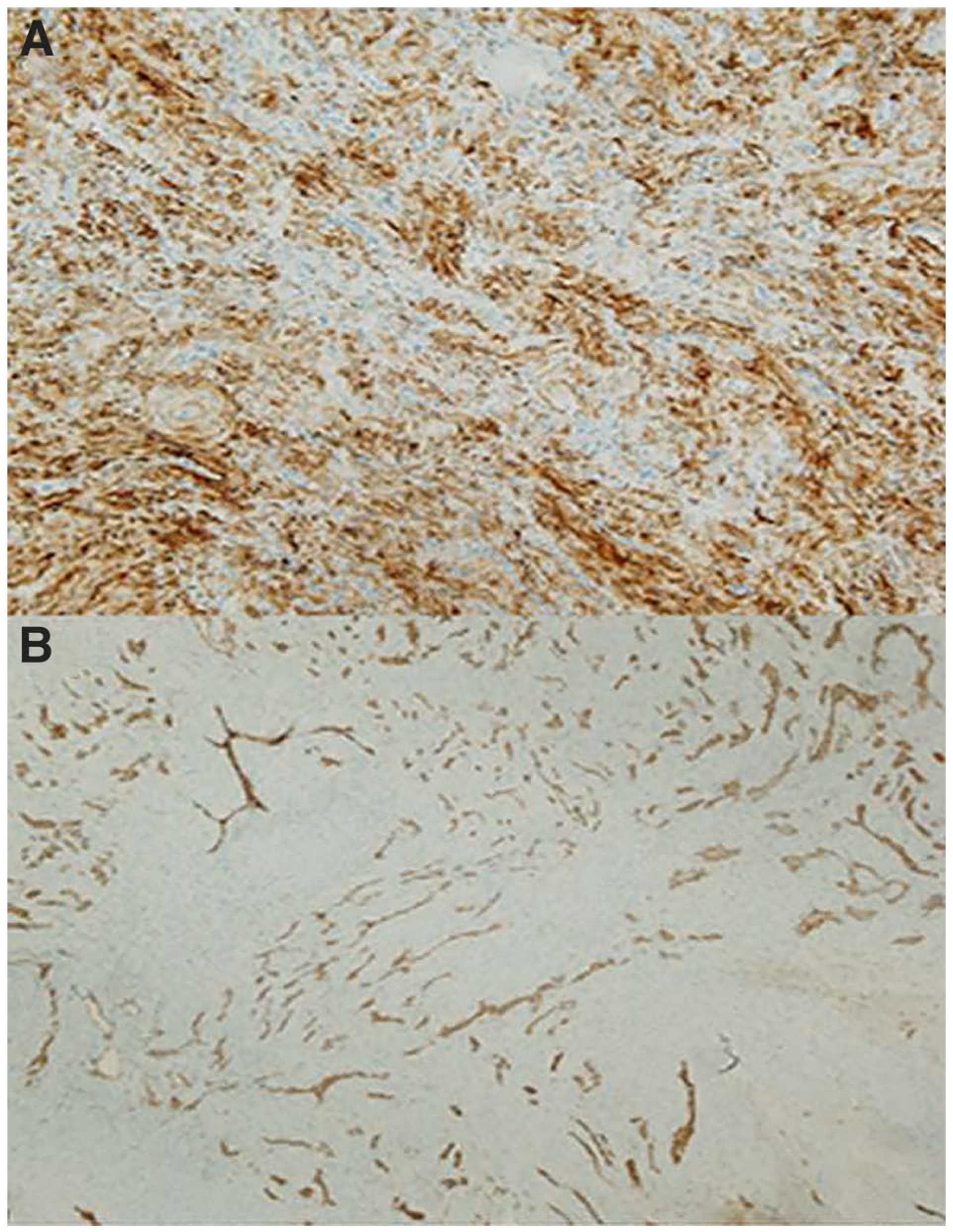
We decided to perform a 5-mm punch biopsy and histologic examination. After standard formalin fixation and paraffin embedding, hematoxylin and eosin–stained sections (4 μm) were obtained and examined. The histologic examination revealed a well-circumscribed although unencapsulated nodule composed of spindle-shaped, myoid-appearing cells, with a vaguely concentric arrangement around numerous intralesional slit-like or ectatic blood vessels. No atypia, mitosis, or necrosis was observed (Fig. 1). Spindle cells were diffusely positive to desmin immunostaining, and endothelium-lined intralesional blood vessels were highlighted with CD31 immunostaining (Fig. 2).
The diagnosis of myopericytoma was made. Myopericytoma is usually composed of oval to short fusiform cells arranged in a multilayered concentric growth around elongated to ectatic vessels. Immunophenotypically, tumor cells have a myoid phenotype, expressing myoid markers such as smooth muscle actin, caldesmon and, less frequently, desmin and CD34 [3].
It is considered to be a benign lesion along a morphologic spectrum between glomus tumour and myofibroma [2].
Clinically, it is difficult to differentiate myopericytoma from other benign conditions and, more importantly, it may also be categorized in the differential diagnosis with malignancies. In the foot, only a small number of soft-tissue lesions prove to be malignant. The most frequent malignancies of the feet are clear cell sarcoma, leiomyosarcoma, fibrosarcoma, malignant fibrous histiocytoma, and malignant myopericytoma. However, it can rarely manifest features of malignancy and secondary metastasis with aggressive clinical behavior [4].
Imaging investigations such as ultrasound, radiography, and magnetic resonance imaging may help in monitoring these lesions, but surgical excision and histologic examination are always recommended, because benign and malignant forms are clinically indistinguishable [5]. Malignant myopericytoma shares some morphologic and immunophenotypic similarities with benign myopericytoma, but also demonstrates worrisome features such as high cellularity; frequent mitotic figures, with rare atypical mitotic figures; scattered pleomorphism, with nuclear enlargement and occasional multinucleation; and focal areas, with thin-walled hemangiopericytoma-like branching vessels, frequent apoptotic bodies, and necrosis [5]. Furthermore, it is still not clear whether this malignant form is a change in a preexisting benign myopericytoma or a de novo lesion.
In conclusion, we think that every nodule of the foot should be evaluated and possibly excised. In fact, only histopathologic examination and, particularly, immunohistochemistry are able to distinguish benign myopericytoma from the malignant form and other malignant nodules.

Financial Disclosure

None reported.

Conflicts of Interest

None reported.

References

  1. SINGER AD, DATIR A, TRESLEY J; et al. Benign and malignant tumors of the foot and ankle. Skeletal Radiol 2016, 45, 287. [Google Scholar] [CrossRef] [PubMed]
  2. MENTZEL, T.; DEI TOS, A.P.; SAPI, Z.; et al. Myopericytoma of skin and soft tissues: clinicopathologic and immunohistochemical study of 54 cases. Am J Surg Pathol 2006, 30, 104. [Google Scholar] [CrossRef] [PubMed]
  3. PAEK JO, KANG HS, YEO KY; et al. A case of myopericytoma on the lower leg. Ann Dermatol 2011, 23, 201. [Google Scholar] [CrossRef] [PubMed]
  4. PATRICK, A.; SOARES-DE-ALMEIDA, L.; HEINZ, K. Malignant myopericytoma: report of a new case and review of the literature. Am J Dermatopathol 2016, 38, 307. [Google Scholar] [CrossRef] [PubMed]
  5. MCMENAMIN, M.E.; FLETCHER, C.D. Malignant myopericytoma: expanding the spectrum of tumours with myopericytic differentiation. Histopathology 2002, 41, 450. [Google Scholar] [CrossRef] [PubMed]
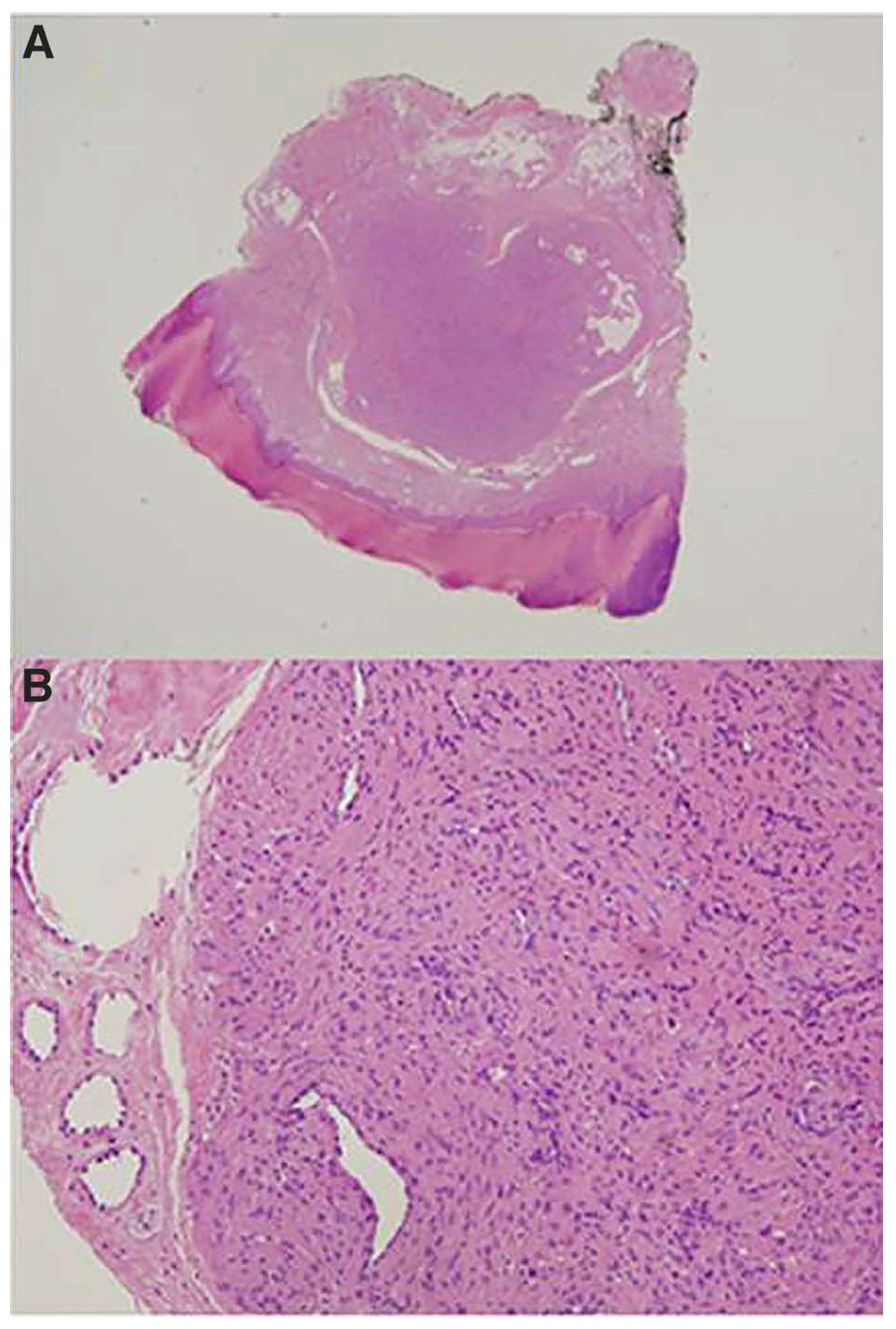
Figure 1. A, Well-circumscribed unencapsulated nodule (H&E, 32). B, Spindle-shaped myoid-appearing cells with a vaguely concentric arrangement around numerous intralesional slit-like or ectatic blood vessels (H&E, 320).
Japma 109 00264 g001
Figure 2. A, Spindle cells diffusely positive (desmin immunostaining, 320). B, Positive endotheliumlined intralesional blood vessels (CD31 immunostaining, 310).
Japma 109 00264 g002