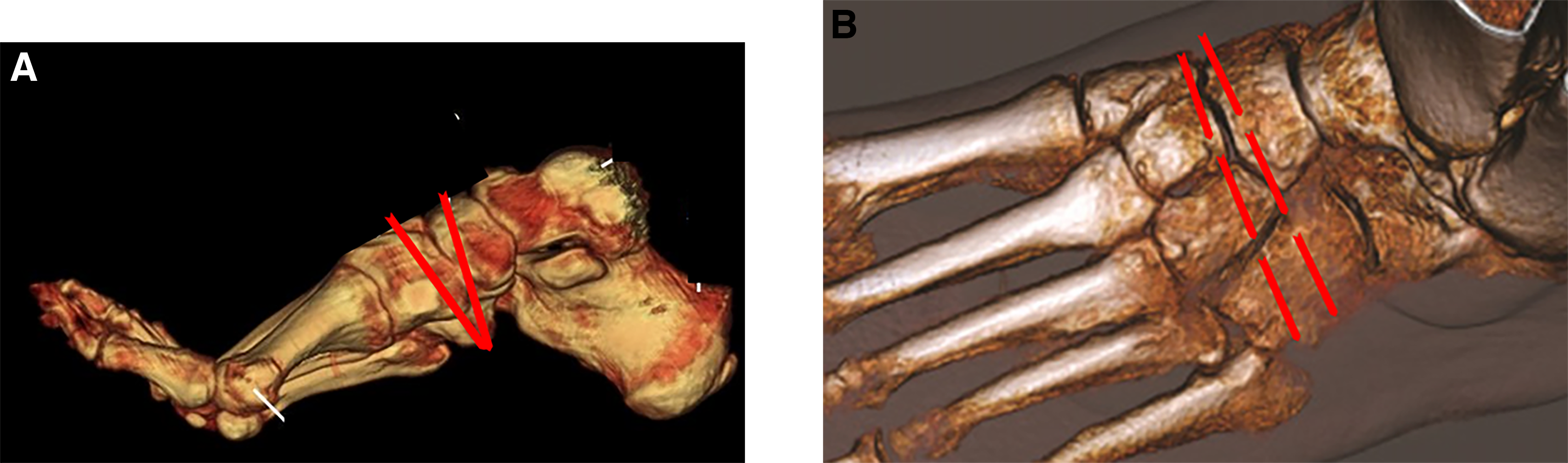
Determination of the underlying etiology and the pathoanatomy in the individual patient is essential to determine the appropriate treatment in a particular patient with a foot deformity. The goals of any treatment should be a painless and plantigrade foot having the capacity of regular shoe wear. The Cole osteotomy is performed in patients having a cavus foot with the apex of the deformity in the midfoot. Correction of the deformity at this midfoot level improves foot and ankle stability by creating a plantigrade foot. Transverse wedge osteotomy through all three naviculocuneiform joints and the body of the cuboid bone is the surgical technique (
Fig. 1).[
1] Saunders was the first to describe the midfoot osteotomy in 1935.[
2] However, the technique was popularized by Cole in 1940.[
1]
Figure 1.
Three-dimensional view of the foot with interrupted lines showing the orientation of the osteotomy in the sagital plane (A) and the transverse plane (B). A transverse wedge osteotomy through all three naviculocuneiform joints and the body of the cuboid bone is made in Cole osteotomy.
Figure 1.
Three-dimensional view of the foot with interrupted lines showing the orientation of the osteotomy in the sagital plane (A) and the transverse plane (B). A transverse wedge osteotomy through all three naviculocuneiform joints and the body of the cuboid bone is made in Cole osteotomy.
The etiology of a pes cavus foot includes neuromuscular diseases (Charcot-Marie-Tooth), congenital diseases (residual talipes equinovarus, arthrogryposis), and trauma (post–compartment syndrome fibrosis, peroneal palsy, fracture malunion, and burn contracture).[
3] Preoperative evaluation should begin with a family history and a neurologic evaluation to rule out or identify specific neurogenic causes of the deformity. Electromyelograms should be considered to verify any neuromuscular disease or any muscular imbalance of the foot and ankle.
A physical examination should be performed while the patient is both weightbearing and nonweightbearing to evaluate the flexibility of the deformity. The hindfoot, midfoot, and forefoot should be evaluated. A modified Coleman block test is helpful to evaluate any fixed hindfoot cavovarus deformity. Residual rearfoot varus found during the test may require calcaneal valgus osteotomy to achieve a correct heel position.
Weightbearing radiographs should include anteroposterior and lateral foot and ankle views. It is crucial to evaluate all aspects of the deformity because pes cavus may involve a combination of hindfoot, midfoot, forefoot, and ankle deformities that cannot be addressed with an isolated midfoot osteotomy. Hyperflexion of the first metatarsal and equine position of the ankle are the frequently associated forefoot and hindfoot deformities, respectively.
Any surgical procedure that interferes with a foot deformity should aim to constitute a plantigrade, mobile, stable, painless, and well-balanced foot. No single surgical procedure can achive all of these goals simultaneously. There are various procedures described for pes cavus, divided into three broad categories: soft-tissue procedures (tendon transfers, tendon lenghening); corrective osteotomies of the hindfoot, midfoot, or forefoot; and fusion procedures (ie, triple arthrodesis).
Osteotomies for forefoot cavus have been recommended at the metatarsal bases, tarsometatarsal joints, and naviculocuneiform joints.[
1,
2,
4-
7] Indications for a midfoot osteotomy include a cavus foot having the apex of the deformity at the midfoot level. Patient must be skeletally mature and should not have any vascular impairment of the foot. With proper planning, not only midfoot cavus but also a forefoot cavus deformity can be corrected with a midfoot osteotomy. Alvik[
8] suggested broadening the medial cuneiform–navicular wedge to correct a concomitant hyperflexion deformity of the first ray. Saunders[
2] described correction of a cavoadductus deformity by widening the resection laterally. Contraindications include gross motor weakness, progressive neuromuscular disease, skeletal immaturity, and those listed in
Table 1.[
1,
2,
4-
7,
9]
Table 1.
Indications and Contraindications for Midfoot Osteotomy8
Table 1.
Indications and Contraindications for Midfoot Osteotomy8
The midfoot Cole osteotomy is technically simple and has the ability to overcome multiplanar deformities while sparing the subtalar and ankle joints. The purpose of this study is to show the clinical and radiographic results of five patients (six feet) who have undergone Cole midfoot osteotomy for the treatment of pes cavus deformity.
Materials and Methods
Review Procedures
The clinical records and radiographs of patients with a diagnosis of pes cavus who were surgically treated with a Cole osteotomy between January 1, 2011, and December 31, 2015, at Marmara University Hospital (Istanbul, Turkey) were retrospectively reviewed. Clinical records and radiographs were available for five patients (six feet). Records were reviewed to determine the etiology, simultaneous surgical operations besides cole osteotomy, duration of follow-up, and postoperative complications.
All of the patients were evaluated according to the American Orthopaedic Foot and Ankle Society (AOFAS) Midfoot Scale questionnaire before the surgery. Postoperative clinical evaluation was performed at the final follow-up visit with the same questionnaire.
Preoperative and postoperative anteroposterior and lateral weightbearing radiographs were analyzed. Radiographic angles were measured by both of us independently using standard goniometer techniques. On the lateral view, the talo–first metatarsal angle (Meary's angle) and the calcaneal pitch angle were measured. On the anteroposterior view, the talo–first metatarsal angle and the talocalcaneal angle were measured. Preoperative and postoperative differences were assessed by analysis of variance; statistical significance was defined as P < .05.
Surgical Technique
All of the surgical procedures were performed with the patient under general anesthesia and in the supine position. A tourniquet was routinely used. Because of the presence of an equine deformity in all of the feet, lengthening of the gastrocnemius muscle using the Vulpius technique was performed routinely. Before starting the osteotomy, owing to the varus position of the ankle and the subtalar joint, both joints were fixed at neutral position by manuplating the ankle and crossing a Steinman pin through the calcaneus to the distal tibia under fluoroscopy. A curvilinear incision was made over the naviculocuneiform joint medially and over the cuboid bone laterally. Under fluoroscopic imaging, a sagittal saw was used to create a dorsal and slightly laterally based transverse wedge osteotomy through the navicular bone medially and the cuboid bone laterally (
Fig. 1). Kirschner wires were placed under fluoroscopy to serve as osteotomy guides. The navicular part of the medial osteotomy was made just proximal to the naviculocuneiform joint, and the osteotomy reached laterally in the midcuboid level. A second osteotomy began in the medial cuneiform just distal to the naviculocuneiform joint, again reaching laterally in the cuboid bone. Most of the angular correction was created by this second osteotomy. Then, two osteotomies converged plantarly and slightly medially in the cuboid bone to correct the adduction deformity in the transverse plane. After removing the osteotomized wedge, the foot was forced to dorsiflexion and abduction until the removed area was closed in the corrected foot position. Temporary fixation was achieved by crossing 2-mm Kirschner wires. Kirschner wires may also be used for permanent fixation. Screws, staples, plate and screws, or external fixation are options for permanant fixation. Our choice was staples or Kirschner wires.
In the postoperative period, nonweightbearing was continued until radiographic union was maintained (7–9 weeks). After radiologic bony union is seen, partial weightbearing and, finally, full weightbearing were permitted.
Results
Mean clinical follow-up was 15.7 months (range, 6–36 months). The various preoperative diagnoses, simulataneous surgical procedures, and individual patient data are summarized in
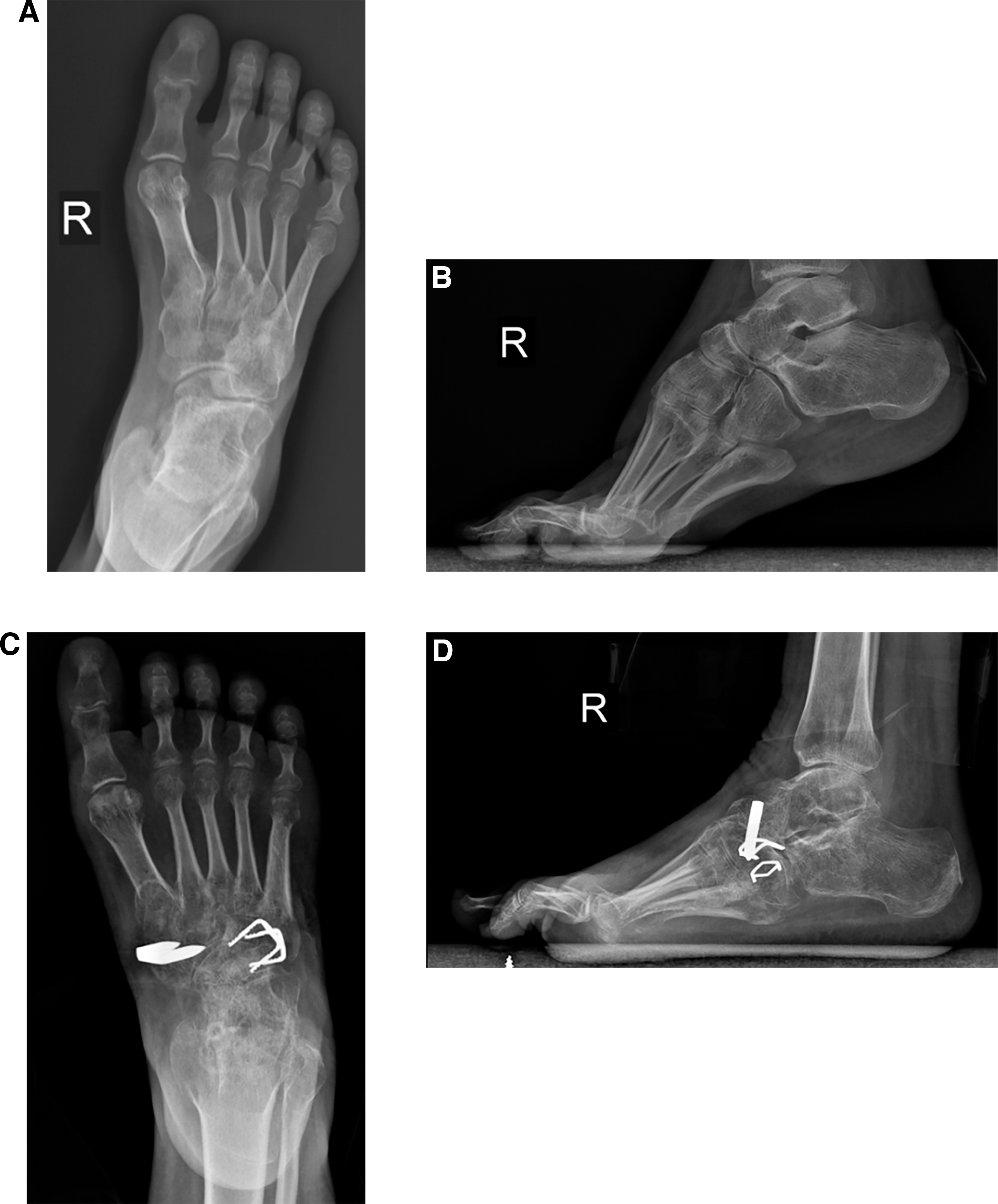
Table 2. Radiographic improvement in all of the parameters was apparent during postoperative follow-up. Preoperative and postoperative radiographic images are shown in
Figure 2. The most significant change was seen in the sagittal plane measurements: the lateral talo–first metatarsal angle decreased by a mean of 21.2° (
P < .05) and the calcaneal pitch angle decreased by a mean of 10.8° (
P < .05). Radiographic changes in the transverse plane were also significant: on anteroposterior radiographs, the talo–first metatarsal angle decreased by an average of 21.7° (
P < .05) and the talocalcaneal angle decreased by a mean of 10.6° (
P < .05) (
Table 3).
Table 2.
Medical Record Review Summary
Table 2.
Medical Record Review Summary
Figure 2.
Preoperative weightbearing dorsoplantar (A) and lateral (B) radiographs of a patient with a diagnosis of Charcoat-Marie-Tooth disease. On lateral radiography, the patient can stand on the toes only because of extreme Achilles tightness. Postoperative weightbearing dorsoplantar (C) and lateral (D) radiographs of the same patient with a more plantigrade foot and correct angles.
Figure 2.
Preoperative weightbearing dorsoplantar (A) and lateral (B) radiographs of a patient with a diagnosis of Charcoat-Marie-Tooth disease. On lateral radiography, the patient can stand on the toes only because of extreme Achilles tightness. Postoperative weightbearing dorsoplantar (C) and lateral (D) radiographs of the same patient with a more plantigrade foot and correct angles.
Table 3.
Radiographic Angular Correction Results
Table 3.
Radiographic Angular Correction Results
Preoperative and postoperative subjective AOFAS questionnaires were completed by all five of the patients. The mean ± SD AOFAS score was 38.8 ± 15.5 preoperatively, and it increased to 79.5 ± 10.5 postoperatively (P = .0003). In the postoperative follow-up period, all of the patients had no or mild pain with daily activities. Two patients defined occasional discomfort with high-impact activities only. Patients reported having either no (three patients [four feet]) or moderate (two patients) difficulty with uneven terrain or walking on hills. Three of the patients (four feet) were able to wear fashionable, conventional shoes without an in-shoe brace, whereas the remaining two had to wear comfort shoes with inserts.
Postoperative complications of the surgical procedure were minor wound dehiscence (that healed before weightbearing) in two feet, recurrent Achilles tightness in two feet (two patients), and partial nonunion of the midfoot osteotomy (nonunion between the navicular, middle cuneiform, and lateral cuneiform bones) in one foot.
Discussion
For many years, the topic of pes cavus has been the object of many discussions, with numerous literary works dedicated to its etiology and treatment. Although the Cole osteotomy was presented in the literature more than 80 years ago, there were few studies published in the literature as a primary procedure for the treatment of adult pes cavus deformity. The first article on this procedure was published by Saunders in 1935.[
2] It was a report about the results of 102 feet treated with anterior tarsal resection. Minimum follow-up was 2 years, and 58% of the feet showed good-to-excellent results (no residual cavus deformity, flexible foot with good ankle joint dorsiflexion, and no pain or limp).
To our knowledge, this is the fourth article to analyze the short- to middle-term clinical and radiographic results of midfoot osteotomy to correct cavus foot.[
7,
10,
11] In 1988, Leal et al[
10] reported the results of eight feet (six patients) treated with Cole osteotomy in a retrospective study with radiographic and clinical review. The osseous union rate was 100%, and no long-term problem was reported. However, Levitt et al[
12] warned to avoid Cole osteotomy in skeletally immature patients because of the high (30%) pseudarthrosis rate. In the present study, although all of the patients were skeletally mature, one patient developed nonunion between the navicular, middle cuneiform, and lateral cuneiform bones.
Tullis et al[
7] retrospectively reviewed 11 feet of eight patients with Cole midfoot osteotomy and analyzed the radiographic parameters. Similar to the present radiographic findings, the most significant improvement was detected in the sagittal plane parameters. Eighty percent of their patients responding to the questionnaire recommended the surgical procedure to others. The mean time to radiographic union was 2.3 months, with a 100% fusion rate. Zhou et al[
11] prospectively reviewed 17 patients (mean age, 16.8 years; mean follow-up, 25.3 months) treated with Cole midfoot osteotomy combined with adjacent joint-sparing internal fixation. At the final follow-up visit, the AOFAS score significantly increased from 34.7 to 75.8, similar to the scores in the present study, and radiologic improvement was also significant for Meary's angle, calcaneal pitch angle, tibiotalar angle, and Hibb's angle. All of the osteotomies reached bony union in all of the patients at a mean of 7.8 weeks.
In the literature, Cole osteotomy results were reported without any major complications in skeletally mature patients.[
5,
7,
10,
11] Minor complications, such as contracted digits, fixation failure (pin loosening or breakage), minor wound dehiscence (that healed before weightbearing), and mild transient foot discomfort, were reported.[
7] Similar to the literature, we also experienced some minor complications, such as wound dehiscence and Achilles tightness (two patients; both underwent gastrocsoleus fascial release as a second operation). However, besides the minor complications, we experienced partial nonunion of the midfoot osteotomy in one patient. A second surgery was not considered because of the mild symptoms.
Kirschner wires and staples were used as the osteotomy fixation material in the present study. The use of staples for osteotomy fixation in Cole osteotomy is unique in the literature. We immobilized the patients for at least 7 weeks in a below-the-knee cast. A different internal fixation method, such as cannulated screw, can be used to compress the osteotomy site, as in the study by Zhou et al.[
11] Zhou et al applied three cannulated screws to fix the osteotomy between the Lisfranc line and the Cyma line. The advantage of their method is to permit early weightbearing and mobilization. They applied a below-the-knee cast for 4 weeks. Then, they started active mobilization exercises of the foot and ankle with partial weightbearing.
Pes cavus may involve a combination of hindfoot, midfoot, forefoot, and ankle deformities that cannot be addressed with an isolated midfoot osteotomy. Hyperflexion of the first metatarsal as a forefoot deformity was present in two patients (two feet). The Jones procedure (transfer of the extensor hallucis longus tendon from the distal phalanx to the neck of the first metatarsal) was performed for one and dorsal closing wedge osteotomy of the first metatarsal was applied for the other. Because equine contracture of the ankle was present in all of the patients, Achilles tendon lengthening (Vulpius procedure) was routienly applied to all of the feet. In the literature, supplementary procedures besides Cole osteotomy to correct the combined deformities were not addressed in detail. Only Zhou et al[
11] mentioned posterior tibial tendon transposition and Z-plasty of the Achilles tendon in the same surgery with Cole osteotomy. In our opinion, single Cole osteotomy alone may not always be sufficient to correct a cavus foot deformity, and, depending on the severity of deformity, some additional procedures might be required. So, it is crucial to understand primary and compensatory components of the deformity preoperatively.
Small sample size is the main weakness of the study. Although the differences were found to be statistically significant, the validity would have been greater with a larger cohort of patients. The retrospective review process is another weakness of the study, but it provides additional information to the literature about this infrequent surgical procedure.
In conclusion, the Cole osteotomy is a preferable procedure with satisfying long-term results for the surgical treatment of symptomatic cavus deformities with an apex in the midfoot.