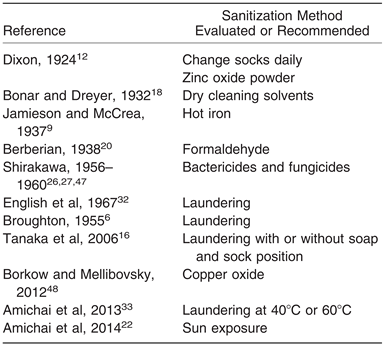
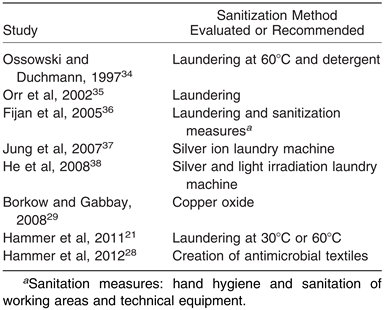
The goal of this review is to identify sanitization methods that can be used on fungally contaminated shoes, socks, and textiles to help manage superficial fungal foot infections. Examining sanitization methods, with the goal of decreasing recurrence and relapse rates, would not only benefit the patient but would also decrease the economic burden associated with these infections.
Results
A total of 33 studies were found, encompassing a broad array of techniques ranging from formalde-hyde fumigation and foot powder application, to more modern approaches such as the use of silverlight irradiation technology and UV light applications (
Table 1,
Table 2 and
Table 3).[
5,
8,
9,
10,
11] The need for sanitization, and sanitization techniques that could be used in the management of superficial fungal infections, were critically reviewed and compared across eligible studies.
The Need for Sanitization
The idea that shoes could act as a fungal reservoir with the potential to reinfect a cured or improved dermatophytosis patient dates back to the 1920s.[
12] This discovery was made with a small data set (one patient), but it sparked the idea that fungally infected individuals could transfer fungal cells from their feet to their shoes.[
12] Proceeding with this idea, Jamieson and McCrea found that 98% (52/53) of inner sole shoe samples collected from ringworm-infected patients were culture-positive for fungi and other suspected pathogens (
Monilia,
Cryptococcus, yeast, and
Penicillium brevicaule).[
9] In dermatophytosis patients, approximately 40% (40/100) of inner sole shoe samples have been found to be culture-positive, with 12 of the culture-positive shoe samples producing the same pathogen isolated from corresponding skin samples.[
13] In tinea pedis patients, only 34% (35/104) were reported to have infected footwear.[
6] In contrast, 80% (8/10) of closedtoe shoes or boots worn by onychomycosis patients were found to contain dermatophytes, nondermato-phyte molds, yeasts, or a combination thereof.[
14] It was also discovered that dermatophytes (
Trichophyton rubrum and
Trichophyton mentagrophytes) could still be detected in inner soles of previously used shoes that had been stored for 1 to 4 weeks.[
15] This suggests that common causal strains associated with superficial fungal infections have the potential to survive for long periods in shoes, necessitating a means of effective removal.[
15]
The possibility of other footwear items (eg, slippers and socks) to act as fungal reservoirs also suggests a need for sanitization. The number of dermatophytes isolated from different footwear options showed that bare feet had the highest number of dermatophytes, compared with stockings, socks, and tabi socks (100%, 90%, 30%, and 10%, respectively).[
16] Slippers worn by dermatophytosis patients have been reported to contain the same pathogenic fungi as those isolated in their corresponding skin samples.[
13] As slippers are less likely to be replaced, this type of footwear could be heavily infected with fungal colonies. Socks can also act as a fungal reservoir. Based on the experiments conducted by Bonifaz et al., approximately 10.5% of fungally infected individuals could be at risk of reinfection because of the fungal reservoirs located in their socks.[
17] Bonifaz et al. also showed that dermatophyte prevalence in socks may depend on the type of isolation method used, as a higher number of infected socks were reported with serial dilution isolation compared with direct isolation methods (
P = .05).[
17] Along with socks, textiles have also been considered as potential fungal reservoirs because of the presence of trapped organic matter, creating a food source for fungi and other causal agents.[
18]
Contrary to the supportive evidence mentioned, there are also opposing opinions on the need to sanitize. It has been proposed that shoes as a source of reinfection/infection, and thus the need for shoe sanitization, may be exaggerated, as infection/ reinfection can occur without endogenous sources such as infected shoes.[
9] Sulzberger (as cited in Rosenthal et al.[
19]) suggested that perhaps the source of foot-related exacerbations and recurrences is exposure to shoe polish, sock dye, sock finish, and leather tanning or dye agents, proposing that the best preventative solution would be to purchase ‘‘proper shoes and proper socks.’’[
9] Sulzberger also states that flare-ups are usually due to already present fungi that are activated by exposure to moisture or maceration and thus these precautions ‘‘aren’t necessary.’’[
19] In addition to Sulzberger, Baer (as cited in Ajello and Getz[
15]) has also suggested that if there are no favorable fungal conditions present (eg, moisture levels), and resistance levels found with the individual are adequate, a fungal infection is unlikely regardless of the presence of a fungal reservoir (eg, infected shoes).[
15] Despite these opposing opinions, the large body of evidence to support the use of sanitization has resulted in the creation of many different sanitization methods, such as formaldehyde fumigation, dry cleaning solvents, mothballs, laundering, ozone, and ultraviolet irradiation.
Basic Sanitization Methods
Within the 33 studies found, a few basic sanitization techniques were recommended, such as replacing heavily contaminated shoes with new shoes and changing socks daily.[
1,
2] In addition, the use of boiling water to sanitize footwear has been reported to successfully remove dermatophyte colonies from sandals, sneakers, and boots.[
16] Caution is advised, however, as boiling water may ruin woolen or silk materials; thus, using a hot iron for sterilization purposes might be a better choice for these textiles.[
9,
20] Other effective options that can be used on sensitive fabrics include cold water and wiping with a wet towel.[
16] Storing fungally contaminated textiles separate from sterile textiles and using an easy-to-disinfect laundry basket can also help prevent dermatophyte transmission.[
21]
Sun exposure has also been determined to be a cost-effective sanitization option.[
22] Negative sock cultures were found to be significantly higher in socks exposed to sun for 3 days compared with socks kept indoors (
P < .0001).[
22] In order to effectively sterilize contaminated items with the sun, UV light needs to be absorbed by fungal DNA at a wavelength of 200 to 300 nm, a discovery made by Ward in 1890[
24] and expanded upon by many.[
23]
Antifungal and Antimicrobial Materials
The ability of shoes, socks, and textiles to act as fungal reservoirs can be dependent on the materials incorporated. For instance, in a study conducted by Bonar and Dreyer, it was found that fungi were not able to grow on rubber, whereas fungal growth thrived on fabric.[
18] In fungal adherence tests, nylon and cotton materials found in socks allowed dermatophyte passage, whereas the tight or fluffy fibers associated with wool socks and tabis helped to prevent dermatophyte entry.[
25] The rate to which stockings, socks, and tabis prevent dermatophyte transmission has been reported to be 58.2%, 94.7%, and 98.9%, respectively.[
16]
Incorporating these findings, the creation of antifungal/antimicrobial shoes, socks, and textiles was explored in four eligible studies.[
26,
27,
28,
29] Excellent antifungal activity was found in shoes that contain insoles mixed with pentachlorophenol (PCP).[
26] The highest antifungal activity of these treated shoes was reported in their cloth lining, which enabled complete prevention of
Trichophyton colonization.[
26] Sodium PCP–treated insoles were reported to inhibit saprophyte growth, whereas lindanetreated insoles were not as effective.[
27] Even after 6, 24, and 48 hours of continuous washing, the antibacterial effect of sodium PCP could still be found.[
27] Similar to the sodium PCP–treated insoles; sodium PCP–treated socks were still able to retain antibacterial action after five washes and 55 days of wear.[
27] Sodium salt and calcium salt of PCP incorporated into rubber shoe parts also showed bacterial inhibition.[
27] In fungicidal activity tests, sodium salt of PCP–treated shoe parts showed considerably less
T rubrum growth and had a stronger antifungal action against
Trichophyton interdigitale compared with lindane-treated shoe parts.[
27] Despite this promising discovery, the practicality of this specific combination is quite limited, as PCP has been known to cause adverse health effects.[
30]
Antimicrobial- and antifungal-impregnated textiles have also shown promising results. Silver ion–treated textiles (2%) have been found to have a strong inhibitory effect on
Candida albicans growth, with
C albicans inhibition also occurring in didecyldimethylammonium chloride–, polyhexamethylene biguanide–, and 5% silver chloride– treated textiles.[
28]
Trichophyton rubrum and
T mentagrophytes showed resistance to copper-treated textiles, and
T rubrum was completely inhibited by didecyldimethylammonium chloride–treated textiles.[
28] It was also discovered that individuals who slept in sheets containing copper oxide had lower bacterial colonization compared with those who slept in sheets without this biocide.[
29] The ability of fungal mycelium to penetrate treated textiles can differ between samples and can be species dependent.[
28]
Trichophyton mentagrophytes was able to grow between didecyldimethylammonium chloride– treated fibers, whereas
T rubrum penetration was completely inhibited.[
28] These antimicrobial textiles should not replace other sanitization procedures but could be used as part of a primary or secondary preventive measure against reinfection.
Formaldehyde
Formaldehyde fumigation was a sanitization method recommended in three eligible studies.[
9,
13,
20] Jamieson and McCrea recommended using formaldehyde fumigation for shoe sanitization, a method previously investigated by Henderson.[
9] Henderson showed that shoes treated with formaldehyde did not show fungal evidence after treatment.[
9] He also noted that enhanced formaldehyde retention can be found with leather shoes, as leather can allow for gradual release.[
9] In agreement with Jamieson and McCrea, the use of formaldehyde to sterilize shoes was suggested by Mitchell in 1937.[
9] He suggests that patients should place infected shoes inside a box that contains two caster cups of formaldehyde, with shoes thoroughly aired after treatment to prevent formaldehyde dermatitis. Berberian actually tested this hypothesis by treating infected shoes with formaldehyde; after 12 hours of formaldehyde exposure, there was complete absence of
T interdigitale growth in all treated stockings and inner shoe lining samples.[
20] Moistening stockings before formaldehyde treatment quickened the disinfection process.[
20] As mentioned by Henderson, this method does pose some health risks, such as formaldehyde dermatitis, and thus formaldehyde is no longer recommended despite its ability to eliminate fungal reservoirs found in shoes and stockings.
Sanitization Powder
The use of sanitization powder was recommended in two studies; however, neither study evaluated the effectiveness of this sanitization method.[
12,
13] Jamison and McCrea noted that ‘‘excellent results’’ can be achieved when shoes and feet are powdered with a combination of hydroxyquinoline, sodium perborate, sodium borate, boric acid, and aluminum silicate twice daily, a discovery made by Magee and Hartfiel in 1940.[
13] In addition, Jamieson and McCrea also recommended the incorporation of 8-hydroxyquinoline, parachlorometaxylenol, and chlorthymol into leather insoles of shoes and slippers, a discovery made by Seldowitz in 1940.[
13] As the evidence given by these studies is inexplicit, it is difficult to determine the efficacy of this sanitization method.
Sanitization Chemicals
Dry cleaning solvents, chemical disinfectants, and pharmaceutical antifungal sprays were investigated as sanitization methods in two eligible studies.[
18,
31] Dry cleaning solvents (cleaners’ naphtha) achieved very little fungicidal effects after 1 hour of exposure, with the highest fungicidal effect seen against
Epidermophyton cruris.[
18] Minimal fungicidal effects were found with kerosene and carbon tetrachloride after 5-, 10-, and 15-minute exposures.[
18] Conversely,
T interdigitale borne in skin scales could be completely eliminated when treated with sodium hypochlorite (1%). Chemical disinfectants (eg, chlorine, phenol) were associated with high
T mentagrophytes survival rates, whereas chlorine (1%) and terbinafine (0.01%) had the best disinfection rate against
T mentagrophytes strains, with fungicidal effects occurring within 15 minutes.[
31] Phenol, terbinafine, and chlorine were able to enlist fungicidal effects against
T raubitschekii and
T tonsurans strains within 15 minutes of exposure.[
31] Spray formulations of antifungal agents showed no growth of
T raubitschekii and
T tonsurans strains.[
31] This study suggests that terbinafine has the potential to be a great noncorrosive, nontoxic disinfectant. Terbinafine, in its topical spray formulation, has a low likelihood of drug-drug interactions with other ongoing antifungal prescriptions, so it could be easily added to any management strategy.
Mothballs
Only one study evaluated the use of mothballs as a sanitization method for the prevention of superficial fungal infections.[
8] After 4 days of exposing shoes previously worn by onychomycosis patients to mothballs (99.83% naphthalene), Warshaw and Ahmed found that only one of eight pairs of shoes had a negative culture after treatment.[
8] Based on these results, mothballs are not an effective sanitization method for eliminating fungal reservoirs in shoes.
Laundering
Laundering infected socks and textiles was a sanitization method mentioned by 40% (13/33) of eligible studies.[
6,
16,
21,
32,
33,
34,
35,
36,
37,
38] Seven of these studies determined that laundering socks and textiles was not an effective sanitization option.[
6,
18,
20,
21,
33,
36,
39] A critical review of these studies revealed that laundering was not effective at low temperatures (eg, 30°C–40°C)[
21,
33]; specific laundry settings created by the National Association of Laundry Owners (1932) were not sufficient[
18]; and, if not properly cleaned, the laundering machines could actually act as a fungal reservoir, infecting sterile textiles.[
36,
39] Successful sanitization using this sanitization method was heavily dependent on the textile used (eg, woolen socks versus broad-mesh nylon socks) and the causal strain (eg, yeasts versus
Aspergillus molds) involved.[
6,
33]
In contrast, in six eligible studies, laundering was found to be a sufficient sanitization method.[
16,
32,
34,
35,
37,
38] In these studies, the sanitization abilities of the laundering process was still impacted by the causal strain; however, dermatophyte colonies (
T rubrum and
T interdigitale) were still reduced and/or eliminated after laundering.[
32] A critical review of these supportive studies revealed that laundering at higher temperatures (60°C–75°C),[
34] washing socks immediately after removal,[
16] and using settings that exceeded guidelines provided by the Department of Health[
35] offered an effective means of sanitizing infected materials.
In two eligible studies, the incorporation of a silver ion production system and light irradiation technology into laundry machines increased their sanitization capabilities.[
37,
38] A silver laundry machine, containing an electronic silver ion production system, was evaluated with fabric contaminated with
T rubrum,
C albicans,
Microsporum canis, and
Aspergillus flavus.[
37] During the final spin step, the silver laundry machine (with and without detergent) had significantly higher antifungal activity compared with the conventional laundry machine (
P < .05).[
37] Infected textiles washed with the silver laundry machine using detergent showed a reduction in the total number of fungi and a reduction in all fungi species (expect
A flavus) when washed without detergent.[
37] Conversely, conventional laundry machines were not fungicidal when infected textiles were washed without detergent.[
37] In an additional study, infected clothing laundered with three different procedures—combination of silver and ultraviolet light (UVA 395 nm), a silver-only cycle, and a rinse-only cycle—were tested for their sterilization effect.[
38] The silver and ultraviolet light combination had the best sterilizing effect, as this treatment had the lowest number of
S aureus and
C albicans colonies after treatment.[
38] Based on these studies, the sanitization effect of silver may depend on how it is applied, the duration of application, and when it is applied in the washing cycle.
Ultraviolet
Ultraviolet wavelengths have been examined for their use in sanitization in two eligible studies.[
4,
11] A fungal reduction in
T mentagrophytes was reported when a sanitizer (SteriShoe; Shoe Care Innovations, Inc., Menlo Park, California) was accompanied by one, two, and three cycles of UVC irradiation (one cycle of irradiation,
P = .003; two cycles of irradiation,
P = .008).[
4] An overall 76% fungal reduction in
T rubrum–infected shoes also occurred after the SteriShoe sanitizer was accompanied by irradiation; however, no significant difference from control was found.[
4] Cronin et al. also investigated the inhibitory effect of UV irradiation on
T rubrum.[
11] The authors tried to obtain a UV wavelength that effectively inhibits
T rubrum and can penetrate the nail in order to create a low-cost, light-emitting diode phototherapy treatment for onychomycosis. Despite their limited success, they were able to find a wavelength (280 nm, 3.1 J/cm
2) that showed promising antifungal activity against
T rubrum, with complete inhibition after 2 weeks of incubation (
P = .027).[
11] Cronin et al. suggested that this technology could be used to decontaminate shoes owned by infected individuals.[
11] Based on these two studies, the use of UV irradiation is still in the beginning stages, with the sanitization capabilities of UVC irradiation possibly dependent on causal species.
Ozone
Ozone has also been examined for its potential use in sanitization in two eligible studies.[
14] A significant reduction in colony count was found with ozone exposure across eight footwear items and five onychomycosis patients (
P = .001).[
14] Through the use of ozone application, the number of viable organisms in culture samples (that originated from contaminated footwear) decreased.[
14] Direct application of ozone to the interior of the footwear enhanced fungicidal effects.[
14] Two of the three sanitization experiments (direct ozone application combined with a drying cycle) showed a reduction in the fungal burden; however, the third experiment showed an increase in the number of viable organisms.[
14] It was suggested that the increase in the number of viable organisms found in the third experiment could be linked to the drying/heating component, as heat can activate organisms. The authors did not recommend open style ozone devices, as they are less likely to produce the required level of ozone needed to maximize sanitization efficacy.[
14] The fungicidal ability of ozone gas was also tested on
T rubrum and
T mentagrophytes.[
40] Initial experiments of established
T rubrum and
T mentagrophytes showed that ozone sanitization was not successful.[
40] In newly seeded colonies, a cycle of ozone sanitization showed no viable
T rubrum cultures after treatment, with limited viability found in
T mentagrophytes cultures.[
40] Similar results were found when ozone application occurred on gauze, a surrogate for clothing and bedding.[
40] In both liquid and agar media experiments, ozone sanitization reduced viable conidia and extended the timeframe before colonies were visible (2–3 days).[
40] The authors suggested that ozone gas could be used for sanitization but not necessarily sterilization.
Sanitization Putty
Only one eligible study explored the use of sanitization putty to sanitize infected footwear.[
5] Shoe contamination decreased with the use of Cyberclean (Joker Group, Kerzers, Switzerland) as evident by a reduction in the number of culturepositive shoes and an 86% reduction in the number of colony-forming units.[
5] The number of colonies, as evaluated using plate count agar, showed a 5.80 to 5.84 factor reduction in bacterial counts using a 36°C culture and a 22°C culture, respectively (
P < .001 and
P < .001, respectively). A reduction in
Enterococcus (
P < .001) and
Staphylococcus (
P < .001) species also occurred after treatment.[
5] The authors of this study suggested that sanitizing the inside of shoes should be the main focus, as ‘‘feet and socks are easily washed and disinfected.’’