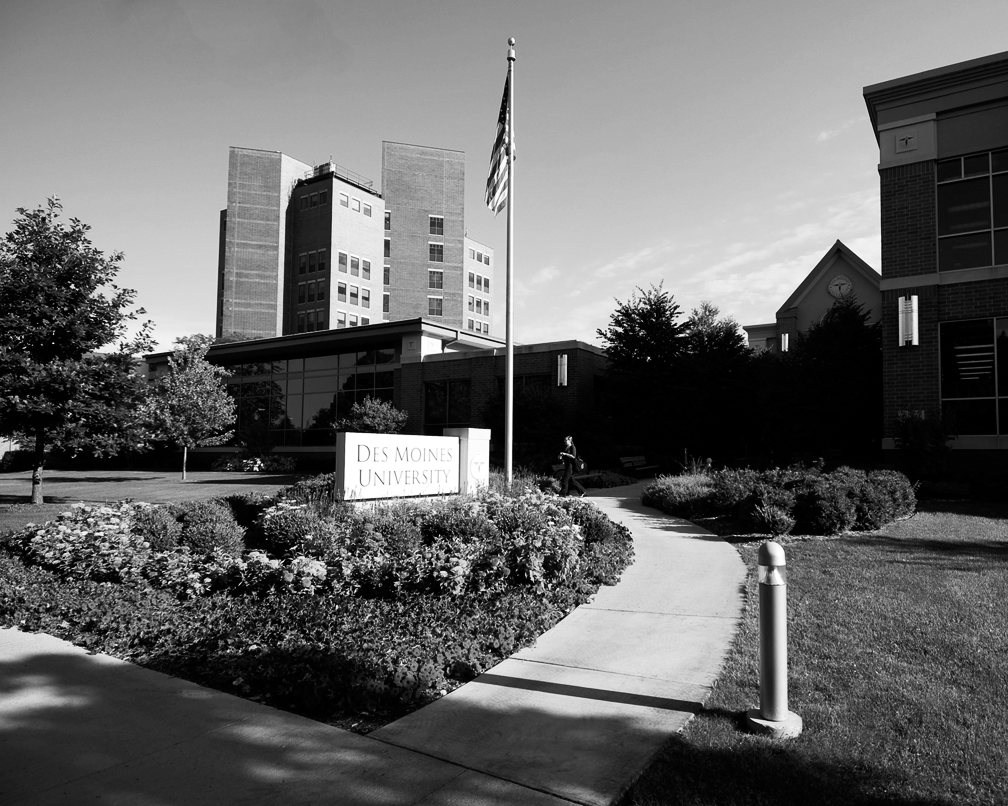
History of Des Moines University
The history of Des Moines University (DMU) reflects a continuing commitment to teach, learn, and serve. The Dr. S.S. Still College of Osteopathy, located in downtown Des Moines, Iowa, was founded in 1898 by Dr. Summerfield Saunders Still and his wife, Dr. Ella Still. After nearly 80 years of graduating osteopathic physicians and several name changes, the leadership of DMU recognized the need for additional members on the health-care team. In 1981, the Board of Trustees voted to establish the College of Podiatric Medicine and Surgery (CPMS) and the College of Health Sciences. The CPMS was the first college of podiatric medicine to open in nearly 20 years and the sixth member college of the American Association of Colleges of Podiatric Medicine. The CPMS was also the first podiatric medical college in the nation housed within a health sciences university, a concept that the profession promoted in 1985 with Project 2000. The first Doctor of Podiatric Medicine (DPM) degree was awarded in 1986. Today we have more than 1,500 alums. The institution was renamed Des Moines University in 1999 and now enrolls nearly 1,800 students in eight graduate degree programs. In addition to the DPM and DO degrees, the University also awards the DPT in Physical Therapy and Master of Science degrees in Anatomy, Biomedical Sciences, Physician Assistant Studies, Health Care Administration, and Public Health. From its beginning as a simple two-story building in downtown Des Moines, the University has grown into a 22-acre health sciences institution that includes state-of-the-art teaching and learning resources and an on-campus clinic.
Educational Philosophy
The mission statement of CPMS is “to educate a diverse group of highly competent and compassionate podiatric health professionals to improve lives in the global community.” Our goal is to train students to be physicians first and specialists second. This is particularly important as we look at the ever-changing landscape of health care. Life expectancy is increasing, people want to remain active, and certain diseases with lower-extremity implications are epidemic. We can perform the history and physical examination, we can admit our own patients and consult other members of the health-care team as needed, and we can help patients gain access to basic medical care through our relationships with primary care providers.
Academic Curriculum
To achieve our mission and define a contemporary podiatric physician, our educational philosophy has always been and continues to be driven by a three-part curriculum. First is the basic sciences component, which we feel should be identical in detail and rigor to osteopathic and allopathic medical education. The full-time basic science faculty members in the College of Osteopathic Medicine deliver the foundational basic science content to the podiatric medical students in the first and second years of the program. Podiatric and osteopathic medical students take the same courses, sit in the same classrooms and laboratories, and are held to the same academic standards. It has taken time, but we have reached a point in our history where the basic science faculty members do not differentiate between the two cohorts of students. They just refer to them as the first-year medical students. Those teachers take great pride in the performance of our students in Part I of the American Podiatric Medical Licensure Examination. First-year DPM and DO students also take the yearlong Clinical Medicine course, taught in alignment with the yearlong General Anatomy course, learning to perform a comprehensive history and physical examination while developing professionalism and communication skills. Recently, the CPMS has partnered with the College of Osteopathic Medicine to provide diagnostic ultrasound training in both of these first-year courses, with further training in the second year and beyond.
The second component of our academic program, presented in the first semester of year 2, is a series of clinical medicine systems courses. The content of these courses broadly reflects the academic experience of osteopathic and allopathic medical students. It is the relationships between the various clinical systems and the lower extremity that offer a uniqueness to this aspect of the curriculum. Our license may limit our ability to treat, but it does not limit our ability to diagnose, with an emphasis on relating podiatric medical conditions to systemic diseases.
The third element of the curriculum is that which provides us our professional identity: a series of podiatric medical courses, including Biomechanics, Clinical Podiatric Medicine and Diagnostics, Dermatology, Surgery, Emergency Medicine and Trauma, Basic Medical and Surgical Skills, and Health Care Systems/Community Medicine/Medical Jurisprudence, which contribute to meeting the identified objective of the academic program.
First- and second-year students receive training in interprofessional education in partnership with the other clinical programs at DMU and through a clinical interprofessional education collaborative with Drake University's College of Pharmacy and Grand View University's Nursing Program. In preparation for clinical training, the CPMS is committed to a greater understanding of health-care disparities and the need to appreciate the values of diverse populations by requiring completion of the Diversity Health Series presented by Kaiser Permanente as part of the second-year Cultural Competency course. We also encourage student participation in medical missions and global clinical rotations.
Throughout the first 2 years of the curriculum, coursework is supplemented with experiential learning through simulation, standardized patient encounters, laboratories, and small-group discussions, with many learning objectives complemented through co-curricular activities. Des Moines University is rich in classroom, laboratory, and simulation resources, with learning and assessment technologies to match.
The College is most known for its third-year Evidence-Based Podiatric Medicine and Surgery course. This learning experience comprises four clinical units (Infectious Disease, Rearfoot Pathology, Forefoot Pathology, and Diagnostic Imaging) spanning 7 months of the third year. These academic units are assigned to specific clinical rotations. The course is a capstone experience that integrates the basic sciences with the clinical sciences in a manner that allows students to apply the information in a clinical situation. Students use learned skills and knowledge, and develop new skills to solve clinical problems. Students must ascertain key components of the patient history and physical examination to recommend appropriate diagnostic tests that lead to a condition diagnosis and implementation of a management plan of action and its resulting consequences. Students apply evidence-based assessment skills to evaluate the literature and select the most appropriate course of action in dealing with a clinical problem. Students also apply the knowledge that they have acquired in presenting a clinical case and developing a scientific poster where the principles of evidence-based medicine are applied with a critical review of related published materials. Finally, students demonstrate appropriate medical documentation, respect for all patients, and the ability to work as a member of the health-care team, which are all critical to successful patient management.
Clinical Curriculum
Students participate in a shadowing experience during the second year by attending clinic sessions with third-year students and clinicians in the on-campus DMU Foot and Ankle Clinic. This experience is designed to prepare them for the end-of-year 4-week Summer Orientation Rotation. Third-year students remain in the Des Moines area, completing clinical rotations in internal medicine, vascular surgery, emergency medicine simulation, a community-based podiatric medicine/surgery rotation typically associated with an orthopedic group, and at the DMU Foot and Ankle Clinic, which offers an exceptional clinical experience in managing complicated diabetic foot complications. To assist the transition to the fourth year, third-year students complete a hospital-based clerkship at one of the many medical centers across the United States, just before the start of the fourth-year experience.
During the fourth year, students are required to complete a 3-month core hospital rotation that includes non–podiatric medical rotation requirements, a specified number of podiatric medical/surgical rotations, a medicine rotation, and a podiatric medical private practice rotation, leaving the remaining months open for approved elective rotations of the student's choice. As part of our commitment to meeting our mission, a fourth-year student may participate in a global health rotation through the DMU Global Health Department at one of several DMU-approved international locations. The fourth year provides students with the opportunity to receive training across the United States and to experience the various practice patterns that exist from region to region while demonstrating their professionalism, knowledge, and skill sets to prospective residency programs.
Research
We believe that faculty of a health sciences university are uniquely positioned to use their talents to conduct scholarship that advances medicine and health care. Because DMU's environment offers the opportunity, infrastructure, and robust intellectual climate necessary for discovery, research is embraced as not only an opportunity but also a responsibility. Consistent with this belief, the research enterprise at DMU has become an integral part of the institutional strategic plan in support of the mission. The CPMS has been a leader in supporting the research vision of DMU through our own research plan and commitment. Scholarship is part of the workload requirement of the faculty and an expectation for students. Students are looking consistently into evidence that supports the different clinical procedures that are taught in the classrooms, laboratories, and clinics. Scholarly product in the CPMS, in terms of posters and podium presentations at local- and national-level meetings, is at an all-time high. Additional evidence that the scientific discovery in the CPMS has matured is the significant increase in scientific publications in professional peer-reviewed journals, many with a focus on DMU's identified musculoskeletal and medical education areas of research emphasis. Research has become part of our culture. It is incorporated into almost all of the CPMS functions, starting with the new student orientation, to monthly faculty and CPMS student club meetings, to monthly research forums, to research elective courses and tracks, to the evidence-based curriculum, and continuing after graduation for many of our alums. The overarching purpose of the DMU Research Office is to foster a research-favorable environment and to help define and advance the University-wide research agenda, with an emphasis on student participation in all phases of faculty research projects.
Assessment
Having a robust curriculum and ambitious mission statement are not enough to determine whether our students are meeting the high expectations that we have set. To this end, the CPMS has developed and implemented a systematic approach that provides comprehensive assessment of the academic program. The fundamental requirements for an improvement process are establishing a set of objectives, identifying tactics that offer measurable evidence, and assessing whether the results meet the intended benchmark. A vital component of the improvement process is assessment. Our assessment plan and process has evolved so that it is closely aligned with strategic planning at the program and institutional level. Reaching this level of synchronization has taken a great deal of time and commitment on the part of all members of the CPMS.
We attempt to integrate measurable outcomes with established benchmarks in all activities where meeting the objective brings benefit to the program. Whether it be strategic planning, programmatic outcomes, student learning outcomes, admissions and retention, curriculum mapping, or research productivity, measurable outcomes are established and assessed, with appropriate revisions as needed. The process to develop critical assessment and evaluation procedures depends on the quality and accuracy of the data used to establish a set of higher standards. The CPMS uses processes that are data-driven in terms of establishing goals and metrics to evaluate the achievement of those goals. In a recent response from the Higher Learning Commission related to the University's Assurance Report, the CPMS was complimented on the nature of our assessment processes.
Quality
Program outcomes that the Council on Podiatric Medical Education has identified as quality measures include national board first-time pass rates, residency placement, and 4-year graduation rates. These are the outcomes that all colleges are required to make available to the public over the most recent 3-year period. We view high performance metrics in these indicators not as goals but as expectations. These high standards allow us to provide an educational experience for our students that achieves the goals set forth in our strategic plan, in support of our mission. To that end, the CPMS has a long history of exceptional performance in first-time pass rates for all parts of the national board examination process, a 90% four-year graduation rate, and 100% residency placement of our graduates who participated in the match process.
Summary
Des Moines University took a chance more than 35 years ago by integrating a podiatric medical school into a storied osteopathic medical school to form a graduate health sciences university. The idea of putting podiatric and osteopathic medical students together in both a formal and informal curriculum was questioned. If we look at where we are today, what was an educational experiment has turned into an academic way of life. We are proud of our accomplishments. Most of all, we are proud of our graduates, who are “highly competent and compassionate podiatric health professionals who improve lives in a global community.”