College History
On a visit to Cleveland in 1913, a New York City chiropodist, Max Harmolin, was inspired to stay and open an office. [
1] Following his arrival, the Ohio legislature passed the 1915 Platt-Ellis Bill, which provided for regulation of the medical specialties. Through his relationships with other founding members of the Ohio Chiropody Association, he and his colleagues, Cecil Beach, Oscar Klotzbach, and Charles Spatz, established a new college of chiropody in Cleveland.
Lester E. Siemon, MD, became the first president. First located in a downtown Cleveland office building, the Republic Building, it opened with one lecture hall, one laboratory, a microscope, a few Bunsen burners, and a clinic with six chairs for patients. Needing only 1 year of high school for admittance, the class of 1917 graduated after completing an 8-month course. Of the members of the matriculating class, almost half were women.
The Ohio College of Chiropody made two moves before embarking on the construction of its own building on Cornell Road in University Circle in 1932.
By 1932, the curriculum had evolved into a 3-year program, and, in 1938 the College added the requirement of undergraduate coursework before admittance. Over time, the profession standardized the educational requirements and curriculum among all its schools, and in 1948, a podiatric medical education began requiring 4 years of study and clinical work.
Eventually, the profession and the College began to use the term Podiatry instead of Chiropody and, in 1963, the College changed its name to the Ohio College of Podiatry. In 1967 the College officially began using the name Ohio College of Podiatric Medicine. The Doctor of Podiatric Medicine (DPM) degree was first granted to the 1968 graduating class. Before that time, the degree was DSC, Doctor of Surgical Chiropody. Looking for more space and updated educational and clinical facilities, in 1976 the College moved to Carnegie Avenue in Cleveland's University Circle. In 1990, the College invested heavily in a new clinical site. From this came the Cleveland Foot and Ankle Clinic, a new freestanding clinic designed with education in mind and to provide patient care to the urban population in the College neighborhood.
The College has kept up with changes in medical education and technology. In keeping with this, the College began to research options on a relocation or renovation plan in 2004. After significant contemplation and taking financial considerations into account, the Board of Trustees decided to relocate. Several locations throughout northeast Ohio were explored to be the next location for the College. In early 2006, a 115,000–square foot Georgian building in Independence, Ohio, became available. This site was ideal in both location and specifications. The relocation and remodeling was completed in July 2007, with lecture halls, a state-of-the-art anatomy laboratory, simulated patient laboratories, a medical library, computer laboratories, and a cafeteria. In keeping with the College's history of service to the urban community, a new clinical location was also opened on Euclid Avenue in an area known as Cleveland's Health-Tech Corridor.
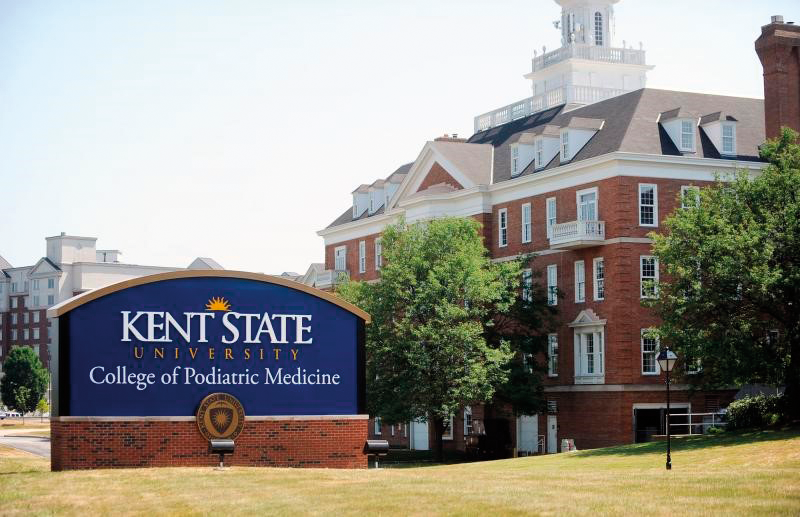
For several years, the College looked for a university with which to affiliate, partner, or merge. That goal was achieved on July 1, 2012, when the Ohio College of Podiatric Medicine merged with Kent State University, one of the largest universities in Ohio, to become the Kent State University College of Podiatric Medicine (KSUCPM) (
Fig. 1), the first podiatric medical school affiliated with a public university.
Figure 1.
Kent State University College of Podiatric Medicine, Independence, Ohio.
Figure 1.
Kent State University College of Podiatric Medicine, Independence, Ohio.
The merger offers interprofessional education, research, and opportunities to develop dual degrees. Kent State is globally recognized, nationally ranked, and a top-tiered Best National University in
U.S. News and World Report. [
2] Kent State is ranked among the top 100 national public universities in the
U.S. News and World Report's top public schools list for 2015–2016. [
3] Kent State generates
$1.96 billion annually in added income to the northeast Ohio economy. [
2]
Merging with a Public Research University
Although the Ohio College of Podiatric Medicine had been a leader in podiatric medical education for a century, the acquisition in 2012 by Kent State University, a public research university, opened doors to many unique and collaborative opportunities that would not have been possible otherwise. Opportunities include sharing of faculty, research facilities, recruitment of highly qualified students, and access to expertise in higher education.
Research
In 2013, a collaborative research effort began with Kent State's Liquid Crystal Institute and the College of Podiatric Medicine regarding potential uses of thermochromic liquid crystals (TLCs) in medical diagnostics. As the name implies, a liquid crystal exists in an intermediate state between the liquid and crystalline phases. The TLCs change color in response to fluctuations in temperature, similar to the iconic mood rings. [
4] These TLCs can be coated onto a fabric such as a sock, which can be used by patients at home to “self-monitor” local changes in temperature that could indicate potential foot pathology, such as peripheral arterial disease and diabetic foot infections. Faculty from Kent State's world renowned Fashion School were also called on to help identify the most suitable materials to enhance the performance of the TLCs. More recently, the College of Nursing joined the team to consider other medical applications beyond the lower extremity.
There are other research projects currently ongoing with the Exercise Physiology Department, the College of Public Health, and the School of Library and Information Science. Along with these combined projects comes the benefit of increased student opportunity and participation in research that would have not been possible before the merger.
Curriculum
These multidepartmental collaborations have led to several new working associations and partnerships that have the potential to span many areas of the academic arena. Being an internationally recognized public research university, Kent State employs thousands of faculty, many of whom are experts in their respective academic areas. Several of these faculty experts are now providing instruction at the College of Podiatric Medicine. This gives KSUCPM students exposure to some of the brightest minds in the country. For instance, the College of Public Health co-administrates the KSUCPM community health curriculum, including lecture delivery and capstone project. Also, KSUCPM is working closely with the College of Public Health to develop a prepodiatry roadmap for Kent State University undergraduate students majoring in public health to seek admission to KSUCPM. Furthermore, conversations have begun regarding a Master's program and a certification program in the College of Public Health for KSUCPM students.
A recently approved “3+4” program for a Bachelor of Science in Exercise Science/Physiology and Doctor of Podiatric Medicine will allow a candidate to complete and receive both degrees within a 7-year period. The discipline-specific courses required for Exercise Science/Physiology would provide exceptional preparation for candidates to successfully challenge the curriculum at the College of Podiatric Medicine. This curriculum would more than adequately prepare students to excel in the areas that distinguish the podiatric physician from other health-care providers, particularly in biomechanics, pathomechanics, and sports medicine.
In addition, there is a reciprocal relationship with the Athletic Training Department in which their faculty provide instruction to KSUCPM students in exchange for interprofessional clinical experiences for their students. Moreover, the School of Biomedical Sciences provides PhD candidates to teach in KSUCPM anatomy courses and labs. Finally, a certification program has been developed in Health Informatics, and a possible DPM/MBA dual degree is being considered.
Finally, the Cleveland Foot and Ankle Clinic is the major teaching clinic of KSUCPM. The merger has offered the opportunity to expand our service area into the KSU main campus health center. Under the guidance of the KSUCPM faculty, podiatric medical students are now able to treat the foot and ankle problems at the DeWeese Health Center on the Kent campus.
Continuing Medical Education
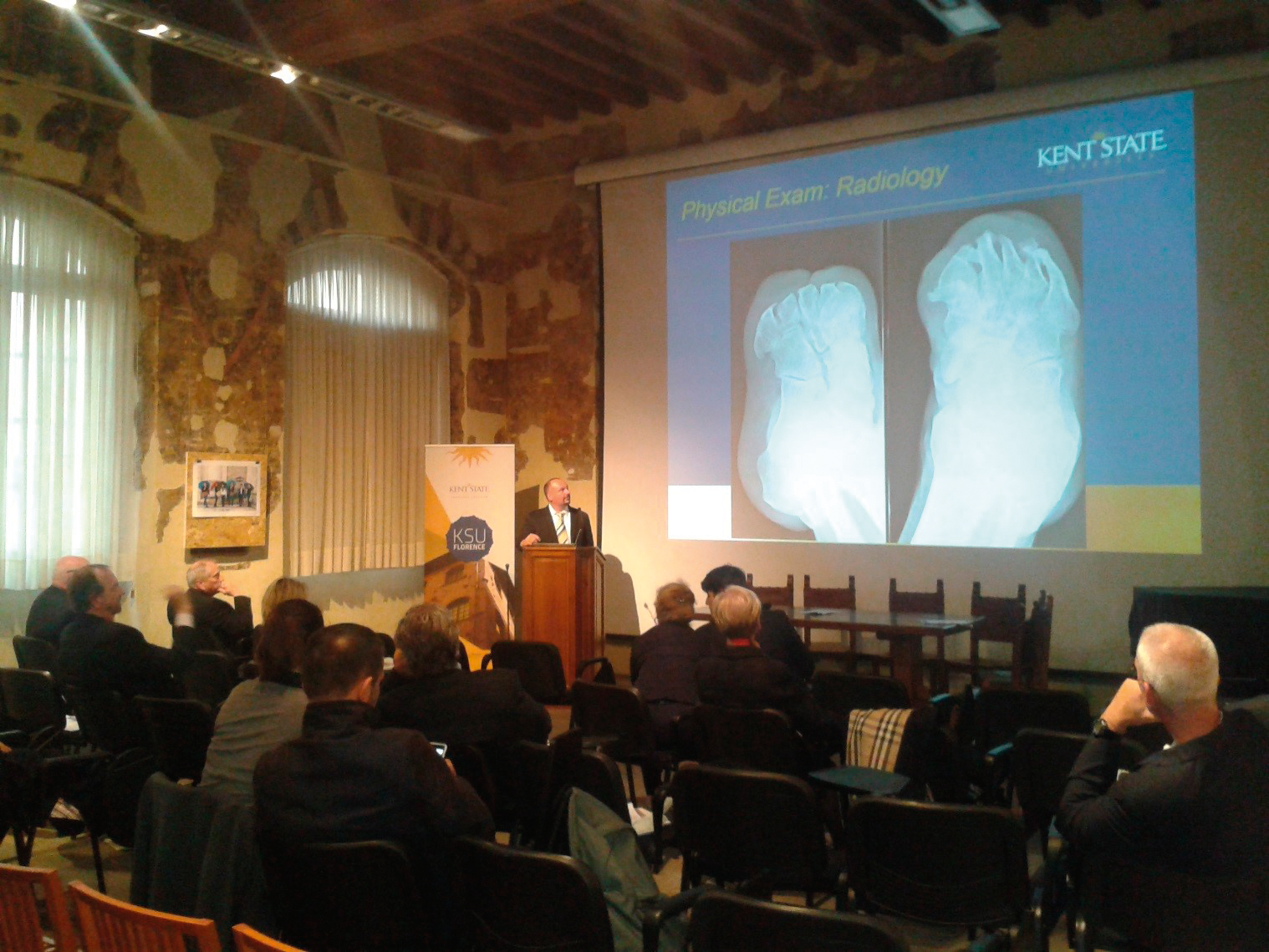
KSUCPM has long been a leader in regional continuing medical education. However, with the Kent State affiliation came not only increased national notoriety but also the ability to expand and collaborate abroad. International programs have been a long-time Kent State strength, with campuses in places such Italy and Switzerland. Kent State has a robust Office of Global Education that works to identify and develop international opportunities. In 2015, KSUCPM hosted the inaugural International Diabetic and Dysvascular Foot Conference at the beautiful Kent State campus in Florence, Italy, where scholars and medical professionals from opposite sides of the world were able to come together and connect for a common purpose (
Fig. 2). Through this collaboration. KSUCPM has been able to establish unprecedented partnerships for continuing medical education and professional development as well as potential clinical opportunities for students on a global scale.
Figure 2.
Inaugural International Diabetic and Dysvascular Foot Conference in Florence, Italy.
Figure 2.
Inaugural International Diabetic and Dysvascular Foot Conference in Florence, Italy.
Services
The affiliation with Kent State University offered the opportunity to partner on many of the services offered to KSUCPM faculty, students, and staff. For example, the KSUCPM Student Affairs Department and their main campus colleagues are partnering to complete a Jed Foundation initiative, which works to protect the emotional health of students. Under the direction of those from the Jed Foundation and Kent's campus, KSUCPM has already taken strides to review and improve the opportunities for students to seek mental health support.
The office of educational resources at KSUCPM also works very closely with the Student Accessibility Services Office at the Kent campus to provide excellent service to students seeking accommodations for a variety of reasons.
Since joining Kent State University, the KSUCPM Library has undergone many upgrades and enhancements that have increased the resources available that support instruction, patient care, and scholarly activities. The most significant benefit of affiliating with Kent State has been the increased access to thousands of journal subscriptions, including individual titles and journal aggregated databases. This has expanded the KSUCPM Library's collection in all fields of medicine, especially sports medicine, wound care, public health, and internal medicine. Being in the Kent State University library system, the KSUCPM Library now has access to OhioLINK, a consortium of 121 Ohio academic libraries that share print materials and contribute to e-book and e-journal purchases for all to access.
Additional faculty and staff benefits from the merger include employee assistance programs, a public employee retirement system, and tuition assistance for employees and family members. A new benefit to the main campus community is the convenience of podiatric medical care at the Kent State University branch of the Cleveland Foot and Ankle Clinic. Joint services are also provided through various offices, including Human Resources, Information Technology, and Property and Facility Services.
AACPM Value to KSUCPM
In 2009, the American Association of Colleges of Podiatric Medicine (AACPM) in conjunction with the Council of Faculties (faculty representatives from all of the colleges) made the decision to launch a comprehensive curriculum project. Although the individual podiatric medical colleges are exceedingly supportive of this project, the continued growth and maturity of this endeavor ultimately stems from the AACPM's leadership.
Because of this project, numerous and meaningful relationships between the colleges of podiatric medicine have developed at both the faculty and administrative levels. These connections have led to improved collaboration and collegiality between the colleges to a degree that is unprecedented in the annals of podiatric medicine.
The AACPM provides support to the enrollment management and student affairs offices at each college of podiatric medicine through a Student Affairs Officers Council, which meets twice a year. The AACPM provides guidance relative to trends within the applicant pool, including demographic, marketing, and academic data. In addition, the AACPM provides guidance relative to application trends within other medical specialties. These services have enhanced our process of student recruitment.
The AACPM also employs a Career Promotion Strategist who works to promote awareness of podiatric medicine as a career choice among the overall community, prehealth advisors, and undergraduate/graduate students. This position works closely with KSUCPM to maximize recruiting and marketing efforts.
Finally, the AACPM is instrumental to KSUCPM students in the clerkship and residency process and residency development for the future of the profession.