Simulation in clinical education is defined as using a device or environment that attempts to imitate the real world and enables student training within a safe, controlled learning environment.[
1] Through simulation, students can develop skills without fear of adverse clinical consequences while supported by prompt feedback.[
2-
4] Simulation is considered particularly useful for the development of technical skills and confidence.[
5,
6] The growth of simulation in clinical education has been driven by increased focus on patient safety, reduction in community acceptance for clinicians to acquire skills on real patients, reduction in direct clinical contact training hours, increased patient complexity, increased demands on health services, and an increase in the demand for student teaching in clinical settings.[
3,
7-
9] Simulation is not intended to replace conventional teaching methods or practical clinical experience, but to be integrated as an adjunct to traditional methods to support student learning.[
3]
Although simulation has been used in clinical education since the 1960s, its application in podiatry is limited. The only study of which we are aware investigated the effect of a 2-day simulation training program on the podiatric management of foot ulcers, and involved 16 qualified podiatrists as participants.[
10] The program included Web-based learning modules, practicing individual foot ulcer management part tasks (eg, debriding a model foot ulcer), and participating in replicated clinical consultation scenarios (eg, treating a standardized patient such as an actor with a model foot ulcer). Results found a 42% improvement in participant confidence with no significant change in knowledge, because of their high baseline knowledge. However, the program was not sustainable because of high costs. As far as we are aware, to date, there have been no studies of simulation training with podiatry students.
An essential skill for podiatrists is the high-risk procedure of conservative sharp debridement for the management of skin lesions, callus, corns, and wound care. This skill is time consuming to teach, and requires many hours of practice to refine. It is considered high risk, as the technique is most commonly applied in complex patient groups, and poor execution of the technique could result in lacerations, potentially leading to chronic wounds, infections, and hospitalization and/or amputation. Traditionally, podiatry students initially observe conservative sharp debridement being performed by their clinical supervisors and then practice the skill on appropriate patients as the opportunity arises. With an increase in demand for clinical placements and a trend toward fewer clinical placement hours for podiatry students, simulation may be an alternative way of teaching debridement skills using medical foot-care models. Therefore, the aim of this pilot study was to determine whether simulation training added to a traditional podiatry clinical placement improved student skills and confidence in conservative sharp debridement of callus compared with clinical placement alone.
Materials and Methods
Research Design
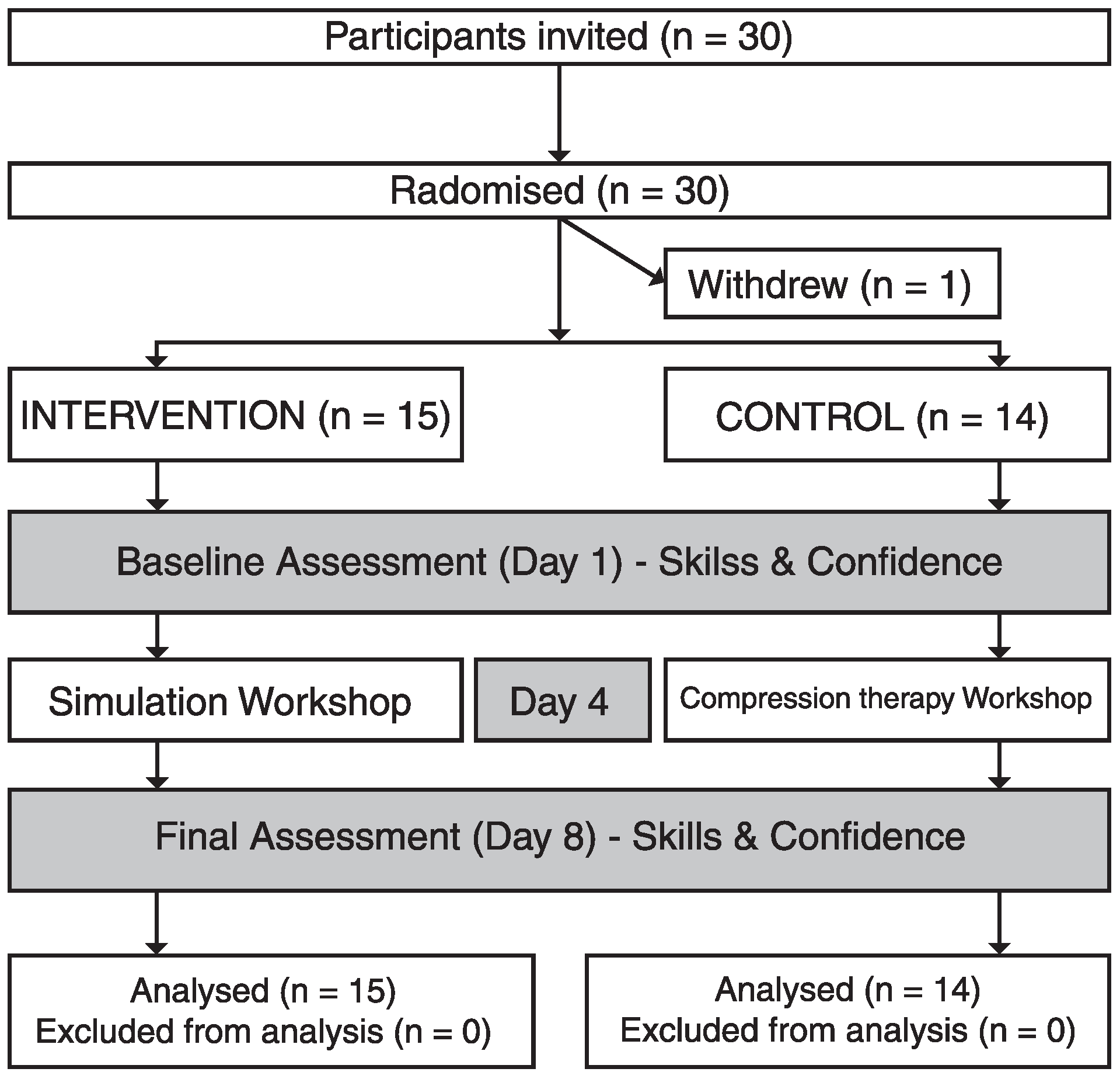
A pilot randomized controlled trial was conducted over a 12-month period (July of 2014 to July of 2015) at a single site of a large multicampus metropolitan health service in the northern region of Melbourne. Approval for the trial was obtained from the health service's human ethics committee before commencement. The trial duration was designed to match the shortest length of podiatry student clinical placements at the health service (8 days). Participants were allocated randomly to either an intervention group or a control group using a block randomization method (
Fig. 1). The randomization sequence was generated using a Web-based program (
www.Randomization.com) and the allocations were sealed in opaque envelopes before distribution. Participants were asked not to discuss their allocation with anyone. Assessments were completed on the first (day 1) and last (day 8) days of a student's placement. Both groups completed a 2-hour workshop on day 4 of the placement. A podiatrist with 5 years' clinical experience who had no other involvement with student education or assessment during the trial period delivered both the intervention and control workshops. The assessments and intervention and control group workshops took place within a nonclinical space dedicated to clinical education.
Figure 1.
Flow of participants through the trial.
Figure 1.
Flow of participants through the trial.
Participants
Participants were included if they were a third- or fourth-year podiatry student on clinical placement within the health service where the study was completed. During the student's preplacement orientation session, information about the trial was presented by an administrative staff member employed by the health service who was not involved in student training or supervision. Written informed consent was obtained from each participant.
Intervention Group
Participants allocated to the intervention group completed a 2-hour simulation workshop on conservative sharps debridement of callus on a medical foot-care model on the fourth day of their clinical placement. Overall, during the 12-month trial period, a total of six workshops were conducted for participants in the intervention group. Each intervention workshop included between one and four participants. The workshop encompassed theoretical and practical components. The theoretical components were based on knowledge and skills acquisition and application, necessary for delivery of safe conservative sharp debridement. The practical components consisted of simulated conservative sharp debridement on a medical foot-care model, with deliberate practice and debriefing.
The medical foot-care model was a part-task trainer of a life-size, silicone-based right foot with replaceable synthetic callus “plugs” on the plantar surface of the foot, located on high-pressure areas correlating to the third and fifth metatarsophalangeal joints. The instructional approach applied by the workshop facilitator was Peyton's Four-Step Approach, modified for small-group teaching,[
11] which teaches skills using four steps: demonstration, deconstruction, explanation, and performance. The facilitator provided guidance and offered constructive feedback, support, and advice where required.
Control Group
Participants allocated to the control group were offered an alternative 2-hour workshop on compression therapy also on the fourth day of their clinical placement, with two to four participants in each workshop. Overall, during the 12-month trial period, a total of six workshops were conducted for participants in the control group.
All participants continued with traditional placement, including the application of sharp debridement as the opportunity arose with patients. At the completion of each placement, for equity, the control group was offered the simulation workshop and the intervention group was offered the compression therapy workshop.
Outcome Measures
Two outcomes were measured on day 1 of clinical placement (baseline) and again on day 8 of clinical placement (after intervention). The primary outcome was an assessment of conservative sharp debridement skills on a medical foot-care model. This outcome was completed by an assessor (registered podiatrist) blinded to group allocation who had no involvement in the recruitment, randomization, training, or supervision of the participants. Each participant's skills in conservative sharp debridement were assessed in seven key areas: scalpel loading, body ergonomics, scalpel position, scalpel movement, skin tension, hand location, and blade removal. Each aspect was rated as either appropriate or inappropriate. Students were rated overall as competent if they were assessed as competent in all seven areas. The secondary outcome measure was student confidence. Participants were asked to rate their confidence in each of the seven areas measured during the assessment of conservative sharp debridement skills plus one additional area (communication skills) on a five-point Likert scale scored from 1 = strongly disagree to 5 = strongly agree. Participants completed the survey immediately before each assessment of the primary outcome. The possible range of scores on the questionnaire was 8 (no confidence) to 40 (very confident). This measure was not blinded, as it was rated by the participants who were aware of their group allocation.
Statistical Analysis
Data were analyzed according to intention-to-treat principles using SPSS Version 22.0 (IBM Corp., Armonk, New York). Student characteristics were analyzed descriptively. Logistic regression was performed to assess the impact of group allocation and baseline competency (competent or not competent) on the likelihood that participants were rated as competent after intervention (day 8). Analysis of covariance was used to analyze between-group differences in student confidence immediately after the intervention, with baseline scores as the covariate.[
16,
17] A minimum significance level of
P < .05 was applied.
Discussion
Simulation-based education is a rapidly developing learning environment for supplementing clinical education in health-care training,[
10,
12,
13,
18] providing opportunity for clinical experiences[
18] and allowing improvements in skills and confidence.[
5,
6,
14] Factors driving simulation-based education include patient safety, increased demands on health services with increased patient complexity, and increase in demand for clinical placements.[
3,
7-
9] With a trend toward fewer clinical placement hours for podiatry students, reducing direct clinical contact training hours, simulation-based education provides the potential to enhance student clinical placements with improved efficiency and rigor. Students are exposed to opportunities that may not always be available in the traditional clinical placement and are offered the opportunity to learn and develop skills in a safe environment to prepare for the “real” clinical experience.[
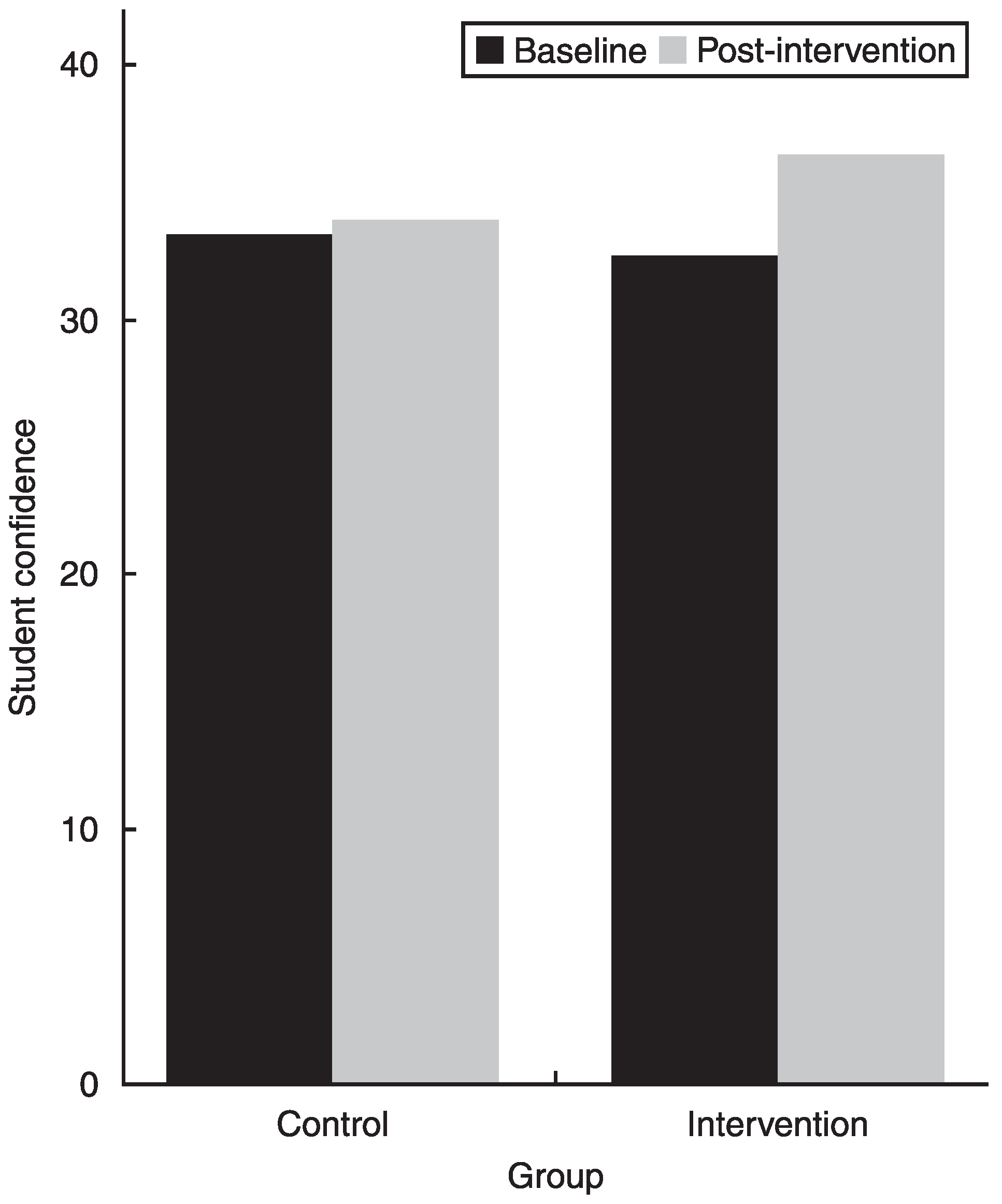
18] The results of this pilot trial provide preliminary evidence to suggest that simulation may be a useful addition to podiatry student education. The participants who received the 2-hour simulation workshop on conservative sharp debridement skills were more likely to be assessed as competent after the workshop, and also reported higher confidence levels in the short term.
It is difficult to isolate the effects of simulation-based education from other educational interventions, as it is embedded within broader placement activities.[
18] In this trial, both groups continued with traditional training of debridement skills while on clinical placement. The intervention group also received clinical education in the form of simulated debridement, whereas the control group received education unrelated to the debridement skill to control for attention. That is, the trial was designed to control the dedicated time allocated to clinical education while participants were on placement. The aim was to determine the impact of incorporating simulated conservative sharp debridement into a traditional clinical placement. We found an improvement in skills and confidence of the participants in the intervention group; however, not all participants achieved competence in all areas. We suggest that further modifications to the intervention are required to achieve a higher competency rate. For example, it may be beneficial to increase the frequency of and exposure to simulated conservative sharp debridement practice to increase competence. Further studies could investigate whether a higher competency rate transfers to improved safety for patients.
Although podiatry students' skills and confidence were shown to improve, their level of knowledge was not assessed. It is therefore unknown whether their increase in skills and confidence were transferred to a clinical environment; for example, would the participants know when and how to perform the skills competently in a “real life” scenario with a patient? Given the short duration over which the trial was conducted, we do not know whether these short-term gains are retained over the longer term. The setting and equipment used in the trial should also be considered. The trial was conducted in a nonclinical space on one site. This had the benefit of providing a consistent, safe, and dedicated environment to run the trial with no distractions, where participants could repeat conservative sharp debridement without risk of patient lacerations, allowing the opportunity to practice, receive feedback, improve, and debrief. A part-task trainer foot model was deliberately matched to students, because this allowed for deconstruction of conservative sharp debridement technique, where each step could be rehearsed and practiced repeatedly without the complexities of dealing with real patients in a clinical setting. This deliberate practice allows for students to master the basic skill, which can be refined until their performance becomes instinctive.[
18] The baseplate of the silicone-based foot-care model needed to be fixed to the tabletop with adhesive tape for stability and safety during simulated skills training. The effect of the silicone foot model taped to a table, in a nonclinical “artificial” room, could have an effect of low realism and authenticity for the participants. It was outside the scope of the trial to assess whether simulated practice of conservative sharp debridement transferred to clinical “real” practice. The realism of simulated conservative sharp debridement on a part-task trainer can be increased by attaching the model to a simulated patient in a clinical room, for the addition of simultaneous effective communication in a more genuine setting. Future studies need to build on these preliminary data before it could be recommended that simulation become a core component of clinical training for podiatry students.
Both groups continued with traditional conservative sharp debridement during their clinical placement; however, the amount of exposure to traditional sharp debridement the participants received and the complexity of the patients they saw were not monitored during the trial and are therefore unknown. Randomization of the participants to two groups would be expected to result in groups with comparative levels of exposure. However, the nature of this trial design, with the intervention group having additional exposure and training on the foot-care models on which both groups were assessed, may have meant that intervention group participants were more likely to be comfortable with the equipment and may have performed better in their skills assessment as a result. This is a limitation of the trial.
Teaching time efficiency and cost effectiveness were not assessed in this trial. An economic analysis would be required to understand whether this method of clinical education delivery for podiatry student placements is more efficient and more cost-effective than traditional placement alone. The initial price of the part-task trainer and ongoing costs for the dedicated consumables, including replaceable callosities, scalpel handles, blades, and blade removers, are relatively low. Facilitator training is also minimal. For health-care services, time must be set aside from clinical work to allow dedicated simulated training time, which may impose additional training costs. However, these costs may be offset by decreasing risk of sharps injury and adverse patient outcomes. The controlled environment of simulation has the potential to improve patient safety and the quality of health-care delivery, and to reduce errors.[
12,
13,
15] As the number of hours that podiatry university students spend on clinical placements has significantly diminished in recent years, an economics analysis may also focus on the timeliness of this simulated training.
A limitation of the study is its small sample size, and it is unknown whether similar results would be found in a larger population. Furthermore, applying logistic regression in studies with small sample sizes can be problematic, as doing so can overestimate the size of the effect. The benefit of using this approach was that the model could take into account that some participants were assessed as competent at baseline. Future studies are needed to replicate the outcomes of this study and to accurately estimate the size of the effect. Another limitation is that only one assessor, who was blinded to group allocation, completed all of the skills competency assessments. No reliability testing was performed, nor was a second tester used to check the consistency of the skills assessments. However, the assessor was blinded to group allocation, which reduced the chances of a biased ascertainment of outcomes. In addition, the content of the intervention and control workshops was not checked for consistency. However, the same facilitator performed all workshops using preplanned content. This is likely to have kept variations in the delivery of the style and the content of the workshops to a minimum. Furthermore, to the best of our knowledge, a validated conservative sharp debridement assessment tool is not available; therefore, an assessment tool was developed for use in this trial. Future research should consider alternate assessment methods, such as the use of video with multiple assessors, test for consistency of assessments, and workshops with creation of a validated tool to assess the skills and confidence of participants.