Next Article in Journal
Comparison of Diabetic Foot Care with Other Diabetic Preventive Care Services
Previous Article in Journal
Comparative Study Between the Different Techniques of Molding and the Morphology of the Foot in Weightbearing
 
 
Journal of the American Podiatric Medical Association is published by MDPI from Volume 116 Issue 1 (2026). Previous articles were published by another publisher in Open Access under a CC-BY (or CC-BY-NC-ND) licence, and they are hosted by MDPI on mdpi.com as a courtesy and upon agreement with American Podiatric Medical Association.
Article

Percutaneous Electrochemical Debridement of the Plantaris Tendon. A Novel Option in the Treatment of Midportion Achilles Tendinopathy

by
Gabriele Mattiussi
* and
Carlos Moreno
Medical Services, Udinese Football Club, Viale A. e A. Candolini, 2, Udine, 33100 Udine, Italy
*
Author to whom correspondence should be addressed.
J. Am. Podiatr. Med. Assoc. 2018, 108(5), 437-441; https://doi.org/10.7547/17-078
Published: 1 September 2018

Abstract

Plantaris tendon disorders are a well-known source of midportion Achilles tendinopathy. Plantaris tendon thickening and fibrous tissue formation between the tendons are the histologic abnormalities that are typically observed. Surgical approaches (scraping of the Achilles medial and ventral paratendinous tissues and excision of the plantaris tendon) have already shown good clinical outcomes; despite this, the cost-benefit ratio of these interventions may be unfavorable, and their accessibility is limited. Percutaneous needle electrolysis is a minimally invasive ablative technique increasingly being considered for the treatment of tendinopathies and associated conditions. Herein we introduce a novel procedure to treat plantaris tendon–related midportion Achilles tendinopathy. The procedure starts with the ultrasound-guided insertion of an uncoated needle (diameter, 0.30–0.40 mm; length, 30 mm) between the plantaris and Achilles tendons. Subsequently, galvanic current (intensity, 2 mA) is locally transferred, which induces instant nonthermal electrochemical ablation of the intertendinous tissues in close proximity to the needle, finally debriding the plantaris tendon. To further promote its release, the second part of the procedure involves partial tenotomy of the lateral peripheral aspects of the plantaris tendon. Usually, the session does not exceed 30 min. Percutaneous needle electrolysis may be considered as a valid alternative to surgery. The outpatient procedure presented herein is, in fact, safe and quick to perform. In addition, long suspension of working or sporting activities after treatment is not required. Future investigations are needed to ascertain the short- and long-term therapeutic outcomes of plantaris tendon–related midportion Achilles tendinopathy treatment, in particular by comparing them with those obtained with other mini-invasive interventions.

The role of the plantaris tendon in the etiopathogenesis of midportion Achilles tendinopathy has been certified during the past decade [1-3]. However, research of highly specific diagnostic modalities and optimal treatment strategies is still ongoing. Plantaris tendon–related midportion Achilles tendinopathy is clinically characterized by debilitating pain and swelling, which are typically localized in the medial aspects of the Achilles tendon body [2,3]. Friction and compression traumas between the tendons are likely to be the biomechanical disorders that lead to the histologic changes observed in most research, such as plantaris tendon thickening, fibrous tissue formation between the tendons, and alteration of the vascularization and innervation patterns of the Achilles paratenon [1-4].
Surgical scraping of the Achilles medial and ventral paratendinous tissues has shown good clinical results in many trials, especially when associated with excision of the plantaris tendon [5-8]. Despite this, the cost-benefit ratio of these interventions may be unfavorable, and their accessibility is relatively limited. In addition, postsurgery rehabilitation protocols may last several months. Consequently, there is a need to identify new therapeutic solutions that may be as effective as surgery but without these relevant weak points.
Thus, the main purpose of this article was to introduce debridement of the plantaris tendon via electrochemical ablation induced by cathode-centered percutaneous needle electrolysis. The latter is an ultrasound-guided and minimally invasive technique that may be considered a valid alternative to surgery or, at least, a treatment option to contemplate before performing it. In support of this hypothesis, minimally invasive techniques (needle scraping or sclerosing polidocanol injections) have already shown encouraging clinical results in the treatment of plantaris tendon–related midportion Achilles tendinopathy [9], and, on the other hand, percutaneous needle electrolysis is generally of increasing consideration in the treatment of tendinopathies and associated conditions [10-13].

Percutaneous Needle Electrolysis

This study was designed and conducted according to national and international standards and in compliance with the Helsinki Declaration and the International Principles governing research on humans.

Equipment

We apply the technique using a specifically developed and medically certified device (EPI Advanced Medicine, Barcelona, Spain). This instrument permits intratissue galvanic current transfer, at settable intensities, through an appropriate noncoated needle (diameter, 0.30–0.40 mm; length, 30 mm; EPI Advanced Medicine). While the needle acts as the cathode, the anode can be handled by the patient or applied to the skin. The cathodic flow is the only one that is used during the procedure (cathode-centered electrolysis). When the current is transferred, the basic electrochemical process of saltwater electrolysis instantly develops, inducing the nonthermal ablation of the tissue in close proximity to the needle. The latter is inserted under ultrasound guidance to precisely treat the target tissue without involving other structures. For this purpose, we use the Logiq S7 Expert ultrasound equipped with ML6-15 (50 mm; 6–15 MHz) and L8-18I-D (25 mm; 8–18 MHz) linear probes (GE Healthcare, Chicago, Illinois).

Preliminary Ultrasound Investigation

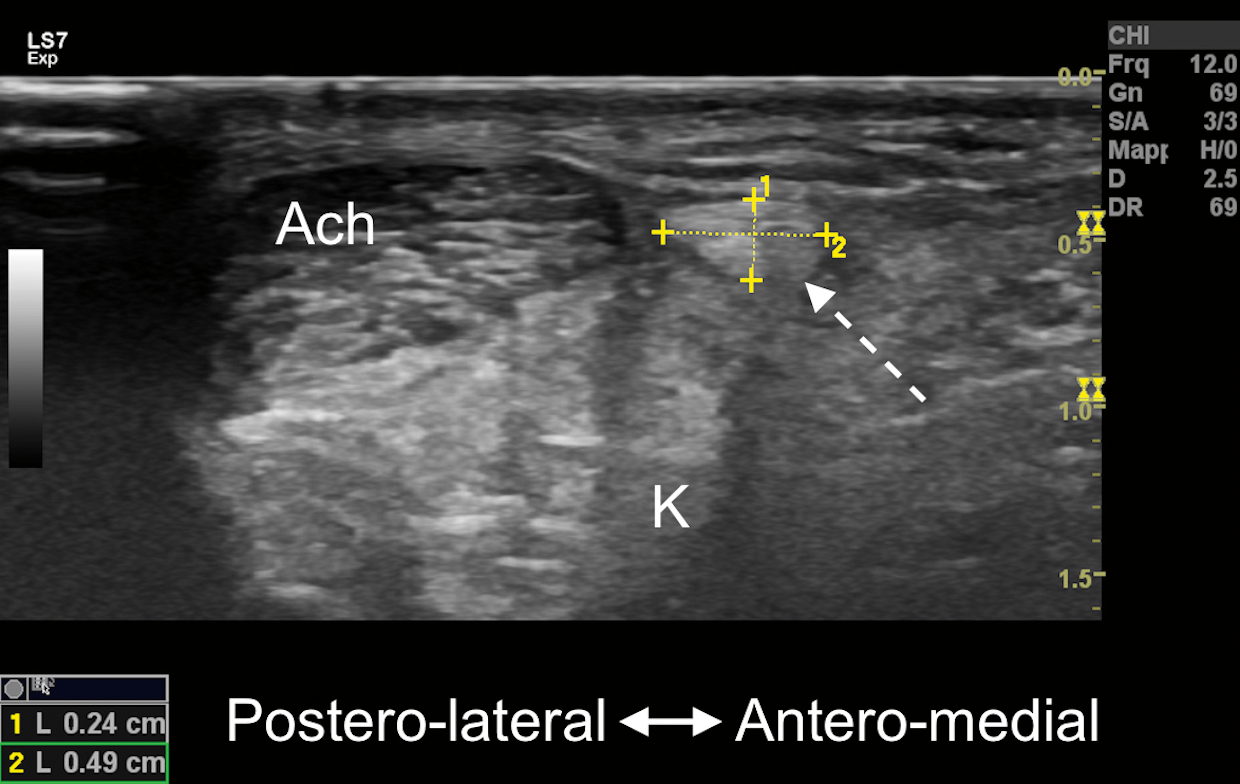
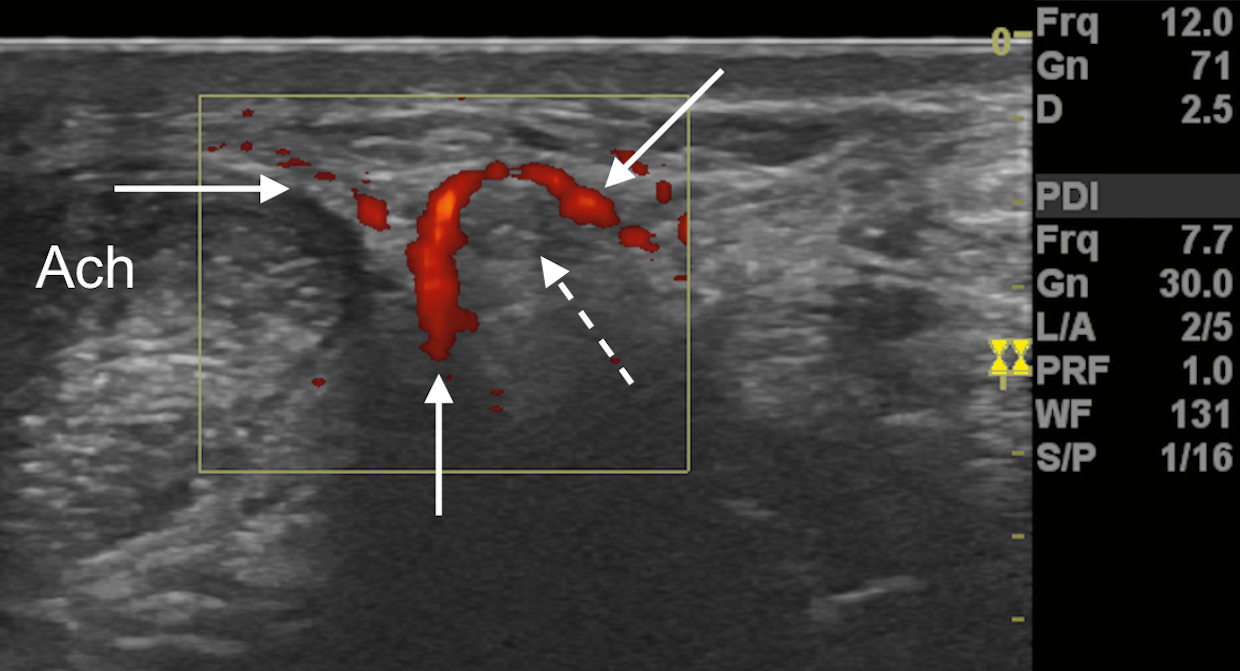
The patient lies on his or her side, with the medial aspects of the Achilles tendon directed upward. The region is shaved and disinfected by applying a proper protocol. A preliminary ultrasound is performed to accurately detect the portions of the plantaris tendon in anatomical relationship with the medial aspects of the Achilles tendon body. It may be helpful to delimit the region to be treated, marking its distal and proximal limits with a sterile dermographic pencil. It is also advisable to mark the points at which the patient notes having more pain and swelling (“critical areas”) and where the major anatomical alterations are discernible (Figs. 1 and 2).
Figure 1. Plantaris tendon morphological abnormalities are commonly observed in patients with midportion Achilles tendinopathy. The transversal, grayscale, high-resolution ultrasound image presented shows increasing of the thickness and width of the plantaris tendon (broken arrow). To complete an accurate investigation, it is advisable to compare the dimensions of the tendon with those of the contralateral one and to take into high consideration the data concerning the normal morphological features of the plantaris tendon presented by Olewnik et al. [1] Ach indicates Achilles tendon; K, Kager's fat pad. Probe used: ML6-15 (50-mm footprint).
Japma 108 00437 g001
Figure 2. Transversal, high-resolution ultrasound image showing high blood flow (filled arrows) in the medial aspects of the Achilles tendon (Ach) and paratenon, between the Achilles and plantaris tendons (broken arrow), and around the latter. In patients with midportion Achilles tendinopathy, these signs may be discernible also in the ventral portions of the Achilles tendon [2]. Probe used: ML6-15 (50-mm footprint).
Japma 108 00437 g002

Description of the Procedure

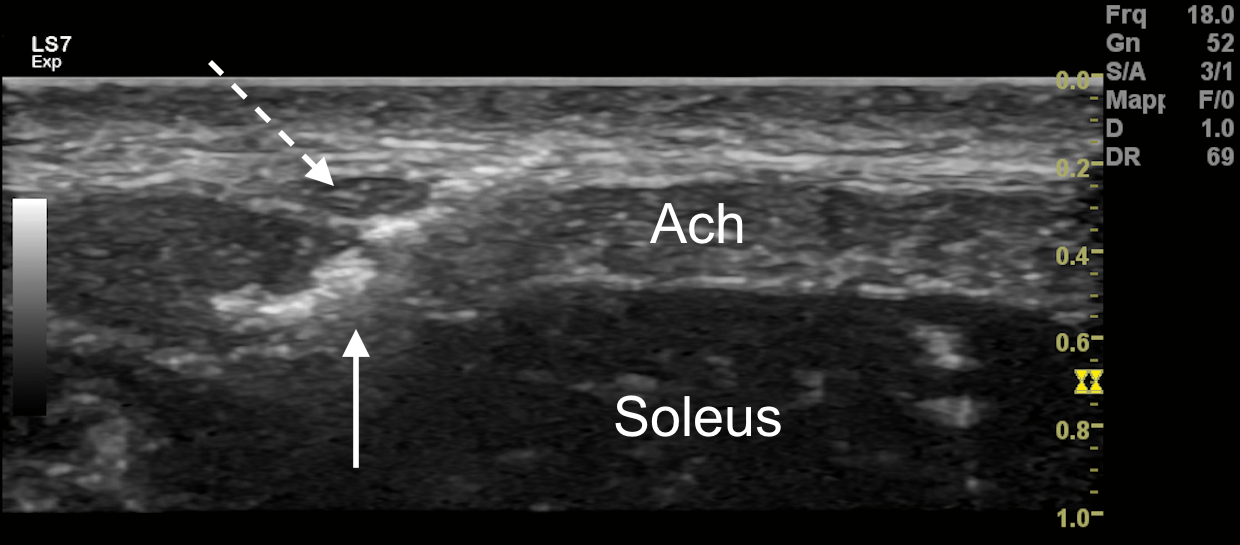
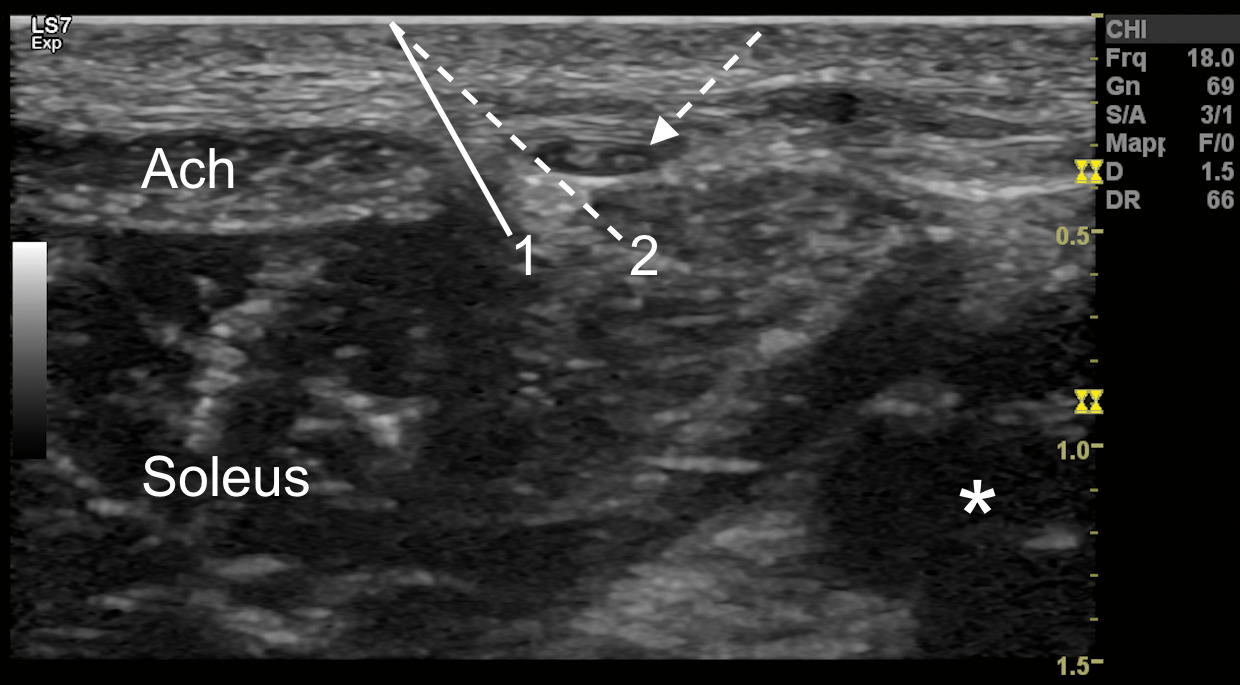
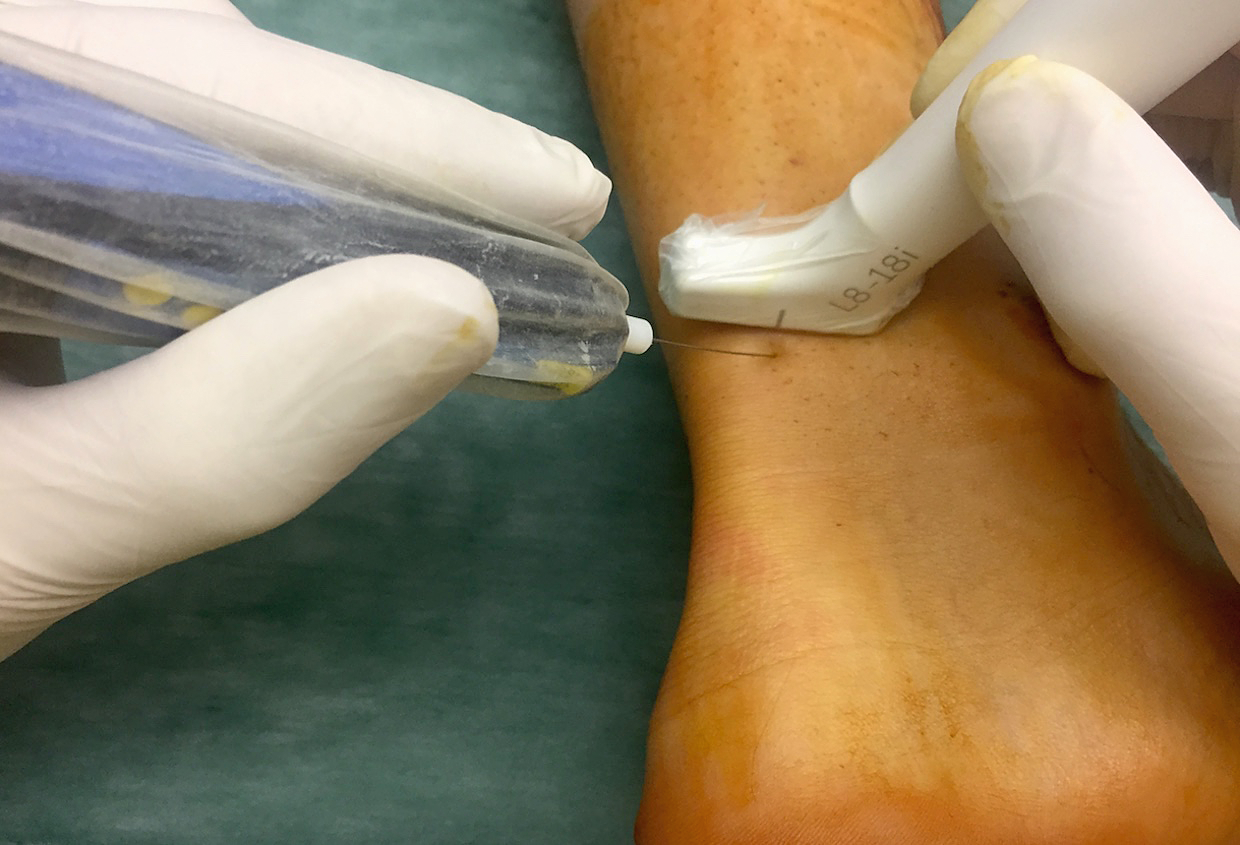
The procedure is graphically represented in Figure 3. First, the needle is inserted between the plantaris and Achilles tendons under ultrasound guidance (Fig. 4). Subsequently, the galvanic current is transferred (intensity is preset to 2 mA). Doing this, the local ablation of the fibrous intertendinous and Achilles paratenon tissues is instantaneously obtained, anatomically debriding the plantaris tendon (Fig. 5). The single applications of current last 2 to 3 sec.
Figure 3. Schematic diagram of the percutaneous needle electrolysis procedure for debridement of the plantaris tendon. The needle is initially inserted between the plantaris (broken arrow) and Achilles (Ach) tendons, as indicated by line 1, and, subsequently, within the lateral peripheral aspects of the plantaris tendon, as indicated by broken line 2. Asterisk indicates tibial neurovascular bundle.
Japma 108 00437 g003
Figure 4. Ultrasound-guided insertion of the needle between the Achilles and plantaris tendons. Considering their anatomical relationship, the preferred approach is in the posterior-to-anterior and medial-to-lateral direction. Inclination of the needle is variable and depends on the specific morphological features of the tendons.
Japma 108 00437 g004
Figure 5. An iperechoic area (arrows) is typically observable around the needle immediately after the application of galvanic current and consequent development of the electrochemical process. This should confirm that only the intertendinous tissues have been treated, without involvement of other structures (first part of the procedure). Broken arrow indicates plantaris tendon; Ach, Achilles tendon. Probe used: L8-18I-D (25-mm footprint).
Japma 108 00437 g005
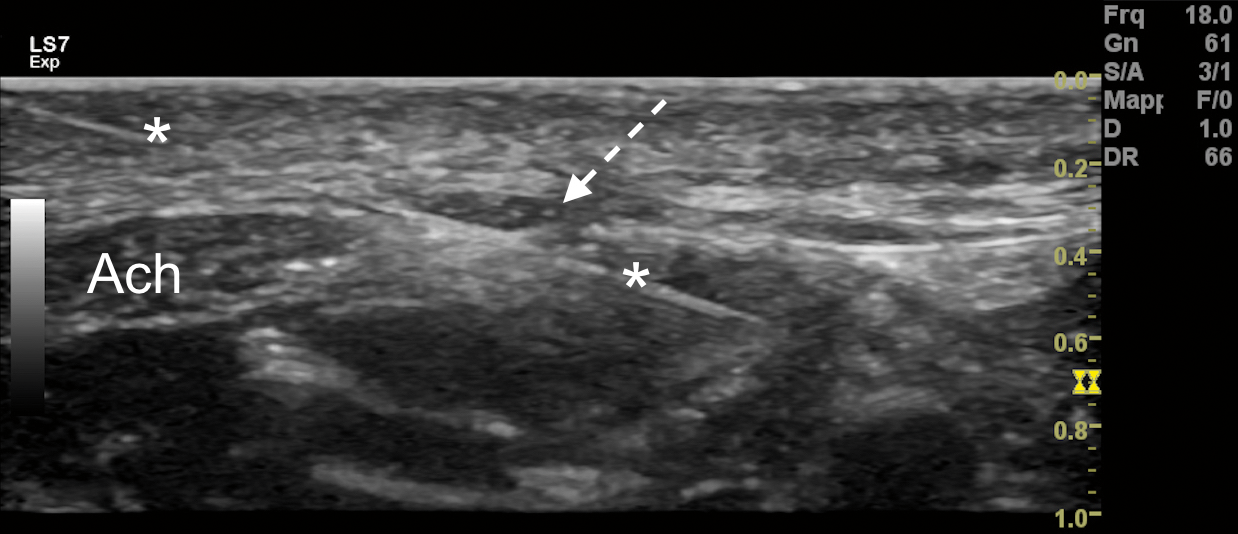
Then, the needle is partially withdrawn and pointed toward the plantaris tendon. To further promote its release, a partial tenotomy of the lateral peripheral aspects of the tendon is performed (Fig. 6). To this effect, the single application can have a variable duration of 2 to 6 sec, depending on the mechanical resistance offered by the tendinous tissue to the needle penetration (the lower the resistance, the shorter the application). We underline the fact that the needle should not be inserted within the plantaris tendon body but so that it is in direct contact with only the lateral surface of the tendon; this is essential to preserve its physiologic collagen structure.
Figure 6. After ablation of the intertendinous fibrotic tissues, the needle (asterisks) is partially withdrawn and inserted into the lateral peripheral aspects of the plantaris tendon (second part of the procedure). Broken arrow indicates plantaris tendon; Ach, Achilles tendon. Probe used: L8-18I-D (25-mm footprint).
Japma 108 00437 g006
All the actions presented previously herein are repeated approximatively every 5 mm (or less in the critical areas), in a distal-proximal direction, throughout the previously skin-marked region. Typically, the total duration of the session does not exceed 30 min (including disinfection and dressing processes).

Tolerability of Pain and Adverse Effects

The insertion of the needle typically causes minimal discomfort. In contrast, patients may experience moderately strong pain during the application of galvanic current. However, anesthetics are usually not locally injected before percutaneous electrolysis because the procedure is generally well-tolerated by patients (the single galvanic current application can be stopped at any time if the pain is not bearable) and because the use of syringes would substantially increase the overall invasiveness of the intervention. However, use of anesthetics remains a considerable option. Relevant vagal reactions during and immediately after the intervention are possible [14]. Bleeding in the area of needle insertion and intervention-related discomfort in the treatment area (up to 48 hours) are the most common adverse effects. Infection-related issues are extremely rare because the technique is minimally invasive and the electrolytic process has a substantial bactericidal effect.

Discussion

The main purpose of this article was to introduce debridement of the plantaris tendon via electrochemical ablation induced by cathode-centered percutaneous needle electrolysis to treat plantaris-related midportion Achilles tendinopathy. This novel procedure permits elimination of the fibrous tissue interposed between the plantaris and Achilles tendons, finally debriding the plantaris tendon. Because the peritendinous histologic alterations are likely to be the cause of the tendinopathic symptoms (and not the tendinous tissue degeneration per se), we introduced a procedure that purposely aims to preserve the tendon collagen structure while treating the previously mentioned abnormalities. This approach allows us to improve the local biomechanics and, consequently, the clinical condition of the patients in terms of local pain reduction and recovery of the associated functional deficits, which are typical in patients with midportion Achilles tendinopathy [3].
The main practical value of this technique is the possibility of performing it in outpatient clinics, which considerably reduces the costs, waiting list–related issues, and other implications and adverse effects of Achilles tendon surgery, such as suture reactions, incisional neuromas, and granuloma formation [15]. Furthermore, note that postsurgery protocols may last several months. On the contrary, consistent with our experience, in particular with professional football (soccer) players, it is not necessary to completely suspend the sporting (or working) activities for more than 24 to 48 hours after the procedure. In fact, the adverse effects tend to be very moderate. However, many authors who use this technique, including us, find it helpful to implement a complementary protocol of active physical therapy [10-13]. Preliminary studies performed by our research group indicate that the short-term clinical results (not yet published) after percutaneous needle electrolysis treatment in professional athletes are very promising but that it is commonly necessary to conduct at least three to five sessions (one per week) to obtain long-lasting results. However, to date, clinical or imaging predictors of outcome are substantially unknown.

Conclusions

Percutaneous needle electrolysis is an ultrasound-guided and minimally invasive technique that allows specific treatment of the anatomical alterations that cause plantaris tendon–related midportion Achilles tendinopathy. Because it is safe and quick to perform, it may be considered as a valid alternative to surgery. Future investigations are needed to ascertain the short- and long-term therapeutic outcomes in the treatment of plantaris tendon–related midportion Achilles tendinopathy, in particular by comparing them with those obtained with other mini-invasive interventions.

Financial Disclosure

None reported.

Conflict of Interest

None reported.

References

  1. Olewnik L, Wysiadecki G, Polguj M, et al: Anatomic study suggests that the morphology of the plantaris tendon may be related to Achilles tendonitis. Surg Radiol Anat39: 69, 2016.
  2. Masci L, Spang C, van Schie HTM, et al: How to diagnose plantaris tendon involvement in midportion Achilles tendinopathy: clinical and imaging findings. BMC Musculoskelet Disord17: 97, 2016.
  3. van Sterkenburg MN, van Dijk CN: Mid-portion Achilles tendinopathy: why painful? an evidence-based philosophy. Knee Surg Sports Traumatol Arthrosc19: 1367, 2011.
  4. Spang C, Harandi VM, Alfredson H, et al: Marked innervation but also signs of nerve degeneration in between the Achilles and plantaris tendons and presence of innervation within the plantaris tendon in midportion Achilles tendinopathy. J Musculoskelet Neuronal Interact15: 197, 2015.
  5. Perace CJ, Carmichael J, Calder JD: Achilles tendinoscopy and plantaris tendon release and division in the treatment of non-insertional Achilles tendinopathy. Foot Ankle Surg18: 124, 2012.
  6. van Sterkenburg MN, Kerkhoffs GMMJ, van Dijk CN: Good outcome after stripping the plantaris tendon in patients with chronic mid-portion Achilles tendinopathy. Knee Surg Sports Traumatol Arthrosc19: 1362, 2011.
  7. Bedi HS, Jowett C, Ristanis S, et al: Plantaris excision and ventral paratendinous scraping for Achilles tendinopathy in an athletic population. Foot Ankle Int37: 386, 2016.
  8. Calder JDF, Stephens JM, van Dijk CN: Plantaris excision reduces pain in midportion Achilles tendinopathy even in the absence of plantaris tendinosis. Orthop J Sports Med4: 2325967116673978, 2016.
  9. Alfresdon H, Ohberg L, Zeisig E, et al: Treatment of midportion Achilles tendinosis: similar clinical results with US and CD-guided surgery outside the tendon and sclerosing polidocanol injections. Knee Surg Sports Traumatol Arthrosc15: 1504, 2007.
  10. Abat F, Diesel WJ, Gelber PE, et al: Effectiveness of the Intratissue Percutaneous Electrolysis (EPI®) technique and isoinertial eccentric exercise in the treatment of patellar tendinopathy at two years follow-up. Muscles Ligaments Tendons J4: 188, 2014.
  11. Valera-Garrido F, Minaya-Munoz F, Medina-Mirapeix F: Ultrasound-guided percutaneous needle electrolysis in chronic lateral epicondylitis: short-term and long-term results. Acupunct Med32: 446, 2014.
  12. Moreno C, Mattiussi G, Nunez FJ, et al: Intratissue percutaneous electolysis combined with active physical therapy for the treatment of adductor longus enthesopathy-related groin pain: a randomized trial. J Sports Med Phys Fitness57: 1318, 2017.
  13. Arias-Buria JL, Truyols-Dominguez S, Valero-Alcaide R, et al: Ultrasound-guided percutaneous electrolysis and eccentric exercises for subacromial pain syndrome: a randomized clinical trial. Evid Based Complement Alternat Med2015: 315219, 2015.
  14. de la Cruz Torres B, Albornoz Cabello M, Garcia Bermejo P, et al: Autonomic responses to ultrasound-guided percutaneous needle electrolysis of the patellar tendon in healthy male footballers. Acupunct Med34: 275, 2016.
  15. Saxena A, Maffulli N, Nguyen A, et al: Wound complications from surgeries pertaining to the Achilles tendon: an analysis of 219 surgeries. JAPMA98: 95, 2008.