Maintaining good foot health throughout childhood is critical for development of the musculoskeletal system and longer term health and well-being.[
1] Good foot health is important for enabling children as they learn to walk and to understand, explore, and learn about the physical and social dimensions of their surrounding environment. Understanding the determinants of growth of the pediatric foot is therefore important to inform good foot health practices in children and ensure that factors impacting on foot development are mitigated. Determinants of growth of the pediatric foot and limb are multifactorial (eg, genetic, nutritional, and hormonal) and remain poorly understood.[
2] After an initial period of rapid growth in early infancy,[
3] changes with shape, structure, and morphology of the foot are ongoing throughout childhood and adolescence.[
4-
7] The distal location, flexibility, and growth phases of the developing foot underpin the risk of foot pathology and deformation[
8]; therefore, greater knowledge of the determinants of foot shape and morphology are important for advancing our understanding of factors affecting foot development. It follows that external influences on the foot, such as higher levels of force applied to skeletal and soft tissues because of excessive body mass (ie, obesity), may affect the development, structure, and function of the foot.
The impact of childhood on the musculoskeletal system is well recognized, with recent attention given to the association between obesity and musculoskeletal pathologic conditions.[
9-
11] Obesity in childhood has been reported to affect foot structure and function, with obese children found to have larger[
12,
13] and flatter foot dimensions.[
13-
19] Existing research has also identified disproportionate body dimensions, specifically shorter limbs in relation to overall height in overweight and obese children compared with typical weight children.[
20] The longer term impact of childhood obesity on the foot remains undetermined, yet changes to the shape and structure of the foot could have longer term implications for foot health and increase the risk of foot-related musculoskeletal injuries. This is important because structural and morphologic changes in the obese adult foot are documented[
21] and commonly recognized precursors to footwear- and biomechanical-related pathologies such as flat feet, tendonitis,[
22] and foot pain.[
23]
Given the dramatic rise in the prevalence of overweight and obesity in children and young people, these findings raise concerns that may have population-wide unforeseen implications on a number of pediatric foot heath matters. Anthropometric measurements of the foot (foot dimensions) can help to 1) advance understanding of the impact of obesity on physical form and 2) determine the impact on footwear design. Despite this, understanding the factors that affect the development of the pediatric foot remain poorly understood, with the impact of obesity poorly recognized in historical pediatric foot reference databases.[
3,
5-
7] Through undertaking a retrospective analysis of existing anthropometric data, the aim of this study was to determine the association between obesity and pediatric foot dimensions.
Methods
For this study, a secondary analysis of existing anthropometric data from the Anthrokids database[
23] was undertaken. This data set (an extension from a previous survey) was collected over a 22-month period from a random selection of schools in the United States. The authors collected anthropometric measurements from 4,127 individuals aged 0 to 18 years. The data collected were, at the time, deemed to represent the US population in relation to race, demographics, and socioeconomic factors, and further details relating to sampling and demographics are available.[
24] The precision and consistency of the raters was determined in the original study, and findings from their preliminary analysis were presented. There were no concerns reported. For the purpose of this study, height, weight, foot length, and foot breadth in children aged 2 to 18 years were used for analysis. The data were reviewed, and incomplete data sets were excluded from analysis. Of the initial data set accessed (n = 3,900), the final sample for our analysis comprised 3,713 participants, of which 1,892 were male and 1,821 were female (
Table 1). Permission was granted for using the data in our retrospective analysis (S. Ressler, written communication, August 2016).
Table 1.
Demographics for Study Participants.
Table 1.
Demographics for Study Participants.
Weight Classification
Body mass index (BMI) was derived by the current authors from the measurement of body mass (in kilograms) and height (in meters), as defined in the original AnthroKids protocol.[
24] The BMI was then converted to gender-specific standard deviation scores (SDS) for each participant using decimal age with the following formula:
1 SD of BMI (for age).
The SDS allows for the effect of age and sex on BMI. The BMI SDS was calculated from the UK1990 growth references,[
25] using LMSGrowth software. The model assumes that BMI is normally distributed at any specified age and summarizes this into three age-specific smooth curves: L (lambda), M (mu), and S (sigma). Each individual was then classified according to their BMI SDS into weight categories of underweight, typical weight, overweight, obese, and severely obese. Height and body mass were also converted to SDS. For the descriptive analysis, we used the five weight categories, but the obese and severely obese were collapsed to represent an obese group for statistical analysis.
Foot Measurements
Two measures of foot dimensions were included in the original data set: foot length (FL) (in centimeters) and foot width (FW) (in centimeters). Foot length was defined as the measurement from the rearfoot (posterior calcaneus) to the most distal aspect of the longest toe. Foot width was calculated between the medial first metatarsal head and the lateral fifth metatarsal head. These measurements were taken using modified callipers with the participants in relaxed standing position and with socks and shoes removed.
Data Analysis
All statistical analysis was performed using SPSS Version 20 (IBM Corp, Armonk, New York). The data were checked for normal distribution through construction of P-P plots and histograms. The data were normally distributed.
Bivariate correlation analysis was conducted on BMI SDS with FL and FW in male and female subjects separately, with Pearson correlation coefficients reported. Logistic regression was used to determine relationships between FL, FW, and weight category as the predictor variable. Significance was set at P < .05.
Results
Descriptive statistics for the sample are listed in
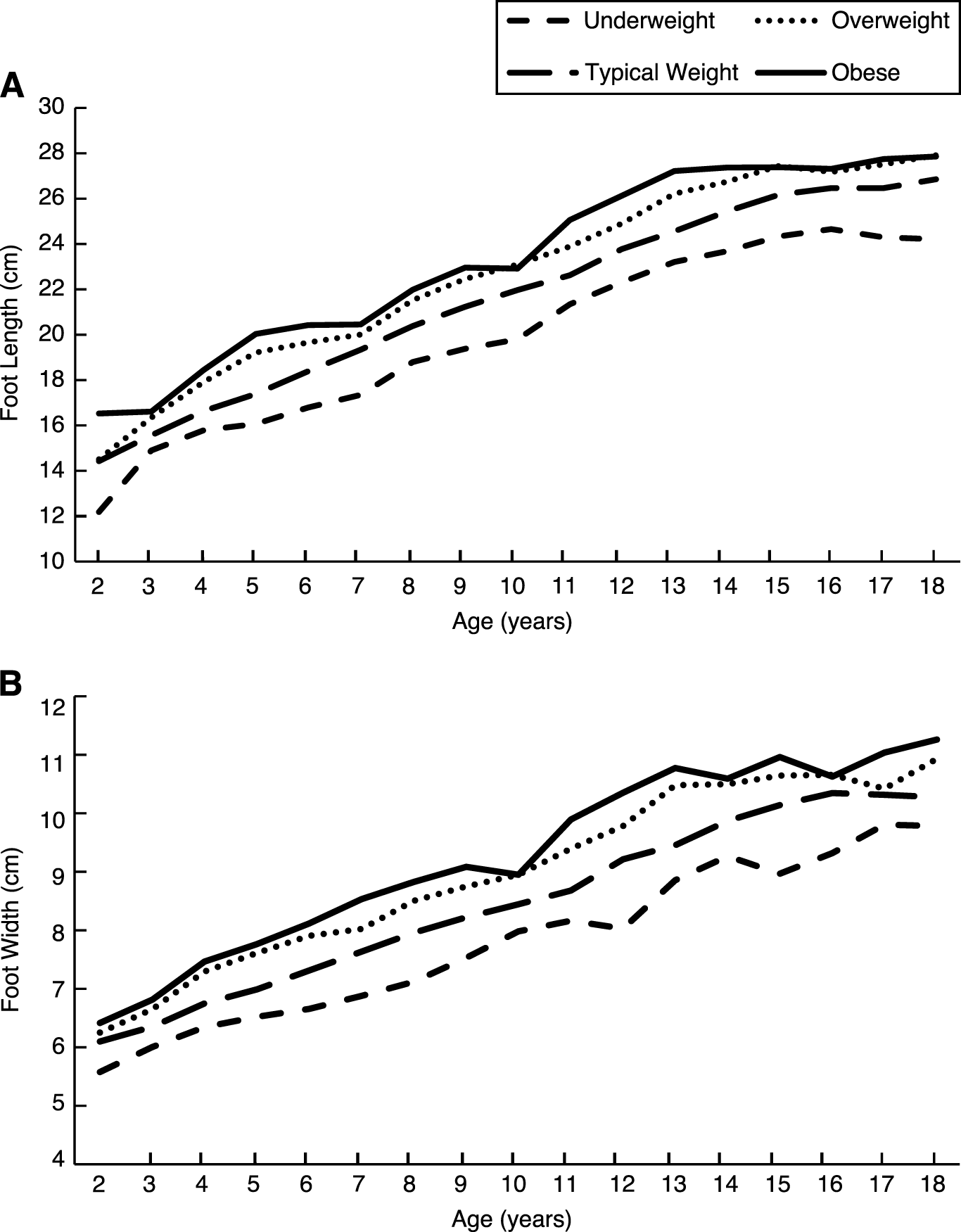
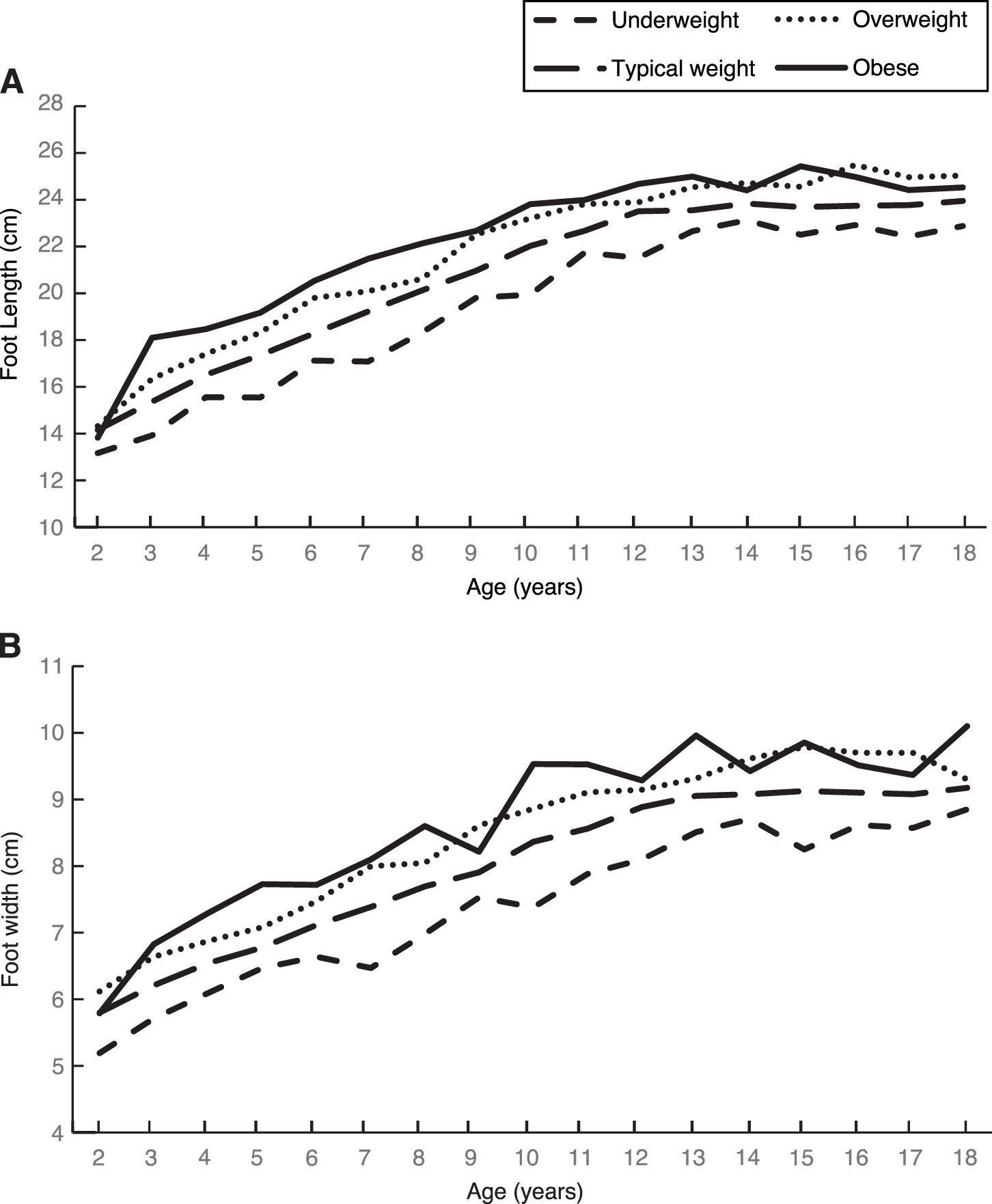
Table 1. The mean age for the participants was 10.49 ± 4.47 years and 10.48 ± 4.37 years for boys and girls, respectively. The prevalence of combined overweight and obesity was 17.4% and 12.8% for boys and girls, respectively. Mean SDS for height was –0.01 ± 0.99 and mean SDS for mass was –0.001 ± 1.03. The boys demonstrated a steeper trajectory for foot length (
Fig. 1A), with changes in FL for girls appearing to plateau in early adolescence (
Fig. 2A). Foot length was greater for obese and overweight boys and obese girls (
Figs. 1A and
2A). Foot width was greater for the boys (
Fig. 1B) compared with the girls (
Fig. 2B), and was maintained across the age range.
Figure 1.
A, Mean foot length (in centimeters) for boys. B, Mean foot width (in centimeters) for boys.
Figure 1.
A, Mean foot length (in centimeters) for boys. B, Mean foot width (in centimeters) for boys.
Figure 2.
A, Mean foot length (in centimeters) for girls. B, Mean foot width (in centimeters) for girls.
Figure 2.
A, Mean foot length (in centimeters) for girls. B, Mean foot width (in centimeters) for girls.
Foot length was significantly correlated with BMI SDS (
r = .336 and
r = .232 in boys and girls, respectively) and FW (
r = .378 and
r = .285 in boys and girls, respectively). The relationship between FL and FW and BMI SDS was examined separately for boys and girls (
Table 2). Compared to obese boys, typical weight (FL,
P < .05 [odds ratio (OR) = .83]; FW,
P < .05 [OR = .56]) and underweight (FL,
P < .05 [OR = .76]; FW,
P < .05 [OR = .41]) boys had significantly shorter and narrower feet. Compared to obese girls, overweight (FL,
P = .02 [OR = .88]; FW,
P = .02 [OR = .72]), typical weight (FL,
P < .05 [OR = .77]; FW,
P < .05 [OR = .47]), and underweight (FL,
P < .05 [OR = .70]; FW,
P < .05 [OR = .33]) girls had significantly shorter and narrower feet.
Table 2.
Logistic Regression Based on BMI SDS Categories in Male and Female Study Participants.
Table 2.
Logistic Regression Based on BMI SDS Categories in Male and Female Study Participants.
Discussion
Understanding foot shape and factors that affect foot development is fundamental to informing good foot health in children. The purpose of this study was to determine associations between obesity and pediatric foot dimensions. Using an existing database, we have undertaken a retrospective analysis and demonstrated associations between larger foot dimensions and obesity in children. Our findings suggest that overweight (male subjects only) and obesity in childhood resulted in larger and wider foot dimensions across childhood and suggest that obesity may be a determinant of foot growth (as determined by the dimensions recorded in the existing data set). The findings from this study add further support to previous literature that reported obesity affected the structure of the pediatric foot.[
12-
15,
18] Dowling et al[
14] reported obese children (n = 45 obese; age, 9.2 ± 1.4 years) had broader, higher, and thicker structural features of their feet. The findings also concur with a later study[
12] that reported larger foot dimensions, specifically larger mean foot length, for obese children.
The trajectories for FL and FW across childhood are similar to previous research that reported differences in foot dimensions between boys and girls.[
26] The data reported in this study suggest that further consideration of factors, beyond gender, that affect growth and development of the pediatric foot are necessary. The emergence of obesity as a major public health concern is unlikely to be accounted for in previously published growth data for foot dimensions, and this work challenges current understanding of the pattern of foot characteristics across childhood. Because of the retrospective nature of the study, it is difficult to explore our findings further, but there is a clear need for ongoing research to inform our understanding of the growth patterns and trajectories of the pediatric foot, particularly as obesity is recognized to affect musculoskeletal structure and function. These data reported underpin the need for further work exploring the determinants of foot dimensions throughout childhood.
The obese children in this study had wider feet than their typical weight counterparts. This is similar to findings that have previously been reported for adults.[
26] Changes with FW were previously thought to be attributable to decreased ligament strength, resulting in reduced integrity of the forefoot and forefoot splay during weightbearing. Given the constant increase in load applied to the ligaments and soft tissues, it is feasible that increased and prolonged tissue stress could lead to deformation of the ligaments and potentially tissue failure, thus resulting in increased width and instability of the forefoot during weightbearing. This is plausible given the findings from recent studies in adults that have demonstrated that obesity affects the structure and function of the tendons[
27,
28] and plantar fascia.[
29] Childhood obesity has been reported to increase peak plantar pressures and peak vertical forces[
14,
17]; therefore, changes in foot dimensions reported in this study might also be a compensatory mechanism to reduce the load applied to plantar foot tissues. Consideration of the biomechanical changes of the foot are important to relate these findings to clinical practice, but it is also acknowledged that the prevailing theory would suggest that changes to foot dimensions are also related to the endocrine functions of adipose tissue, which has an established metabolic role and is associated with increased height for age.[
30] Despite this, differences in whole-body dimensions and bone mass have been reported to persist after adjustment for obesity-related increases in height, maturation, and lean mass.[
30]
Although this study demonstrated significant differences between typical weight and overweight and obese individuals for FL and FW, it is important to take into consideration the limitations of the study. Caution with the ecologic validity of the work is also needed. The data used for this study were retrospective and, as such, it was not possible to control for all potential determinants of foot dimensions in children, such as ethnicity. Equally, because of the retrospective nature of the study, it could be argued that the data do not reflect current nutritional, environmental, and/or behavioral factors that may affect growth and development. The data were collected in the United States, but for the purpose of this work, we have used the UK growth reference values for BMI SDS and interpretation.[
25] However, given that the mean and SD of the SDS for height and weight closely approximate 0 and 1.0, respectively, indicates that the US population in this study was very similar to the UK reference population. Despite this, the findings from this work do support the view that obesity is a factor that impacts foot development and, as such, the findings from this analysis underpin calls for further work in the area.
In light of the association between obesity and musculoskeletal complications in children, access to the relevant health services to negate factors that may compromise foot development is important. Appropriate and fitting footwear is essential to support the development of the pediatric foot, provide support and protection, and maintain long-term foot health. Inappropriate and poor-fitting footwear may predispose to common foot pathologies, impaired balance and stability during activity, increased risk of tripping and falling, and increased health burden for children. Therefore, it is important to understand the impact of obesity on foot structure to ensure that appropriate footwear is commercially available and used as a key intervention in minimizing lower limb complications.
Conclusions
The data reported in this study demonstrated that FL and FW were significantly shorter in typical weight male and female subjects compared with obese counterparts. These findings support the view that obesity is a determinant of foot dimensions in children. Further work is needed to explore the role of biomechanical and endocrine parameters as determinants of foot growth and thus further understand the impact of obesity on the musculoskeletal system.