Dysfunction of the intrinsic foot muscles has been associated with the development of common toe pathologies.[
1] This altered muscle function combined with irregular phalanx bone shape,[
2] ill-fitting footwear, and trauma[
1] is thought to be important in the development of painful pathologic abnormalities, including, mallet toe, retracted toe, and clawing of the toe. These toe deformities often leave patients with painful skin lesions, osteoarthritis, and altered stability and balance.[
3,
4]
It is thought that in normal function, the main aim of the toes is to expand the weightbearing area of the metatarsals, reducing immediate pressure on the forefoot during loading and heel lift.[
5] If there is an absence or reduction of this toe contact, through deformity or dysfunction, there is an associated increase in peak plantar pressure on the metatarsal heads during gait.[
4] Altered peak plantar pressure as well as increases in contact time during forefoot loading and toe-off are thought to contribute to changes in skin thickness and painful callus formation.[
5,
6] The most common site for pain has been reported to be the second toe and metatarsal, with effective pressure off-loading management for painful callus including silicone splints and toe props.[
7] However, this treatment is often prescribed when the digits have a fixed deformity with associated arthritis and patients are unable to flex the interphalangeal joints. A solid understanding of how the toe develops into a fixed joint position is still unclear, making preventive management challenging for patients presenting with flexible toe deformities.
It has recently been shown that toe grip strength is related to the ability to curl the toes, and when a restriction in movement occurs at the toes due to a pathologic condition there is an observed reduction in toe grip strength.[
8] A reduction in toe grip strength has also been identified as a risk factor for falls in the elderly, and improving the grip strength of the toes reduces this risk.[
9,
10] However, therapeutic interventions to improve muscular control of the forefoot and, therefore, aiming to prevent debilitating mechanical toe pathologies arising are sparse and often ignored.[
11] Developing an understanding as to whether toe grip exercises for toes that have no pathologic disorders would improve the ability to flex the toes will provide initial data to support the use of grip exercises. Exercising the toes and foot flexion have been shown to improve athletic ability, with an increase in jump distance seen after a 7-week training period.[
12,
13] Yet, the direct impact of improving toe flexion on plantar pressure of the digits and metatarsals is unknown.
The purpose of this article, therefore, was to investigate the impact of specific exercises focusing on foot flexion and toe grip on apical toe and plantar metatarsal pressures in participants with no toe deformities. These pressure data will be used as a surrogate measure to indicate the grip strength.
Method
Participants
A convenience sample of 23 healthy participants was recruited from a student population (ten women and 13 men; and mean ± SD age, 32 ± 13 years; weight, 72.9 ± 26.3 kg; and height, 1.8 ± 0.1 m). Ethical approval was granted via the Staffordshire University ethics committee, and all of the participants gave informed consent. Any participant presenting with lesser toe deformities, neuropathy, or systematic disease that is known to alter digital function was excluded from the study. Foot posture was assessed using the Foot Posture Index,[
14] and individuals with extremes of posture (highly supinated or highly pronated) were excluded.[
15]
Data Collection
Data were collected from the participant's dominant leg, which was identified by performing a single-leg squat. The leg chosen to squat on was determined as the preferred dominant limb, and, therefore, all of the data for the study were collected from that limb.[
16]
Static Seated Maximum Digital Flexion
Digital plantar pressures were initially collected from individual sensors using WalkinSense (Tomorrow Options Microelectronics, Porto, Portugal). Five individual, circular, piezoresistive force, 100-Hz sensors were placed on the apices of digits 1 to 5. The sensors are made of a flexible material and are less than 1 mm thick and measure 1 cm in diameter. Each sensor was secured with Micropore surgical tape (3M, St. Paul, Minnesota) as per the method outlined by Branthwaite et al.[
17] After sensor application, participants were seated on a chair, and the hip, knee, and ankle joints were flexed to 90° because it is known that ankle dorsiflexion can improve toe flexion grip.[
18] Participants were instructed to maximally flex and grip the toes into the ground while keeping the calcaneus and forefoot flat on the floor. This fixed foot position was monitored to reduce error in performance and standardize data collection. Contraction of the toe flexion was timed for 5 sec and repeated to gain three sets of pressure data with a 10-sec rest period between maximal contractions.
Dynamic Plantar Pressure
Dynamic plantar pressure during gait was captured using a MatScan pressure mat (Tekscan Inc, South Boston, Massachusetts). A 15-m walkway was composed of ethyl vinyl acetate mats with the 3-m pressure plate placed 5 m in from the start; this accounted for natural acceleration and deceleration during gait. After individual system calibration, each participant was instructed to walk barefoot along the walkway at a self-selected speed. A timing gate (Brower Timing Systems, Draper, Utah) was used to monitor the participant's speed, which was then kept constant for all trials before and after exercise. A continuous walking loop was completed crossing over the pressure plate three consecutive times. From the data, eight footsteps were taken and averaged from the middle portion of the plate to eliminate any step features. The data for the plantar region of each foot were separated into masked regions consisting of metatarsal heads 1 to 5 and the apices of toes 1-4/5 according to anatomical position.
Intervention
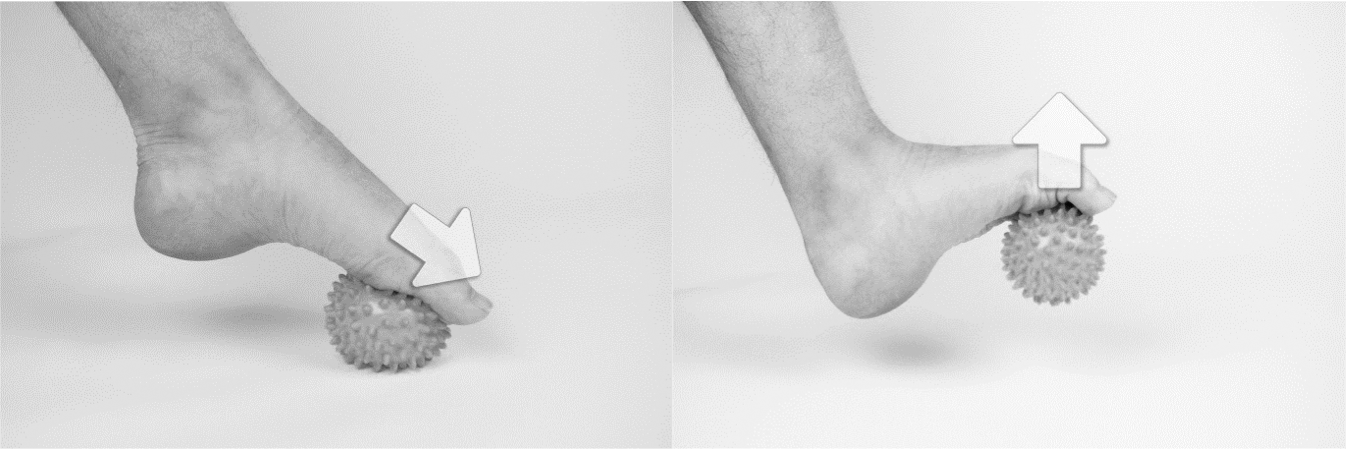
After initial pressure measurements were taken each participant was given an exercise ball measuring 70 mm in diameter. Each ball was inflated to the same pressure (8.5 psi). Instructions on performing the exercises were given to each individual participant, which was backed up with an instruction sheet (
Fig. 1) and a diary for the participant to refer to in the exercise period. Participants were asked to perform the exercise using the identified dominant limb every day for 5 min. Participants were asked to perform the exercise in a seated position with the knee and ankle flexed at 90° and the ball placed under toes 2 to 4. Gripping motion around the ball was instructed to be performed using all of the toe digits 1 to 5. Progress was recorded on the diary sheet to assess compliance with the program. After 4 weeks the participants returned to repeat the pressure tests described. Preexercise and postexercise results were then evaluated.
Figure 1.
Use of a spiky ball while performing an active flexion grip of the intrinsic foot muscles. (Reprinted with permission from Healthystep ©
http://www.healthystep.co.uk.)
Figure 1.
Use of a spiky ball while performing an active flexion grip of the intrinsic foot muscles. (Reprinted with permission from Healthystep ©
http://www.healthystep.co.uk.)
Data Processing
Data from the seated maximal flexion test were averaged, and the mean preexercise and postexercise data were calculated and extracted for peak pressure, length of time spent at peak pressure, and pressure-time integral.
Dynamic gait plantar pressure was extracted and analyzed to gain average data from the eight steps defined for the masked regions consisting of metatarsal heads 1 to 5 and the apices of toes 1-4/5. Peak force contact area and contact time were calculated for each region before and after exercise.
All of the pressure data, seated and dynamic, were then statistically tested using a two-tailed paired-samples t test. Significance was set at a confidence level of 95% (P < .05) (IBM SPSS Statistics for Windows, version 21.0; IBM Corp, Armonk, New York), and the tests were completed to assess for differences before and after the exercise intervention for each outcome measured.
Results
Static Seated Maximum Digital Flexion
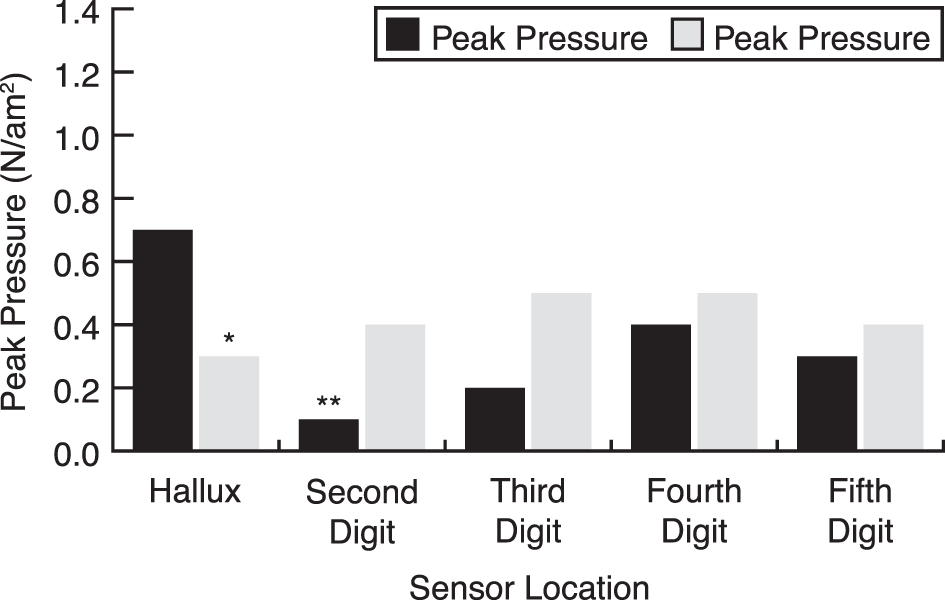
Digital apical pressure while seated showed an increase in peak pressure after exercises in lesser digits 2 to 5. The peak pressure on the hallux reduced after the exercise intervention. Statistical significance was seen in lesser digits 2 (
P = .003) and 3 (
P = .001) (
Fig. 2).
Figure 2.
Mean ± SD peak pressures for the apical sensors placed from the hallux to the fifth digit before and after the exercise intervention. Asterisk indicates a statistically significant P value of 0.003. Double asterisk indicates a statistically significiant P value of 0.001.
Figure 2.
Mean ± SD peak pressures for the apical sensors placed from the hallux to the fifth digit before and after the exercise intervention. Asterisk indicates a statistically significant P value of 0.003. Double asterisk indicates a statistically significiant P value of 0.001.
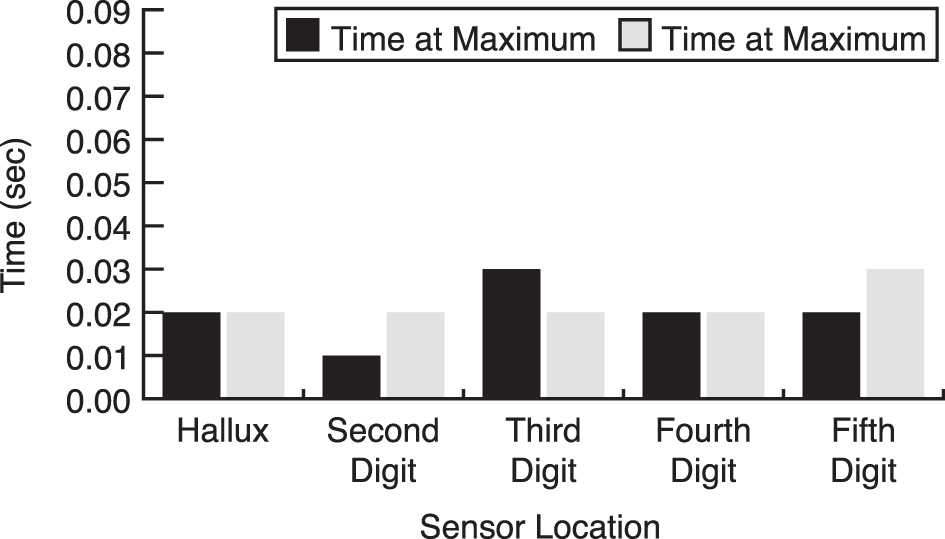
The amount of time spent at peak pressure, while seated, did not systematically increase after the exercises were completed except for the fifth digit, where an increase in time at peak pressure was observed (
Fig. 3). The third digit, after exercise, had reduced time at mean peak pressure.
Figure 3.
Mean ± SD time at peak pressures for the apical sensors placed from the hallux to the fifth digit before and after the exercise intervention.
Figure 3.
Mean ± SD time at peak pressures for the apical sensors placed from the hallux to the fifth digit before and after the exercise intervention.
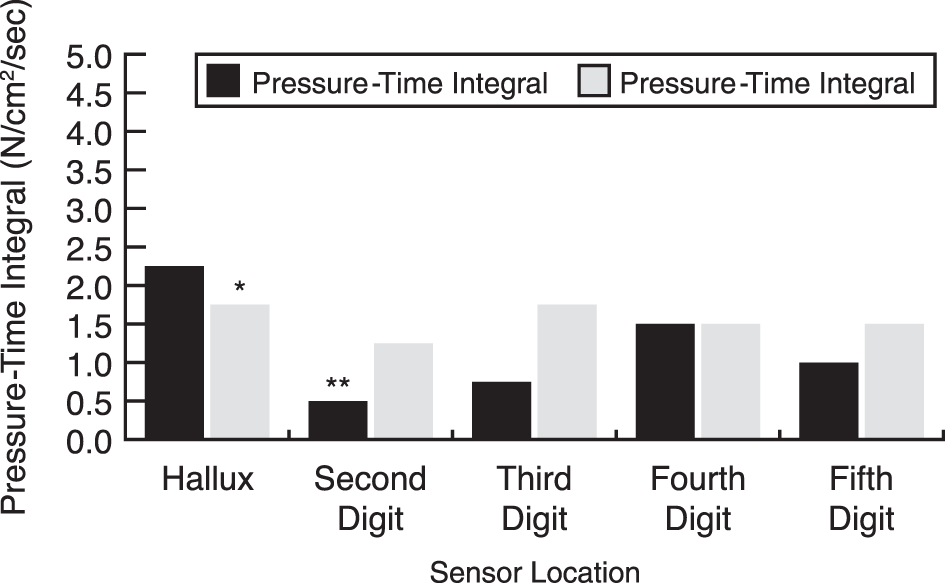
Pressure-time integral varied among the digits, with an increase seen at the second, third, and fifth digits; a reduced reading at the first digit; and no change recorded after exercises at the fourth digit (
Fig. 4). Significant increases in pressure-time integral were measured at the second (
P = 0.03) and third (
P = .001) digits.
Figure 4.
Mean ± SD pressure-time integrals for the apical sensors placed from the hallux to the fifth digit before and after the exercise intervention. Asterisk indicates a statistically significant P value of 0.03. Double asterisk indicates a statistically significiant P value of 0.01.
Figure 4.
Mean ± SD pressure-time integrals for the apical sensors placed from the hallux to the fifth digit before and after the exercise intervention. Asterisk indicates a statistically significant P value of 0.03. Double asterisk indicates a statistically significiant P value of 0.01.
Dynamic Plantar Pressure
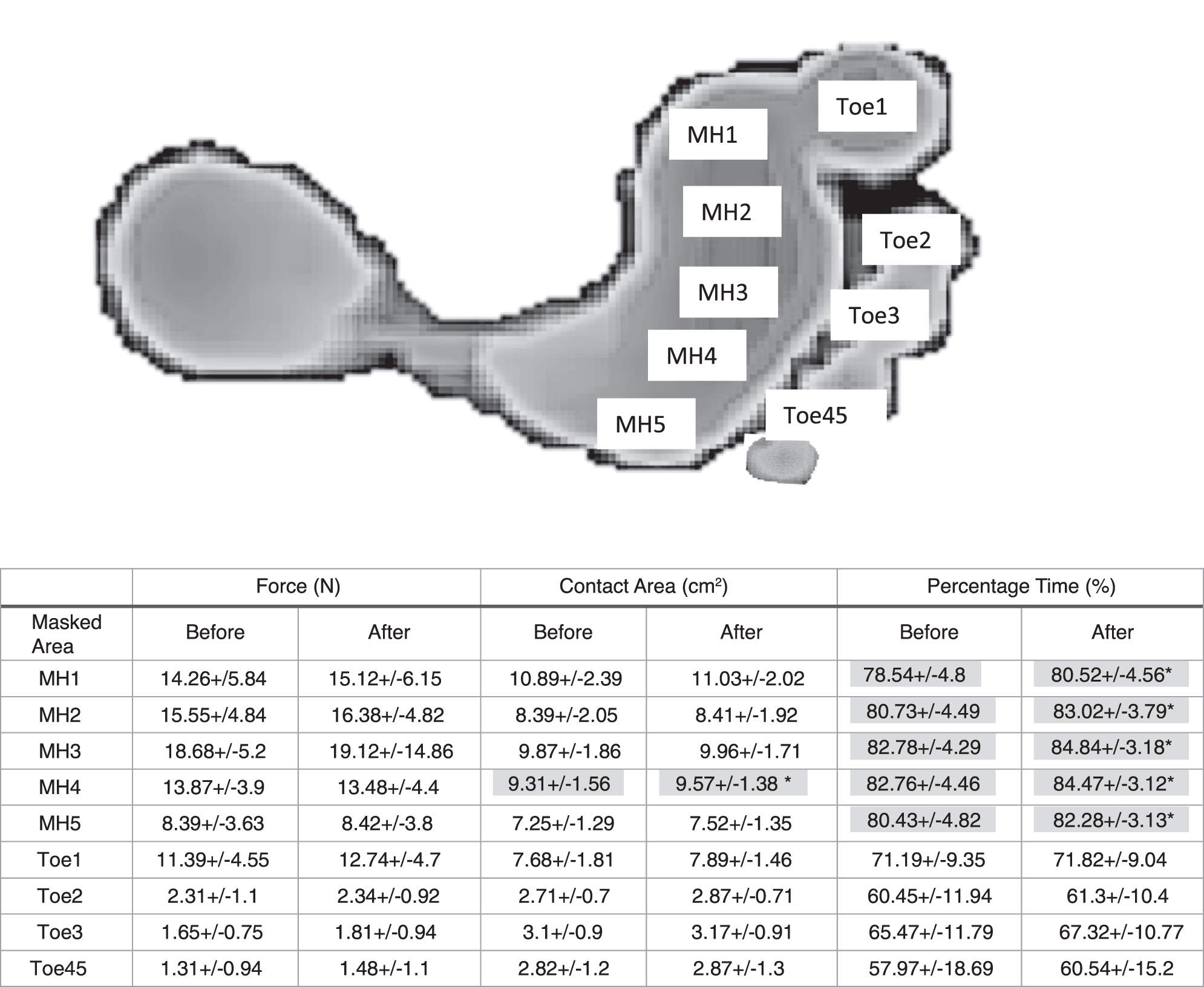
Dynamic walking did not significantly change after the exercise intervention. There was no change in the peak force produced in all masked regions after the exercise intervention. There was, however, a significant increase in contact area around the fourth metatarsal (
P = .04) and a systematic increase in the contact area on all other masked regions (
Fig. 5).
Figure 5.
Plantar pressure data for each of the masked regions of the metatarsals and digits identified on the plantar pressure scan before and after the exercise intervention. Statistical difference identified with shading and *P > .05. MH indicates metatarsal head.
Figure 5.
Plantar pressure data for each of the masked regions of the metatarsals and digits identified on the plantar pressure scan before and after the exercise intervention. Statistical difference identified with shading and *P > .05. MH indicates metatarsal head.
The percentage times for all of the metatarsal regions significantly increase after the exercises; this was not observed in the digits with minimal changes occurring in percentage contact time after exercise (
Fig. 2).
Discussion
Toe grip exercises improve the capability of the second and third toes to increase the amount of peak plantar pressure and pressure-time integral placed on the apices of the toes in a static seated position. This improvement may be due to the anatomical position of the flexor digitorum longus muscle, which inserts into the apices of toes 2 to 5.[
19] Similarly, it has been suggested that there is a connecting slip from the flexor hallucis longus tendon to the second and third flexor digitorum tendons[
20] possibly assisting in function, allowing for a mechanical advantage over the fourth and fifth digits. This anatomical variation could support the significant effect seen for the second and third toes compared with the fourth and fifth as it is possible that the action of gripping the toes has some support by recruiting the flexor hallucis muscle. This anatomical anomaly could also be used to explain why the hallux had a reduced amount of peak pressure after exercise, as the recruitment of flexor hallucis longus is altered. The toe grip exercises encourage flexion of lesser digits 2 to 5, but because the second and third digits are anatomically positioned in the middle of all of the digits, the increased pressure recordings observed could be attributed to these two digits being dominant in the gripping exercise. Attention to technique and ball position is recommended on clinical intervention to maximize the outcomes. Similarly, attention should also be given to patients who have hallux pathology because completing the exercise seems to reduce apical pressure in the first digit. Further anatomical studies focused on variation of muscle architecture and function during grip are warranted to support and rationalize these results.
The second toe has been shown to be the most frequent location for end-stage pathology.[
7] The use of grip exercises in a nonpathological toe before the end-stage deformity occurring could improve the overall control and function of the toe flexors of the foot. Improving the ability of the toes to flex has already been associated with increased athletic capabilities[
13] and reduced risks of falling.[
9] Introducing simple toe grip exercises as part of a management plan for weak toe flexors could possibly improve dynamic function during gait.
During gait there were a few statistically significant changes after the intervention of the grip exercises. These changes were evident in maximum plantar force and contact area of the selected regions. Although there was a significant increase in area under the fourth metatarsal, there was equally a systematic increase in the area under the other metatarsals. It is unclear what caused this effect. However, the anatomical variations[
19,
20] could alter the mechanics of the forefoot during loading by increasing the contact area under the fourth metatarsal as the second and third metatarsals are dorsiflexed from improved second and third digital grip. It is interesting that there were significant changes in the percentage contact time of all of the metatarsal heads after completing the exercises, suggesting that toe grip exercises cause the forefoot to be in contact with the ground for longer during gait. The clinical implication of this should be considered individually because in some patient groups it may not be a desired outcome to increase contact time at the forefoot.
Temporal parameters during gait have been associated with the effectiveness of other lower-limb therapies, including orthoses.[
21] Altering the percentage contact timing of the selected regions suggests that the muscle activation has also been changed. Although this study did not look specifically at the electromyographic muscle function, by actively exercising the toes with flexion exercises it can be assumed that the digital toe flexor muscles were strengthened, which, in turn, increased the percentage of time the metatarsals were in contact with the ground. Previous work has shown that during obstacle training in an elderly population, the plantar contact time is altered, indicating improved stability and more efficient gait.[
22] The metatarsal area was not isolated in this study and instead the whole foot was assessed. By reporting the effect of timings as a percentage of gait, this study is able to isolate the impact that the intervention had on a specific masked region, expanding our understanding of the role the forefoot plays during gait. By initiating contact with the metatarsals for a longer time during gait, toe grip exercises could improve stability and make gait more efficient.
None of the participants recruited for this study had any clinically diagnosed toe pathologies. It has been suggested that toe deformities are progressive and that the rigid end-stage arthritic deformity has limited function.[
23] By exploring the effects of toe grip exercises on a group with no toe deformities, this study provides baseline data. It is possible that including participants with some pathologic disorder might have given different results, as the progression of joint disease could alter muscle function. Further research using the grip exercises on a group of individuals with pain in the digits related to toe dysfunction is warranted to explore the clinical application of this exercise regimen.
This study was limited by a small sample size, but significance was seen in some of the tested variables. Where significance was not reported, the limitations were around a large standard deviation for the measured outcome, suggesting that there was increased variability among the individuals recruited. Similarly, for some of the outcomes recorded, an increase was observed that bordered on significance, indicating that recruitment of a larger sample would have indicated significance. Furthermore, the clinical application of this exercise regimen should be advanced to evaluate the response of toe grip exercises on a group of patients with toe pain and pathology.
Conclusions
Implementing a course of toe flexor grip exercises using an exercise ball can improve the function of the lesser toes, specifically the second and third digits. The toe grip exercises alter the percentage contact time of the metatarsals, improving stability and gait efficiency. Further work should now be conducted on individuals who have toe abnormalities associated with toe flexor weakness to assess the clinical impact of toe grip–strengthening exercises.