A schwannoma, or neurilemmoma, is a benign tumor originating from the Schwann cells of the peripheral nervous system that give rise to the myelin sheath around the axon.[
1] As a consequence of their origin, these tumors have the ability to occur throughout the body and usually affect the soft tissues.[
2] There are, however, several cases in the literature that report the involvement of schwannomas in osseous structures.[
3-
5] Schwannomas may occur in superficial or deep nerves. However, those affecting the deep nerves have been found to hold a predilection for female subjects.[
6] Although most common between the ages of 20 and 50 years, there have been reports of schwannomas in individuals aged 1 to 61 years.[
6]
Schwannomas have the usual clinical presentation of a painless mass; however, the presence of the tumor can put pressure on surrounding structures, resulting in pain.[
7] This is most apparent in schwannomas within the tarsal tunnel.[
8] Whereas these masses are typically solitary, a clinical presentation of multiple schwannomas is usually indicative of neurofibromatosis type 2 and schwannomatosis.[
9]
Aside from clinical presentation, several tools are available for surgical planning and diagnosis of a schwannoma. Magnetic resonance imaging and sonography have proven to be useful in determining the relative extent or involvement of the surrounding tissues.[
10,
11] It should be noted, however, that a definitive diagnosis requires clinical findings, medical imaging, and histopathology.
The ultimate treatment of a schwannoma is surgical excision. After surgical excision, a histopathologic analysis should be performed to confirm the diagnosis and to rule out malignancy.[
1,
7,
12] The risks of surgical removal include the loss of sensory or motor function of the nerve. The benefits, however, are that it is usually curative and has a low recurrence rate if the resection is complete.[
3] Incomplete resection of the soft-tissue mass has resulted in a recurrence rate of less than 5%.[
8] Histopathologic analysis of schwannomas shows benign-appearing spindle cells distributed in two main zones: the Antoni A zone and the Antoni B zone. The diffuse presence of S100 protein in immunohistochemical staining is consistent with the diagnosis of a schwannoma.
In this case report, we describe the unusual presentation of a schwannoma on the dorsolateral aspect of the foot. The location of the schwannoma made this case particularly difficult to diagnose.
Case Report
A 51-year-old man presented with a 5-year history of a slow-growing soft-tissue mass on his right foot. He reported moderate to severe sharp pain on compression of the mass. On physical examination, a soft, cystic, firm mass was detected approximately 1 cm proximal to the head of the fifth metatarsal. No neurologic deficits were noted. Nonsymptomatic hallux valgus and tailor's bunion deformities were also noted, but were unrelated to the chief complaint. His physical examination was otherwise unremarkable. Ultrasonography of the right foot showed a well-circumscribed 1.0 × 0.5 × 1.0-cm hypoechoic subcutaneous soft-tissue mass adjacent to the fifth metatarsal, with peripheral and moderate internal vascularity.
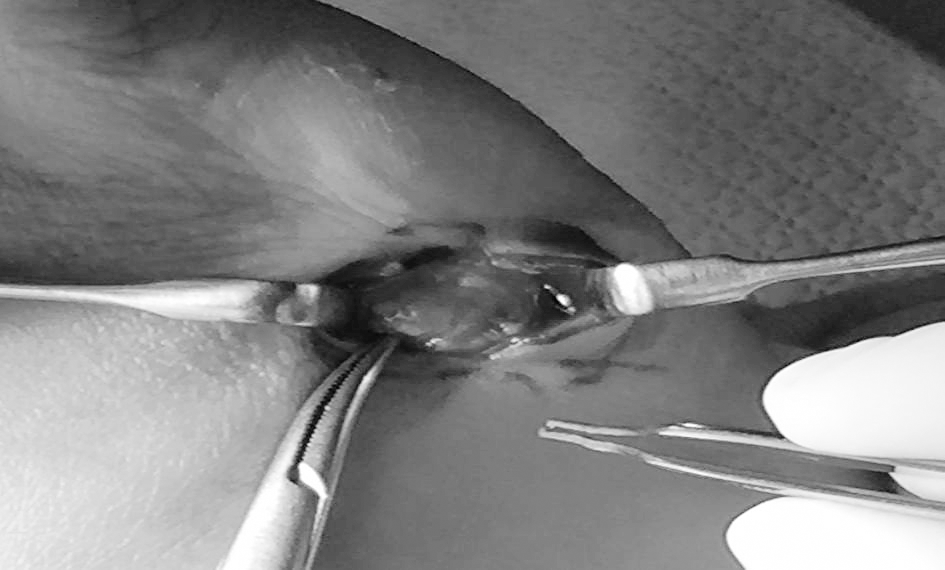
Surgical excision of the soft-tissue mass was performed (
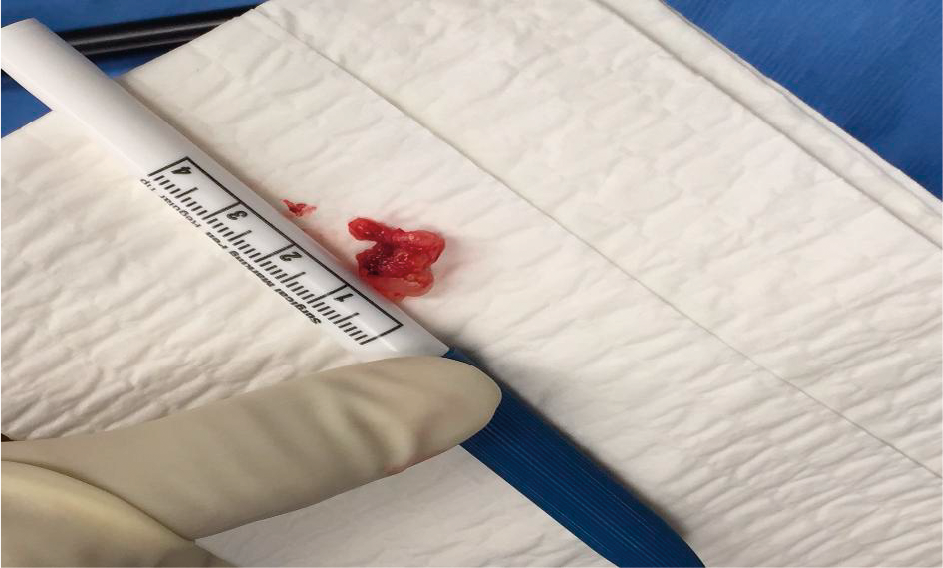
Fig. 1). On removal, the mass was noted to be pedunculated, yellow-tan in color, hemorrhagic, and well encapsulated, with no evidence of joint fluid in or around the mass (
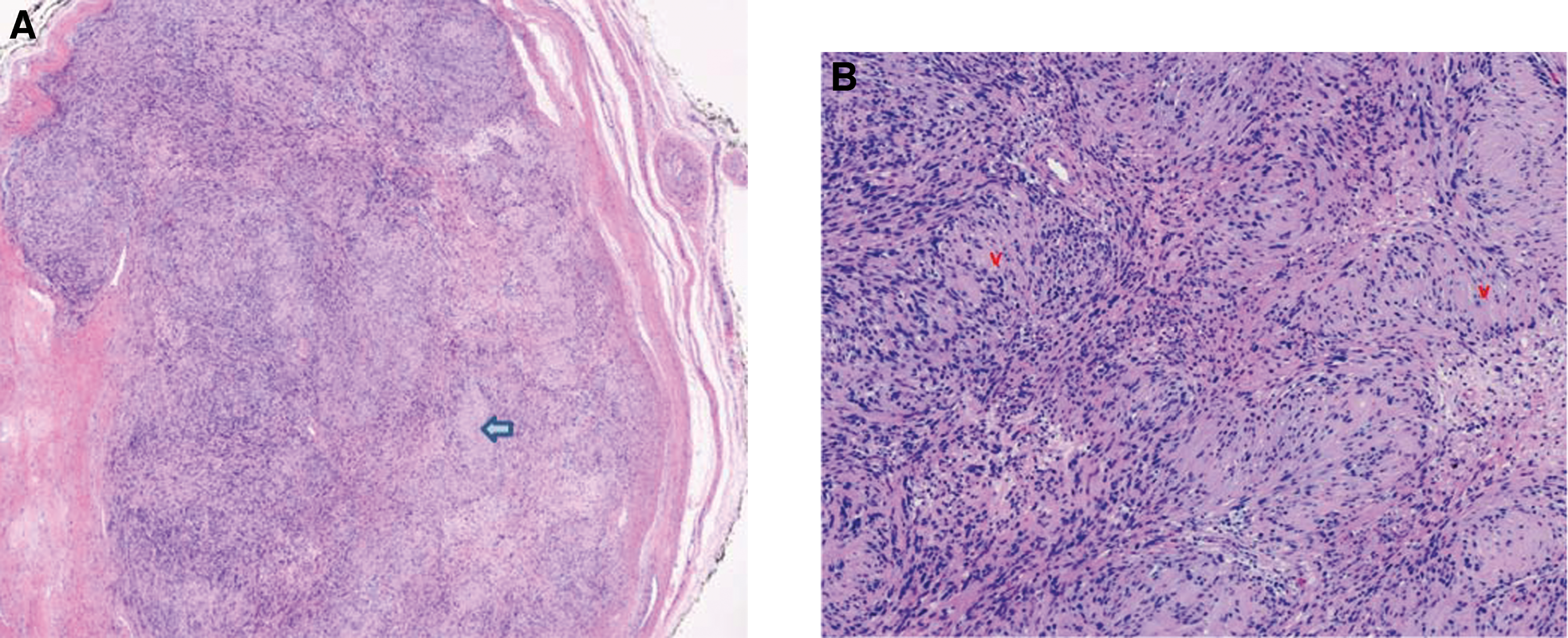
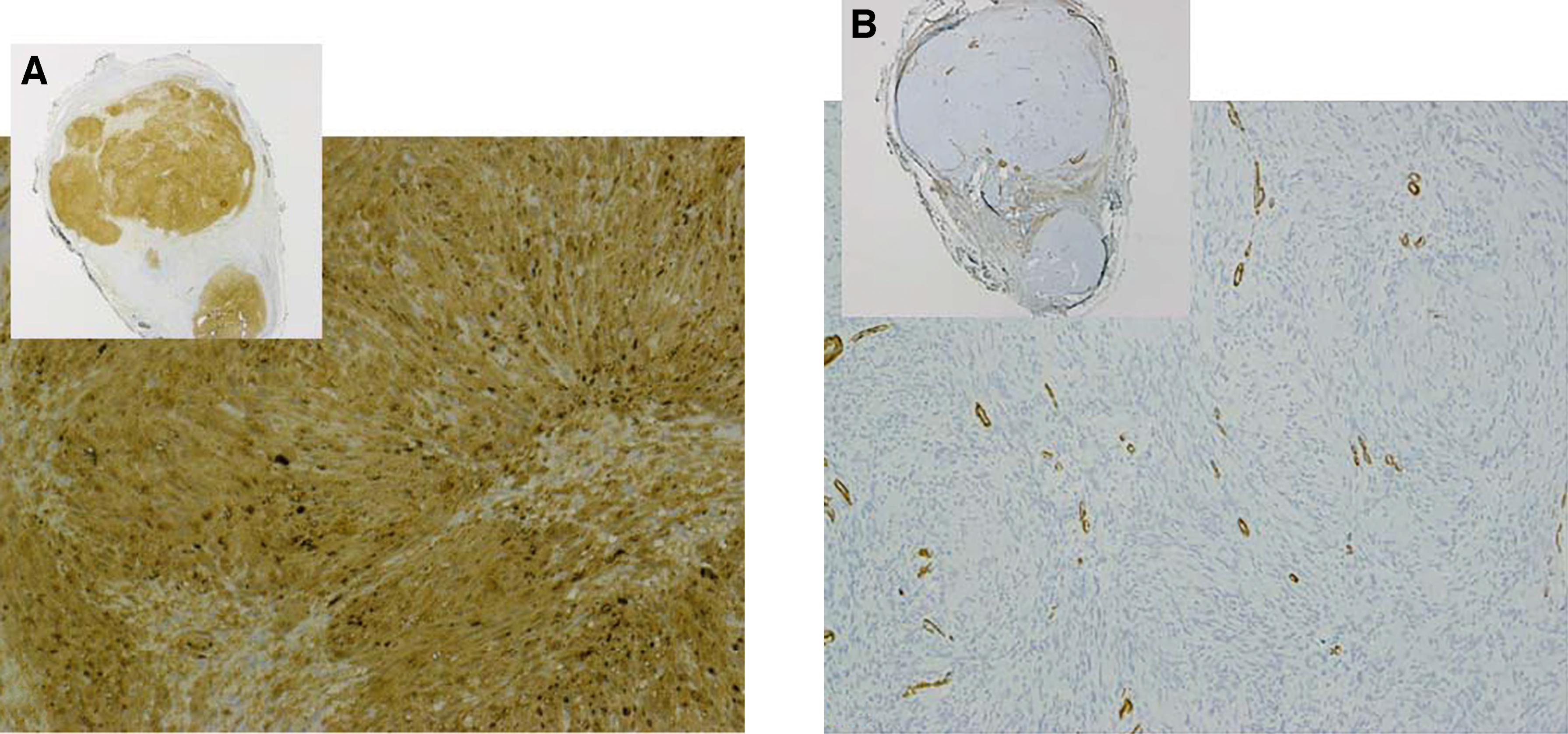
Fig. 2). Histopathologic analysis was positive for S100 and negative for smooth muscle actin; additional histologic features that are characteristic for a schwannoma were appreciated (
Figs. 3 and
4).
Figure 1.
Intraoperative excision of mass.
Figure 1.
Intraoperative excision of mass.
Figure 2.
Schwannoma specimen.
Figure 2.
Schwannoma specimen.
Figure 3.
A, Schwannoma: an encapsulated nerve sheath tumor composed of a denser cellular area (Antoni A) and a myxoid, less cellular area (Antoni B, arrow). B, Characteristic palisading nuclei around an acellular area can be seen (Verocay bodies (V)).
Figure 3.
A, Schwannoma: an encapsulated nerve sheath tumor composed of a denser cellular area (Antoni A) and a myxoid, less cellular area (Antoni B, arrow). B, Characteristic palisading nuclei around an acellular area can be seen (Verocay bodies (V)).
Figure 4.
Diffusely positive staining with S100 (A) and the negative staining of the lesional cells with smooth muscle actin (B) confirmed the morphologic impression. The smooth muscle actin staining in this image highlights the muscular vessel walls.
Figure 4.
Diffusely positive staining with S100 (A) and the negative staining of the lesional cells with smooth muscle actin (B) confirmed the morphologic impression. The smooth muscle actin staining in this image highlights the muscular vessel walls.
Discussion
Within the current literature, many have noted the incidence of a schwannoma in the foot and ankle to be less than 10%, with these tumors most commonly occurring in the tarsal tunnel.[
7,
8,
12] Our case is unusual in that the schwannoma presented on the dorsolateral aspect of the foot, with no neurologic abnormalities, making the diagnosis a less likely initial consideration.
Soto et al[
11] reported an unusual presentation of a schwannoma that was located in the ungual bed of the left great toe of a 51-year-old woman. In the article, the authors used color Doppler ultrasonography to reveal slow-flow arterial vessels in the periphery. Unlike the findings of Soto et al, ultrasonography of our patient revealed not only peripheral vascularity, but also moderate internal vascularity. Internal vascularity often suggests a neoplastic process as opposed to a benign one.
To rule out a malignant condition, specimens were submitted to pathologic examination after surgical excision for gross dissection, sectioning, and immunohistochemical staining. Consistent with other findings in the current literature, S100 immunohistochemical staining confirmed the diagnosis of a schwannoma and therefore a benign pathology (
Fig. 4).[
11] An encapsulated nerve sheath tumor with both dense cellular areas (Antoni A) and myxoid areas (Antoni B) was appreciated with the presence of palisading nuclei surrounding an acellular region collectively confirmed to be Verocay bodies as demonstrated in
Figure 3. All histopathologic findings and immunohistochemical staining were consistent with the diagnosis of a schwannoma and therefore a benign lesion.
Conclusions
A schwannoma is a benign, encapsulated, slow-growing soft-tissue tumor originating from the Schwann cells of peripheral nerves.[
8,
12] A schwannoma located on the foot and ankle has an incidence of less than 10% and occurs mainly in the fifth decade of life.[
12] A single schwannoma usually is benign, whereas multiple schwannomas can indicate an underlying syndrome such as neurofibromatosis type I or type II or schwannomatosis. Less than 1% of schwannomas become malignant.[
7] Surgical management is the definitive treatment, with a low recurrence rate. We present a 51-year-old man with a schwannoma occurring at a rare location, the dorsolateral aspect of the foot, with ultrasonography displaying an unusual vascularity pattern for a benign lesion.