Tarsal coalition is an uncommon condition in which there is biological aggregation of two or more tarsal bones. This joining may be fibrous (syndesmosis), cartilaginous (synchondrosis), or osseous (synostosis) [
1]. This phenomenon is historically reported to have a prevalence of 1% in the population [
2]. However, this is believed to be an underestimate because only symptomatic cases come to attention [
3]. Indeed, cadaveric studies have suggested an incidence of up to 13% [
4,
5].
Coalitions most commonly present in late childhood or adolescence [
1]. This is suggested to be due to ossification of coalitions between 8 and 16 years of age, leading to restricted motion [
3]. Twenty-five percent to 50% of cases are bilateral, although both sides are not always symptomatic [
6].
Etiology can be congenital or acquired. Congenital disease is believed to be caused by failure of mesenchymal differentiation and segmentation, with failure of normal tarsal joint formation [
7]. Coalitions are thought to be inherited in a unifactorial, autosomal dominant pattern with variable penetrance [
4]. Acquired disease can arise from inflammatory arthritis, infection, trauma, neoplasm, and other causes [
8,
9].
Clinically, coalitions can cause hindfoot pain, stiffness, decreased subtalar motion, valgus deformity, and nonhealing ankle sprains [
10,
11]. They may also present as peroneal spastic flatfoot, rigid flatfoot attributed to peroneal spasm, or adaptive peroneal shortening in response to heel valgus.
Ideal imaging modalities for investigation depend on the type of fusion. However, an escalating sequence of radiography, computed tomography, and magnetic resonance imaging (MRI) should be used depending on clinical suspicion until the diagnosis is reached.
Management of coalitions may be conservative or surgical, with the goal of analgesia and improved function. Conservative options include arch supports, physiotherapy, short-leg walking casts, activity modification, and anti-inflammatory medications [
1]. Surgical management involves resection of abnormal tissues or primary arthrodesis [
5].
In Europe and the United States, talocalcaneal and calcaneonavicular coalition are the most common [
4,
12]. One review found that these two variants accounted for 90% of cases (53% calcaneonavicular and 37% talocalcaneal) [
4]. Other forms, including talonavicular, calcaneocuboid, naviculocuneiform, naviculocuboid, cuneometatarsal, and metatarsocuboid coalitions, have been published but are uncommon [
2,
13-
15]. Extensive fusions of the hindfoot are rare and usually associated with congenital syndromes such as fibular hemimelia and Alpert syndrome [
16].
Isolated cuboid-lateral cuneiform coalition is extremely rare and, to our knowledge, has not been reported in the orthopedic literature. We present a case in which investigations of a patient presenting with severe foot pain and restricted movements revealed this unusual coalition as a cause.
Case Report
A 40-year-old woman presented to an elective foot and ankle clinic with a 1-year history of left foot pain that had intensified during the previous 6 months with pain on walking. She reported an ability to walk for only 10 min continuously before experiencing left foot pain and swelling. She also had increased stiffness in her foot. There was no history of trauma. The patient was otherwise fit and well. She took no regular medications and had no relevant family history.
On examination she was noted to have a pes planus deformity in her foot and was thought to be inherently minimizing overload in the lateral aspect of her foot. There was a reduction in hindfoot movement, with the left having 50% compared with the right. There was tenderness over the talonavicular joint with a palpable lump.
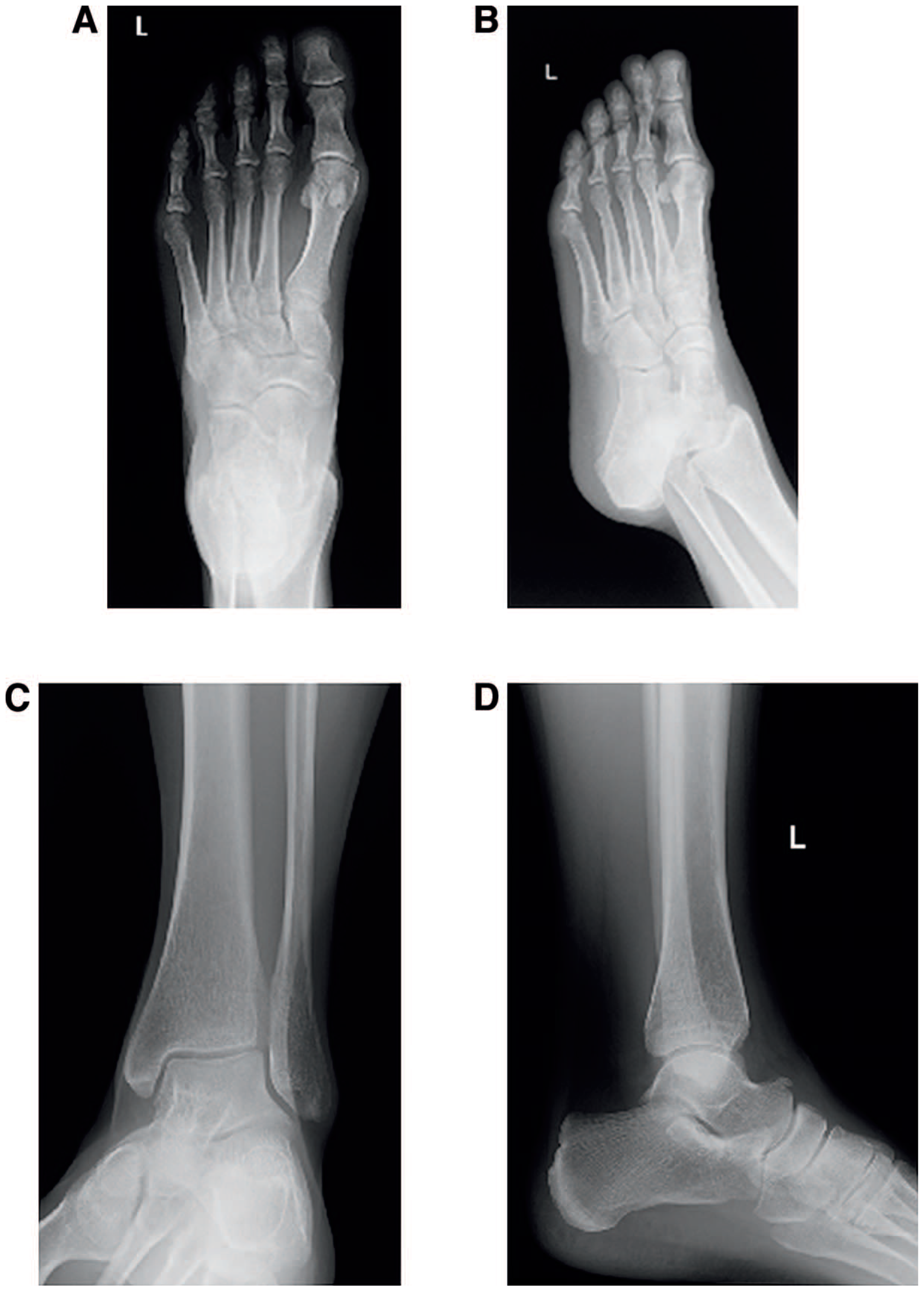
A radiograph of the foot and ankle (
Fig. 1) revealed anterior new bone formation with a beak on the anterosuperior surface of the talus. There was no associated joint abnormality at the talonavicular joint. The report also stated that there was mild joint space loss at the first metatarsophalangeal joint consistent with early degenerative change, but there was no evidence of erosions or other articular abnormality.
Figure 1.
Anteroposterior (A) and oblique (B) radiographs of the left foot and anteroposterior (C) and lateral (D) radiographs of the left ankle.
Figure 1.
Anteroposterior (A) and oblique (B) radiographs of the left foot and anteroposterior (C) and lateral (D) radiographs of the left ankle.
An ultrasound of the region was reported as showing an unremarkable talotibial joint but a prominent anterior beak on the talus, which can be associated with a subtalar coalition. Moderate degenerative change in the region of the fourth tarsometatarsal joint with substantial soft-tissue inflammatory change and synovitis around this region were also noted. The calcaneocuboid, talonavicular, and remaining metatarsophalangeal joints appeared normal. The Achilles, peroneal, posteromedial, and anterior tendons were unremarkable.
Based on the radiographic and ultrasound reports, a talocalcaneal coalition was strongly suspected. An MRI of her foot was scheduled. While awaiting this, the patient was advised to wear good-fitting shoes with rigid soles and shoes that extend above the ankle to provide support.
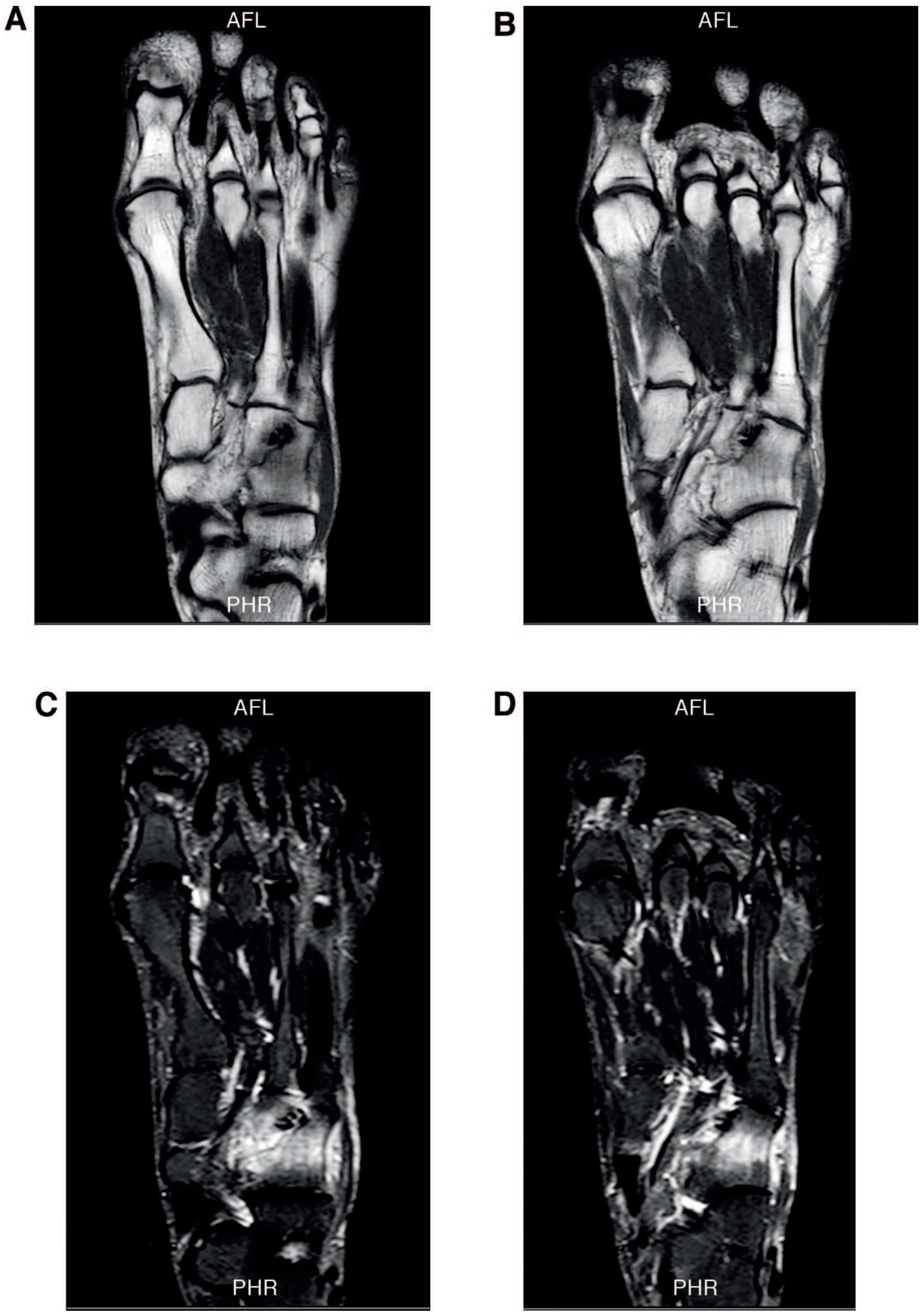
The MRI demonstrated coalition of the cuboid and the lateral cuneiform (
Fig. 2). The images showed narrowing of the joint space, an irregular bone interface, and substantial marrow edema in both bones. On further review it was noted that the coalition expressed low signal on T1-weighted images and high signal on T2-weighted images. These findings suggest that the coalition was cartilaginous in nature (a synchondrosis rather than a syndesmosis or synostosis) [
1]. As with the ultrasound, osteophytic beaking was noted on the anterosuperior aspect of the talus. The MRI also detected fluid in the adjacent synovium above the cuboid as well as small effusions in the third and fourth tarsometatarsal joints.
Figure 2.
T1-weighted (A and B) and T2-weighted (C and D) magnetic resonance images of the left foot showing cuboid-lateral cuneiform coalition.
Figure 2.
T1-weighted (A and B) and T2-weighted (C and D) magnetic resonance images of the left foot showing cuboid-lateral cuneiform coalition.
The findings of the cuboid-lateral cuneiform coalition were deemed to be the cause of her pain and hindfoot stiffness. She was managed with an aircast boot to offload the foot and was referred for physiotherapy. She was also referred for ultrasound-guided hydrocortisone injection into the area of the pseudoarthrosis.
Three weeks after this procedure she was once again reviewed in the clinic. She responded well to the management measures. She was advised to gradually wean herself off the aircast boot and commence physiotherapy. An overall biomechanical assessment and formal rehabilitation was recommended. She was subsequently discharged from the foot and ankle service with a long-term plan to consider repeated corticosteroid injections or surgical fusion of the cuboid and lateral cuneiform should the problem persist.
Four months after she was discharged from the clinic she presented to our foot and ankle service with foot discoloration. She reported almost full range of movement in her foot, with no tenderness. On examination there was noted to be skin discoloration with thread veins over the injection site. This was attributed to leakage of corticosteroid, which is common in this area with very little fat. She was reassured and followed up 1 year after her initial consultation. She remained well, with full mobility and no stiffness in her foot. She required no ongoing treatment for her coalition.
Discussion
The present patient had an isolated cuboid-lateral cuneiform coalition, a condition that has not been reported in the literature to date. Indeed, as a cohort, tarsal coalitions represent a poorly identified phenomenon. Because medical professionals generally have a poor understanding of these conditions, delays in diagnosis and treatment are common.
Patients will see a primary-care practitioner, emergency department physician, or junior orthopedic surgeon as their first point of care, and because these practitioners may have never seen a case in their training, they are unlikely to investigate patients with this condition in mind. Tarsal coalitions must be better understood by these doctors and need to be considered in the differential diagnosis of atraumatic foot pain, stiffness, and decreased range of motion at any age.
This patient had direct access to an expert foot and ankle surgeon, which vastly improved her chances of a prompt and accurate diagnosis. The etiology of her coalition was thoroughly debated. Because the cuboid-lateral cuneiform articulation is normally immobile, her condition was thought to be a long-standing issue that had recently become symptomatic.
Similar to most individuals with a symptomatic tarsal coalition, she presented with foot pain, stiffness, deformity, and a reduction in range of motion. Her management followed a standard course. She was investigated with a stepwise radiologic algorithm using radiographs followed by ultrasound, with conclusive diagnosis being achieved with MRI. This patient responded well to nonoperative management with an aircast boot, hydrocortisone injection, and physiotherapy.