The pathology that is usually present in the medial heel region has traditionally been known as plantar fasciitis. However, recently, the term
plantar fasciosis has been used to dismiss the inflammatory component and emphasize the degenerative nature that is observed histologically in the insertion zone in the calcaneus [
1]. Regardless of its inflammatory or degenerative nature, this pathology is usually described as heel pain in the medial calcaneal tuberosity [
2]. It is estimated that 1 in 10 people may experience heel pain at some point in their lives [
3]. Up to one third of cases may be bilateral [
4] and are usually observed in patients of working age, between 40 and 60 years old, patients with intense physical activity, or in patients whose body mass index is >30 kg/m
2 [
4-
7].
The most common initial treatment includes the use of analgesics, stretching exercises, and rest. However, in cases where conservative treatment is ineffective, infiltration with intralesional steroids is often used. This procedure is usually effective in patients with acute pain but produces only short-term pain relief [
8]. Customarily, these treatments are accompanied by exercises for stretching the gastrocnemius and soleus muscles and the plantar fascia itself [
2,
9]. One of the most used treatment methods is infiltration with steroids, which relieves the pain rapidly, and reports have demonstrated its effectiveness for treating plantar fasciitis [
2]. However, complications have also been described with its use, such as application site infections, heel fat pad atrophy, and plantar fascia rupture. Although the rupture of the fascia may help to resolve the pain, it usually affects the biomechanics of the foot [
10,
11].
Recently, platelet-rich plasma (PRP) has been used as a therapeutic alternative for obtaining relief and resolution of symptoms. There are various modalities of PRP preparation, which result in greater or lesser concentrations of leukocytes according to the number of centrifugations used and the revolution velocity employed. There are currently several trademarked products on the market that can be used. The biotechnology now in use has reportedly been successfully used for muscle and tendon injuries [
12]. Additionally, its safety and potential for reducing pain has previously been proven in patients with plantar fasciitis [
13,
14].
In its simplest definition, PRP is a blood derivative with a higher number of platelets than those found in peripheral blood [
15]. Currently, PRP can be obtained through a process of two-phase centrifugation known as plasmapheresis in which the liquid and solid components of the anticoagulated blood are separated. The first phase is carried out at a lower centrifugation speed (1,200–1,500 rpm), and it separates the plasma and platelets from the white and red cells. The second phase is performed at a higher centrifugation speed (4,000–7,000 rpm) to increase the concentrations of PRP and platelet-poor plasma [
15]. The PRP formulation may vary in cellular content, which may influence its effects on tissue healing. Thus, two principal types of PRP are produced: leukocyte-rich PRP (LR-PRP), which includes white blood cells, and leukocyte-poor PRP (LP-PRP), which contains a minimal amount of white blood cells. The increase in the number of platelets is also a variable in these samples [
12]. The white cells, as well as monocytes and neutrophils, can trigger localized inflammatory effects. These effects may suggest that these cells are critical to the repair process; however, some reports have found that neutrophils may impede healing [
16].
Once the PRP is obtained, it can be applied with an activating agent, such as thrombin, gluconate, or calcium chloride, to release growth factors rapidly, or it can be infiltrated directly and thereby produce a slower release when activated by the collagen in the area [
17,
18].
In addition to the variations previously described, other patient factors, such as age and comorbidities, may also cause variations in the cellular content and the growth factors in the PRP [
19]. However, the optimal amount of platelets and growth factors required for the healing of tendons or muscles is not yet known. According to Marx [
20], clinical effectiveness was obtained with a concentration of at least four times that of the normal platelet concentration. However, efficacy studies have been performed with preparations of lower concentrations [
21,
22], including a study by Giusti et al [
23], who proposed that the most effective platelet concentration for stimulation of angiogenesis was 1.5 × 10
6 platelets per microliter in an in vitro study.
The objective of our study was to compare the use of intralesional steroids against intralesional PRP, using pain scales and functional evaluation, in patients with plantar fasciitis who did not respond to conservative treatment.
Patients and Methods
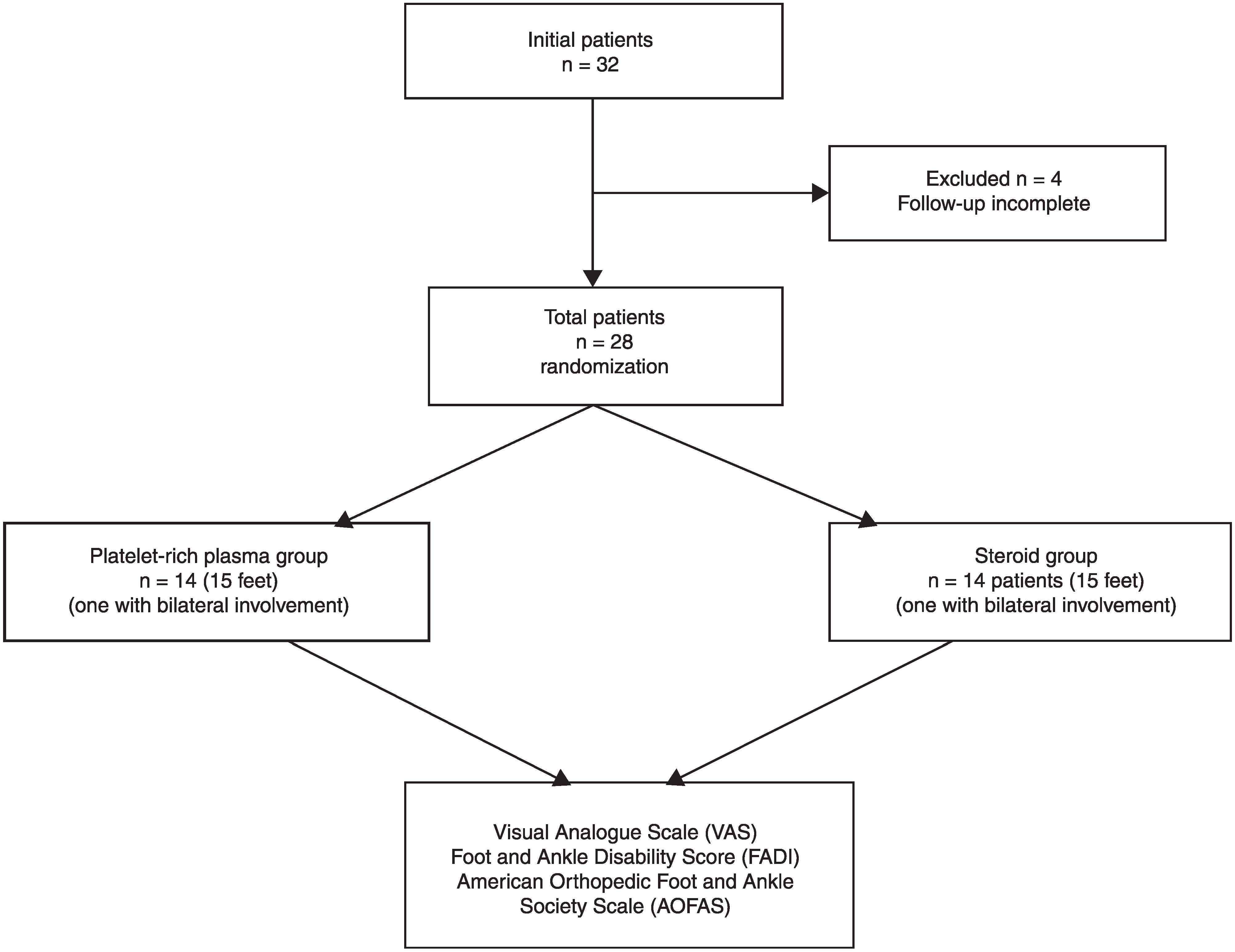
A controlled, randomized, blinded clinical assay was performed (
Fig. 1). All of the patients included in our study were diagnosed with plantar fasciitis in the outpatient clinic by the same orthopedist (J.E.R.). All of the patients underwent conventional radiographs of the foot and magnetic resonance imaging (MRI) to rule out stress fractures and associated bone lesions. The inclusion criteria consisted of skeletally mature patients with heel pain at the insertion of the plantar fascia (anterior-medial calcaneal tuberosity), failure of conservative treatment for 3 months (orthotics and nonsteroidal anti-inflammatory drugs, without stretching exercise), and no previous infiltrations. The exclusion criteria consisted of patients with associated pathologies, such as alterations in the ipsilateral ankle and knee, osteoarthritis, rheumatoid arthritis, ankylosing spondylitis, Reiter’s syndrome, neurological abnormalities, skin infections, or a history of infection at the application site in the previous 3 months. The ethics committee of our institution approved this study. All of the included patients were informed regarding their condition. Likewise, the purpose of the study was explained to them, and all agreed to participate by signing an informed consent form. Patients were assigned to one of the two groups in a randomized manner by selecting a sealed envelope. All procedures were applied by the same researcher (R.L.C.), who was blinded to the application through the use of covered syringes; further assessments were performed by another investigator (J.E.R.) blinded to the treatment.
Figure 1.
Flow chart of patient selection, randomization, treatment, and evaluation.
Figure 1.
Flow chart of patient selection, randomization, treatment, and evaluation.
Steroid Application
The steroid treatment group received 8 mg of dexamethasone (Alin Depot; Chinoin, Aguascalientes, Mexico) plus 2 mL of lidocaine as a local anesthetic. Asepsis of the heel region was performed with antiseptic sanitizer (Avagard; 3M, St. Paul, Minnesota) for 2 minutes. The drug was administered afterward by an infiltration in the anteromedial zone of the calcaneus (zone of greatest pain).
Preparation and Application of PRP
A 40-mL volume of whole blood was taken from the basilic or antecubital vein of the upper limb in sterile tubes and vacuum sealed with 3.8% sodium citrate as an anticoagulant (BD Vacutainer; Becton, Dickinson and Company, New Jersey). The samples were transported to the tissue engineering laboratory of the bone and tissue bank where they were centrifuged for 10 minutes at 1,800 rpm (Heraeus Megafuge 1.0R; Fisher Scientific, Waltham, Massachusetts) to separate the cellular parts corresponding to the erythrocytes and leukocytes. The upper plasma layer was removed from each of the tubes (taking care not to remove the buffy coat) and collected into a 50-mL sterile conical polypropylene tube (Falcon; Fisher Scientific, Corning, New York) for a second centrifugation step for 12 min at 3,400 rpm. The plasma supernatant, or platelet poor plasma (PPP), was removed, leaving a volume of 3 mL in which the platelets were resuspended. The 3 mL of PRP obtained was transferred to a sterile glass tube and vacuum sealed without anticoagulant (BD Vacutainer). An aliquot of the final PRP was sent to the laboratory to quantify the number of platelets. Manipulation of the samples was performed in a sterile environment within a class II biosafety cabinet (Logic 3440801; Labconco, Kansas City, Missouri). Prior to the administration of PRP to the patient, activation of the platelets was induced by adding 0.45 mL of 10% calcium gluconate and inverting the sample several times to ensure a homogeneous mixture. Then, the activated PRP was aspirated with a 5-mL syringe for application to the patient using the technique described above after asepsis and the application of 2 mL of lidocaine into the application site.
Analysis of Whole Blood and PRP Samples
Additionally, for all patients, a blood sample was obtained in a tube that contained EDTA as an anticoagulant (BD Vacutainer). An analysis of the baseline platelet content (in the whole blood) and the platelet content in each of the PRP samples that were generated was performed.
Post-Treatment Monitoring and Management of Patients
All of the patients were given an explanation and instructions for the exercise program, which consisted of stretching the plantar fascia with the patient seated while performing an extension of the toes with his or her hand, and crossing the affected leg on the opposite thigh. The patients were instructed to perform 10 repetitions of each exercise three times a day and to maintain the exercise for 10 sec during each repetition, according to DiGiovanni et al [
9].
All of the patients were evaluated at the beginning of the study (pretreatment) and at 2, 4, 8, 12, and 16 weeks post-treatment with the Visual Analog Scale (VAS) [
24], Foot and Ankle Disability Index (FADI) [
25], and American Orthopedic Foot and Ankle Society (AOFAS) scale [
26]. The VAS assesses the pain level by assigning a score from 0 to 10, with 0 representing no pain and 10 representing the worst pain level. The FADI scale assesses activities such as standing, walking on flat or uneven surfaces, walking on inclines, and the length of time of walking without difficulty. It also includes a section for sports activities and ankle or foot pain (or both). The highest score is 136 points, indicating the best clinical situation, free of pain and limitations, while the lowest score is 0. The AOFAS scale evaluates foot pain, function, and alignment. The best score is 100 and indicates wellness, while the lowest score is 0, indicating the worst possible condition of the patient.
Statistical Analysis
Using a formula to test hypothesis and two media difference, with a value of zα of 1.96 with significance level of 95 for two tails, and a value zβ of 1.24 with power 90, a sample of 13 participants for each of the groups was obtained. The results were reported in contingency tables, frequency tables, percentages, measures of central tendency and dispersion. Quantitative variables were analyzed with a Student t test for independent samples with a significance level of 95 with their respective confidence intervals. A P-value of <0.05 was considered statistically significant. Statistical analysis was performed with IBM SPSS version 20 (SPSS, Inc, Armonk, New York).
Results
Demographic data
We included a total of 32 patients divided into two groups of 16 patients each and excluded two patients in each group (four total) for not completing the follow-up. The final number of patients included was 28, which consisted of 14 patients in the steroid group (one patient with bilateral involvement) and 14 patients in the PRP group (one patient with bilateral involvement), with a total of 30 treated feet. The right foot was the most frequently affected foot (63%). The average age of the patients was 44.8 (range, 24–61) years, and 80% of the patients were female, while 20% were male. The patients did not experience any treatment-related complications in either group. The mean ± SD of the platelet number in the peripheral blood and PRP was 270.4 ± 71.1 × 10e3/μL and 678.8 ± 198.7 × 10e3/μL, respectively, meaning there were 2.5 times more platelets in PRP than in whole blood.
Visual Analog Scale
Before the infiltration, the pain experienced by the patients included in the steroid-treated group was more intense and showed statistical significance. During patient follow-up, an improvement in pain (decrease in the VAS score) was found in both groups. The difference was not statistically significant between the two groups. At the end of the study, the VAS value in the steroid group was 0.47 (± 1.3), while the value of the PRP group was 0.33 (± 0.72) (
Table 1).
Table 1.
Results of Visual Analog Scale.
Table 1.
Results of Visual Analog Scale.
Foot and Ankle Disability Index
During the initial evaluation, no statistically significant difference between the two groups was found for the FADI score. During follow-up consultations (2, 4, 8, 12, and 16 weeks), a progressive increase in the FADI score was observed in both groups of patients, reflecting clinical improvement. However, the difference in improvement between the two groups during the follow-up consultations was not statistically significant (
Table 2).
Table 2.
Results of Foot Ankle Disability Index (FADI).
Table 2.
Results of Foot Ankle Disability Index (FADI).
American Orthopedic Foot and Ankle Society Scale
At the beginning of the evaluation, no statistically significant differences between groups were presented. Throughout the evaluation period, clinical improvement in the patients was evident, but no significant difference between the two study groups was observed (
Table 3).
Table 3.
Results of AOFAS.
Table 3.
Results of AOFAS.
Discussion
In recent years, the use of PRP has increased in diverse clinical situations such as biological and autologous therapeutic alternatives. For the VAS, we found that at the beginning of the evaluation, the patients treated with steroids had significantly greater pain than those in the group that received PRP (
Table 1). However, during all subsequent evaluations, both groups presented improvement, and no differences between the groups were found at the end of the study. For the evaluation of the FADI and AOFAS functional ankle scales, at the beginning of the study both groups were similar, with no differences between them, and all patients improved throughout the duration of the study (
Tables 2–
3). At the end of the study, no significant differences were observed between the two groups. One of the key components for the treatment of the chronic plantar fasciitis involves fascia and gastroc-soleus complex stretching exercises, as described above by DiGiovanni et al [
9]. Therefore, we think that the intralesional infiltration may be used with steroids or PRP as an adjuvant for the rapid alleviation of pain and to initiate the stretching exercises.
In particular, clinical studies [
14,
27] have reported the use of PRP as a safe and effective treatment for plantar fasciitis. In one of these studies, 14 consecutive patients were treated with three injections of PRP for 12 months. They were assessed using the modified Roles and Maudsley score as well as the VAS, and good results were shown in nine patients (64%). The VAS score decreased significantly from 7.1 (± 1.1) before treatment to 1.9 (± 1.5) at the final follow-up evaluation (
P < 0.01) [
14]. Double centrifugation PRP was applied to 23 consecutive patients who were the subjects of a retrospective study, and they were assessed using the VAS, Medical Outcomes Study Short Form 12 Health Survey, and Foot and Ankle Outcome Score (FAOS). A mean improvement of the VAS score from 7 to 4 was found. The FAOS scores for the pain, symptomatology, and quality of life scales improved significantly during the follow-up period [
27]. In a cohort-type study with two treatment methods (either steroids or PRP) using a commercial system and evaluated with the VAS, FADI, and AOFAS, a significant improvement was found in all scales after 3 months for patients treated with PRP [
28].
A prospective evaluation of the use of double centrifugation PRP in plantar fasciitis was performed using the VAS pre- and post-application in addition to an assessment of the plantar fascia thickness by ultrasound. It was found that the VAS score decreased from 9.1 prior to the injection to 1.6 following the application. The rate of patient satisfaction was 88%, and significant changes in the thickness of the plantar fascia were observed during the study period. In addition, no complications were presented during the evaluation [
13].
Sixty patients with failure of conservative treatment were divided into two groups. The first 30 patients received 40 mg of methylprednisolone, and the other 30 patients received double centrifugation PRP. The patients were evaluated with the modified Roles and Maudsley criteria and the VAS at 3 weeks and 6 months after injection. No differences in the VAS were observed between the groups at the end of the study, but the scores were significantly lower in both groups compared to the values at the initiation of the study. Likewise, no differences were found between the groups when they were evaluated using the Roles and Maudsley criteria. It was concluded that both methods are effective for the treatment of the plantar fascia. In addition, the use of PRP appears to be advantageous, considering the possible complications from steroids [
29].
The weaknesses of our study include the short follow-up period of the patients, the low number of patients studied, and the inclusion of more epidemiological data such as IMC, which has been linked to an increase in the incidence of this condition [
30]. The strengths of our study include the use of validated and standardized scales for this type of pathology and the absence of complications with any of the two types of infiltration. Additionally, we used our double centrifugation technique of PRP preparation, which has a lower cost than the commercial method.
We used double centrifugation to obtain the PRP with the lowest possible amount of white blood cells; the cells are usually activated with 10% calcium gluconate. With this procedure, activation of the PRP is usually achieved between 10 and 15 min after its incorporation, and to date, no application difficulty has been reported. We can conclude that the use of PRP is an effective treatment method for patients with plantar fasciitis who do not respond to conservative treatment because PRP demonstrates an efficacy equal to that of steroids, without presenting, so far, the complications associated with steroid use that were not present during the time of this study. On the other hand, PRP is more expensive than a steroid infiltration; the process to obtain the PRP requires more time for the patient and the physician. In addition, the regenerative properties of PRP on soft tissues, such as muscles and tendons, could represent an additional benefit to patients by reducing inflammation and promoting the regeneration of damaged tissue [
31]. Plantar fasciitis treatment with PRP seems promising; however, more studies with level 1 evidence are needed to determine the real beneficial effects of this therapy.