The prevalence of onychomycosis in the United States is estimated to be at least 12%. This prevalence increases with age and is highest in individuals older than 65 years [
1,
2]. Because half of all abnormal toenails are not mycotic, it is important to confirm the diagnosis of onychomycosis [
3]. Therapy can be costly, and with systemic therapy there is the rare possibility of hepatic complications. Insurance requirements may require confirmatory testing [
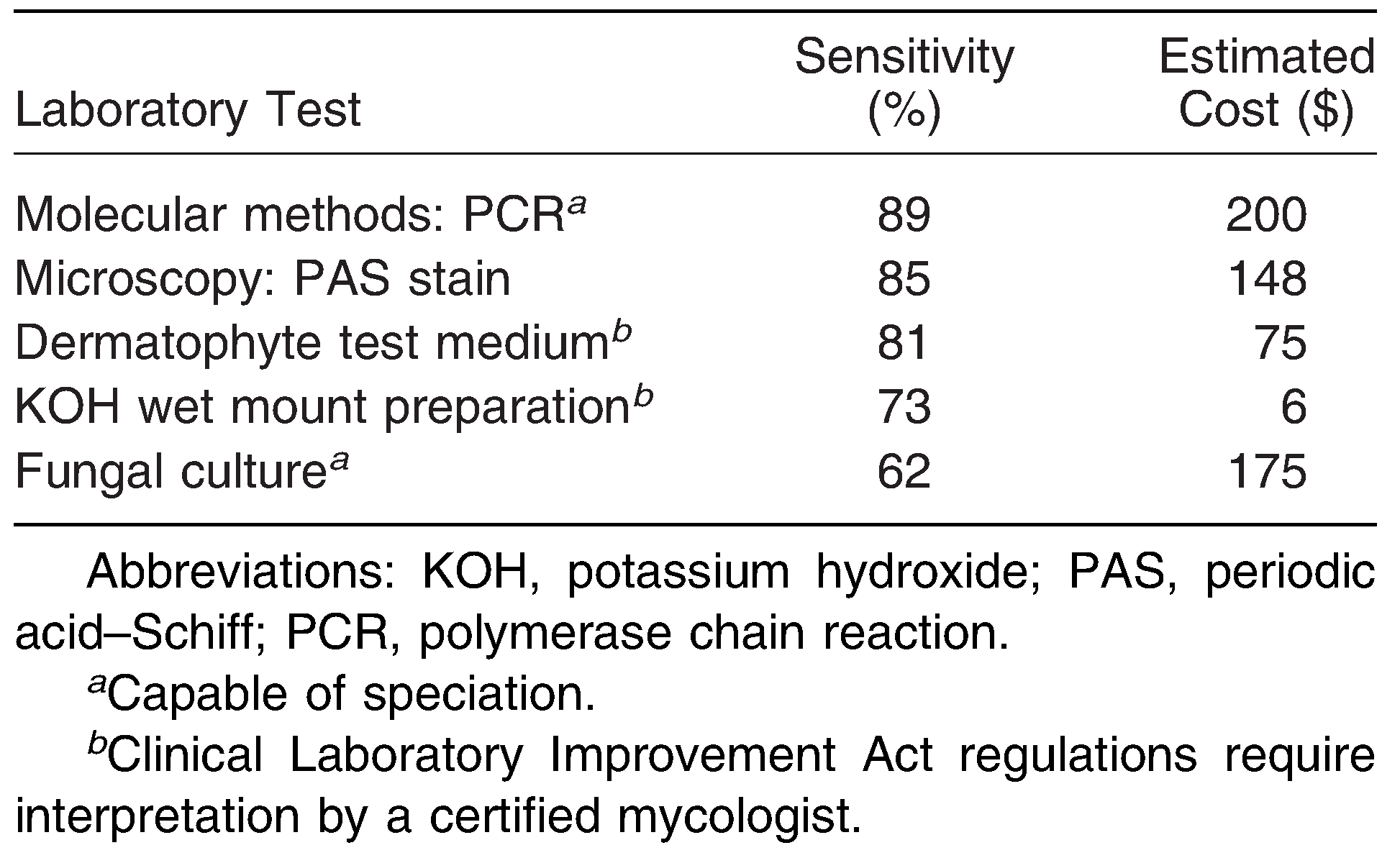
4]. Currently, laboratory testing to verify the clinical diagnosis of onychomycosis is commonly achieved with a variety of laboratory tests, including potassium hydroxide (KOH) wet mount preparation, periodic acid–Schiff (PAS) stain, Gomori's methenamine silver (GMS) stain, fungal culture, and molecular testing. Fungal culture and molecular testing are able to speciate if the origin of the fungus infection is clinically important. The median sensitivities of the common laboratory tests that have been reported by 20 different studies covering 3,000 cases are listed in
Table 1.
Table 1.
Median Sensitivities of Various Laboratory Tests for Onychomycosis [5-8].
Table 1.
Median Sensitivities of Various Laboratory Tests for Onychomycosis [5-8].
The cost of individual tests ranges from
$6 to
$200. Previously, dermatophyte test medium and KOH were performed in the office by physicians, but now regulations of the Clinical Laboratory Improvement Act require certified mycologic interpretation [
9]. Laboratory testing can add costs and delays to the initiation of treatment. Pathology analysis with selective stains costs approximately
$148. Depending on the tests ordered to diagnose and treat onychomycosis, the estimated societal costs can range from
$9.62 million to
$233.89 million [
10]. Pathologic testing with fungal selective stains may take days to weeks to receive a report. Fungal culture may take weeks to grow and speciate the fungus [
11]. Balancing cost, sensitivity, and specificity, PAS-stained nail clip biopsy is the best test to verify clinically significant onychomycosis [
4]. Point-of-care diagnosis of onychomycosis could speed up diagnosis and reduce costs.
Jesus-Silva et al [
12]. reported the dermoscopic features observed in 178 KOH- or culture-positive patients in Mexico. They found longitudinal striae in 32.9%, spike patterns in 14.19%, and linear edge patterns and distal irregular terminations in 13% to 32% of their patients. They concluded that dermoscopy may be a useful diagnostic tool but based on their results should not be used as the sole diagnostic criterion [
12].
Piraccini et al [
13]. performed a retrospective examination of 57 dermoscopic images that were compared with mycologic findings. They found a jagged proximal edge with spikes of the onycholytic area and longitudinal striae in mycologically positive cases, whereas a linear edge without peaks in the area of onycholysis was found in cases of traumatic onycholysis [
13]. Nakamura et al [
14]. studied 500 patients with all types of nail disorders in Brazil. In the patients with onychomycosis, they identified yellow or brown discolorations (chromonychia), onycholysis, opacity, and longitudinal whitish streaks, subungual keratosis with ruinous aspect, or adjacent skin dryness or scaling [
14].
Kallis and Tosti [
15]. recently reported two cases of clinical onychomycosis that failed to improve with antifungal therapy and that help to emphasize the importance of dermoscopy in the detection of underlying rare onychomatricoma as well as concurrent onychomycosis. The objective of the present study was to determine the correlation between dermoscopic patterns and positive mycologic test results used to diagnose onychomycosis in a sample US population.
Materials and Methods
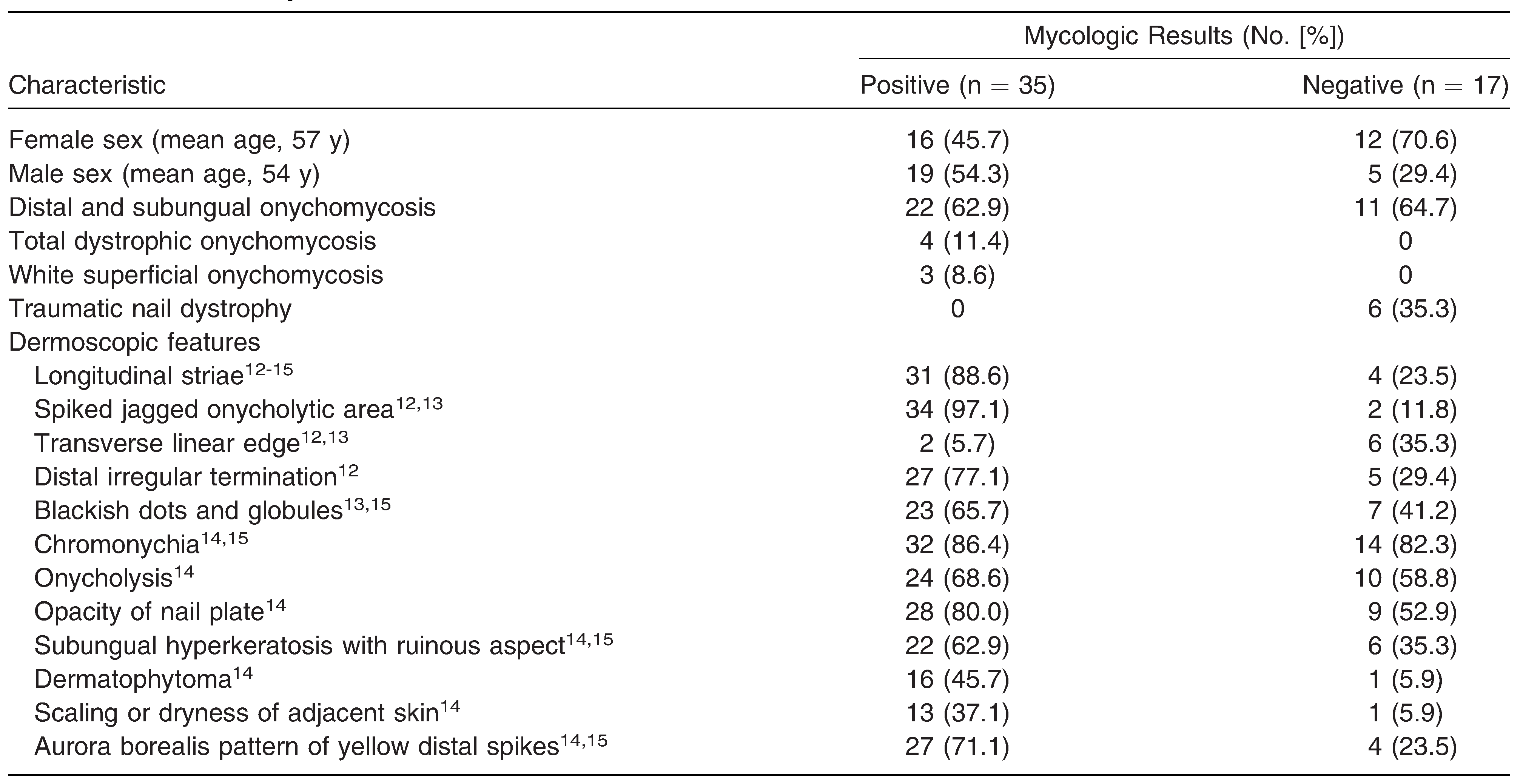
The study was approved by the institutional review board of Kent State University College of Podiatric Medicine (Independence, Ohio). Clinical and dermoscopic images were obtained with a digital camera (EOS Rebel; Canon USA Inc, Melville, New York) attached to a dermatoscope (DermLite Foto or DermLite Pro HR; 3Gen Inc, San Juan Capistrano, California) or with a smartphone (iPhone 6; Apple Inc, Cupertino, California). The records of 52 patients from the Cleveland Foot and Ankle Clinic (Cleveland, Ohio) with suspected onychomycosis with records of both dermoscopic images and mycology reports were retrospectively reviewed. The characteristics of the study cohort are shown in
Table 2. There were 28 females and 24 males, with ages ranging from 2 to 82 years. The digital dermoscopic images were examined by the author to detect previously reported dermoscopic features of onychomycosis [
12-
14]. Twelve different features were detected in the study cohort (
Table 2). The dermoscopic features detected were correlated to PAS stain, GMS stain, or fungal culture test results [
17]. Patients without any mycologically positive test results were used as controls.
Results
All of the patients had at least a nail clip biopsy specimen stained with PAS, and 20 also had GMS staining performed to increase sensitivity. Six patients also had a fungal culture, and three patient specimens were stained with Fontana Mason stain for melanin. Thirty-five of 52 (67.3%) mycologically positive and 17 of 52 (32.6%) mycologically negative patients were reviewed. The study data are summarized in
Table 2.
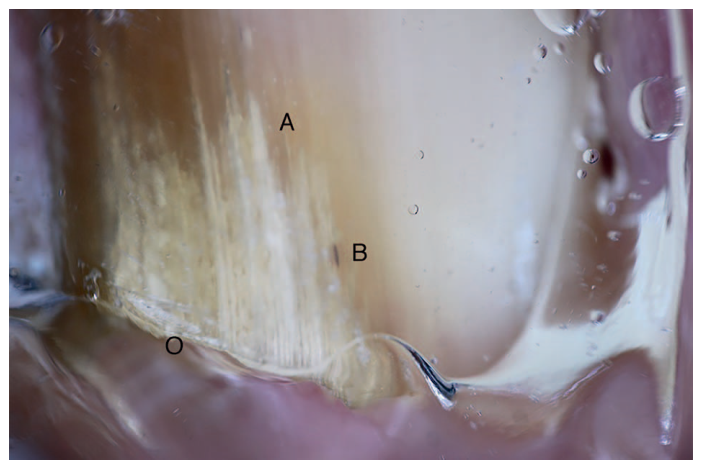
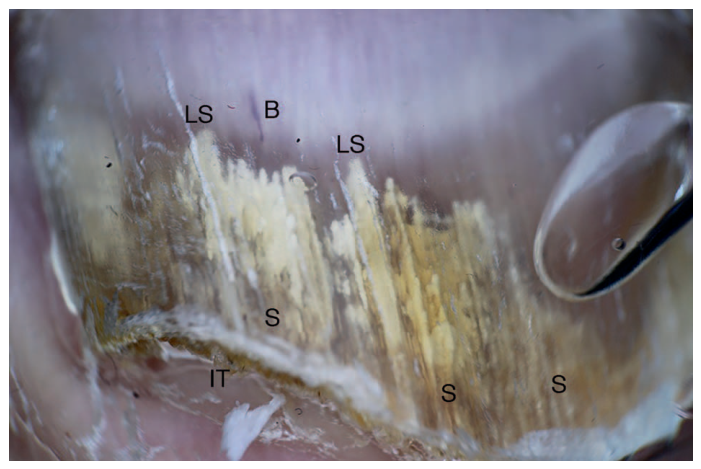
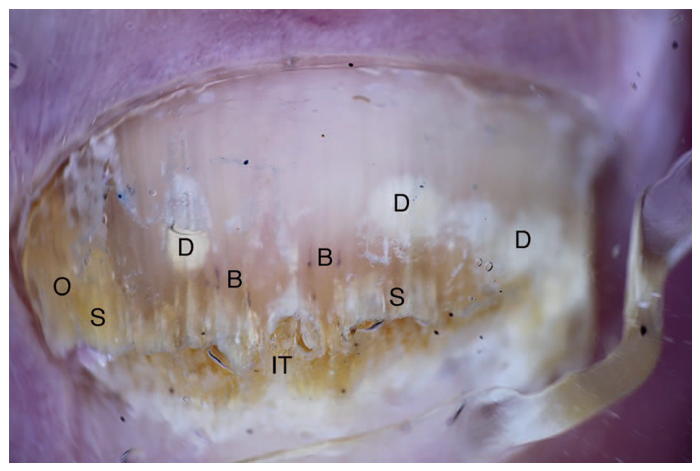
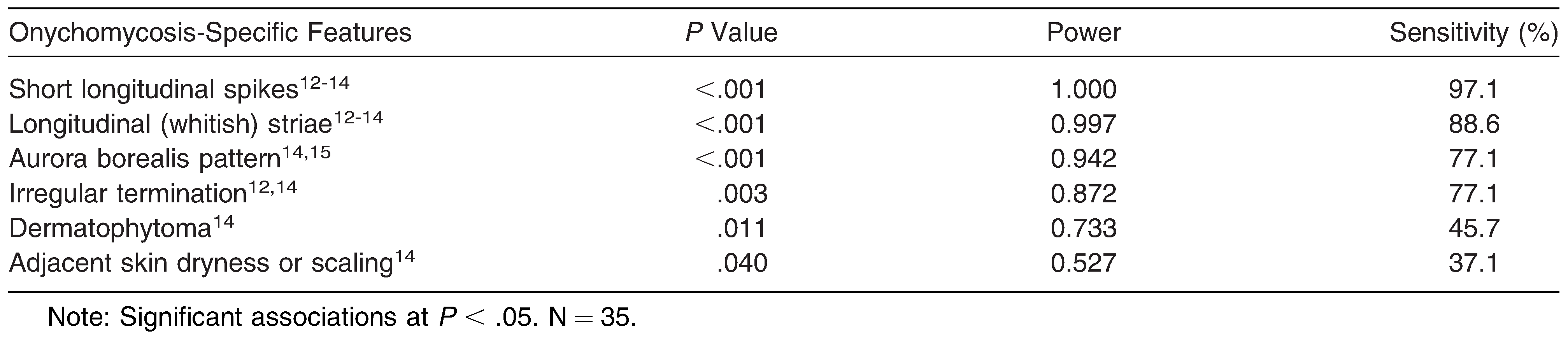
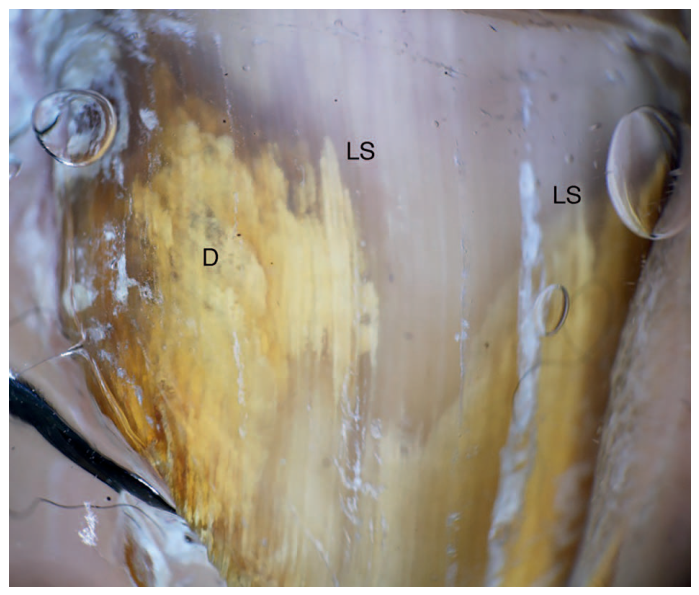
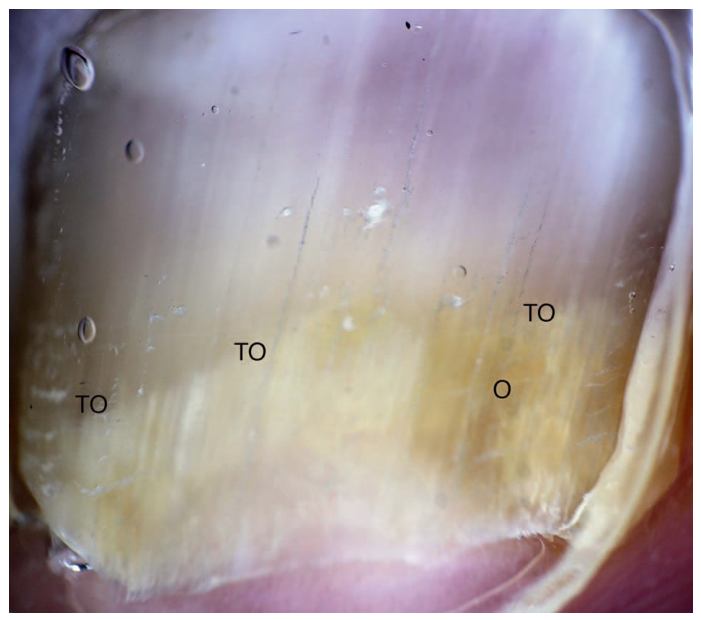
Short distal spikes, wider longitudinal striae, aurora borealis pattern, irregular distal termination, dermatophytoma features, and adjacent dry scaly skin all correlated significantly to the laboratory test results (
Figs. 1–
5). In addition, the pathology results found that 12 of 17 (71%) of the mycologically negative patients had subungual orthokeratinization indicative of chronic microtrauma, whereas only ten of 35 (29%) of the mycologically positive patients had signs of microtrauma. Some patients may have both traumatic onycholysis and secondary onychomycosis features detected. The absence of the mycotic features listed in
Table 3 and the presence of nail opacity, transverse onycholysis, or blackish dots or globules indicates microtrauma as the cause of the nail dystrophy.
Figure 1.
Nail unit dermoscopy. A indicates the aurora borealis pattern; B, linear black globule.
Figure 1.
Nail unit dermoscopy. A indicates the aurora borealis pattern; B, linear black globule.
Figure 2.
Hallux nail dermoscopy depicting white longitudinal striae (LS), a black linear globule (B), spikes (S), and irregular termination (IT).
Figure 2.
Hallux nail dermoscopy depicting white longitudinal striae (LS), a black linear globule (B), spikes (S), and irregular termination (IT).
Figure 3.
Onychomycosis of hallux toenail. B indicates black linear globule; D, white dermatophytoma; IT, irregular termination; O, onycholysis; S, short spike.
Figure 3.
Onychomycosis of hallux toenail. B indicates black linear globule; D, white dermatophytoma; IT, irregular termination; O, onycholysis; S, short spike.
Figure 4.
Dermoscopic features of distal subungual onychomycosis. D, indicates yellow dermatophytoma; LS, longitudinal striae.
Figure 4.
Dermoscopic features of distal subungual onychomycosis. D, indicates yellow dermatophytoma; LS, longitudinal striae.
Figure 5.
Transverse linear onycholysis (TO) characteristic of microtraumatic nail dystrophy without features of onychomycosis. O, onycholysis.
Figure 5.
Transverse linear onycholysis (TO) characteristic of microtraumatic nail dystrophy without features of onychomycosis. O, onycholysis.
Table 3.
Dermoscopic Features of Onychomycosis in Order of Power
Table 3.
Dermoscopic Features of Onychomycosis in Order of Power
Chromonychia, described by Nakamura and Costa [
14]. as yellow, white, or brown nail discoloration, was not a distinguishing feature because it was found in both the mycologically positive (86.4%) and mycologically negative (82.3%) groups. Onycholysis also was found in the positive mycology group (68.6%) and the negative mycology group (58.8%). Abnormal separation of the nail plate from the nail bed is an initial feature of both onychomycosis and traumatic nail dystrophy [
13].
Discussion
A recent analysis by Mikailov et al [
10]. suggested that the cost of laboratory testing for systemic therapy may not be worth the prevention of the rare case of hepatic failure [
10]. Current treatment guidelines, however, still recommend appropriate testing to diagnose and manage onychomycosis, especially when oral therapy is planned [
3,
18].
Although fungal cultures remain necessary to perform an etiologic diagnosis and are required by the Food and Drug Administration in drug trials, their lower sensitivity and higher cost limit their clinical usefulness. The KOH wet mount preparations, although specific for dermatophytes, also have low sensitivity and are operator dependent. The KOHs require access to a microscope and currently must be performed by a certified technologist for reimbursement. Pathologist-interpreted PAS and GMS stains are very sensitive but can cost
$148 [
10].
Because most patients prefer to be managed with topical therapy, a significant cost savings could be achieved if point-of-care diagnosis of onychomycosis by dermoscopy is used. The present data demonstrate that point-of-care dermoscopy is not only accurate but significantly reduces cost and diagnostic delay. Which features correlate with pathologic onychomycosis and which features are found in nonmycotic nail dystrophy? Short spikes extending proximally from the hyponychial space occur initially along with onycholysis. In many cases, these signs can be appreciated only with a dermatoscope. The dermatophytic spikes extend proximally, tunneling under the nail plate along the nail bed grooves, and, as the infection progresses, widen into wider and longer striae as the infection typically progresses from distal to proximal along the nail bed longitudinal rete furrows.
Irregular distal subungual termination and subungual hyperkeratosis often develop. Over time, a so-called aurora borealis pattern, composed of many short and centrally longer spikes, may be appreciated. In more severe and long-standing cases, a collection of mycotic keratitis may develop into a subungual dermatophytoma. These features are all significantly associated with positive mycologic test results. On average, four sensitive dermoscopic signs of onychomycosis were detected in each mycologically positive patient.
Because approximately 50% of abnormal toenails are not mycotic but are dystrophic due to acute or chronic microtrauma from constrictive foot gear, diagnosis becomes important. Also, some insurers may require costly laboratory testing even when only debridement is necessary to manage onychomycosis in selected patients. A point-of-care diagnosis of traumatic nail dystrophy can be aided by detecting nail plate opacity in nine of 17 (52.9%), black dots or globules in seven of 17 (41.2%), or transverse onycholysis in six of 17 (35.3%) of the mycologically negative patients.
Limitations of this study design are that it is retrospective and that it is dependent on the accuracy of the observations of a single observer, which to some extent may be subjective. Also, the results of nail plate testing may depend on the collection method used.
Conclusions
These data demonstrate that dermoscopy positively correlates with common histopathologic tests used to diagnose onychomycosis. Point-of-care diagnosis of onychomycosis with high sensitivity and disease specificity would save significant time and cost in the overall management of onychomycosis. Nail unit dermoscopy is easily performed with 10× magnification under polarized light. Dermoscopy detects the subungual features of onychomycosis that have been reported by multiple international authors [
12-
16].
Dermoscopy results are combined with laboratory test results, especially in patients who desire systemic therapy. In most patients, however, immediate point-of-care diagnosis by dermoscopic observation of specific features could allow immediate initiation of at least topical treatment. Short spikes, longitudinal striae, and aurora borealis features are 90.4% sensitive for onychomycosis. Nail plate opacity, subungual ruinous aspect, and black dots and globules were found in cases that were mycologically negative. These nonmycotic nail dystrophies are more likely due to traumatic onycholysis secondary to ill-fitting shoes and would not respond to antifungal therapy. Dermoscopy of the nail unit is a useful clinical tool that is used to easily identify features of onychomycosis to easily differentiate it from traumatic nail dystrophy. Nail unit dermoscopy should speed accurate diagnosis and reduce costs.
Acknowledgment: Jill Kawalec, PhD, director of research and Joan Lannoch, senior graphic designer at Kent State University College of Podiatric Medicine.
Financial Disclosure: None reported.
Conflict of Interest: None reported.