The medial longitudinal arch (MLA) is formed by a complex of tarsal and metatarsal bones, ligaments, and tendons. Characterization of the MLA morphology is essential for the clinical evaluation of foot pathologies such as pes planus and pes cavus. Although there are several methods for measuring the MLA, to date, no ubiquitously accepted method exists [
1]. Whereas some studies assess the dynamic arch index [
2,
3]. to describe the medial longitudinal arch, others use the static arch height index (AHI) [
4,
5].
For the AHI, a caliper-based platform is commonly used [
6,
7]. Dynamic measurements were often acquired with ink paper or pedobarographic platforms [
2,
3,
8,
9]. Other methods of evaluating the MLA include digital photography and radiographic assessments [
10]. There are several advantages and disadvantages for each of the methods. Static caliper-based measurements are generally influenced by the rater but show high reproducibility [
6,
10]. and can therefore be completed with one attempt. Dynamic pedobarographic measurements are more affected by individual gait characteristics, especially in children, [
3]. but have excellent reliability, especially regarding the arch index in adult [
11]. and pediatric populations [
3]. However, when comparing static and dynamic measurements, there is conflicting evidence. No correlation was found by Cashmere et al, [
11]. whereas a correlation was found by Teyhen et al [
9]. Thus, there is still no sufficient evidence regarding whether the dynamic and static methods are comparable.
Different methods for assessment are used and have been tested regarding their reliability, validity, and correlation in the adult population, [
12,
13]. whereas little is known about the applicability of the measurement methods in children [
3,
14,
15]. First data suggest good test-retest reliability for foot metrics in children using the pedobarographic Emed-n50 platform (Novel GmbH, Munich, Germany) [
3]. Furthermore, the MLA of children changes with increasing age, [
2,
16,
17]. although the dynamically measured arch index seems to remain consistent from the age of 6 years [
2]. However, the adequate use of static and dynamic foot measures in children is still unclear. It is also unknown whether static and dynamic foot metrics are influenced by the time of day. Considering that human anthropometry is subject to a circadian rhythm (eg, larger body length in the morning than in the evening), [
18]. it is hypothesized that the foot is exposed to physical load throughout the day that might have an effect on the MLA. This is supported by Fourchet et al, [
19]. who showed changes in measured pedobarographic foot characteristics following high-intensity running.
Because of the above-described research deficit, this study is a first attempt to evaluate the applicability of current static and dynamic foot metric measures in children. For this, the aims of the study were to 1) determine the interrater and intraday reliability of dynamic arch index and static AHI measurements for children, 2) investigate the association between the dynamic and static measurement of the foot's medial longitudinal arch, and 3) explore the variation of the dynamic and static arch indices with assessments at two different times of the day (ie, morning and afternoon).
Methods
Participants
The sampling pool consisted of three local sports teams that provided a summer sports camp during school holidays. Inclusion criteria were age between 5 and 13 years and the ability to perform the walking tasks independently. Exclusion criteria consisted of operations of the musculoskeletal system in the past 6 months, foot deformation such as clubfeet or pes equinus, and acute injuries of the musculoskeletal system.
Eighty-six children participated in this study, 35 girls and 51 boys, with a mean ± SD age of 8.9 ± 1.9 years (range, 5–12 years). The mean ± SD height was 1.41 ± 0.13 m (range, 1.12–1.75 m), the mean ± SD weight was 34.4 ± 9.7 kg (range, 20.1–64.3 kg), and the mean ± SD body mass index (BMI) was 16.9 ± 2.4 kg/m [2]. (range, 13.6–29.7 kg/m [2].).
Of the included children, 76 were measured in the morning and afternoon and hereafter are referred to as the intraday reliability cohort (mean ± SD for age, 8.7 ± 1.9 years; height, 1.40 ± 0.13 m; weight, 33.6 ± 9.6 kg; and BMI, 16.8 ± 2.4 kg/m [2].; 42% were girls). Twenty-eight children were measured by two raters at the same time point, referred to as the interrater reliability cohort (mean ± SD for age, 9.8 ± 1.6 years; height, 1.47 ± 0.09 m; weight, 37.4 ± 8.2 kg; and BMI, 17.0 ± 2.1 kg/m [2].; 29% were girls). Data from 18 children were included in both reliability cohorts. The study was approved by the ethical commission of the local medical association.
Instrumentation
Body length was measured with a portable stadiometer (seca 217; seca GmbH & Co KG, Hamburg, Germany) and body mass was measured with a scale (Omron BF51; OMRON Healthcare Europe BV, Mannheim, Germany). For the static foot arch measurements, a specially constructed platform [
6,
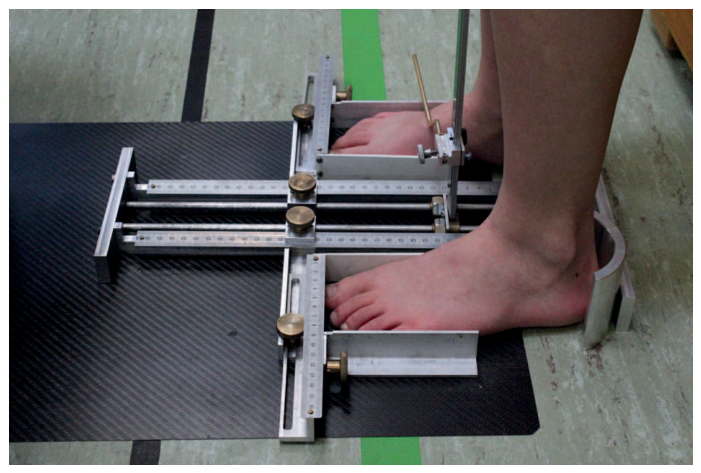
7]. (
Fig. 1) was used to measure heel-to-toe length (HTL) and dorsum height at 50% of HTL (DH) in sitting and standing positions. Dynamic foot dimensions were acquired with a pedobarographic device (Emed-n50 platform). This pedobarographic device has a sensor resolution of 4 sensors/cm [2]. on an area of 475 × 320 mm, which makes a total of 6,080 sensors on the platform. The recording frequency was set at 50 Hz. The platform was embedded in a wooden walkway, with a total area of 600 × 3600 mm, in order to level the platform to the ground.
Figure 1.
Specially constructed foot measurement platform for the assessment of foot characteristics. Heel-to-toe-length (HTL) as well as the dorsal height at 50% of the HTL can be assessed (DH).
Figure 1.
Specially constructed foot measurement platform for the assessment of foot characteristics. Heel-to-toe-length (HTL) as well as the dorsal height at 50% of the HTL can be assessed (DH).
Procedure
At first, height and weight were measured. Two children started at the same time and were randomized to one of the two raters using either the static or the dynamic assessment. The first static measurement was taken seated, which equals approximately 10% of the body weight on each foot. The HTL and DH of both feet were measured [
6,
7,
10]. The same procedure was repeated in the standing position, which equals approximately 50% of the child's body weight on each foot [
4].
The dynamic measurement was acquired with a two-step approach that was shown to be a reliable protocol [
14]. For familiarization, the children were asked to walk a few times across the walkway with their usual walking speed. The instructions followed a predefined protocol. The children were told to walk like they would usually walk looking up straight and using a self-selected, comfortable speed and cadence. An individual marker was placed on the ground where the children had to start in order to place the second step on the platform. The children were asked to walk in both directions until three trials for the left foot and the right foot were captured. If participants targeted the platform, stepped on the border, or altered their gait, the trial was excluded and the measurements were repeated. If there were four or more correct measurements for one foot, the first three steps were used for the data analysis.
For the interrater reliability, 28 of the children were measured by two different raters successively in a randomized order. After the first measurements, which were held in the morning between 9 and 11
am, the whole measurement procedure was repeated a second time in the afternoon from 2 to 4
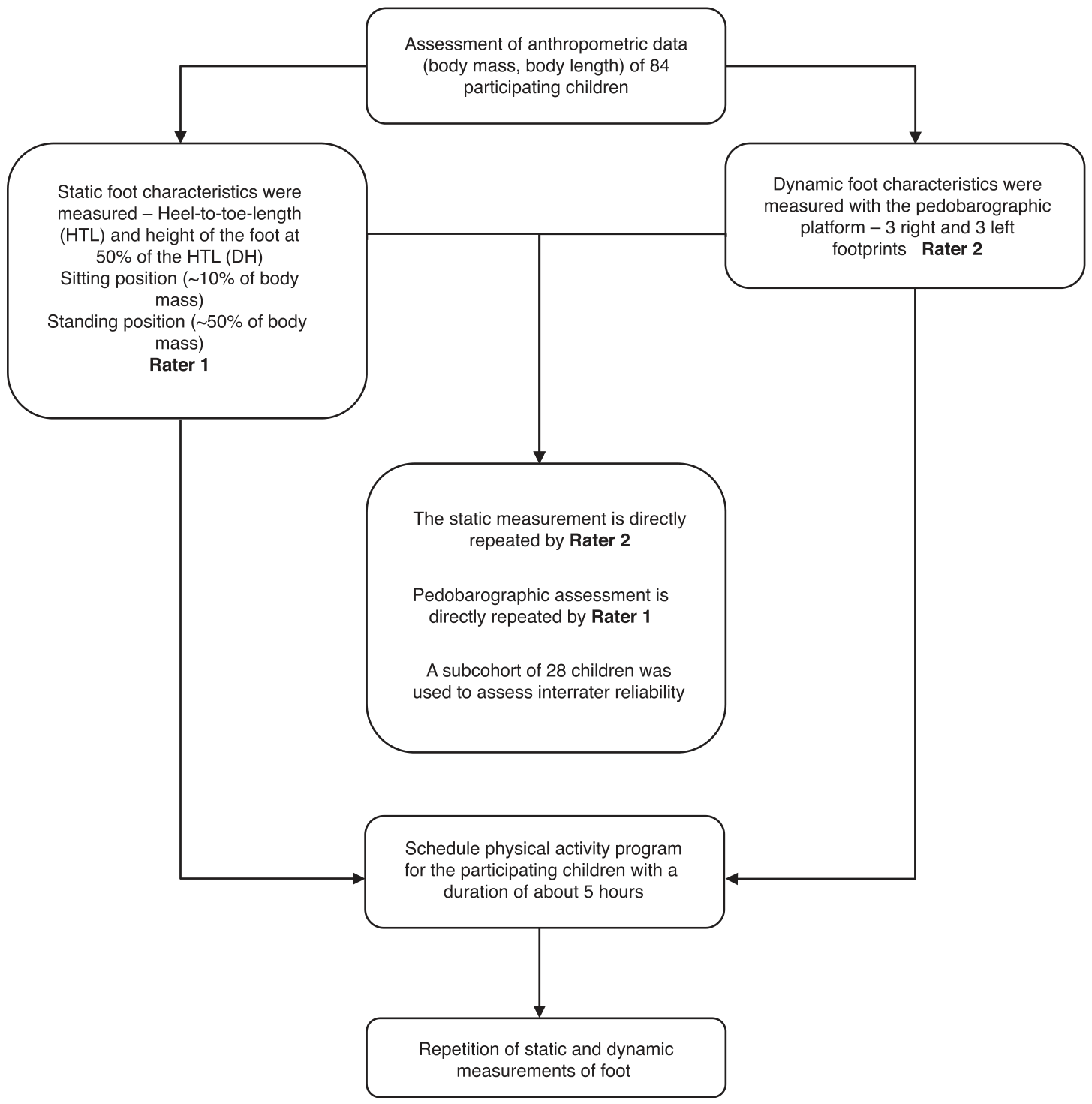
pm to determine the intraday reliability. Before the first investigation in the morning, the children were not physically active. In the time between the measurements, all children performed a similar sports program of at least 5 hours. A flowchart of the study procedure is shown in
Figure 2.
Figure 2.
Flow chart displaying the study protocol.
Figure 2.
Flow chart displaying the study protocol.
Data Reduction
The static measurements were recorded on paper and the dynamic measurements were recorded with the Novel Database pro m (Version 24.3.20; Novel GmbH) and subsequently exported into an Excel spreadsheet (Microsoft Corp, Redmond, Washington). The dynamic data were analyzed with the Novel Database pro m and the arch height indices were calculated for every measurement. The static AHI was calculated by dividing the DH by the HTL [
6,
7,
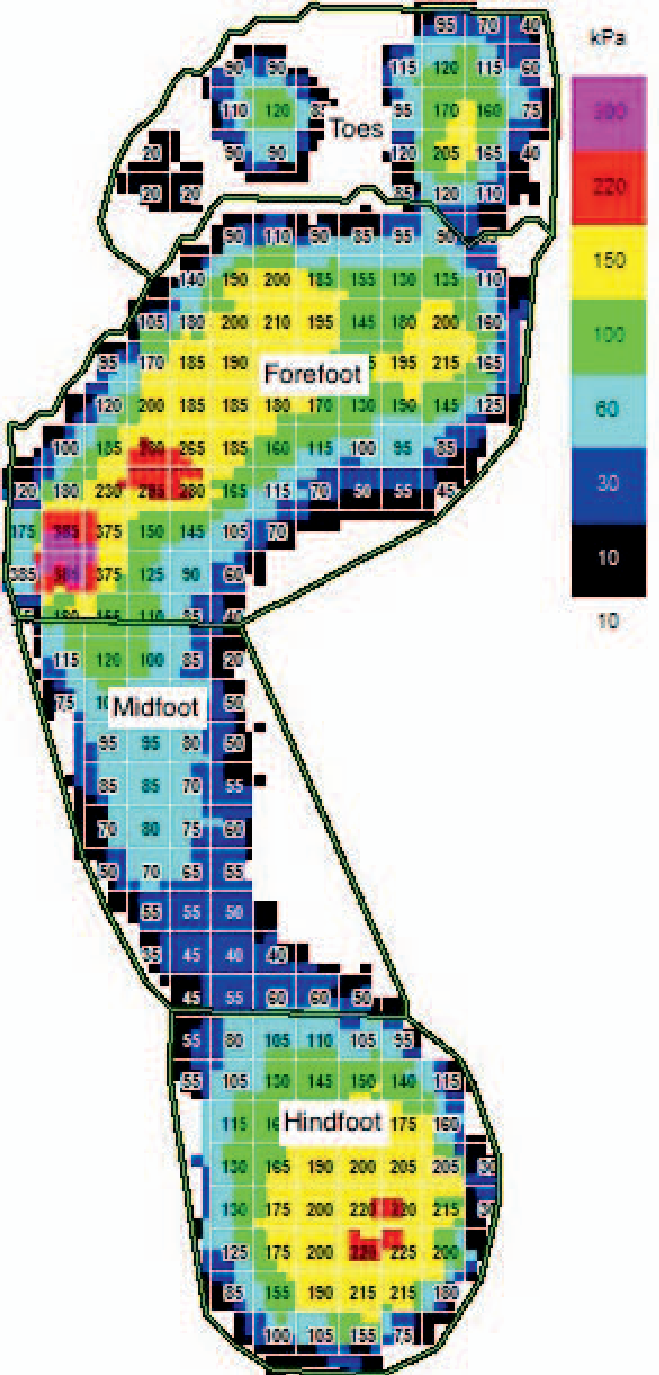
20]. For the calculation and statistical analysis, the mean value for each foot was used. The dynamic arch index of the Emed system is calculated with an algorithm that masks the foot into three regions—forefoot, midfoot, and hindfoot. The area of the midfoot divided by the area of the whole foot (excluding the toes) is defined as the arch index (
Fig. 3). All data were exported to a spreadsheet to form a compatible file for IBM SPSS Version 23 (IBM Corp, Armonk, New York) and STATA Version 14.0 (StataCorp LP, College Station, Texas). All further calculations were performed with SPSS and STATA.
Figure 3.
Exemplary footprint of one participant measured with the Emed-n50 platform. Arch index is calculated as a ratio of the midfoot area divided by the sum of the forefoot, midfoot, and hindfoot areas excluding the toes.
Figure 3.
Exemplary footprint of one participant measured with the Emed-n50 platform. Arch index is calculated as a ratio of the midfoot area divided by the sum of the forefoot, midfoot, and hindfoot areas excluding the toes.
Statistical Analysis
To investigate the effects on foot arch variability resulting from the within-day repeated measurements and by the raters for the three methods, mixed models were established for each condition. A fully crossed random intercept model with the clusters child, side (defining the foot), and rater or time, respectively, was performed. To make the effects of the clusters on the variance components comparable between the different models, the standardized foot arch was analyzed and reported. For each condition, the variability between the repeated measures was visualized using Bland-Altman plots.
The correlations of static and dynamic measurement are calculated as within-subject Pearson product-moment correlation coefficients (r). Furthermore, to determine associations of children and setting characteristics (BMI, gender, side, time, and rater) with the dependent variable foot arch, a mixed model was established. In the case of high agreement between methods, one model was performed, whereas the measuring method and the interaction between method and children and setting characteristics were modeled as fixed effects and the cluster child as a random effect. Backward elimination using the Wald test was performed to exclude insignificant interactions. In the case of disagreement, similar models were performed stratified by methods. Effect estimates, corresponding 95% confidence intervals (CIs), and P values of the models are reported. A value of P < .05 was considered statistically significant.
Results
In this study, a total of 172 feet were measured and analyzed (both feet of 86 participants). The static AHI in the sitting position for both feet combined had a mean ± SD value of 0.267 ± 0.015 (range, 0.236–0.299) and a mean value ± SD in the standing position of 0.237 ± 0.014 (range, 0.201–0.264). The dynamic arch index assessed with the Emed-n50 platform had a mean value ± SD of 0.171 ± 0.065 (range, 0.019–0.319).
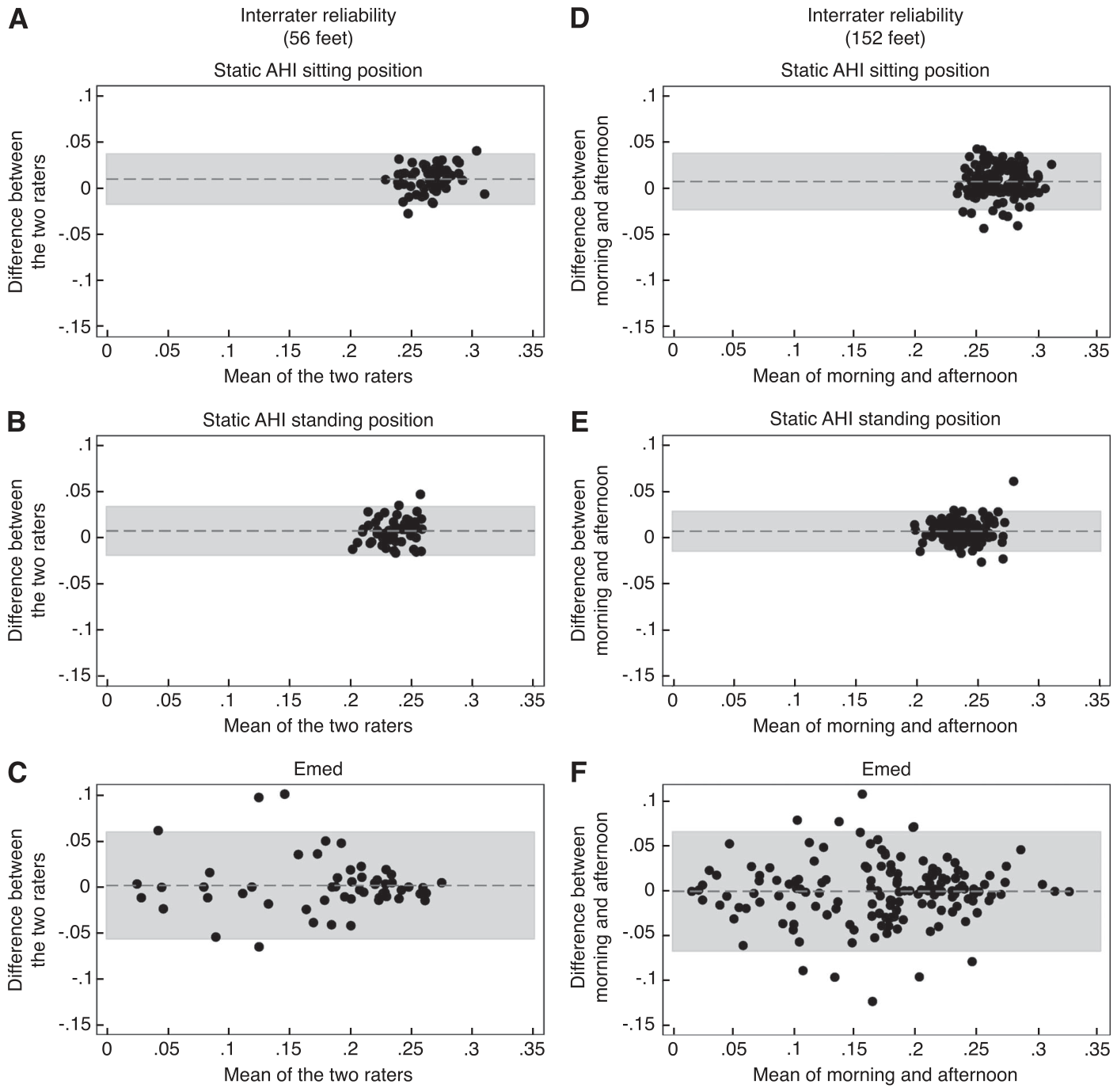
As shown in Table 1, the standardized variance components of Emed for rater and time equal 0.00, which shows excellent agreement for the dynamic arch index within those repeated measurement settings (reliability, 1.00). Good to excellent agreement is also shown for the static AHI in sitting (intraday reliability [0.90] and standard variance components = 0.11; interrater reliability [0.80] and standard variance components = 0.25) and standing positions (intraday reliability [0.88] and standard variance components = 0.13; interrater reliability [0.85] and standard variance components = 0.18). Additionally, Bland-Altman plots were customized to confirm and illustrate the agreement of the intraday and interrater reliability (
Fig. 4).
Table 1.
Standardized Variance Components of a Fully Crossed Random Intercept Model on the Foot Arch and the Corresponding 95% Confidence Interval.
Table 1.
Standardized Variance Components of a Fully Crossed Random Intercept Model on the Foot Arch and the Corresponding 95% Confidence Interval.
Figure 4.
Bland-Altman plots representing comparisons of intraday and interrater reliability for the three testing conditions. A, Intraday reliability for the static arch height index (AHI) in the sitting position. B, Intraday reliability for the static AHI in the standing position. C, Intraday reliability for the dynamic arch index (Emed). D, Interrater reliability for the static AHI in the sitting position. E, Interrater reliability for the static AHI in the standing position. F, Interrater reliability for the dynamic arch index (Emed). Broken lines represent the mean, and 95% confidence intervals are shown in the gray shaded areas.
Figure 4.
Bland-Altman plots representing comparisons of intraday and interrater reliability for the three testing conditions. A, Intraday reliability for the static arch height index (AHI) in the sitting position. B, Intraday reliability for the static AHI in the standing position. C, Intraday reliability for the dynamic arch index (Emed). D, Interrater reliability for the static AHI in the sitting position. E, Interrater reliability for the static AHI in the standing position. F, Interrater reliability for the dynamic arch index (Emed). Broken lines represent the mean, and 95% confidence intervals are shown in the gray shaded areas.
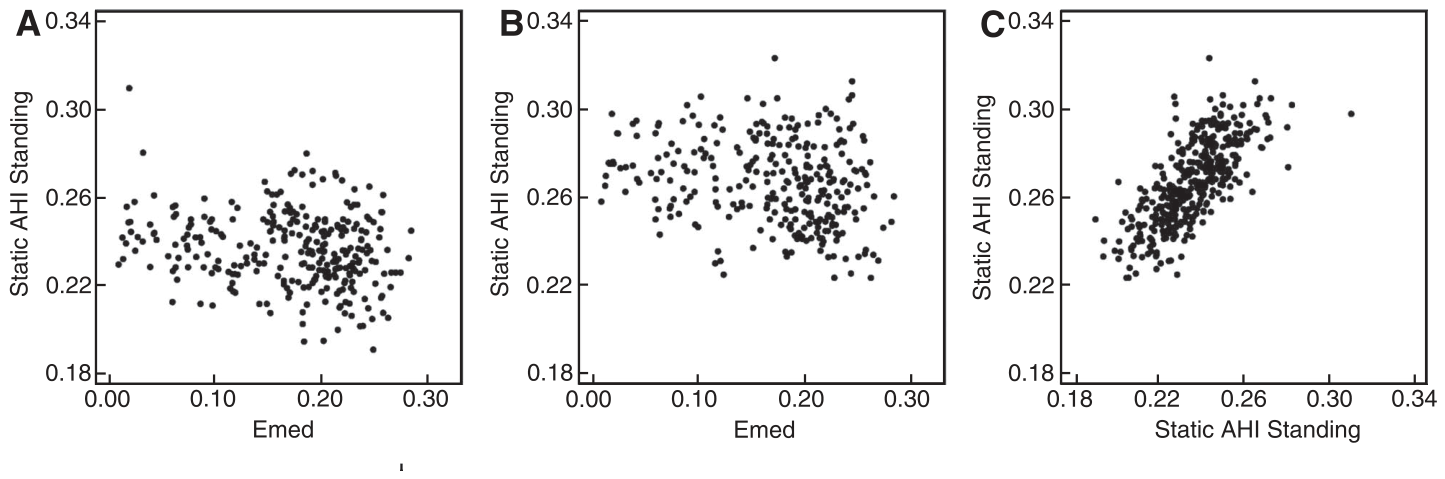
The Pearson correlation coefficient yields poor correlation between the dynamic arch index as well as the sitting (
r = –0.070) and standing static AHI (
r = –0.138). The correlation between the two static measurements is high (
r = 0.649). The correlations are displayed in the scatter plots in
Figure 5.
Figure 5.
Scatter plots displaying the correlation between (A) dynamic arch index (Emed) and static arch height index (AHI) in the sitting position, (B) dynamic arch index and static AHI in the standing position, and (C) static AHI in the standing and sitting positions.
Figure 5.
Scatter plots displaying the correlation between (A) dynamic arch index (Emed) and static arch height index (AHI) in the sitting position, (B) dynamic arch index and static AHI in the standing position, and (C) static AHI in the standing and sitting positions.
The intraday change of the foot arch showed differing results for the three measures. For the static measurement, there was significant variation depending on the time of the day in the standing and sitting positions (P < .001). The dynamic measurements remained unchanged (P = .845).
Estimated means for static arch measurement were higher for sitting (0.267; 95% CI, 0.264–0.270) than for standing (0.236; 95% CI, 0.234–0.239) conditions (P < .001). Furthermore, the mixed regression analysis revealed that the foot arch indices are influenced by gender (female versus male: effect estimates, –0.0084; 95% CI, –0.0140 to –0.0027; P = .004) and time (afternoon versus morning: –0.0067; 95% CI, –0.0084 to –0.0049; P < .001) regardless of which static measurement is used. Side (P = .060) and BMI (P = .232) did not influence the static foot arch measurements, whereas BMI (0.0062; 95% CI, 0.0034–0.0089; P < .001) and side (right versus left, 0.0077; 95% CI, 0.0018–0.0137; P = .011) did influence the dynamic arch index. The estimated mean for the dynamic arch index was 0.171 (95% CI, 0.158–0.184).
Discussion
The results of this study revealed excellent interrater and intraday reliability for the tested static and dynamic arch measurements in children. However, the comparison of the static AHI and the dynamic arch index disclose very low correlation. It has also been shown that the static AHI is influenced by physical activity.
Determination of Intraday and Interrater Reliability
The intraday and interrater reliability of the specially constructed foot measurement platform in this study showed excellent results. These findings are comparable to recent studies regarding the reliability of different foot measurement systems in adults [
5-
7]. Nevertheless, the findings for the reliability of the static foot arch measurements in children show similar or even better values compared with adults [
10]. The dynamic arch index appraised with the Emed-n50 platform exhibited excellent intraday and interrater reliability in children. These findings are in agreement with Tong and Kong, [
3]. who used the same two-step protocol for measurements [
14]. Even though the children's gait is still developing, [
21]. the reliability was high. Consequently, the variability of the children's gait during preadolescence does not seem to diminish the platform's accuracy.
Correlation of Static AHI and Dynamic Arch Index
Previous studies have found a significant correlation between the static AHI and the dynamic arch index for adults (
r = 0.60) [
9]. The low correlation between both measurements in the preadolescent population should be considered and results of both indices interpreted carefully in children. One reason for the differences may be that foot characteristics in children are still developing [
2,
17]. Future research should therefore focus on the validity of the clinical evaluation—which is still the most typical method of determination [
10].—and measurement systems of the arch in children.
Limitations
One limitation of this study is the lack of assessment of the physical activity level performed throughout the day. Different activity levels may have influenced the amount of foot anthropometric changes in each individual. As there was no control group (ie, no physical activity), it is difficult to analyze the difference between circadian and activity-related effects. Furthermore, the static measurement platform was self-built based on the AHI measurement system by Butler et al, [
6]. which is used for a range of studies to measure static dimensions of the foot. The device was not validated but is thought to be equivalent to the system. Additionally, the test protocol may have caused a systematic bias. Because of time limitations, the static measurements were acquired only once for both left and right sides. A second and third repetition of acquisition might cause less bias. The children were able to choose the starting side, which might lead in some cases to three consecutive foot measurements of one side. The children were then asked to start the next trial with the other leg, which may have interfered with their natural gait. The age range (5–12 years) of this study was comparatively low, which might limit the generalizability of this study to the whole population, as might the lack of ethnic diversity. An a priori power calculation was not performed.
Conclusions
Although this study showed excellent reliability for the tested static and dynamic measurement systems of the medial longitudinal arch, there was low correlation between these two systems. Further studies should focus on validating these measurement systems comparing them to clinical evaluations. There was a significant effect of the time of day on the static AHI. This effect should be kept in mind, and for evaluation of the clinical relevance of the measures, further scientific work is needed.
Acknowledgment: The authors would like to express their appreciation to the children who participated and their coaches who made the testing possible. Furthermore, we thank Simon Doyle, MSc, and Dieko Riebe, MSc, for their help with texting; and Dr. Axel Kalpen (Novel GmbH, Munich, Germany) for technical support.
Financial Disclosure: This work was supported by the Ministry for Science and Research in Hamburg, Germany (grant number LFF-FV13). The funding source did not play a role in the design or conduct of the study; in the collection, analysis, or interpretation of the data; or in the preparation, review, or approval of the manuscript.
Conflict of Interest: None reported.