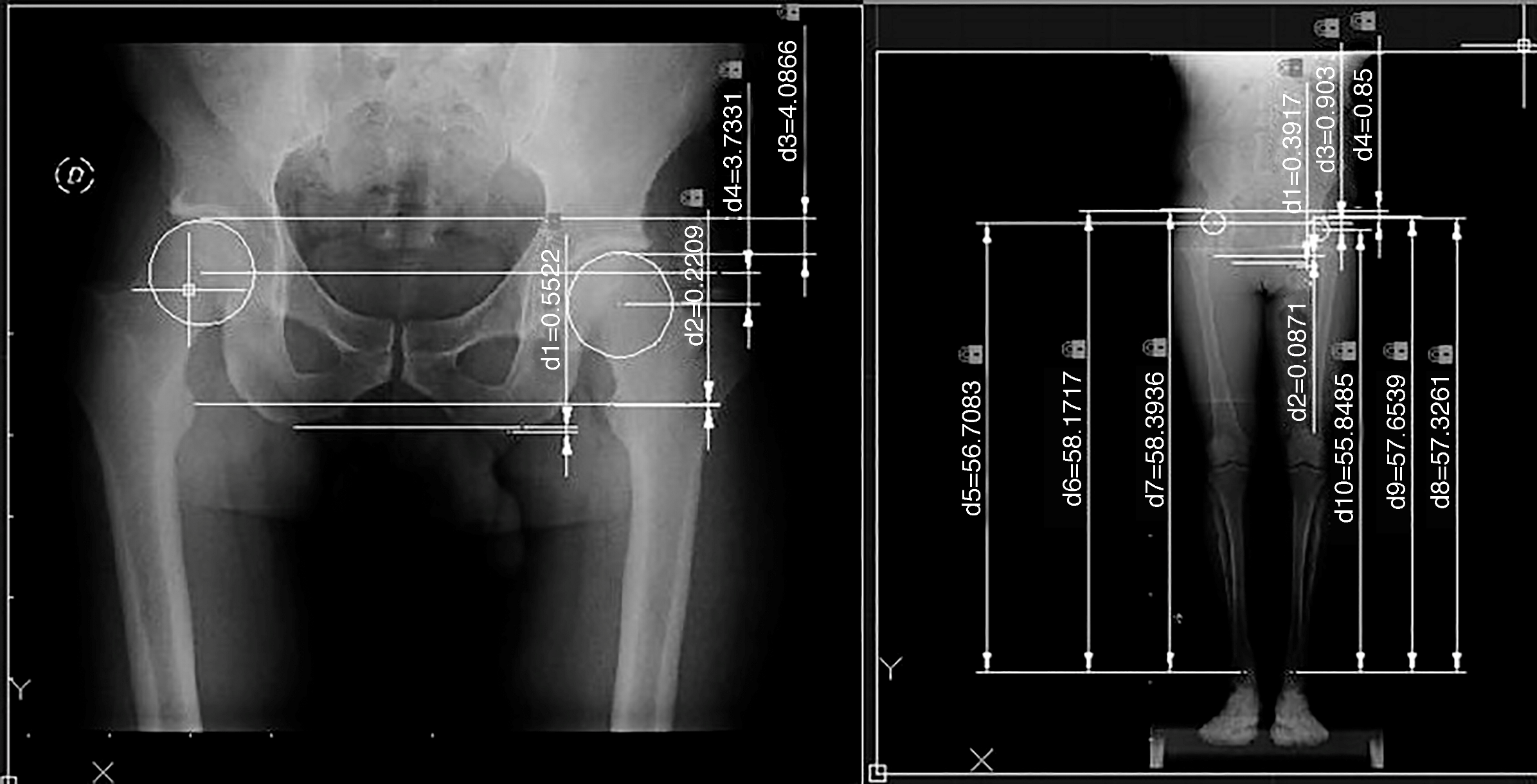
Lower-limb–length discrepancy (LLD) is defined as the condition in which the lower limbs are notably different in length [
1-
3]. This may be structural (when associated with shortened bone structures) or functional (as a result of the difference in positions of lower-limb bone segments) [
1-
3]. There is controversy between the effects on the function and the amount of LLD that should be treated [
1]. The existence of LLD can be an indication of musculoskeletal dysfunction and is an etiologic factor for low-back, back, hip, knee, ankle, and foot pain. It may be the cause of both feet having different morphology and tolerating different loads, which affects gait pattern [
4-
7].
Previous studies have used several diagnostic techniques to measure LLD. Magnetic resonance imaging (MRI) offers the advantage of not exposing the patient to radiation [
8]. Computed tomography (CT) is a method with high interobserver reliability, and there is high concordance between measurement with a tape measure and CT [
9]. This diagnostic method involves the patient undergoing high exposure to radiologic doses. This test also has the disadvantage of not being able to be performed standing; it may hinder correct diagnosis of the LLD [
9]. The tape measure is a simple and preferred method by clinicians to measure LLD [
10]. Other authors have reported a three-dimensional (3-D) reconstruction system using two-dimensional (2-D) radiographs [
9]. Other LLD diagnostic methods reported are anteroposterior pelvis radiography (AP Rx) for hips under load and upright full-length radiography of the lower limbs under load [
9].
Currently, the only validated test for the diagnosis of LLD is upright full-length radiography of the lower limbs [
11]. Different reference points have been reported that can be used to quantify this difference in length [
8-
10,
12-
14]. However, the measurement most commonly used is the upper part of the femur and the distal part of the tibia [
8,
14]. Although, to date, the AP Rx for load-bearing hips is not validated [
15].
The main aim of this study was to validate the AP Rx of load-bearing hips as a test to measure LLD and compare this with upright full-length radiography of load-bearing lower limbs. We also aimed to verify interobserver and intraobserver reliability of the different radiographic measurements for LLD and compare different radiographic measurements taken for the LLD study.
Materials and Methods
Patients
This descriptive and correlational study included 47 consecutive individuals who came to the Podiatry Clinical Area of the University of Seville (Seville, Spain) between February 1, 2013, and December 31, 2014, and who voluntarily participated. The inclusion criteria were closed growth physes, no acute painful symptoms, and LLD. This diagnosis was made by means of a bed measurement protocol in the supine position for both lower limbs with a tape measure from the anterior superior iliac spine to the internal malleolus. It was considered that LLD existed if the difference between the lengths of both lower limbs was 5 mm or greater. The exclusion criteria were acute phase osteoarticular diseases in the lower limb; known congenital malformations in the lower limbs; and surgical arthrodesis of the rachis, pelvis, or lower limbs; or, in women, pregnancy.
Participants were notified of the study procedures, in addition to its benefits, risks, precautions, and adverse effects. All of the participants signed the informed consent form to take part in the study. This study was approved by the University of Seville research ethics committee. A form was filled in with full name, date of birth, sex, height, and weight. Body mass index (BMI) and age were calculated.
Each participant underwent an upright full-length radiographic test for load-bearing lower limbs and an anteroposterior load-bearing hip radiograph according to the same protocol. Both tests were performed with mainstream radiography equipment (GE Compax 400; General Electric, Milwaukee, Wisconsin). The radiographic parameters used were 70 kV and 25 mA/sec for the AP Rx test for load-bearing hips and 82 kV and 51 mA/sec for the lower-limb upright full-length test.
Radiographic Measurements
Upright full-length radiography measured lower-limb length using the following bilateral reference points, used previously in other studies: higher point of the head of the femur [
8,
14], central point of the head of the femur [
9,
12,
13], upper acetabular lip [
10], most prominent point of the lesser trochanter, lower part of the ischial tuberosity, and medial point of the underside of the tibia [
8,
10,
12]. For the hip radiograph, the following bilateral reference points, also used in previous studies, were taken: higher point of the head of the femur [
15], central point of the head of the femur [
15], upper acetabular lip, most prominent point of the lesser trochanter, lower part of the ischial tuberosity, and medial point of the underside of the tibia (
Fig. 1).
Figure 1.
Radiography reference points.
Figure 1.
Radiography reference points.
The following upright full-length radiography measurements were taken: measurement 1 (M1), highest part of the head of the femur at the medial point of the lower articular face of the homolateral tibia; measurement 2 (M2), central part of the head of the femur at the medial point of the lower articular face of the homolateral tibia; measurement 3 (M3), upper acetabular lip at the medial point of the lower articular face of the homolateral tibia; measurement 4 (M4), difference in height between the central point of the head of the left and right femurs; measurement 5 (M5), difference in height between the most prominent point of the left and right lesser trochanters; measurement 6 (M6), difference in height between the lower point of the left and right ischial tuberosities; and measurement 7 (M7), difference in height between the highest point of the head of the left and right femurs. The following measurements were taken on the anteroposterior radiograph of the hips: measurement 8 (M8), difference in height between the central point of the head of the left and right femurs; measurement 9 (M9), difference in height between the most prominent point of the left and right lesser trochanters; measurement 10 (M10), difference in height between the lower point of the left and right ischial tuberosities; and measurement 11 (M11), difference in height between the highest point of the head of the left and right femurs.
For M1 to M3, the measurement was taken at both extremities and the difference was calculated. To calculate the difference in height between both lower limbs for M4 to M11, a tangential line was drawn to the highest point and parallel to the lower border of the radiology plate and the floor. The distance between this line and the lowest point calculated beforehand was calculated. If the right lower limb is longer, the symbol of the measurement is positive, and if it is shorter, it is negative.
Measurements were performed with computer-aided design software (AutoCAD 2013; Autodesk Inc, San Rafael, California) [
16-
18]. Measurements of telemetries and anteroposterior radiographs of the hips were always performed by the same observer (M.R.B), who was blinded to the clinical assessment of LLD. The main observer took the measurements twice. For the intraobserver assessment, the same assessor who measured the 47 cases (M.R.B.) measured the first ten a second time, with a gap of 4 weeks between the first and second measurements. For the calculation of interobserver reliability, a second assessor also blinded to the clinical evaluation measured the first ten cases. There were 847 measurements taken for the study.
Statistical Analysis
Data were analyzed with a statistical software program (SPSS for Windows; IBM Corp, Armonk, New York). It was verified by means of the Kolmogorov-Smirnov normality test that the data follow a normal distribution. The total sample was reported according to age, BMI, and M1 to M11 (mean, maximum, minimum, and typical deviation were calculated). Frequencies for sex and laterality were calculated.
The interobserver and intraobserver reliability test was performed by means of the intraclass correlation coefficient (two factors, mixed effects), and the correlation is considered high if greater than 0.75 [
19].
Bivariate correlations were analyzed between the different measurements from M1 to M11 by means of the Pearson correlation coefficient. The means of M2 to M11 were compared with M1 [
8,
14] (the most commonly reported in the literature) by the Student
t test for related samples. The difference was statistically significant when values were less than 0.05.
Results
The sample comprised 47 participants aged 17 to 61 years (mean ± SD, 31.47 ± 11.42 years); 23 (48.9%) were women and 24 (51.1%) were men. A total of 95.7% and 4.3% were right-handed and left-handed, respectively. The BMI (calculated as weight in kilograms divided by height in meters squared) ranged from 18.51 to 31.71 (mean ± SD, 24.34 ± 3.13).
Table 1 shows the descriptive values for M1 to M11.
Table 1.
Descriptive Values (Minimum, Maximum, Mean, and Typical Deviation) of Measurements 1 to 11
Table 1.
Descriptive Values (Minimum, Maximum, Mean, and Typical Deviation) of Measurements 1 to 11
Interobserver and intraobserver reliability was high for all of the measurements because the intraclass correlation was greater than 0.75 in all cases (
Table 2).
Table 2.
Interobserver and Intraobserver Reliability: Interclass Correlation Coefficients
Table 2.
Interobserver and Intraobserver Reliability: Interclass Correlation Coefficients
There was a strong and positive correlation between the different measurements because coefficient positive values close to 1 were found when performing bivariate correlations by means of the Pearson correlation (
Table 3).
Table 3.
Pearson Correlation Matrix
Table 3.
Pearson Correlation Matrix
Table 4 shows the results of the Student
t test for related samples when comparing the means of M2 to M11 with M1. Statistically significant differences were found between pairs M1 to M4 and M1 to M7 only.
Table 4.
Student t Test for Related Samples to Compare the Means of M1 with M2 to M11
Table 4.
Student t Test for Related Samples to Compare the Means of M1 with M2 to M11
Discussion
The main aim of this study was to validate the AP Rx of load-bearing hips as a test to measure LLD and compare this with upright full-length radiography of load-bearing lower limbs. We also sought to verify interobserver and intraobserver reliability of the different radiographic measurements for LLD and compare different radiographic measurements taken to study LLD.
According to the results, LLD has also been quantified in load-bearing hip upright full-length radiography and radiographs. There is a debate about what is the ideal test for its diagnosis. There was a strong and positive correlation between all of the measurements taken in the hip and LLD measurements. Comparing the difference in length M1 with measurements taken at the hips, there were no statistically significant differences. This meant being able to undertake an anteroposterior radiograph for the load-bearing hip to quantify LLD of the lower limbs; in clinical practice this will entail a reduction in the radiation to which the patient is exposed and a reduction in the cost of the additional test.
Intraobserver and interobserver reliability was verified for all of the measurements. This means that these measurements were reproducible using the AutoCAD software. Although used on various occasions to measure radiographs, to date there is no record of its use to quantify LLD.
Different reference points are reported to quantify LLD in lower-limb upright full-length radiography [
8-
10,
12-
14]. According to this study, similar results were obtained as the most common measurement (M1) [
8,
14], except for M4 and M7. Given that these measurements were taken for upright full-length radiography and only the reference point of the central and highest part of the femur was used, respectively, without considering the reference point of the lower part of the tibia, it is thought that it is more correct to perform both lower-limb–length measurements by calculating their difference instead of using only one measurement point. We believe that it is positive to be able to use several reference points due to the different bone morphological characteristics that at times hinder locating these points.
In 2011, Doyle and Winsor [
8] performed a study to verify the usefulness of MRI when measuring LLD. Lower-limb length (femur and tibia separately and total for each lower limb) was quantified by two different assessors, twice for each measurement. Very high intraobserver and interobserver reliability was observed, with a correlation coefficient greater than 0.99. The sum of the individual measurements of the femur and tibia and the total lower-limb measurement revealed a correlation coefficient greater than 0.99. There were no statistically significant differences between these measurements, and they were 99.9% similar.
Gheno et al [
9] performed a study in 2012 with the aim of evaluating 3-D radiologic reconstruction of the lower limbs from different radiologic images. Computed tomography was used to reconstruct the lower limb, and tibia and femur length measurements were compared from the 3-D reconstruction and the CT scan. No statistically significant differences were found between both measurements. Comparing the femur and tibia length measurements of both observers revealed a high correlation. According to these authors, the measurements in 2-D projections were not reliable to quantify LLD, although 3-D reconstructions were reliable with the added advantage of being able to be performed under load-bearing conditions; irradiation was also reduced regarding CT [
9].
In 2014, Guggenberger et al [
20] performed a study to compare the valuation of LLD in CT, upright full-length radiography, and 3-D models based on 2-D radiographs. When the three measurements were compared, small, nonsignificant statistical differences without any clinical relevance were found. Measurements revealed high interobserver reliability for all of them but higher values for upright full-length radiography.
Interobserver reliability of the measurements was demonstrated in the two aforementioned studies just as in the present study. As for the validity of methods to quantify LLD, Gheno et al [
9] did not consider 2-D projections reliable, and Guggenberger et al [
20] did not find statistically significant differences when they compared the different measurement methods. It would be interesting to compare the present results with 3-D reconstructions and CT to be able to verify whether there is a high correlation between these measurements and, thereby, be able to demonstrate the validity of the anteroposterior projection for hips and upright full-length radiography [
9,
20].
Although radiographs reveal a 2-D image of the lower limbs, according to the present study results they are useful to quantify LLD of the lower limbs. Similar to other authors [
20], we believe that upright full-length radiography is a suitable method to assess LLD because it is accessible and the body is exposed to little radiation. To date, it is considered the gold standard to quantify LLD [
1] and the most commonly used measurement in clinical practice. Considering that according to the present results radiography of the load-bearing hips provides similar data as upright full-length radiography, we could consider the usefulness of this additional test for the evaluation of LLD.
A limitation of this study was not verifying LLD with other diagnostic tests, such as CT and MRI. In future studies it would be interesting to verify whether the differences in length quantified in the radiographs are similar to those revealed in other diagnostic tests to thus be able to verify the usefulness of radiologic tests. Correlation of these results could also be demonstrated with other clinical tests, such as quantification of LLD with a tape measure. Another shortcoming was the reduced sample group and amount of LLD. Future studies should increase the sample number and amount of LLD to verify or refute these results.
In summary, the anteroposterior radiography test for load-bearing hips was a valid and reliable method to diagnose LLD of the lower limbs in those taking part in this study. The radiographic measurement protocol used to evaluate LLD in this work has high intraobserver and interobserver reliability.