Lawrence and Botte [
1] classified fifth metatarsal base fractures into three types according to anatomical subgroup: tuberosity avulsion fractures in zone 1, fractures at the metaphyseal–diaphyseal junction (Jones fracture) in zone 2, and proximal diaphyseal stress fractures in zone 3. Torg [
2] classified fractures involving the zone 1 fifth metatarsal base into intra-articular and extra-articular fractures according to the involvement of the intra-articular surface.
Zone 1 fifth metatarsal base fracture is the most common forefoot fracture; however, the current treatment recommendations for this fracture are controversial, and debate is ongoing regarding its pathomechanics [
3-
5]. Although conservative care was the most common treatment for zone 1 fifth metatarsal base fracture, it was also associated with a considerable risk of complications, a long period of rehabilitation, delayed union, and cubometatarsal joint arthritis [
3,
4]. Therefore, some surgeons have recognized that fractures of the tuberosity that are displaced more than 2 mm or comminuted and zone 1 displaced fractures that involve more than 30% of the cuboid–fifth metatarsal joint may require open reduction and internal fixation [
5-
7].
Many methods have been reported for the fixation of fifth metatarsal base fracture in zone 1, including tension band wiring, crossed Kirschner wires, headless screws, and intramedullary screw fixation [
5,
7-
9]. However, there is no consensus regarding which technique will achieve the best functional outcome [
10]. With these techniques, it is often difficult to achieve rigid fixation and early mobilization when the distal fragment is small or comminuted or when the bone is osteoporotic [
7,
9,
10]. Moreover, complications associated with these techniques may include pin migration, hardware prominence, loss of reduction, and sural nerve neurapraxia [
10,
11].
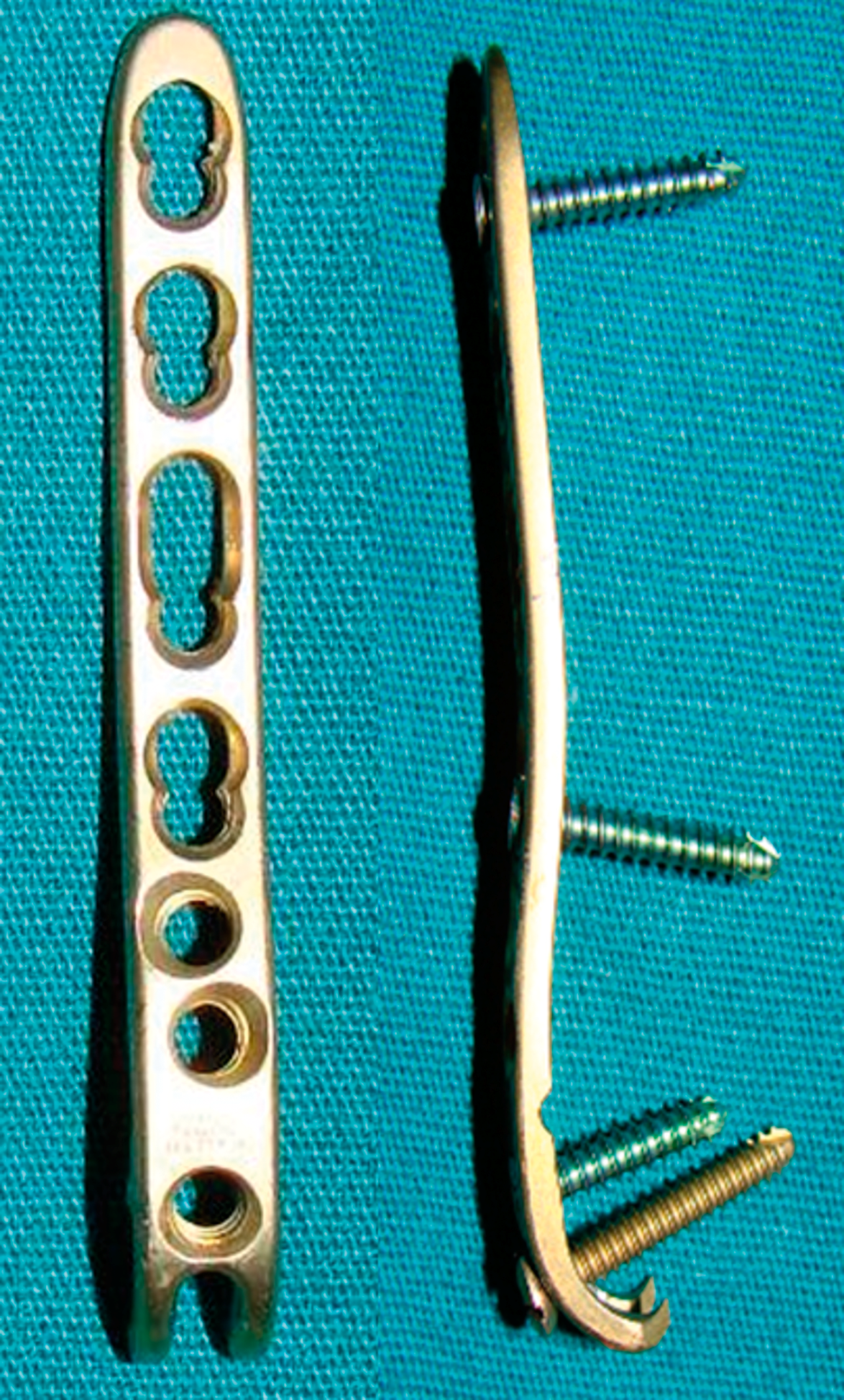
Recently, the locking compression plate distal ulna hook plate (LCP-DUHP) (DePuy Synthes, Oberdorf, Switzerland) (
Fig. 1) was introduced for the treatment of fifth metatarsal base fractures, but without dedicated attention to zone 1 [
6]. The purpose of the present study was to evaluate the clinical outcomes of distal ulna hook plate fixation of displaced or comminuted fifth metatarsal base fractures in zone 1.
Figure 1.
Photographs of the locking compression plate distal ulna hook plate.
Figure 1.
Photographs of the locking compression plate distal ulna hook plate.
Methods
After the institutional review board of Pu’Ai Hospital (Wuhan, China) approved the study protocol and consent forms, the risks and benefits were discussed and the patient provided informed consent. Twenty-one patients were included in the present study from March 1, 2012, to May 31, 2014, including 10 men and 11 women, with a mean age of 47.27 years (range, 27–59 years) and single foot involvement. The mechanisms of injury were a fall from a height in nine patients, step-to-step inversion injury in eight patients, and a sports injury in four patients. The inclusion criteria were the presence of an isolated fifth metatarsal base fracture in zone 1 with more than 2 mm of displacement or comminuted fractures of the tuberosity and fractures that involve more than 30% of the cuboid–fifth metatarsal joint, with follow-up of more than 12 months. The exclusion criteria were nondisplaced zone 1 fifth metatarsal base fracture and other combined foot or ankle fractures.
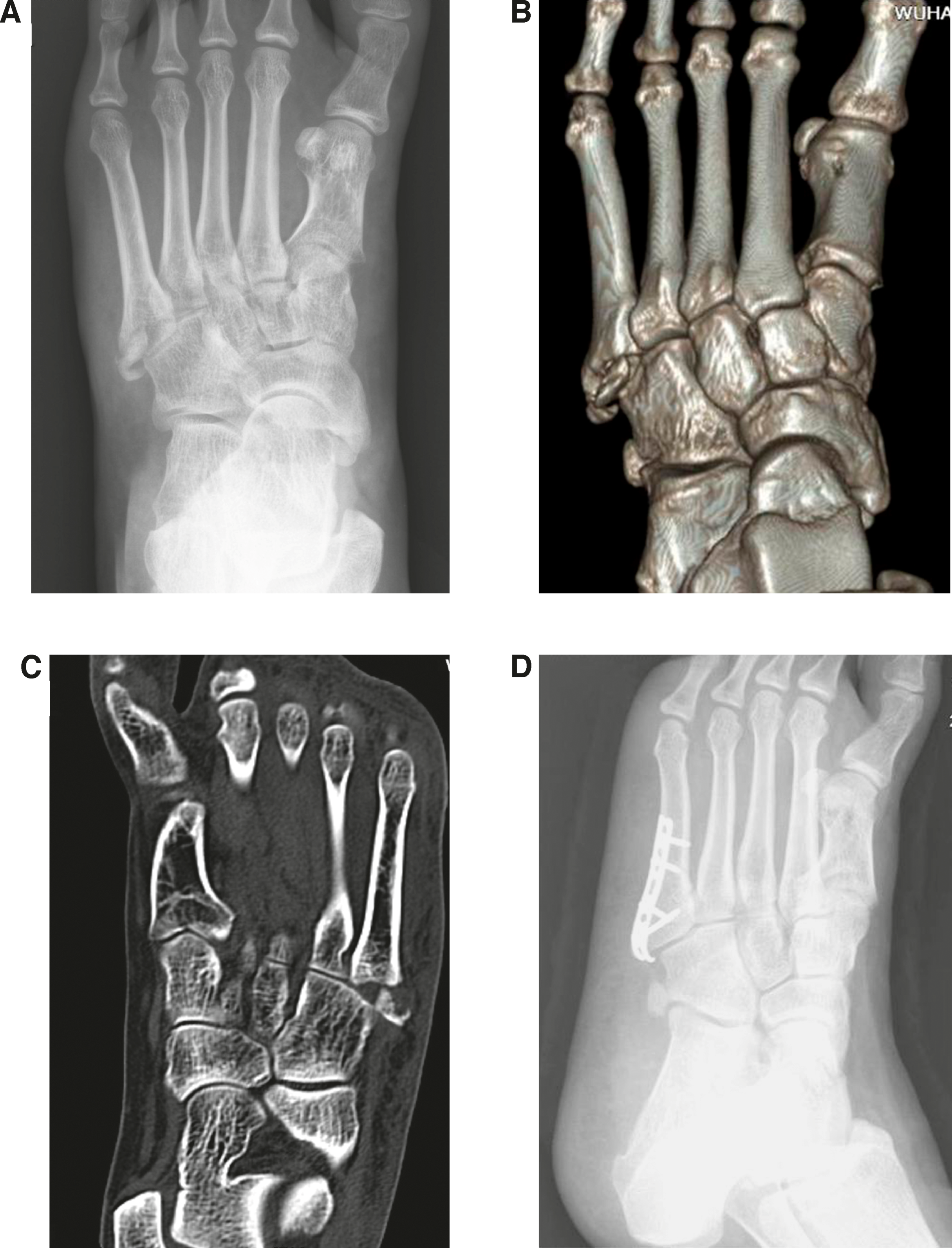
Of the 21 patients, 13 had a zone 1 extra-articular fracture with displacement greater than 2 mm and eight had a zone 1 fracture with disruption of the cuboid–fifth metatarsal joint that involved more than 30% of the joint (with displacement less or more than 2 mm) (
Fig. 2 A–C). All of the patients underwent surgery within 4 days after the injury. All of the procedures were performed by one of us (B.Y.).
Figure 2.
Views of a 32-year-old woman with a zone 1 fifth metatarsal base fracture. A, Preoperative radiograph showing a zone 1 fracture that involves more than 30% of the cuboid–fifth metatarsal joint. B, Preoperative computed tomographic scan showing a zone 1 comminuted fracture. C, The cross-section showing intra-articular fracture with more than 2 mm of displacement. D, Radiograph 4 weeks after surgery showing satisfactory fracture reduction and internal fixation.
Figure 2.
Views of a 32-year-old woman with a zone 1 fifth metatarsal base fracture. A, Preoperative radiograph showing a zone 1 fracture that involves more than 30% of the cuboid–fifth metatarsal joint. B, Preoperative computed tomographic scan showing a zone 1 comminuted fracture. C, The cross-section showing intra-articular fracture with more than 2 mm of displacement. D, Radiograph 4 weeks after surgery showing satisfactory fracture reduction and internal fixation.
Under spinal anesthesia, the patient was placed in the supine position with elevation of the hip on the affected side. The surgery was performed with the help of a thigh tourniquet. A dorsolateral 5-cm incision was made, and blunt dissection was performed carefully to avoid injury to the lateral dorsal cutaneous branch of the sural nerve and peroneus brevis tendon. The periosteum was elevated, and the fracture fragment was exposed. The main fracture fragment was then reduced and held with temporary Kirschner wires. If necessary, the plate was bent to fit the shape of the styloid process of the metatarsal base, the fifth metatarsal tuberosity was gripped by pointed hooks, and then the plate was fixed temporarily by inserting a cortex screw through the sliding hole located in the midpiece of the plate. The plate position was adjusted depending on the location of the primary fracture; once the fracture fragments were reduced to their desired alignment, the screw was tightened up, and then the Kirschner wire was removed. Locking screws were inserted into the diaphysis of the fifth metatarsal to ensure that the plate was held securely to the bone. To ensure that the screws were not in the joint, proper joint reconstruction and proper positioning of the plate using multiple radiographic images were confirmed.
Postoperatively, a nonweightbearing short-leg splint was applied in a neutral position for 3 weeks. Three weeks of weightbearing with a short-leg boot was then allowed. All of the patients were allowed to return to full weightbearing and activity when they were clinically asymptomatic and the radiographs revealed evidence of union.
The patients were evaluated clinically and radiographically, and mean follow-up was 14.32 months (range, 13–19 months). The following factors were assessed: interval to union, functional recovery, and the incidence of complications (ie, infection, sural nerve neurapraxia, delayed union, nonunion, repeated fracture, and post-traumatic cubometatarsal arthritis). Radiographs taken immediately after surgery; at 2, 4, 6, and 8 weeks; and monthly thereafter were examined for evidence of fracture healing, implant failure, and plate migration. Radiographic healing was defined as obliteration of the fracture lines. Clinically, the American Orthopaedic Foot and Ankle Society midfoot scale questionnaire was administered preoperatively and again 1 year postoperatively.
Results
Congruent reduction and satisfactory cubometatarsal joint surfaces (anatomical or intra-articular step-off of <1 mm) were present in 19 patients (
Fig. 2D). In two patients, a remaining incongruity of more than 1 mm was measured on postoperative lateral radiographs. Radiographic bony union was obtained in all of the patients at a mean of 61.9 days (range, 52–85 days). Secondary loss of correction was not seen in the study.
The mean time to full weightbearing and previous activities of daily living was 79.8 days (range, 59–91 days). American Orthopaedic Foot and Ankle Society midfoot scores improved to a mean of 93.16 points (range, 87–100 points) 1 year postoperatively from a mean preoperative score of 42.25 points (range, 27–55 points). Nineteen patients were completely pain free at the follow-up visit, and no patients experienced paresthesia over the sural nerve distribution. Two patients showed radiographic signs of mild degenerative changes or joint space narrowing and noted mild pain with heavy work. In addition, they had to change their position within their company, as both were builders and involved in heavy lifting and climbing ladders as part of their previous position. During postoperative management, one patient reported hardware irritation, which finally healed after implant removal.
Discussion
The incidence of zone 1 fractures in all fifth metatarsal base fractures has been reported to be approximately 93% [
12,
13]. This area is the insertion of the plantar aponeurosis, peroneus brevis, and peroneus tertius [
13]. Therefore, a fracture in this area will continuously receive traction force from around the soft tissue, which could render nonoperative treatment difficult [
11,
13]. The optimal surgical treatment has not yet been determined, but it should include an internal fixation device that can resist the torsion, tension, and bending of the metatarsal [
13,
14]. Tension band wiring of displaced or small comminuted zone 1 fractures is technically difficult and may fail because of unreliable purchase and inadequate reduction [
15,
16]. In that sense, anatomical reduction and plate fixation with some form of locking system and some degree of compression might be a solution [
6,
17].
Because of the similar anatomical architecture between the fifth metatarsal base and its tuberosity and the distal ulna [
6], the LCP-DUHP was anatomically fit to the fifth metatarsal base properly; meanwhile pointed hooks can be firmly anchored into the tuberosity that can provide rotational stabilization and compression of the small, marginal fragments, regardless of the bone quality and the presence of multiple fragments. The plate is thin and the proximal hook is hollow, enabling the surgeon to avoid injury to the lateral band of the plantar fascia. By providing stable fixation of these fractures, the rehabilitation period can be minimized, with early ambulation and the initiation of active range-of-motion exercises [
6,
18,
19]. We initiated active range-of-motion exercises an average of 3 to 4 days after surgery, which allows a rapid return to pre-injury levels of activity [
14]. Operative fixation shortens the recovery time and decreases the rates of nonunion and delayed union [
5,
6].
In the present study, no patients experienced paresthesia over the sural nerve distribution. Sural nerve neurapraxia has been reported with tension band wiring and intramedullary screw fixation [
7,
19,
20], because both techniques required a more than 2-cm-long longitudinal incision that runs proximally along the axis of the fifth metatarsal diaphysis from its tuberosity, [
20] which can cause injury to the pathway of the sural nerve. A bifurcation of the lateral dorsal cutaneous branch of the sural nerve was usually located an average of 18 mm posterior and 11 mm dorsal to the base of the fifth metatarsal [
20]. Investigation of potential nerve injury was performed using a cadaveric study of 10 feet after undergoing placement of a cannulated screw [
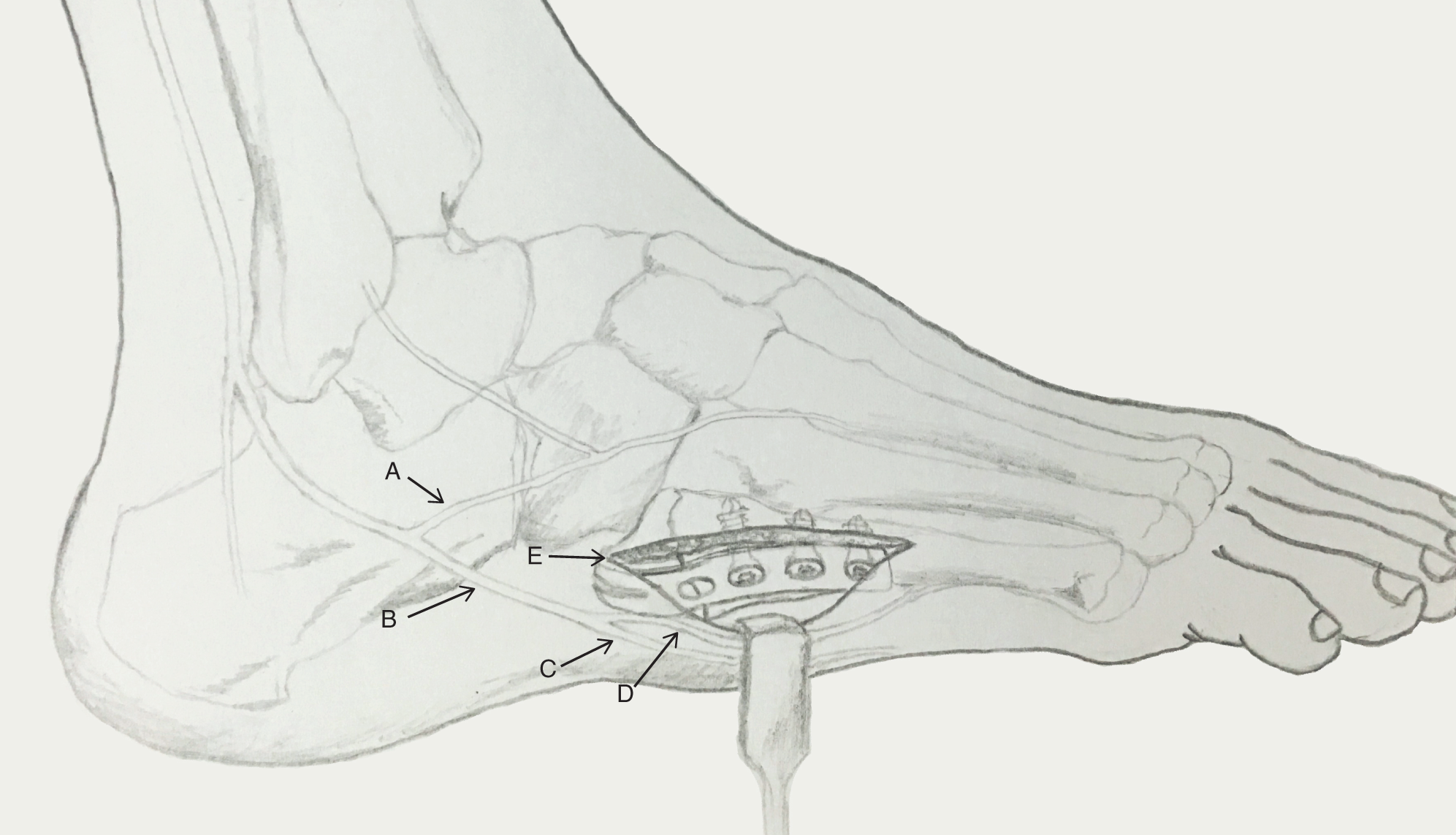
21]. Exploration of the specimens revealed that the dorsolateral branch of the sural nerve was most at risk. Their results showed that the nerve was injured in one specimen. In contrast, the skin incision in the present study was not extended proximally to the fifth metatarsal base tuberosity but, rather, was limited over the fracture area (
Fig. 3). Therefore, the risk of sural nerve injury will be relatively low.
Figure 3.
A schematic representation of the distribution of the cutaneous nerves of the dorsum of the foot in relation to the fractures site and the incision. A, Anastomotic branch (to the intermediate dorsal cutaneous nerve). B, Lateral dorsal cutaneous nerve (LDCN). C, Dorsolateral branch of the LDCN. D, Dorsomedial branch of the LDCN. E, Proximal end of the incision.
Figure 3.
A schematic representation of the distribution of the cutaneous nerves of the dorsum of the foot in relation to the fractures site and the incision. A, Anastomotic branch (to the intermediate dorsal cutaneous nerve). B, Lateral dorsal cutaneous nerve (LDCN). C, Dorsolateral branch of the LDCN. D, Dorsomedial branch of the LDCN. E, Proximal end of the incision.
The present study lacked comparison groups for various fixation techniques. Despite these limitations, the results indicate that use of the LCP-DUHP for zone 1 fifth metatarsal base fractures is an attractive method to achieve accurate anatomical reduction and stable fixation of these displaced and comminuted fractures, which results in more rapid recovery and better function.
Conclusions
The LCP-DUHP might be considered an effective surgical method for zone 1 displaced fifth metatarsal base fractures, especially multifragmentary, osteoporotic fifth metatarsal base fractures.