


Abstract
Malreduction of a distal fibular fracture can lead to degenerative changes in the ankle joint. Previous studies have shown that the selective use of various fibular reconstructive osteotomies may halt the progression of degenerative arthritis by restoring the normal tibiotalar contact area and decreasing the stresses on the articular cartilage. In this case report, we achieved alignment with restoration of the talocrural angle and Shenton's line of the ankle using a transfibular osteotomy and an allogeneic fresh-frozen femoral head graft to fill the resultant defect. The advantage of this procedure is twofold. First, fibular-lengthening procedures may potentially decrease the eventual need for joint-sacrificing procedures such as an arthrodesis or arthroplasty. Second, an allograft allows for larger deficit correction without concern for donor-site morbidity. To our knowledge, this is the first case report using a fresh-frozen femoral head allograft for a fibular-lengthening osteotomy in the podiatric medical literature. Further research with larger patient populations is needed to establish whether fresh-frozen femoral head allograft is a reliable graft option for fibular-lengthening procedures.
Failure to restore the length of the fibula after an ankle fracture has been shown to lead to poor outcomes. Malreduction of a distal fibular fracture results in external rotation and shortening of the fibula. This is followed by a lateral shift of the talus accompanied by permanent instability and a valgus tilt.[1] Often, patients will develop degenerative arthritis attributable to an abnormal tibiotalar contact area and increased stresses on the articular cartilage.[2,3,4]
Subjective symptoms of those presenting with residual ankle incongruity are usually nonspecific and include pain, swelling, stiffness, and occasional instability.[3,5] It is not uncommon for patients to present several years after the initial injury, so it is important to evoke a proper history of trauma and maintain a high level of clinical suspicion for the condition. Owing to variations in patient subjectivity, emphasis is placed on objective findings in the diagnosis of fibular malunions.[5]
Radiographic evaluation of a normal ankle on mortise view should reveal equal joint spaces, an intact Shenton line of the ankle, and an unbroken curve between the lateral talus and the peroneal groove of the fibula. Irregularity seen with these criteria is suggestive of a malaligned ankle.[1] The relative amount of shortening of the fibula can be correlated with the bimalleolar and talocrural angles. Sarkisian et al[6] described the talocrural angle as the angle formed from a line perpendicular to the tibial plafond with a line drawn between the inferior tips of the malleoli. The average measurement was found to be 78.5° (range, 75°–86°), with a difference of 3° or more to the contralateral side, indicative of shortening. The bimalleolar angle, as detailed by Rolfe et al,[7] is formed from a vertical line drawn parallel to the intramedullary canal of the distal fibula with a line connecting the distal tips of the malleoli. The angle was discovered to be 77.8° (range, 72°–86°), with a difference of 2.5° between sides demonstrating shortening. The talocrural and bimalleolar angles will increase as the fibula shortens, and abnormal fibular shortening is reflected by an approximate linear relationship of 1° angle difference to 1 mm of shortening.[3,5,6,7]
Evaluation of the tibiofibular syndesmosis is also of great importance in reconstruction of the fibula. Any synostosis present between the fibula and tibia should be addressed to ensure adequate mobility of the distal fibula after osteotomy. If substantial disruption of the tibiofibular syndesmosis must be performed to allow relocation of the fibula, it should be repaired as needed. In addition, if the tibiofibular relationship demonstrates a propensity for diastasis intraoperatively, then syndesmotic screws may be used accordingly.[5]
Increased use of fibular reconstruction in carefully selected patients may reduce the progression of degenerative, arthritic changes and decrease the need for joint-sacrificing procedures such as arthrodesis or arthroplasty.[8] Several authors have reported techniques for lateral malleolus reconstruction using varying types and locations of fibular osteotomies, with or without the use of bone graft or syndesmotic fixation.
Transverse osteotomy with bone grafting and internal fixation has been shown to be an effective treatment for shortening. Weber and Simpson[1] described lengthening of the distal fibula in 23 patients using a transverse osteotomy with autologous tibial bone graft and plate fixation. Of these patients, 74% experienced good-to-excellent results and 26% fair-to-poor results. The authors noted that careful patient selection is paramount to successful reconstruction because the presence of advanced arthritis preoperatively correlated to unfavorable outcomes. In addition, they also observed benefit in patients irrespective of time elapsed from initial injury. No patients in that series received a syndesmotic screw.
In the largest study conducted to date, Yablon and Leach[4] used a similar surgical technique on 26 patients. Twenty of these patients (77%) were able to return to preinjury levels of activity, three (11.5%) noted improvement of symptoms with intermittent pain, and three (11.5%) had no benefit from the procedure. In situations with obvious talar displacement, syndesmotic reduction and fixation was performed.
Sinha et al[9] performed a transverse infrasyndesmotic fibular osteotomy in conjunction with using tricortical iliac bone graft to correct malunion after open reduction and internal fixation in seven patients. All seven of the patients studied achieved satisfactory bony union and correction of persistent talar shift at an average of 11 months of follow-up (range, 6–24 months).
Some surgeons have popularized techniques that do not require the use of bone graft. Chao et al[10] described a long oblique osteotomy in the sagittal plane at the level of the previous fracture in 12 patients. After mobilization of the tibiofibular ligaments, the surgeons were able to move the distal fragments 4 to 5 mm without difficulty. None of the patients demonstrated radiographic progression of arthritis after mean follow-up of 34 months (range, 27–48 months).
Thangarajah et al[11] reported the outcomes of four patients using a suprasyndesmotic Z-lengthening osteotomy of the fibula. All of the patients returned to full mobility with satisfactory outcomes at their latest clinical review. However, the authors did not disclose a distinct follow-up period.
Weber et al[12] compared the outcomes of both a standard transverse cut versus a sliding Z-osteotomy in the coronal plane in six patients with mean follow-up of 4.3 years (range, 2.3–8.3 years). No difference was noted in the postoperative outcome regarding the type of osteotomy performed. However, the sliding Z subtype did not necessitate the additional procedure of application of tibial autogenous bone graft.
More recently, Brin et al[13] reported the use of a cervical spine cage with locking plate fixation as an alternative to bone grafts in three patients. The mean length restored was 6 to 8 mm, and all of the patients returned to full weightbearing with improved symptoms at 1-year follow-up. No intraoperative or perioperative complications were reported.
In this case report, we present the treatment of a malunited distal fibular fracture using a lengthening and rotational osteotomy with a fresh-frozen femoral head allograft. To our knowledge, this is the first case report using a fresh-frozen femoral head allograft for a fibular-lengthening osteotomy in the podiatric medical literature.
Case Report
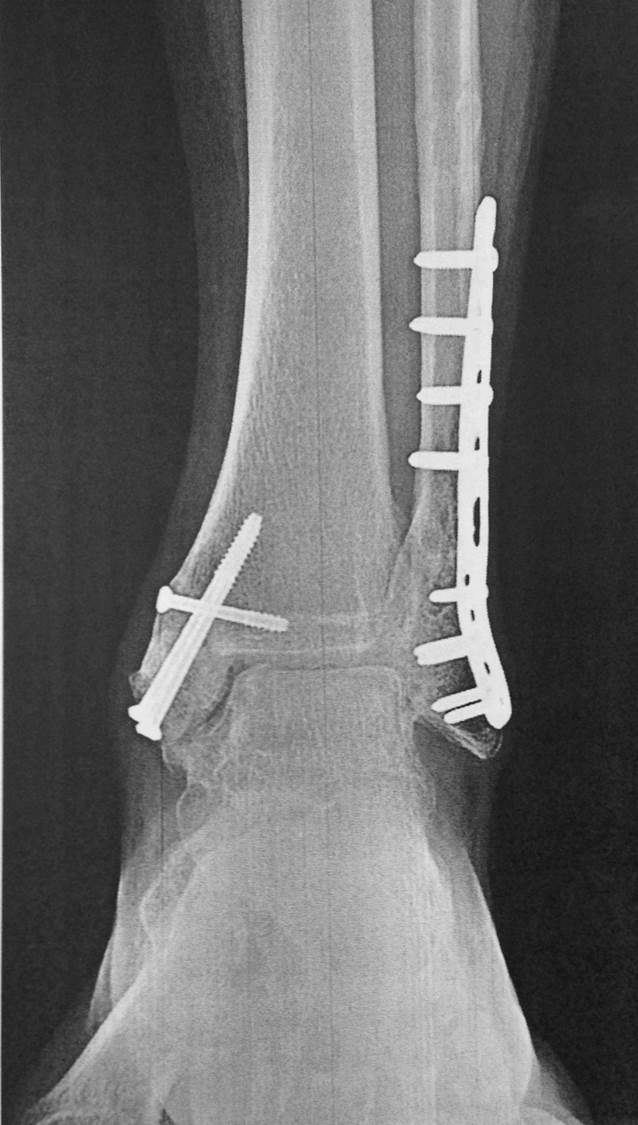
A 43-year-old man on workers' compensation presented with a chief concern of a chronically painful left ankle of 55 months' duration. The patient reported a history of trauma to the area in which a table fell on his ankle resulting in an open bimalleolar fracture with comminution of the fibular fragment. At that time, an orthopedic surgeon attempted open reduction and internal fixation of the fracture. However, despite their best efforts they were unable to adequately restore the length of the fibula due to the degree of comminution present. Six months later, the patient had an ankle arthroscopy as well as a medial malleolar osteotomy performed to remove a loose body from the medial aspect of the ankle joint. The patient, despite this, continued to note pain and stiffness of the ankle and was referred to our clinic. Clinical examination revealed that his medial and lateral malleoli were level with each other (Figure 1). Radiographs revealed a malrotated fibula, drastically increased talocrural angle, and laterally rotated talus with minimal arthritic changes to the ankle joint (Figure 2). The talocrural angle was 82° on the symptomatic limb and 75° on the contralateral side, a difference of 7°. After an extensive talk with the patient regarding potential postoperative complications and the possible need for a future ankle arthrodesis or arthroplasty, the patient elected surgical lengthening of the fibula with allograft bone.
Figure 1
.
Clinical view demonstrating a shortened fibula almost in the same line as the medial malleolus.
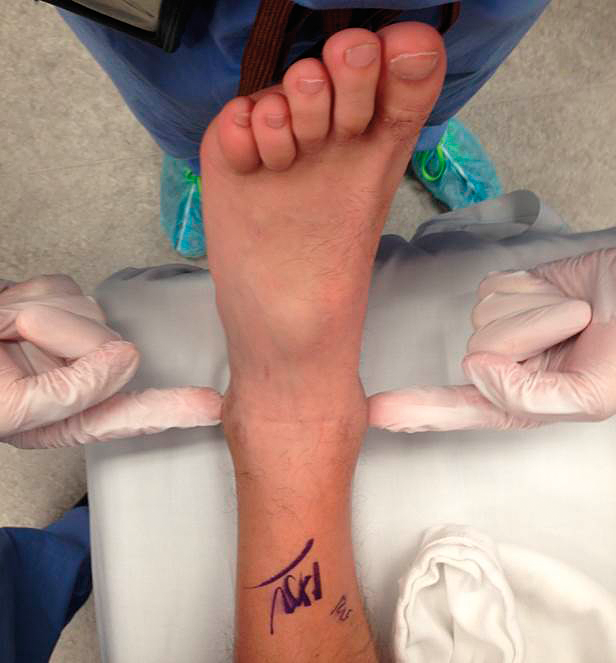
Figure 2
.
Preoperative anteroposterior view of the left ankle showing a malreduced and shortened fibula after open reduction and internal fixation of an ankle fracture.
Procedure
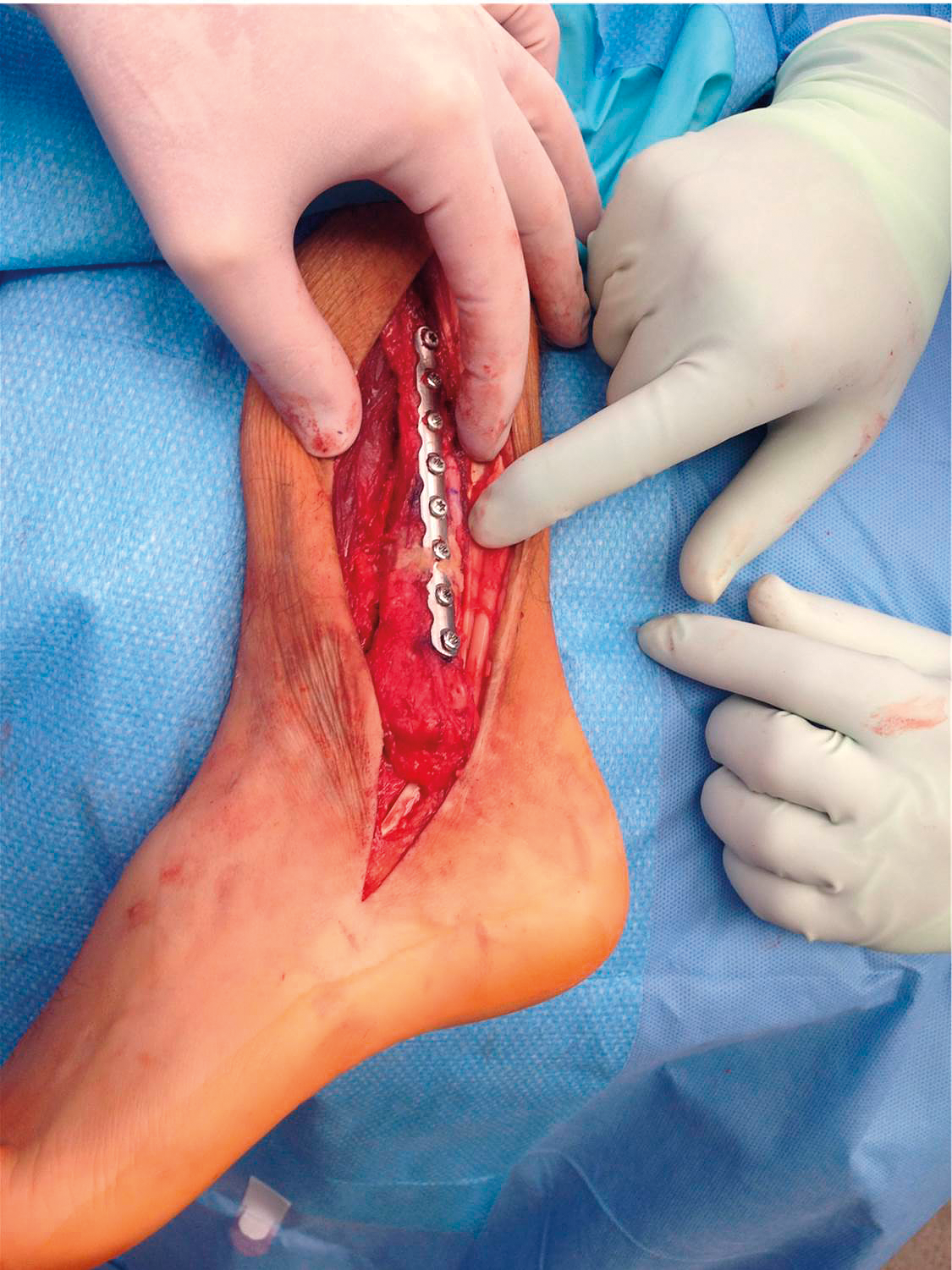
A popliteal block was administered in the preoperative setting. General anesthesia was obtained, and the patient was placed in a lateral decubitus position. A linear incision was made directly on top of the previous healed incision site, and the previously placed hardware was subsequently removed. At this point, one could easily visualize external rotation and shortening of the fibula (Figure 3). To correct this, a transverse fibular osteotomy was performed using a sagittal saw (Figure 4). The resected distal fibula was freed from deep surrounding soft tissues in a sharp and meticulous manner. This also allowed visualization of the lateral ankle joint, where no true arthrosis or deep cartilage defect was noted. The distal fibula was then positioned from its externally rotated position and re-articulated with the talar incisura and held with two 0.062 Kirschner wires into the talar body. A one-third eight-hole tubular plate was then placed along the distal reduced fibula using two 3.5-mm cortical screws. At the proximal level of the fibula, a 3.5-mm cortical setscrew was then placed for lengthening purposes. A lamina spreader was placed between the proximal screw and the proximal end of the fibular plate, and slowly the fibula was brought to length by increasing the space at the level of the transverse fibular osteotomy. The appropriate lengthening and manual rotation was also confirmed with intraoperative fluoroscopy. The amount of distraction needed to restore fibular length and the talocrural angle was approximately measured to be 10 mm. Once the lengthening was achieved, proximal screws were placed across the plate. Next, a fresh-frozen femoral head allograft was cut to the appropriate size, placed between the distraction site, and held with a cortical screw. Any gaps were also filled with demineralized bone matrix bone putty (Figure 5). Syndesmotic reduction forceps were then used, and a screw was then placed across the tibiofibular syndesmosis. Also note that the allograft was placed in position to act as a syndesmotic stabilizer because it extended into the tibiofibular interspace. All of the reductions were double checked under fluoroscopy before final fixation. At the end of the procedure, the lateral malleolus was not only distracted distally and properly aligned, it was also internally rotated. The syndesmotic screw was placed to prevent any potential diastasis and did not enter the ankle joint. The peroneal tendons were noted to be well secured under the fibular groove. Deep soft tissues were reapproximated using an absorbable suture. The skin was reapproximated and coapted using nylon in a running interlocking suture technique. After wound closure, a below-the-knee fiberglass cast was applied and bivalved to allow for swelling.
Figure 3
.
View of the shortened and malrotated fibula after hardware removal.
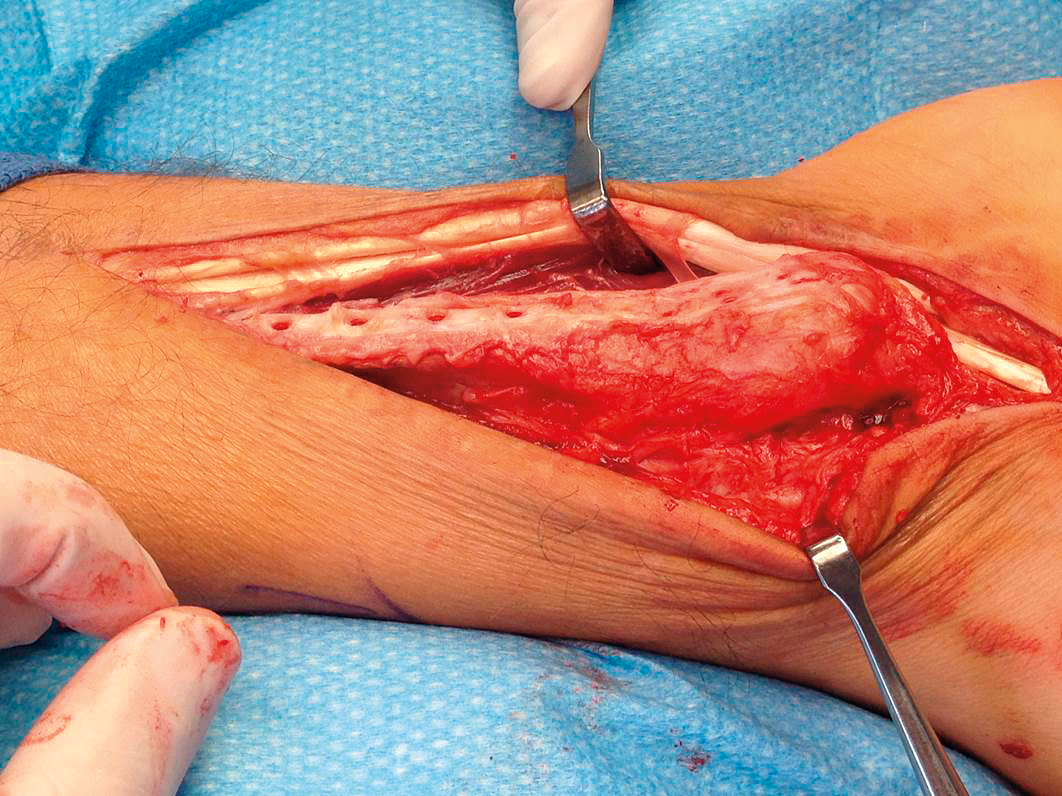
Figure 4
.
View after transverse osteotomy and manual derotation of the fibula.
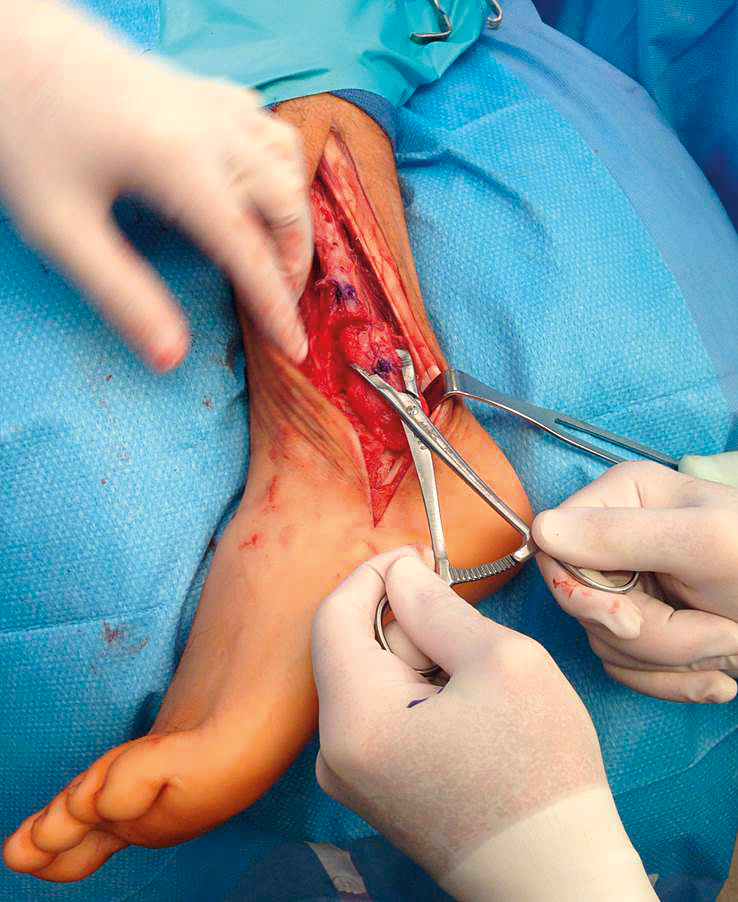
Figure 5
.
View after distraction and fixation of the allograft femoral head with bone putty supplement. Approximately 10 mm of lengthening is achieved.
Discussion
The goal of reconstructive intervention for malunion to the distal fibula is to restore the anatomical alignment, joint congruity, and ankle joint stability.[3] The rationale for the use of fibular-lengthening procedures is to potentially decrease the need for joint-sacrificing procedures such as arthrodesis or arthroplasty by decreasing the progression and symptoms of degenerative changes in the ankle.[8]
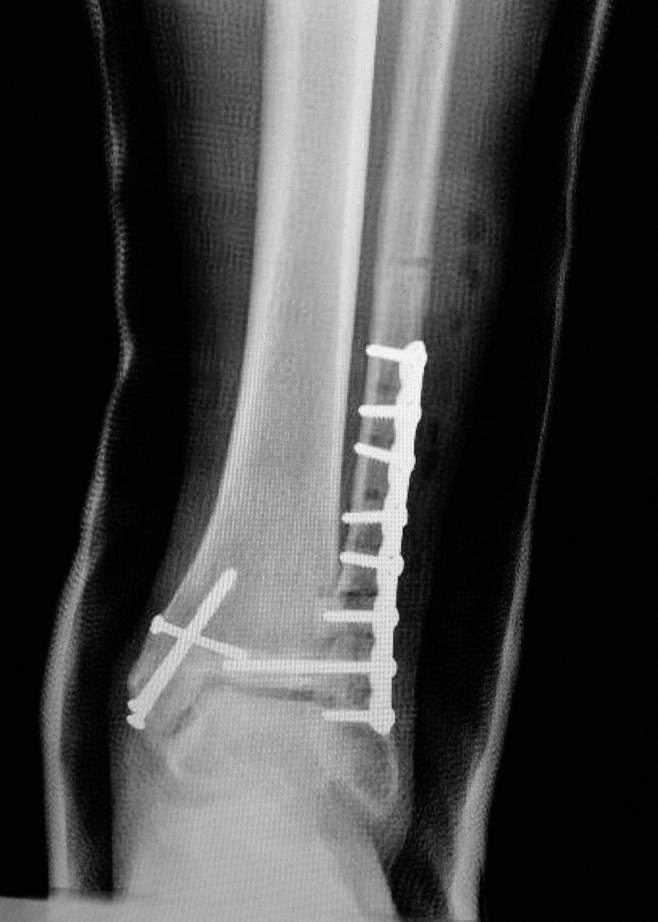
In this case report, a transverse fibular osteotomy was performed, and an allogeneic fresh-frozen femoral head graft was used to fill the resultant defect. Although the use of bone graft to restore fibular length has been well reported in the literature, no previous publications, to our knowledge, have used this graft type, especially in the podiatric medical literature. The use of a viable allograft option would allow podiatric surgeons to perform fibular-lengthening procedures autonomously because proximal harvesting of autograft would not be required. The benefit of a transverse fibular osteotomy is that it allows easier derotation and a substantial amount of lengthening can be achieved. Chu and Weiner[8] stated that a transverse osteotomy is warranted for a fibular malunion greater than 4 mm. In this case, we were able to lengthen the fibula approximately 10 mm using a transverse osteotomy without difficulty. Postoperative radiographs revealed excellent alignment with restoration of the talocrural angle and Shenton's line of the ankle. The postoperative talocrural angle was measured at 74°, within 1° of the contralateral side (Figure 6). A syndesmotic screw was needed because disruption of the tibiofibular syndesmosis was required to allow relocation of the fibula.
Figure 6
.
Postoperative radiograph demonstrating realignment of the ankle mortise and a talocrural angle within 1° to 2° of the contralateral ankle.
Afterward, the patient was placed in a nonweightbearing cast for 6 weeks, which was followed by a period of protected weightbearing in a CAM boot for another 6 weeks. At 5 months, the patient was experiencing continued pain with ambulation and at end range of motion. At this time, the syndesmotic screw was removed. Afterward, the patient noted marked improvement in his ability to perform daily activities with only mild discomfort. Radiographic union was noted on computed tomography 6 months postoperatively. Eight months postoperatively, no further complications were noted.
We recommend fibular-lengthening procedures in carefully selected patients as a salvage procedure to potentially prevent the need for joint-sacrificing procedures such as arthrodesis or arthroplasty. Further research with larger patient populations is needed to establish whether fresh-frozen femoral allograft is a reliable graft option for fibular-lengthening procedures.
Conclusions
Failure to properly reduce and fixate fibular fractures results in poor patient outcomes and leads to degenerative arthritic changes in the ankle. The use of fibular reconstruction in carefully selected patients may reduce the progression of degenerative, arthritic changes and decrease the need for joint-sacrificing procedures such as an arthrodesis or arthroplasty. In this study, we were able to achieve excellent alignment with restoration of the talocrural angle and Shenton's line of the ankle using a transfibular osteotomy and an allogeneic fresh-frozen femoral head graft to fill the resultant defect. Further research with larger patient populations is needed to establish whether fresh-frozen femoral allograft is a reliable graft option for fibular-lengthening procedures.
Financial Disclosure
None reported.
Conflicts of Interest
None reported.
References
- Weber BG; Simpson LA. Corrective lengthening osteotomy of the fibula. Clin Orthop Relat Res 1985, 199, 61. [Google Scholar]
- Ramsey PL; Hamilton W. Changes in tibiotalar area of contact cause by lateral talar shift. J Bone Joint Surg Am 1976, 58, 356. [Google Scholar]
- El-Rosasy M; Ali T. Realignment-lengthening osteotomy for malunited distal fibular fracture. Int Orthop 2013, 37, 1285. [Google Scholar]
- Yablon I; Leach RE. Reconstruction of malunited fractures of the lateral malleolus. J Bone Joint Surg Am 1989, 71, 521. [Google Scholar]
- Davis JL; Giacopelli JA. Transfibular osteotomy in the correction of ankle joint incongruity. J Foot Ankle Surg 1995, 34, 389. [Google Scholar]
- Sarkisian PE; McMaster JH; Kelly E. Closed treatment of ankle fractures: new criteria for evaluation: a review of 250 cases. J Trauma 1976, 16, 323. [Google Scholar]
- Rolfe B; Nordt W; Sallis JG; et al. Assessing fibular length using bimalleolar angular measurements. Foot Ankle 1989, 10, 104. [Google Scholar]
- Chu A; Weiner L. Distal fibula malunions. J Am Acad Orthop Surg 2009, 17, 220. [Google Scholar]
- Sinha A; Sirikonda S; Giotakis N; et al. Fibula lengthening for malunited ankle fractures. Foot AnkIe Int 2008, 29, 1136. [Google Scholar]
- Chao K; Wu C; Lee C; et al. Corrective-elongation osteotomy without bone graft for old ankle fracture with residual diastasis. Foot Ankle Int 2004, 25, 123. [Google Scholar]
- Thangarajah T; Lakdawala A; Battaloglu E; et al. Lengthening z-osteotomy of the fibula to correct persistent talar shift following open reduction internal fixation of ankle fractures. Foot Ankle Specialist 2012, 5, 107. [Google Scholar]
- Weber D; Friederich NF; Muller W. Lengthening osteotomy of the fibula for post-traumatic malunion. Int Orthop 1998, 22, 149. [Google Scholar]
- Brin Y; Palmanovich E; Massarwe S; et al. Using a cervical spine cage to reconstruct malunited fibular fractures. Int Orthop 2013, 37, 447. [Google Scholar]
© 2017 American Podiatric Medical Association