The body of a woman slowly evolves and changes during the 9 months of pregnancy. These changes are found on the physical, hormonal, ligamentous, musculoskeletal, and functional levels [
1]. It is obvious that such changes may affect the static postures as well as the gait of a pregnant woman. Women develop posture and locomotion strategies that would tend to cause static foot and footprint modifications [
2]. Such compensation may have adverse consequences in terms of gait stability and efficiency and may cause pain.
The proportion of pregnant women with pelvic pain can reach up to 33% [
3], and pelvic pain is reported as the most common cause of sick leave during pregnancy [
4]. Pelvic pain is localized in the posterior region of the pelvis, defined as “a pain between the posterior iliac crest and the gluteal fold, especially around the sacroiliac joint. The pain may radiate to the back of the thigh and also occur in conjunction or separately, around the symphysis.” [
5] (p797). This is called pelvic girdle pain (PGP) or pregnancy-related PGP, which represents a musculoskeletal pelvic pain, excluding gynecologic and urologic disorders [
5,
6]. Endurance capacity while in a bipedal position and when walking is impaired by pain [
5].
The sacroiliac joint is particularly vulnerable to shear owing to its anatomical features and relatively flat surface (“form closure”), which must be compensated for by compression forces from the musculoligamentous and fascial active system (“force closure,” stability factor) [
7]. A proper combination of both is needed to maintain the stability of the joint, and failure of one of these factors could be partly responsible for pain in the pelvic area [
8,
9].
The imbalance between the two systems could be due to hormonal factors, such as relaxin, which acts on the soft tissues in the pelvic area to facilitate childbirth [
5]. This hormone secretion induces laxity of pelvic connective tissues, ligaments, and entheses, which makes them more vulnerable to overload and generate pain [
10]. Joint and ligament laxity increases during pregnancy, peaking during the third quarter [
10]. If it is not properly compensated for by the force closure principle of the muscle-tendon structures, it may modify pelvic geometry while causing micromobility, leading to some instability, which will manifest itself through pain and an increase in tiredness when standing or walking [
5].
The center of pressure (COP) represents the application point of the resultant reaction forces exerted by the ground on the foot [
11]. The position of the COP is influenced by an individual’s gait speed, cadence, cycle length, and mass distribution [
12]. The mass gain during pregnancy is approximately 12 kg, and the abdominal mass increases by at least 31% [
13]. It is, therefore, relevant to examine whether COP position changes during pregnancy.
The COP displacement speed is an indicator to describe the performance and quality of gait. The COP velocity ranges from 0.22 to 0.27 m/sec in middle-aged adults and is approximately 0.38 m/sec in young adults [
11]. The COP displacements tend to gradually increase during pregnancy: the COP oscillation area in standing posture varies significantly during the second (
P = .018) and third (
P = .003) quarter when women are blindfolded or keep their feet together [
14]. Lateralization of the gait line induces an increase in peak pressures on the lateral side of the forefoot and in the central midfoot in pregnant women, whereas in the central forefoot, peak pressures are lower in pregnant women [
15]. These changes in plantar support distribution may possibly be responsible for musculoskeletal disorders in the lower limbs and sources of pain during pregnancy.
We know that pelvic pain influences thorax-pelvis coordination and gait speed [
16], but no information is available regarding their effect on COP. The purpose of this study was to describe changes in the COP parameters during gait in pregnant women with PGP. A comparison with healthy pregnant women and healthy nonpregnant women was conducted to verify the presence of change in COP during gait, with the aims of detecting compensation strategies and identifying potential correction means to alleviate these pregnant women’s demand.
Methods
Participants
Sixty-six pregnant women with PGP aged 20 to 45 years were recruited. Inclusion of pregnant women from week 18 of pregnancy to week 27 with pain in the sacroiliac joints or pubic region was verified by a set of tests during clinical examinations. The exclusion criteria were the presence of lumbopelvic pain before pregnancy; other pathologic conditions involving gait problems; surgery of the lumbar spine, pelvis, hips, or knees; fractures; pain radiating below the knee; tumors or active inflammation in the lumbar or pelvic region; known anomalies of the spine; and rheumatic diseases.
For the healthy pregnant women group, 61 women of the same age range were included from week 18 of pregnancy to week 27. The exclusion criteria were similar to those for the PGP group, completed by the presence of lumbopelvic pain during pregnancy and pain in the sacroiliac joints or pubis.
The control group (CG) included 22 nonpregnant women of the same age range, free of pelvic pain, and without any previous surgery of the lower limbs. The characteristics of the sample are presented in
Table 1. The study protocol was approved by the Erasmus Hospital ethics committee, Anderlecht, Belgium. All of the participants signed an informed consent form.
Table 1.
Characteristics of the Three Study Groups
Table 1.
Characteristics of the Three Study Groups
Materials
The COP parameters during gait were measured using an electronic walkway (GAITRite Gold; CIR Systems Inc, Franklin, New Jersey) measuring 6.1 m long and 61 cm wide. Embedded pressure sensors form a horizontal grid. Data were sampled at a frequency of 100 Hz. The walkway is connected to a personal computer by a serial interface cable. The COP coordinates during gait were sampled using GAITRite GOLD software, version 3.2b, and were processed using spreadsheet software (Excel 2007; Microsoft Corp, Redmond, Washington).
Protocol
Before performing the motor task, anthropometric data (age, shoe size, weight, and height) were recorded for each participant. The length of the lower limbs (from the anterior superior iliac spine to the medial malleolus) was determined with a measuring tape in dorsal decubitus.
The motor task consisted of nine gait trials (three at each velocity). Gait speeds were self-selected, but standardized instructions were used. A rest period was allowed between trials. First, the participant was invited to walk at her preferred velocity. Then, the participant walked at fast and slow velocities. The order of these velocities was randomized by dice throwing. Each participant was invited to walk barefoot on the GAITRite walkway. The instructions for fast velocity were “walk as fast as possible, as if you were trying to catch a bus,” and the instructions for slow velocity were “walk slowly, as if you were shopping.”
To counter the methodological bias of acceleration and deceleration in gait, the participants started walking 2 m ahead of the walkway and finished the trial 2 m after the end of the walkway.
Data Processing
The following parameters were calculated:
Stance time (ST) was defined as Tmax – Tmin, where Tmin and Tmax corresponded to the first and last instants of stance phase, respectively.
COP excursion (EXC) was defined as the sum of absolute displacements between two successive COPs in the anteroposterior (AP) or mediolateral (ML) direction. Also, the distance between two successive COPs in the plane formed by the AP and ML axes was computed.
COP mean velocity AP corresponded to the velocity of COP displacement in the AP axis direction, the ML axis direction, or the AP-ML plane and is defined as EXCi / (Tn+1 – Tn), where i indicates the direction (AP or ML) or the plane (AP-ML) and T is the time between two successive positions of the COP.
COP length AP was defined as APmax – APmin, where APmax and APmin represent the largest and smallest AP coordinates of the COP, respectively.
COP width ML was defined as MLmax – MLmin, where MLmax and MLmin represent the largest and smallest y coordinates of the COP, respectively.
The following dependent variables were analyzed: gait velocity, ST, COP EXC, mean COP velocity, COP length, and COP width.
Statistical Analysis
All of the statistical procedures were conducted using Statistica 5.0 software for Windows (Statistica, Tulsa, Oklahoma). To investigate normal distribution of data we used the Kolmogorov-Smirnov test. All of the scores were found to be normally distributed. A Student t test for paired samples did not show a significant difference between sides. Data from left and right feet were thus averaged.
An analysis of variance for repeated measures was performed for comparison of all dependent variables between the different velocities (within-subject factor) and groups (between-group factor). When a significant effect was found, the least significant difference post hoc test was applied. The statistical level of significance was set at P = .05.
Results
Group Effect
Concerning ST, a significant group effect was observed. The post hoc tests allowed us to observe a significantly increased ST for pregnant women (PGP and healthy gravid) compared with the CG (
P < .01): ST was 5% higher for pregnant women at slow velocity, 8% higher at fast velocity, and 12.5% higher at preferred velocity (
Table 2).
Table 2.
Values of Parameters for Pregnant Women with Pelvic Girdle Pain (PGP), Healthy Pregnant Women (HPW), and the Control Group (CG)
Table 2.
Values of Parameters for Pregnant Women with Pelvic Girdle Pain (PGP), Healthy Pregnant Women (HPW), and the Control Group (CG)
Similar results were found for COP AP-ML EXCs and AP, ML, and AP-ML velocities. Indeed, for each of these parameters, a significant difference was found between the pregnant group and the CG (P < .001). It was noted that the AP-ML EXC of the CG was increased compared with that of the healthy pregnant women (+3.5%) and even more compared with that of the pregnant women with PGP (+4%). The results for AP, ML, and AP-ML velocity showed increased COP velocities for the CG compared with pregnant women.
For COP AP EXC, the CG value was increased by 5.5% compared with that of pregnant women with PGP (P = .002). For COP ML length, a group effect was also observed. The post hoc tests showed that AP length in healthy pregnant women was increased by 3% at slow and fast velocities and by 4% at preferred speed compared with that in women with pelvic pain (P < .01).
Effect of Gait Speed
A speed effect was observed for ST, which decreased significantly with speed increase by approximately 38% for all of the groups. Similarly, for all of the groups, COP EXC significantly decreased with increasing gait speed (P < .001). The results were similar for AP-ML EXC in the two groups of pregnant women. Concerning COP AP, ML, and AP-ML velocities, a significant gait speed effect was found for the three groups (P < .001). The COP velocity increased with the increase in gait speed.
A significant speed effect on COP width was observed in women with PGP and in healthy pregnant women (P < .001): the higher the gait speed, the lower the COP width in pregnant women. This decrease was not found in the CG. Gait velocity also had a significant effect on COP length (P < .001), which increased with gait speed.
Interactions
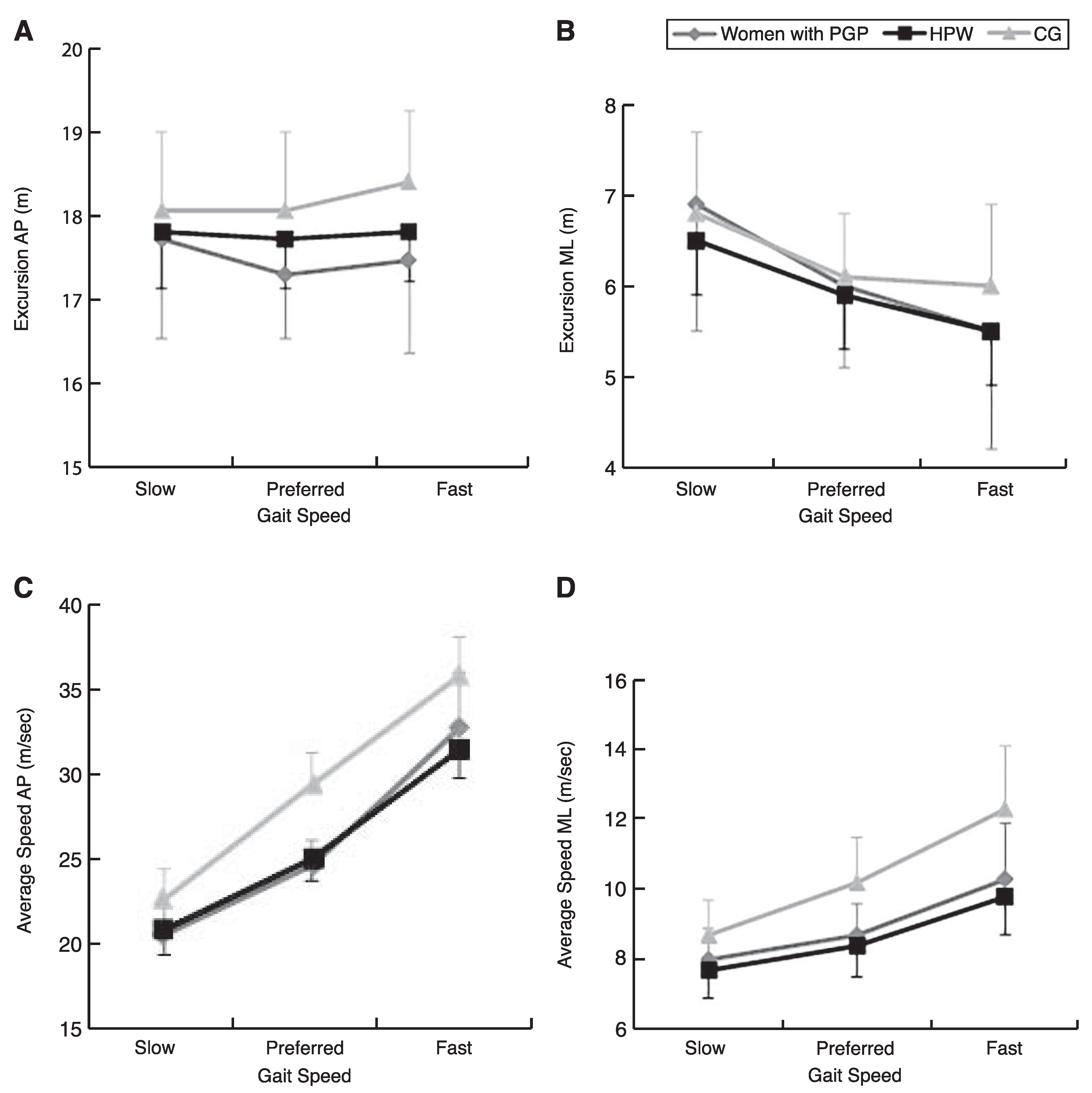
The interactions between group and speed factors were significant for all of the COP parameters except ST (
P = .13) and COP length (
P = .32) (
Fig. 1). Stance time evolution with the increase in gait velocity was similar in the three groups, even if ST was increased in pregnant women compared with the CG (
P < .01).
Figure 1.
Effects of interactions between gait speed and group factors on center of pressure excursions and speed. For each speed, mean ± SD values are given for excursion anteroposterior (AP) (A), excursion mediolateral (ML) (B), average speed AP (C), and average speed ML (D). CG, control group; HPW, healthy pregnant women; PGP, pelvic girdle pain.
Figure 1.
Effects of interactions between gait speed and group factors on center of pressure excursions and speed. For each speed, mean ± SD values are given for excursion anteroposterior (AP) (A), excursion mediolateral (ML) (B), average speed AP (C), and average speed ML (D). CG, control group; HPW, healthy pregnant women; PGP, pelvic girdle pain.
Regarding COP EXC, the interaction between velocity and group factors was significant for the EXC parameters (P < .01). In the CG, an increase in AP COP EXC with gait velocity was notable and mainly for high speed (P < .05). The decrease in ML EXC was limited at high speed (P > .05). In both groups of pregnant women, the increase in AP EXC with speed was more restricted, whereas the decrease in ML EXC was more important (P < .001).
For AP and ML COP velocity, the increase with gait speed was significantly higher in the CG compared with the two groups of pregnant women (P < .001).
Discussion
The main objective of this study was to determine the influence of gait speed, pregnancy, and pelvic pain on COP parameters during gait. These results showed that when gait speed increased, all of the COP velocity parameters were significantly increased regardless of the group. There was, therefore, an effect of gait speed on COP parameters [
11]. This elevation of COP velocity showed a faster displacement of body mass in the direction of the forefoot during stance [
11]. In addition, a faster gait speed was reported to induce a reduction in ST and higher power peaks [
17]. Also, as gait speed increased, the difference between pregnant and nonpregnant women was larger, especially concerning COP velocity and ST. Thus, it can be suggested that gait speed increases the effects of pregnancy.
Stance time was significantly increased in pregnant women compared with the CG [
17-
19]. This highlights the significant effect of pregnancy on ST, whereas pelvic pain did not have any effect on this parameter. These results can be explained by the fact that pregnant women, because of disturbed proprioception [
16] and imbalance sensation [
20], are more cautious during gait. A longer contact time induces gait difficulty [
15]: indeed, the increase in plantar volume [
1], modification of the body image, and lower-limb joint laxity [
1] provide the pregnant woman with a sensation of instability [
20], prompting prolonged support periods on the ground compared with the CG. This augmentation of ST explains the reduction in swing time and single support time, which is more conducive to falls, or that the pregnant woman is more careful during the swing phase, which requires a longer ST [
20].
For pregnant women, COP velocities along the AP and ML axes were significantly slower than for their nongravid counterparts. This difference was higher at preferred speed, where COP mean velocity along the AP axis was decreased by 16% compared with the CG. On the other hand, the group difference in COP velocity increased along the ML axis. It was more and more obvious as the speed was faster. We can link these results to the spatiotemporal parameters of gait in pregnant women: because they have a slower locomotion speed [
16] and a higher ST, it seems consistent that COP velocities are slower. If the gait of pregnant women displays similar characteristics to those of elderly persons (in terms of walking difficulties, fear of movement [
16], and predisposition to falls [
21]), the present results confirm those of Chiu et al [
11], who found a lower COP speed for older persons. This illustrates again a sign of caution when pregnant women move. Gait speed potentiated the effects of pregnancy, but pelvic pain did not seem to have an effect on COP velocity.
The COP displacement parameters (AP, ML, and AP-ML EXCs and length) were decreased for gravid women. Concerning the diminution of EXC along the AP axis, this can reflect the fact that pregnant women displace their body mass less toward the forefoot but maintain it on the rearfoot or midfoot. Pregnant women seemed, thus, to reduce the propulsion phase during gait, which combines plantarflexion and displacement of body mass on the forefoot and toes. Because of augmentation of the anterior abdominal mass, the pregnant woman would avoid transferring her support on the anterior part of the foot to anterior imbalance. The center of gravity is, thus, repositioned, and body alignment is maintained by an extension of the trunk [
18], which concentrates plantar pressures in the back of the foot and decreases them in the forefoot [
15,
17]. As a consequence, COP anterior displacement is limited compared with nonpregnant women. Therefore, the lateralization of the gait line in pregnant women [
15] is aimed at increasing the plantar pressure in the central part of the midfoot and on the lateral part of the forefoot and at decreasing it in the medial part of the forefoot. In this way, COP AP displacement is also lower in pregnant women with pelvic pain, which was confirmed by the present results. This observation implies a decrease in total COP displacement along the AP axis: the AP length was significantly decreased for women with pelvic pain compared with healthy pregnant women.
The COP ML EXC was decreased significantly in pregnant women compared with nongravid women. This diminution was more apparent with increasing gait velocity: pregnant women could have a deficient stability in the frontal plane compared with control women. However, lateral stability was shown to be maintained during pregnancy [
20], suggesting that pregnant women implemented strategies to compensate for this decrement in COP ML EXC. These strategies include a decrease in gait velocity or an increase in step width [
19] to increase stability [
18,
20,
22,
23]. These assumptions of compensation are consistent with the gait adaptation characteristics that we found in pregnant women. However, the direction of the relationship between the changes in COP ML displacement and step width remains unknown.
For nongravid women, the increase in step width seemed to be correlated to a decrease in COP ML displacement [
24]. Thus, by increasing the distance between their feet, pregnant women would be able to minimize COP lateral displacement and ensure stability [
20]. This assumption seems to be confirmed by the fact that after delivery, the ML EXC decreases [
20]. A more marked diminution of COP ML displacement with increasing gait speed was consistent with a reduction in total COP ML width. Gait velocity influenced the components of COP ML displacement. However, a significant group effect on this parameter was not found: it can be concluded that neither pregnancy nor pelvic pain significantly affects COP width.
In summary, the plantar COP displacement of pregnant women was found to differ from that of nongravid women, confirming the results of Lymbery and Gilleard [
23], who demonstrated that with advancing pregnancy, COP displaces less laterally (it was, therefore, in a more medial position) and less early. In addition, the ML ground reaction force increased in a medial direction. These results suggest that pregnant women can adapt their gait to maximize their stability during the support phase and to control ML displacements [
23].
Nevertheless, these conclusions are to be taken with caution because pelvic pain tends to increase with advancing pregnancy [
6]. The women participating in the present study were all in the second trimester of pregnancy. Therefore, it would be interesting to analyze gait in these women again at the end of the third pregnancy trimester to verify the hypothesis of an effect of increasing pelvic pain on COP parameters. In pregnant women with PGP, the COP during gait was similar to that found in healthy pregnant women, but it significantly differed from that in nongravid women. This observation does not exclude a measurable effect of PGP on other gait parameters or that compensation occurs at other levels. Nevertheless, they do not flagrantly affect plantar COP during gait. The modifications of COP displacement and velocity during gait in pregnant women show a postural adaptation to the physical disturbance. These changes suggest the necessity of suitable preparation for these women to limit the functional consequences that can be caused by this instability. A preventive exercise therapy approach could be relevant during pregnancy as well as postpartum.