Glomus bodies are thermoregulatory cells that function as special modified myoarterial structures in the deep dermis that play a role in temperature and blood flow regulation.[
1] Several authors have been associated with the initial description of these lesions. Wood[
2] in 1812 cited several presentations as “painful subcutaneous tubercles.” Hoyer[
3] also reported on a variety of suspected glomus lesions in 1877. Masson[
4] provided the first clinical description of glomus tumors in a report in 1924, citing the lesion as
angioneuromyoma.
Glomus tumors account for less than 2% of all soft-tissue tumors and are categorized into solitary or multiple presentations, with solitary lesions being the most often encountered.[
5] Glomus tumors are rarely multifocal (2%–3%) or malignant (<1%).[
6,
7] Lesions can occur anywhere in the body and have been identified in the head, neck, colon, lung, tongue, stomach, ear, elbow, wrist, hand, foot, toes, bladder, patella, coccyx, rectum, penis, and cervix.[
8] Glomus tumors are most commonly found in the extremities, with up to 75% of the presentations diagnosed in the hand.[
9] Upwards to 90% of the hand lesions were located in the subungual tissues of the fingers.[
10] Although there is a predilection for females with a subungual presentation, there is no propensity for a specific tumor site found in other areas of the body.[
11] Although most glomus tumor occurrences have been reported during the third through fifth decades of life, the lesion may occur at any age.[
12] Recent reports indicate that glomus tumors of the digits occur in approximately 5% of patients with neurofibromatosis type 1 and are considered neurofibromatosis type 1–associated neoplasms.[
13] Solitary benign glomus tumors are small, rarely exceeding 1.0 cm at greatest diameter.[
14]
Imaging modalities available to assist in the diagnosis of a glomus cell tumor include plain film radiography, color Doppler ultrasonography, computed tomography, angiography, and magnetic resonance imaging. A glomus tumor most commonly presents as a solitary blue or purple nodular lesion clinically. Patient presenting symptoms are the classic triad of pain, point tenderness, and temperature sensitivity. Clinical examinations may include the Hildreth test as well as the Love test. The Hildreth test is highly specific and highly sensitive for glomus tumors.[
1] It is essentially pathognomonic due to the vascular nature of the lesion. The test is easily performed by inflating a tourniquet proximal to the suspected glomus tumor site, just above the patient's systolic pressure. A positive test result is an immediate cessation in the painful symptoms. A positive Love test consists of pain on pinpoint pressure directly over the symptomatic lesion when applied by an object such as a pencil tip or toothpick. Using the same device with adjacent pressure to surrounding tissues would not elicit pain. Another example of the vascular nature of these lesions showed an increase in ring finger subungual pain during a 6-month period that coincided with the patient's cessation of cigarette smoking.[
3] Paroxysmal pain presentation in this patient's circumstance demonstrates the known vasoconstrictive action of nicotine in the digits.
Despite advances in imaging capabilities, histopathologic examination of the excised tumor is absolutely necessary to provide a definitive diagnosis. An excisional biopsy of the suspected lesion in a bloodless field is the treatment of choice for symptomatic presentations. Histopathologic composition of the neoplasm on microscopic examination resembles glomus cells. Reoccurrence after surgical extirpation is not common but is possible.[
15] This particular complication occurs most often due to inadequate removal of tumor tissue and is usually encountered with the subungual presentation of glomus tumors, where failure to differentiate between normal tissue and the pathologic lesion is highest.[
1] Recurrences of solitary tumors outside the subungual apparatus are not common.[
1] This is most likely due to better demarcation of the lesion because these presentations tend to be encapsulated, thereby facilitating a more complete excision. Differential diagnoses include but are not limited to ganglion cyst, hiradenoma, myxoid cyst, epidermoid cyst, angioma, melanoma, neuroma, blue nevi, eccrine hidradenomas, Kaposi sarcoma, leiomyoma, neurilemmoma, foreign body, Maffucci syndrome, and venous malformations.
Case Presentation
A well-developed and well-nourished 49-year-old woman presented with a painful nodular lesion in the subcuticular soft tissue of the right medial second toe. The lesion had been gradually enlarging for the past 6 months with a concurrent increase in painful symptoms due to pressure from shoes. She denied trauma or injury to the affected area; however, the patient related a dramatic increase in painful symptoms several weeks before the initial clinic visit while snow skiing.
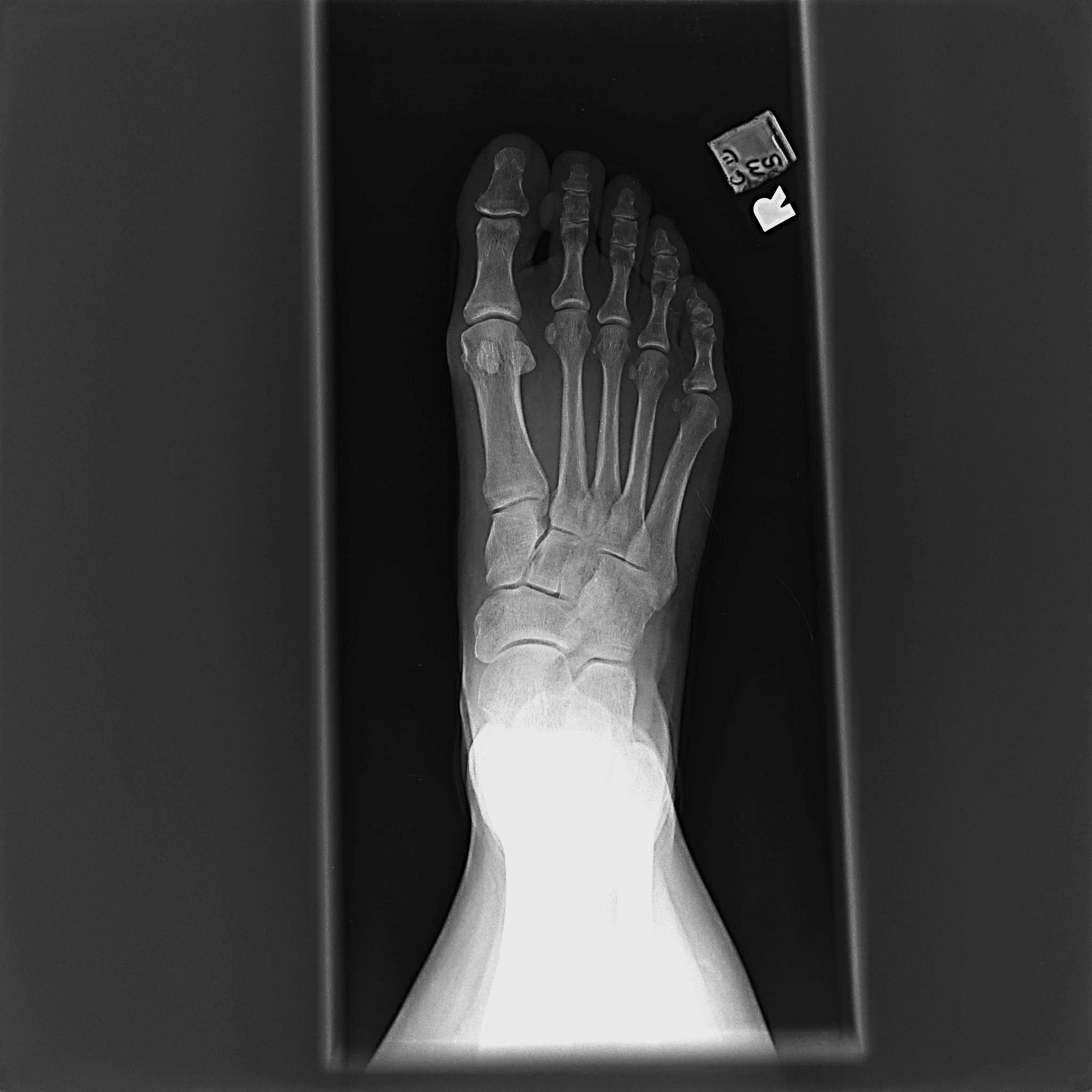
Clinical examination revealed a cystic-appearing, slightly pigmented nodular mass in the subcuticular tissues of the medial right second toe adjacent to the middle phalange. The lesion was not painful to palpation but was painful to direct pressure. Gross dimension of the lesion on clinical examination was approximately 2.0 cm at greatest diameter. A radiographic study composed of three weightbearing views of the right foot graphically revealed a focal soft-tissue nodule along the medial aspect of the second toe at the level of the middle phalanx, measuring approximately 1.4 cm at the base in the dorsoplantar exposure (
Fig. 1). There was no intralesion mineralization and no osseous erosion or remodeling of the middle phalanx associated with the identified soft-tissue lesion in the radiographic study.
Figure 1.
Dorsoplantar weightbearing radiographic image of the right foot depicting the soft-tissue lesion medial to the second middle phalange.
Figure 1.
Dorsoplantar weightbearing radiographic image of the right foot depicting the soft-tissue lesion medial to the second middle phalange.
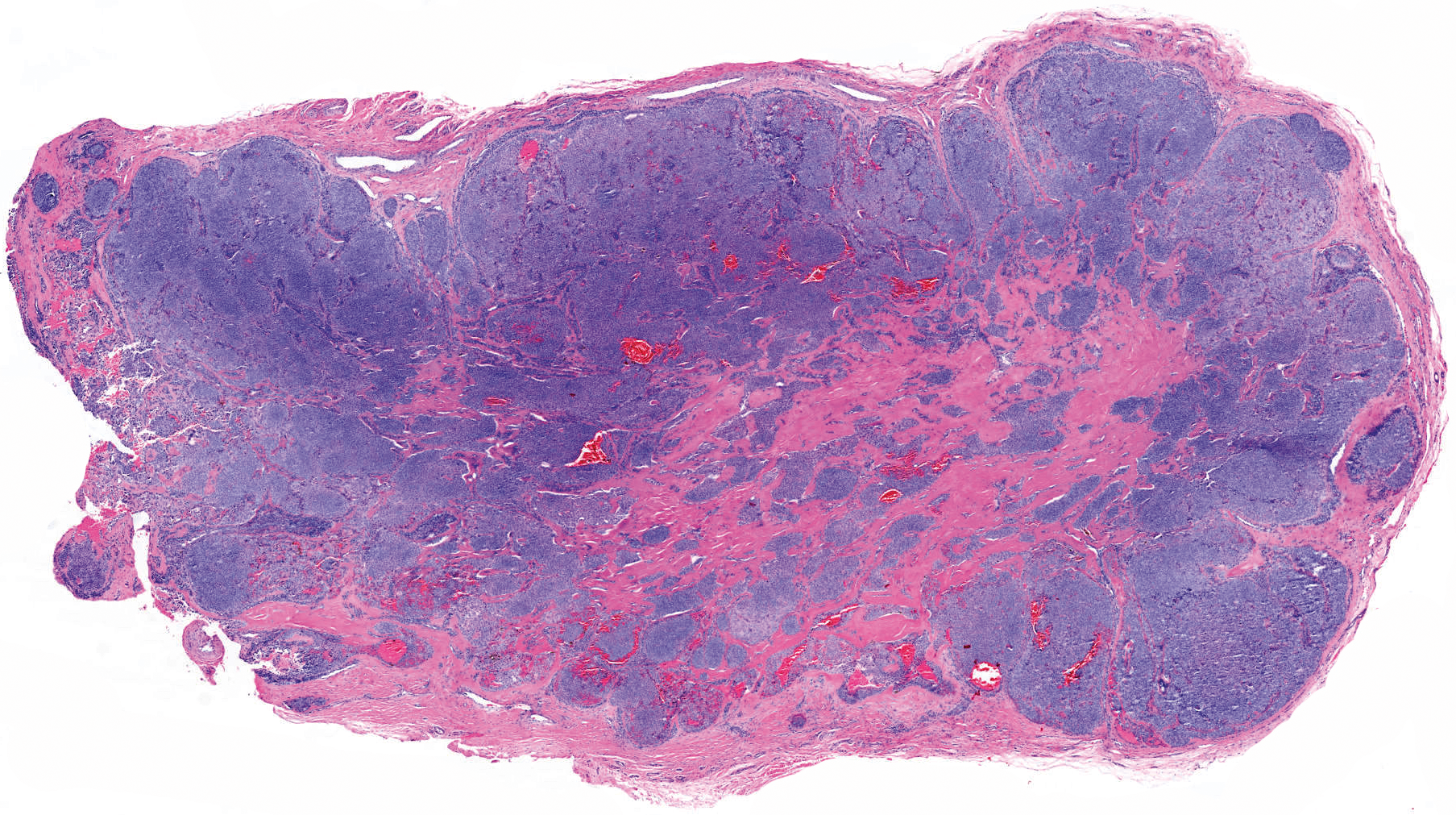
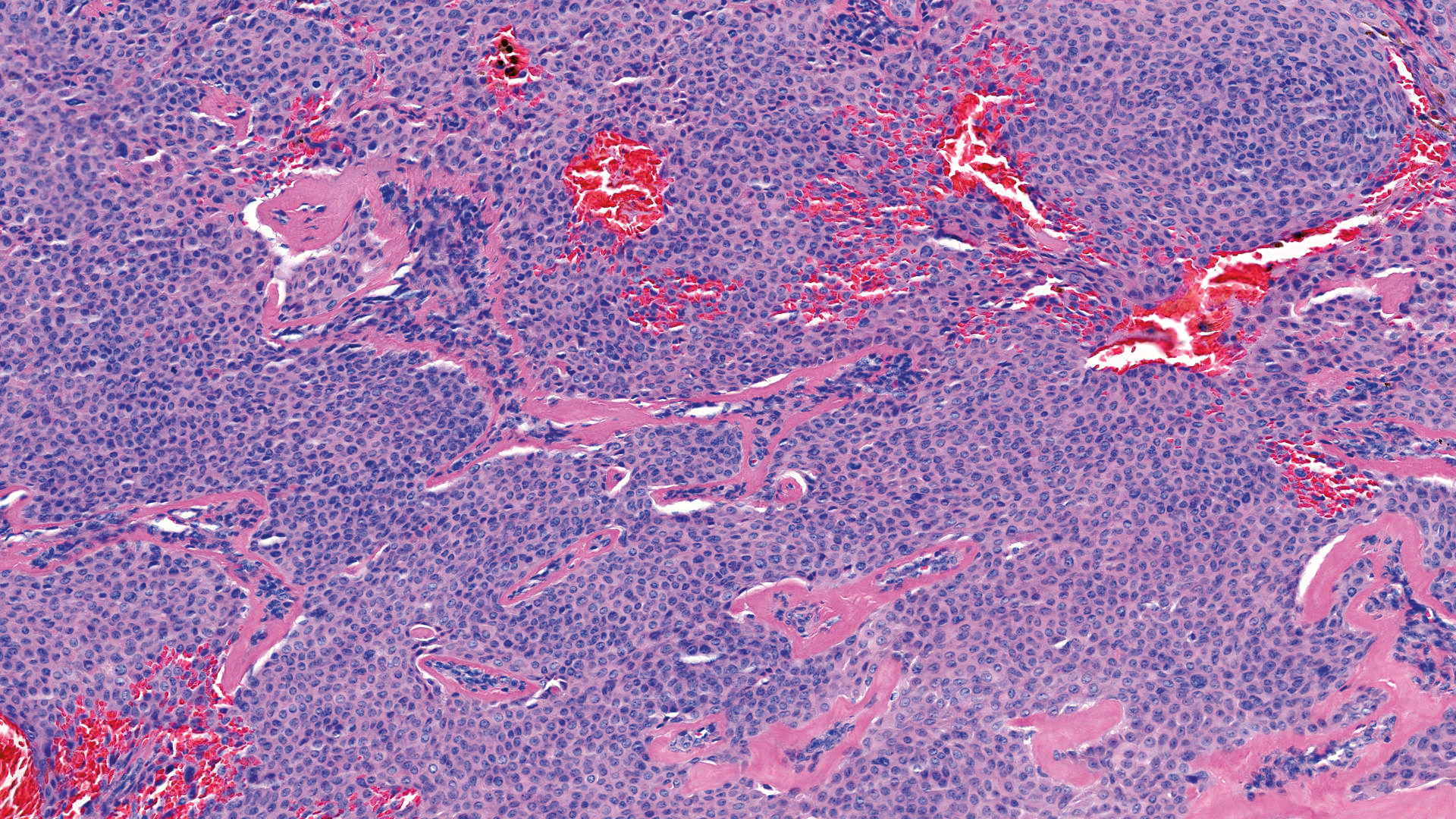
Surgical intervention was deemed the treatment of choice to alleviate the patient's painful symptoms and definitively identify the pathologic lesion. An excisional biopsy identified an encapsulated and pedunculated bluish-purple nodular lesion in the subcuticular tissue of the second toe. The tumor was submitted in toto for pathologic evaluation. Closure was accomplished with a plastic repair used to address the redundant skin. Histologically, the lesion was well circumscribed and composed of several lobules of cuboidal cells with pink cytoplasm and centrally placed nuclei. The cells were very uniform, with no mitotic figures identified in the micrographs. In many areas, the neoplastic cells were present around vascular spaces. The stroma was fibrotic, with focal areas of mucinous degeneration (
Figs. 2 and
3).
Figure 2.
Scanning magnification of the lesion showing a fairly well-circumscribed, ulcerated lesion composed of uniform blue cells (H&E, x25).
Figure 2.
Scanning magnification of the lesion showing a fairly well-circumscribed, ulcerated lesion composed of uniform blue cells (H&E, x25).
Figure 3.
At higher magnification, the cells composing the neoplasm are cuboidal, with small amounts of cytoplasm and centrally placed nuclei. There are also areas of sclerosis and extravasated red blood cells (H&E, x100).
Figure 3.
At higher magnification, the cells composing the neoplasm are cuboidal, with small amounts of cytoplasm and centrally placed nuclei. There are also areas of sclerosis and extravasated red blood cells (H&E, x100).
Discussion
A clinical differential diagnosis for painful digital soft-tissue lesions in the foot should include ganglion cyst, hiradenoma, myxoid cyst, epidermoid cyst, angioma, melanoma, neuroma, blue nevi, eccrine hidradenomas, Kaposi sarcoma, leiomyoma, neurilemmoma, foreign body, and, as indicated, a glomus tumor.
From a pathologic perspective, the differential diagnosis of glomus tumors includes spiradenomas and glomangiosarcomas, the malignant variant of glomus tumors. Spiradenomas are well-circumscribed lesions that have sweat gland differentiation. They are composed of lobules of uniform basaloid cells with dark nuclei and small amounts of cytoplasm. Throughout the lesion, there are deposits of basement membrane that are seen as bright pink amorphous deposits. There is also evidence of ductal differentiation. Vascular spaces can be seen, sometimes numerous. However, these spaces are not surrounded by cuboidal cells as in glomus tumors. Glomangiosarcomas are large and poorly circumscribed, showing only focal features of a glomus tumor. The atypical areas show hyperchromatic cells with prominent nuclei and nucleoli. Mitotic figures are often seen.
Glomus tumors larger than 2.0 cm at greatest dimension with a deep location and mitotic figures present on microscopic examination are specific criteria necessary for a histopathologic diagnosis of malignancy. The size of the lesion in this case (approximately 2.0 cm) was the only criterion that provided concern for consideration of a malignant manifestation.
Although an uncommon occurrence, this case highlights the potential for a nonsubungual glomus tumor manifestation in the foot. The variability evident in this particular presentation identifies the need to adequately evaluate digital soft-tissue lesions with inclusion of glomus tumor in the differential diagnosis of atypical and unexplained localized painful lesions in the lower-extremity digits.