Retronychia, also called posterior paronychia, is the posterior embedding of the nail plate into the proximal nail fold.[
1] It is usually described as concomitant with onychomadesis, a fragmentation or overlap of the nail plate, also defined as a separation of the nail plate from the matrix and usually associated with shedding.[
1-
3] Onychomadesis has been related to nail matrix arrest and commonly occurs 3 to 6 months after a severe inflammatory or systemic condition[
1-
3]; it has been rarely reported after trauma.[
4,
5] Retronychia can affect fingernails and toenails; however, the diagnosis can be clinically complex, since it may clinically mimic an ungual tumor or other inflammatory disease of the nails on physical examination.[
1,
3]
Color Doppler ultrasound has supported the diagnosis by showing the thickening and decreased echogenicity of the proximal periungueal dermal tissue and the decreased distance between the origin of the nail plate and the base of the distal phalanx on two- and three-dimensional images.[
1,
3]
The scarce ultrasound reports on the feet have been mostly focused on retronychia coupled with onychomadesis[
1,
3,
4]; however, to our knowledge there are no reports on a pure traumatic retronychia of the foot.
Case Report
We present a case of a 26-year-old female patient without personal or family history of systemic conditions who was a long-time practitioner of martial arts (Taekwon-Do). She noticed a slower ungual growth, appearance of erythema in the distal part of the right big toe, and color changes in the nail plate after 3 months of using tight shoes.
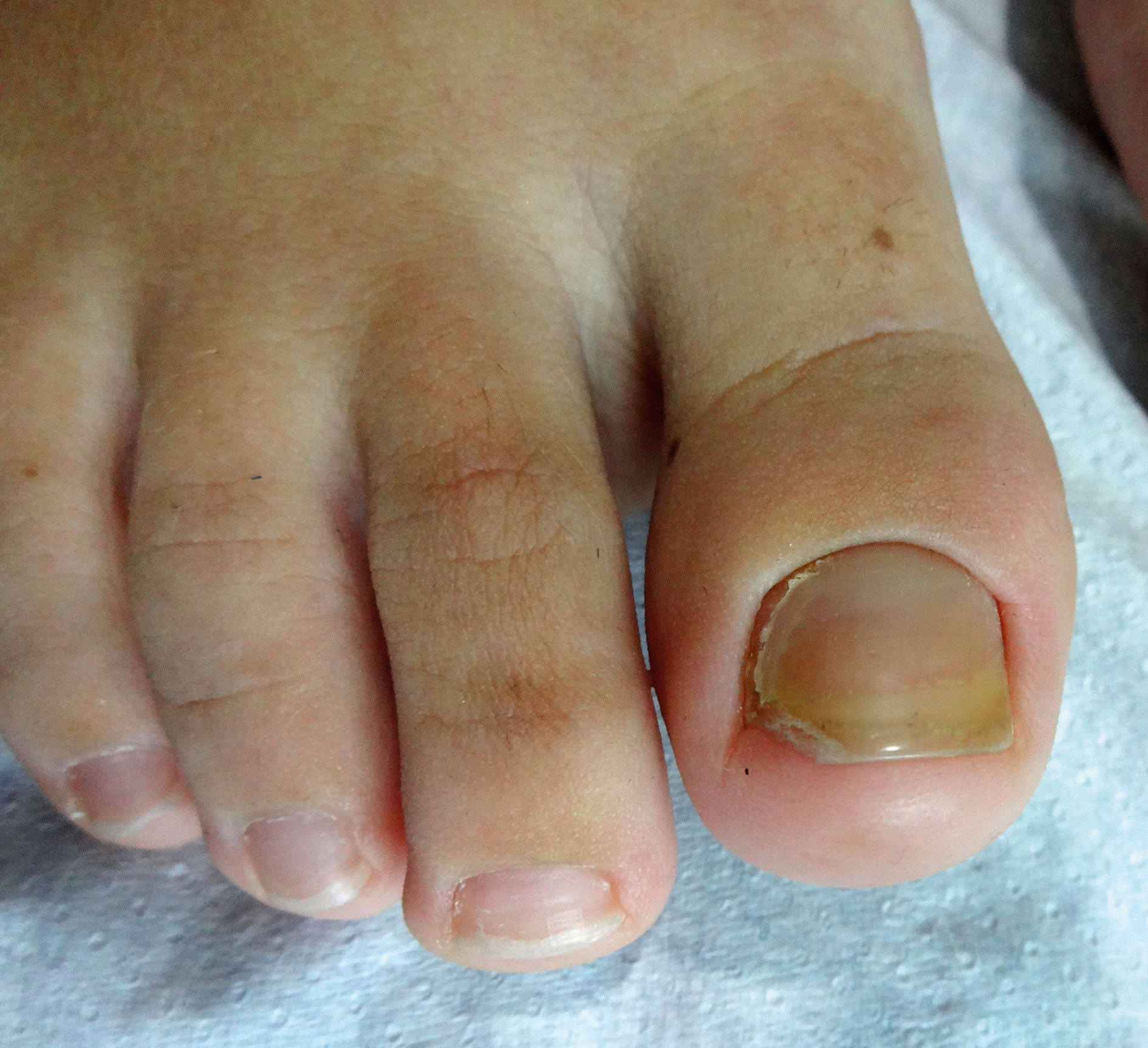
On the physical examination performed by a dermatologist, a yellow coloration of the nail plate with distal onycholisis (ie, spontaneous separation of the distal edge of the nail plate), periungual erythema, and edema of the right big toe was detected (
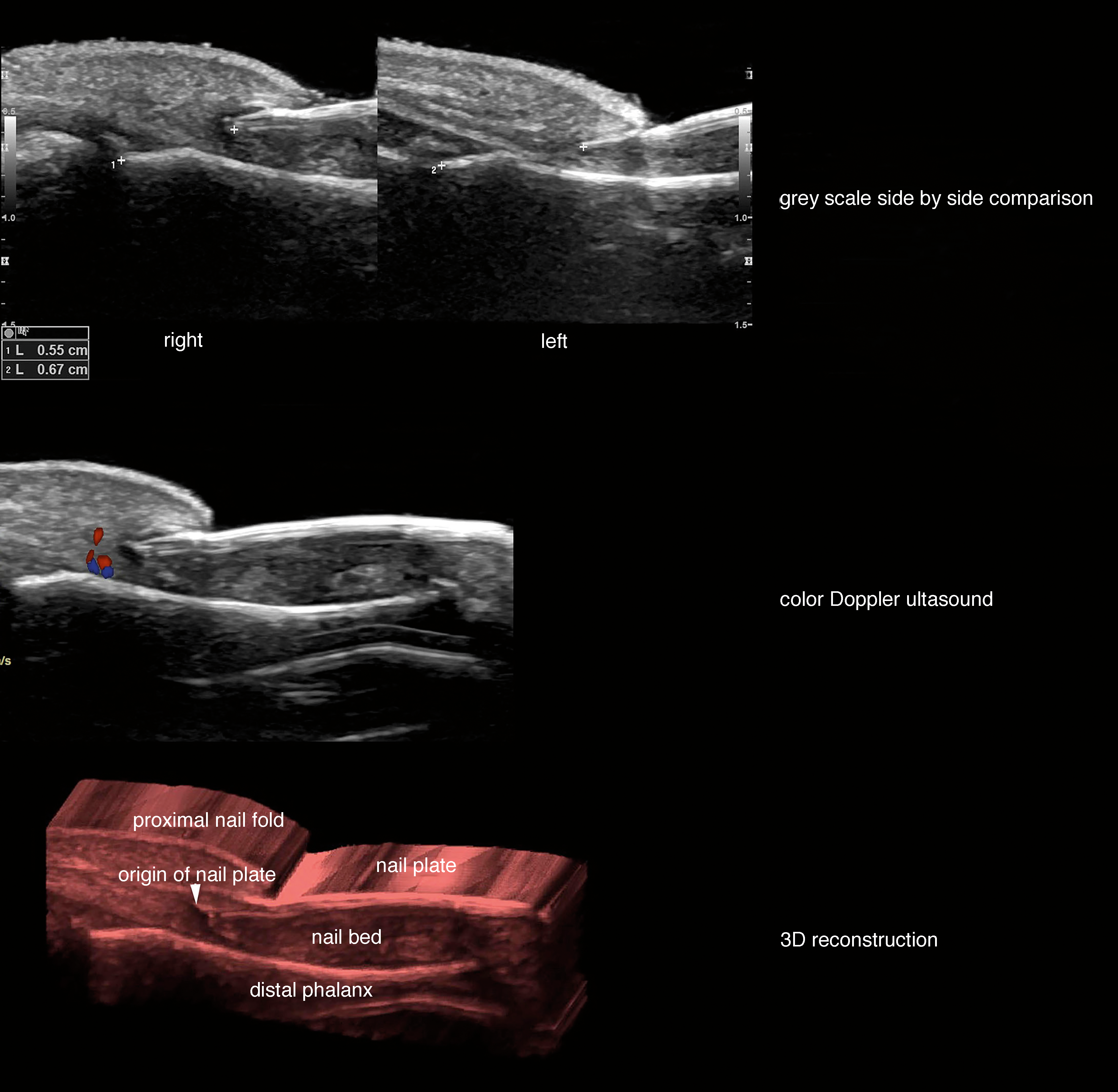
Fig. 1). The patient was referred for a color Doppler ultrasound examination of the nail. This imaging test reported a decreased distance between the origin of the nail plate and the base of the distal phalanx of the right big toe in comparison with the contralateral side (5.5 mm right versus 6.7 mm left). Decreased echogenicity and increased thickening of the nail bed including the matrix region were observed. Additionally, slight increased dermal thickness, decreased echogenicity and hypervascularity of the proximal nail bed were detected. A 4.7-mm hyperechoic focal area in the distal part of the ventral plate was also reported. The sonographic findings were consistent with retronychia with secondary inflammatory changes of the nail bed and proximal periungual region as well as dystrophic alterations of the nail plate (
Fig. 2). No signs of fragmentation or overlap of the nail plate were detected. The rest of the toenails and fingernails were clinically and sonographically unremarkable.
Figure 1.
Clinical photograph of retronychia shows erythema of the periungual region, onycholisis, and mild yellow coloration at the nail of the right big toe.
Figure 1.
Clinical photograph of retronychia shows erythema of the periungual region, onycholisis, and mild yellow coloration at the nail of the right big toe.
Figure 2.
Ultrasound of retronychia. Composite ultrasound image (longitudinal views) demonstrates on top a comparative side-by-side grey scale ultrasound that demonstrates a decreased distance between the origin of the plate and the base of the distal phalanx at the right big toe. Thickening and decreased echogenicity of the nail bed and proximal nail fold are noticed at the right side. Color Doppler demonstrates a mild increase of vascularity (in colors) at the proximal nail bed. At the bottom, a 3D reconstruction of the nail with retronychia.
Figure 2.
Ultrasound of retronychia. Composite ultrasound image (longitudinal views) demonstrates on top a comparative side-by-side grey scale ultrasound that demonstrates a decreased distance between the origin of the plate and the base of the distal phalanx at the right big toe. Thickening and decreased echogenicity of the nail bed and proximal nail fold are noticed at the right side. Color Doppler demonstrates a mild increase of vascularity (in colors) at the proximal nail bed. At the bottom, a 3D reconstruction of the nail with retronychia.
A radiologist (X.W.) performed the ultrasound examination (Logic E9 XD Clear; General Electric Health Systems, Milwaukee, WI) with a compact linear variable high-frequency ultrasound probe that goes from 7 to 18 MHz. Greyscale and color Doppler images were registered in longitudinal and transverse axes at the ungual and periungual regions of both big toes.
Discussion
The presence of retronychia seems to be an unusual condition that has been mostly related to severe systemic inflammatory episodes and local scarring that perpetuate the abnormal posterior location of the nail plate at the proximal nail fold. This alteration may cause slow growth of the nail and modification of its color by involvement of the neighboring matrix region.[
5,
6] Thus, systemic illnesses including severe stress episodes that affect the matrix region, usually very sensitive to hypoxia or distress, have been described as causes of this entity.[
5,
6] To our knowledge, a purely traumatic origin has been rarely reported and to date none of these supposedly traumatic cases have shown on the feet a pure retronychia without onychomadesis.[
1,
3-
6]
In our case, the cause is presumably traumatic owing to the strong exposure to trauma attributable to the long-time practice of martial arts and the recent addition of the trauma generated by the tight shoes in an otherwise healthy patient.
Color Doppler ultrasound with high frequency probes (≥ 15 MHz) seems to be the first-line imaging technique for diagnosing retronychia. It allows confirming with good resolution the exact location of the nail plate and the anatomical changes in the nail bed, nail plates, and the proximal periungual region. Also, this noninvasive imaging examination enables the possibility to perform a side-by-side comparison of the fingers or toes (for example a comparison between the right and left big toes). The latter capability may facilitate the discrimination of abnormalities in the echostructure and regional vascularity of the nail unit.[
1,
3]
Importantly, this imaging modality rules out the presence of onychomadesis,[
1–
3] and allows the assessment of the differential diagnosis with ungual tumors or pseudotumors,[
7,
8] and other inflammatory diseases such as nail psoriasis.[
9] The treatment of retronychia is surgical (total onychectomy) and consists in the removal of the posteriorly embedded nail plate,[
10] which was performed in our case.
Because there are many sports that may potentially injure the toenails, retronychia can be an underestimated entity that perhaps may be clinically mistaken for other common conditions of the nail such as mycotic infections.
In conclusion, retronychia can present a pure traumatic origin and may present in the absence of onychomadesis or systemic conditions that affect the feet. Color Doppler ultrasound seems to be the first-line imaging technique that supports its diagnosis.