The plantar fascia is the fibrous tissue that provides static support to the longitudinal arch on the bottom of the foot. Plantar fasciitis is a common cause of chronic plantar heel pain in the adult population and represents approximately 11% to 15% of all foot symptoms [
1,
2]. Although its pathogenesis is not clear, possible increased risk factors include weak foot biomechanics, intrinsic muscle weakness, long periods of standing and walking, decreased elasticity of the plantar fascia, higher body mass index (BMI; calculated as the weight in kilograms divided by the square of the height in meters), and foot deformities such as pes planus [
3-
5]. The pain is usually felt on the bottom of the heel and is most intense with the very first steps of the day or when the person starts to walk after a rest. The diagnosis is usually made on the basis of patient history and clinical findings [
3]. Physical examination may show local tenderness and swelling in the medial tubercle of the calcaneus. Ultrasonography is also used to visualize the plantar fascia and its insertion owing to its noninvasive and radiation-free nature, good tolerability, and relatively low cost [
6]. Ultrasonographic findings include blurred margins, decreased echogenicity, and thickening of the plantar fascia [
1,
7-
10].
For plantar fasciitis, conservative treatment methods include rest, nonsteroidal anti-inflammatory drugs, foot cushions, nighttime splints, foot orthoses, ice application, physiotherapy modalities (laser, ultrasound, and stretching exercises), and weight control. Most patients achieve improvement with use of these treatments [
3,
11-
13]. In recent years, platelet-rich plasma and botulinum toxin administrations have also been introduced for treatment of plantar fasciitis [
14-
16]. Extracorporeal shockwave therapy (ESWT) and local corticosteroid injection are methods with proven efficacy in pain relief and functional improvement in patients who are refractory to conservative treatment methods [
5]. There are clinical studies in the literature that showed the effectiveness and safety of radial ESWT (rESWT) for treatment of chronic plantar fasciitis [
17-
21]. Placebo-controlled and comparative studies also exist that demonstrated the effectiveness of local corticosteroid injection [
22-
24]. However, few studies compared the effects of ESWT versus local corticosteroid injection [
25-
27]. All of the published studies have compared focused ESWT at different intensities with corticosteroid injection, and we did not identify any study that specifically compared rESWT with corticosteroid injection.
The aim of this study was to compare the long-term clinical and ultrasonographic effects of rESWT and ultrasound-guided local corticosteroid injection treatment in patients with plantar fasciitis refractory to conservative treatment.
Methods
Participants
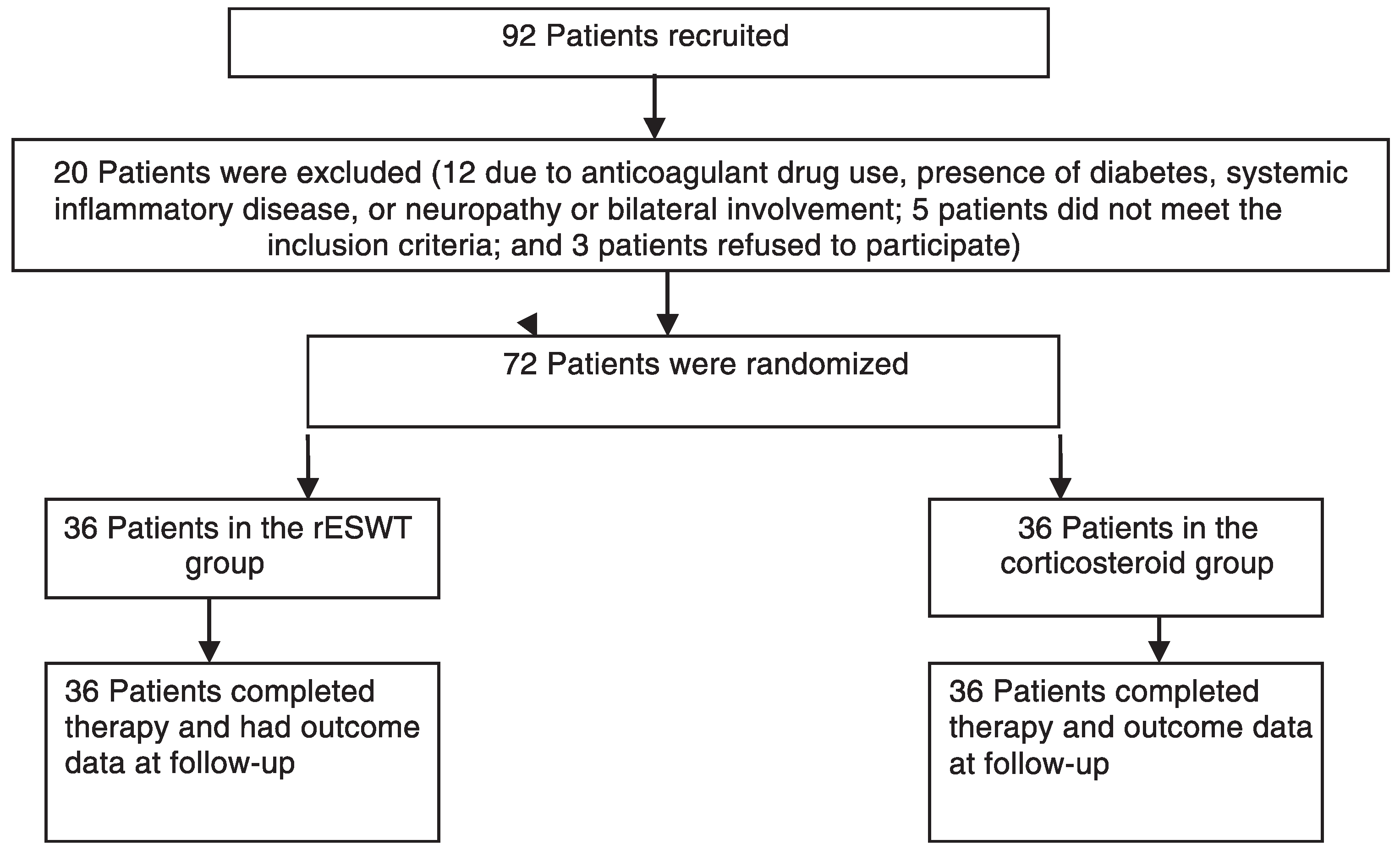
This study enrolled 92 patients admitted to the outpatient clinic with heel pain between November 1, 2012, and August 31, 2013, and subsequently diagnosed as having plantar fasciitis using an appropriate work-up. Of these patients, 12 were excluded due to anticoagulant drug use or the presence of diabetes, systemic inflammatory disease, neuropathy, or bilateral involvement. Five patients did not meet the inclusion criteria, and three patients refused to participate. Finally, 72 patients were recruited. The flowchart of patient recruitment is given in
Figure 1.
Figure 1.
Flow diagram for assignment of randomized study participants. rESWT, radial extracorporeal shockwave therapy.
Figure 1.
Flow diagram for assignment of randomized study participants. rESWT, radial extracorporeal shockwave therapy.
The study inclusion criteria included age 18 to 65 years, local tenderness at the medial tubercle of the calcaneus, pain at the heel with the first steps in the morning or after long periods of standing, ultrasonographic evidence of plantar fascia thickness (PFT) equal to or greater than 4 mm, and refractoriness to conservative treatment for more than 6 months.
Bilateral plantar fasciitis, systemic inflammatory disease, history of local foot trauma or surgery, systemic or local infection, malignancy, neurologic abnormalities, diabetes, anticoagulant drug therapy, peripheral vascular disease, pregnancy, and ESWT or corticosteroid injection within the previous 6 months were exclusion criteria.
Signed informed consent was obtained from all of the patients. The study protocol was approved by the ethics committee of Erciyes University Medical Faculty (Kayseri, Turkey). The study was performed in accordance with the World Medical Association Declaration of Helsinki [
28].
Randomization
After the baseline assessment and data collection, a computer-generated random number list was used to randomize patients into two equal groups: rESWT and local corticosteroid injection treatment. Randomization was performed using sequential sealed envelopes prepared by an independent physician before enrollment. The sealed envelopes contained a record of the treatment allocation. All investigators were blinded to the treatment allocation throughout the study.
Interventions
Seventy-two patients were randomly assigned to two groups. The first group received rESWT and the other group was given corticosteroid injection. A Vibrolith Ortho (ELMED Ltd, Ankara, Turkey) ESWT device was used for rESWT application. Treatment was applied using a 15-mm head with 2,000 shockwaves at each session at 10-Hz frequency with an energy flux density per shock of 0.16 mJ/mm2. Patients were in the prone position on the treatment bed with their feet hanging over the edge of the table. The applicator was placed on the plantar fascia insertion of the calcaneus. Each session was repeated three times per week by the same physiotherapist. Patients were not given local anesthetics. Except for transient skin redness at the administration site in two patients, no procedure-related problems occurred.
The corticosteroid group (n = 36) was given 1 mL of betamethasone sodium plus 0.5 mL of prilocaine by injection. Patients were instructed to lie in the prone position. To minimize the risk of infection, sterile gloves, sterile covers for ultrasound probes, and sterile gel were used. The needle was positioned medially under ultrasound guidance using a caudocranial oblique angle. The injection was given gently and slowly into the thickest area immediately distal to the site where the plantar fascia attaches to the calcaneus. Patients did not experience any complications after the procedure.
Participants in both treatment groups were advised to avoid long periods of standing and any strenuous, pain-provoking activity or high-impact exercise for 1 week after the treatment. Patients in neither group were given additional medical therapy.
Assessments
All of the assessments were completed by the same blinded investigator (M.A.C.) at baseline and 1, 3, and 6 months after treatment. A visual analog scale (VAS), heel tenderness index (HTI), Foot Function Index (FFI), ultrasonographic measurement of PFT, and echogenicity were performed for both groups.
Primary Outcome Measures
A VAS was used to assess subjective pain intensity [
29,
30]. Participants marked the extent of the pain they had experienced during the previous week on a horizontal 100-mm VAS (0 = no pain, 100 = the worst imaginable pain). The FFI was used to measure the impact of plantar fasciitis on foot function. This index consists of 23 items divided into three subcategories that address pain, disability, and limitation of daily life activities. Each item is rated by a VAS divided into ten equal parts. The values calculated for each subcategory indicate the degree of the respective functional disability, and the total score reflects the total foot dysfunction [
31]. The pain subcategory of the FFI questions both the pain that occurs with the very first steps in the morning and pain when standing or walking.
Secondary Outcome Measures
The HTI was used by the physician to assess heel pain, where 0 = no pain, 1 = painful, 2 = painful and winces, and 3 = painful, winces, and withdraws [
6]. All of the patients were also assessed using ultrasonography. Musculoskeletal ultrasound was performed by an experienced radiologist at baseline (before treatment) and 1, 3, and 6 months after treatment with an ultrasound device (Aplio 500; Toshiba Co Ltd, Tokyo, Japan) at B-mode using a 7.5- to 12-MHz superficial probe. Care was taken to maintain the blinding of the physician doing the ultrasound examination to the clinical data of patients. A linear probe was positioned longitudinally over the medial tubercle of the calcaneus. The PFT and its echogenicity were examined during ultrasonographic examination. The PFT was measured at the proximal point of insertion of the fascia into the calcaneal tubercle. A PFT of 4 mm or greater was considered evidence of fasciitis [
32,
33].
Statistical Analysis
Statistical analysis was conducted using a statistical software program (SPSS for Windows, Version 16.0; SPSS Inc, Chicago, Illinois). Mean ± SD, median (range), χ2, and percentage values were calculated for all of the data. The Kolmogorov-Smirnov test was used to test normality of the data distribution. For between-group comparisons, the Student t test was used for parametric data and the Mann-Whitney U test for nonparametric data. For repeated measurements of matched groups, repeated measures analysis of variance was used for parametric data and the Friedman test for nonparametric data. The Wilcoxon signed rank test was used to determine from which group the difference originated. Bonferroni correction was made to avoid type I error. The significance level was set at P < .05.
Results
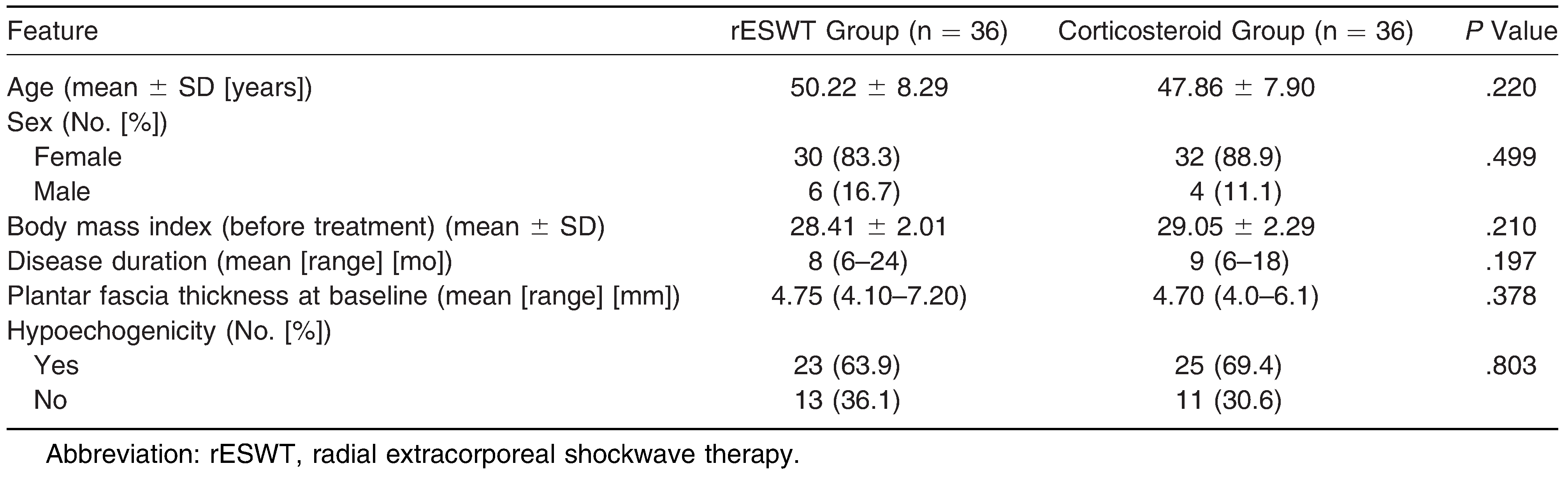
All of the enrolled and randomized patients returned to the clinic for follow-up visits and completed the study. Demographic and ultrasonographic characteristics of patients completing the study are summarized in
Table 1.
Table 1.
Demographic and Ultrasonographic Features of the 72 Study Patients by Treatment Group.
Table 1.
Demographic and Ultrasonographic Features of the 72 Study Patients by Treatment Group.
There were no statistically significant differences between groups in age, sex distribution, BMI (before treatment), disease duration, or PFT at baseline (P > .05).
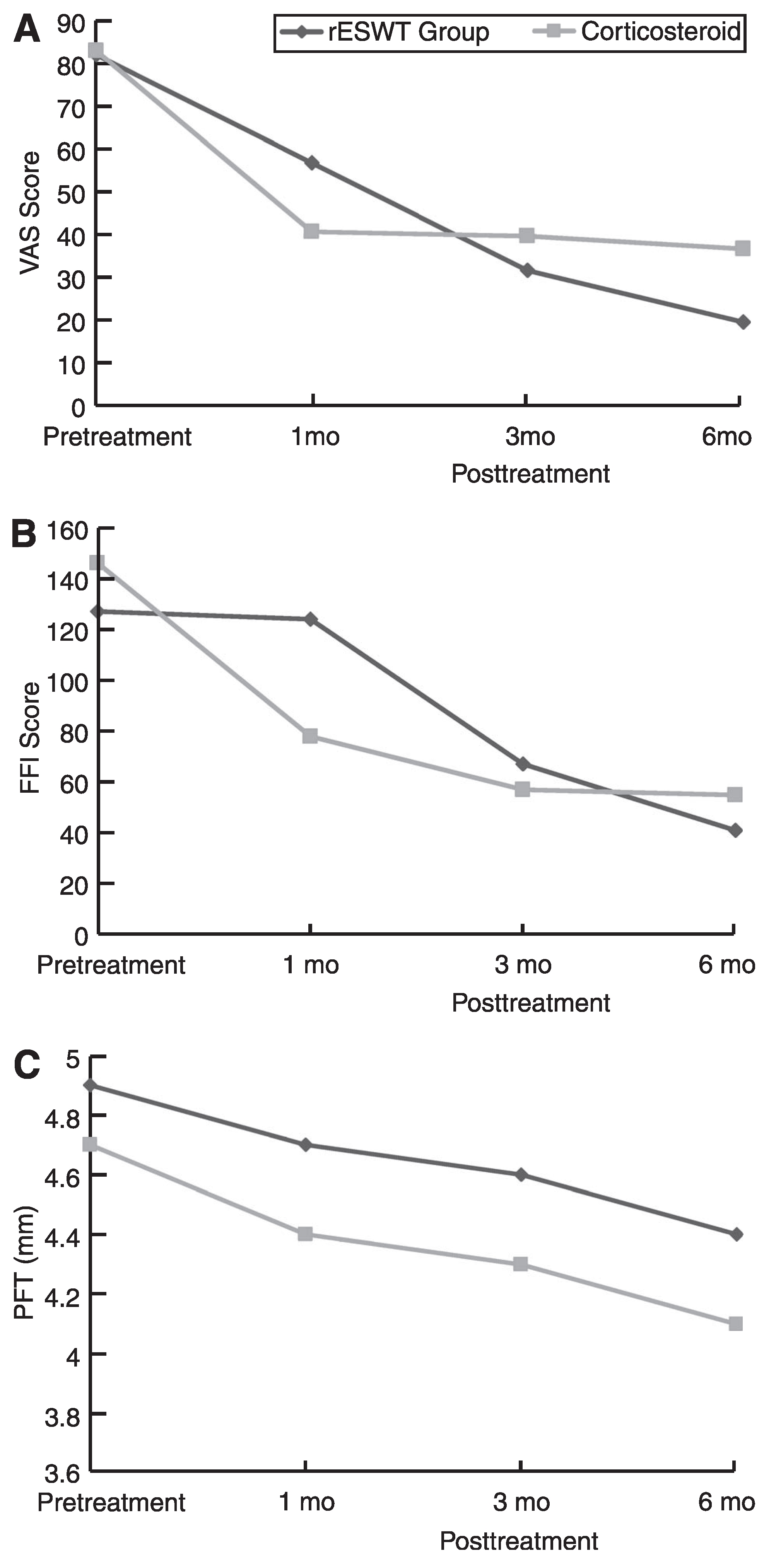
Statistically significant reductions were observed in the VAS scores of both the rESWT and corticosteroid groups 1, 3, and 6 months after treatment versus before treatment (
Table 2). However, although a statistically significant improvement was detected in the VAS scores of the corticosteroid injection group 1 month after treatment, it was no longer seen at 3 and 6 months (
P = .695 and
P = .328, respectively). In contrast, significant improvement was maintained in the rESWT group 1, 3, and 6 months after treatment (
P < .001) (
Table 2).
Table 2.
VAS Scores by Treatment Group During the Treatment Period.
Table 2.
VAS Scores by Treatment Group During the Treatment Period.
The HTI was assessed before treatment and 1, 3, and 6 months after the completion of treatment in both groups. Compared with baseline, 26 patients in the rESWT group (72.2%) and 22 in the corticosteroid group (61.1%) had an HTI score of 0 at the end of 6 months, which indicated pain relief.
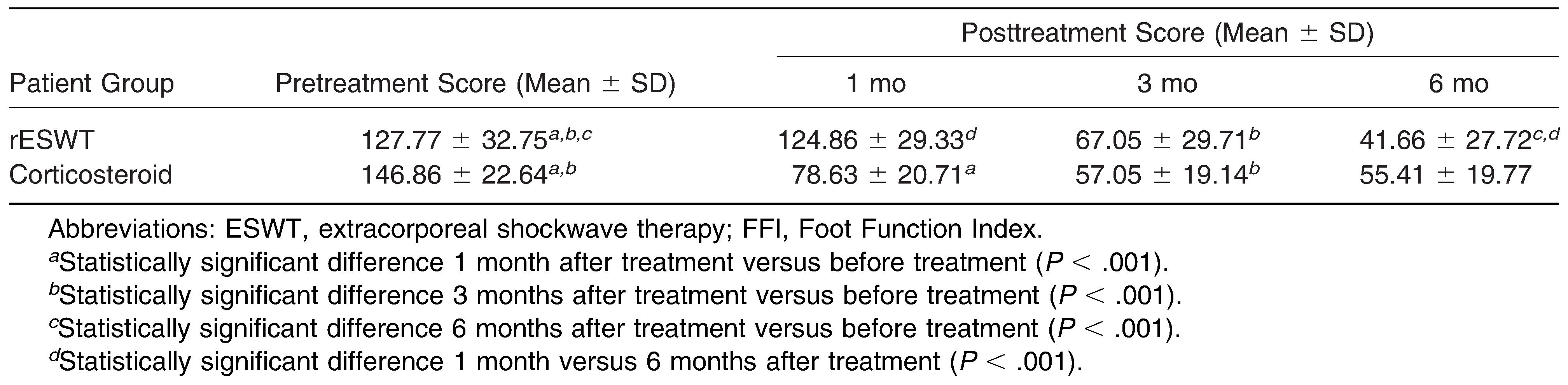
The FFI was evaluated before treatment and 1, 3, and 6 months after the completion of treatment in both groups. The improvement in FFI scores observed in both groups was significant compared with baseline (
P < .001). However, improvement in FFI scores was not significant 1 month after treatment in the rESWT group and 6 months after treatment in the corticosteroid injection group (
P > .05) (
Table 3).
Table 3.
FFI Scores by Treatment Group During Follow-up.
Table 3.
FFI Scores by Treatment Group During Follow-up.
All of the patients underwent PFT measurement and echogenicity assessment by ultrasound at baseline and 1, 3, and 6 months after treatment.
Table 1 shows mean PFT and hypoechogenicity values of the treatment groups. Ultrasonographically, PFT was found to be significantly reduced in both treatment groups 1, 3, and 6 months after treatment compared with baseline (
P < .001), with no significant difference between treatment groups (
P > .05). During follow-up, plantar fascia echogenicity did not show a significant difference (
P > .05).
Figure 2 shows changes in VAS and FFI scores and PFT at the prespecified time points.
Figure 2.
Changes in visual analog scale (VAS) scores (A), Foot Function Index (FFI) scores (B), and plantar fascia thickness (PFT) (C) by treatment group. rESWT, radial extracorporeal shockwave therapy.
Figure 2.
Changes in visual analog scale (VAS) scores (A), Foot Function Index (FFI) scores (B), and plantar fascia thickness (PFT) (C) by treatment group. rESWT, radial extracorporeal shockwave therapy.
Discussion
In the present study, we detected improvement in pain and foot function and reduction in PFT in patients receiving rESWT or ultrasound-guided corticosteroid injection therapy. In the rESWT group, although the beneficial effect on VAS, FFI, and HTI scores was delayed, it was maintained for a long period. On the other hand, corticosteroid injection had an early onset of action and rapidly showed its effect on VAS, FFI, and HTI scores, but its benefits were lost in the next months. In addition, we observed a reduction in PFT at the end of treatment with both modalities, but they did not show a statistically significant difference in that respect.
Recent treatment guidelines recommend the use of ESWT and surgical therapy for patients with plantar fasciitis who have been unresponsive to at least 6 months of conservative treatment [
3,
4,
34]. However, surgical therapy has some unwanted consequences, including injury to the posterior tibial nerve and its branch medial calcaneal nerve, tarsal instability, swelling at the incision site, problems associated with immobilization, delays in returning to daily life and work, and calcaneal fracture [
2,
34]. Thus, efforts to develop nonsurgical treatment methods progress increasingly. In recent years, ESWT has been used as an alternative method to surgical therapy for patients with chronic plantar fasciitis refractory to conservative treatment [
3,
5,
34,
35]. Shockwave therapy has been demonstrated to modulate neovascularization of the damaged tissue, differentiation of mesenchymal stem cells, and release of local angiogenetic factors [
2,
17,
36]. Focal and radial shockwaves can be used for treatment of musculoskeletal disorders. These methods differ in tissue penetration and energy levels. Adverse effects associated with ESWT have mostly occurred after use of high-intensity focused ESWT and include calcaneal pain and erythema [
2]. Studies investigating the effectiveness of rESWT for treatment of plantar fasciitis have shown statistically significant improvements compared with placebo [
19-
21]. In the present study, we also found statistically significant improvements in overall pain scores, pain with the first steps in the morning, and pain while standing and walking in patients receiving moderate-intensity rESWT. We did not observe any procedure-related adverse effects except transient erythema in two patients.
In a systematic review and meta-analysis, the effectiveness of rESWT was compared with that of focused shockwave therapy of different intensity levels for treating plantar fasciitis. Radial ESWT was reported to be an appropriate alternative treatment because of its cost-effectiveness and better efficacy. In the same study, rESWT was considered to be one step ahead compared with focused ESWT due to its wider range of therapeutic areas, requirement for less focusing, and elimination of the need for local anesthesia [
17]. In another review, it was stated that evidence was available that showed that ESWT for musculoskeletal disorders is beneficial and safe and that radial pulse therapy is effective for the treatment of plantar fasciitis [
18]. Thus, we chose to use rESWT in the present study owing to its low cost and no requirement for anesthesia.
Placebo-controlled studies conducted to show the effects of local corticosteroid injection therapy on pain scores and PFT are short-term follow-up studies that covered 12 weeks after treatment [
22,
23]. In these studies, it was reported that the improvement in pain scores was evident at 4 weeks, but it was not maintained at 8 and 12 weeks, and, in contrast, the PFT reduction was maintained until the end of 12 weeks. The effects of corticosteroid injection on chronic plantar fasciitis over a longer period are not known. Similarly, in the present study we found that the improvement in pain scores was apparent 1 month after treatment, but it was no longer present at 3 and 6 months. We believe that this decline may have occurred for two reasons: first, corticosteroid therapy shows a fast onset of action in the early stage, which gradually declines over the next months. Second, patients in the corticosteroid group had to perform daily activities at work or home that required standing for longer periods, and it may occur because of their higher BMI values after treatment.
Studies have also been conducted to establish the role of ultrasound-guided corticosteroid injection in preventing injection-related complications and to elucidate its contribution to treatment efficacy. In one placebo-controlled study, ultrasound-guided corticosteroid injection was reported to avoid the occurrence of injection-related adverse events, including nerve injury, soft-tissue infection, and plantar fascia rupture [
22]. In their study, McMillan et al [
23] reported that ultrasound-guided corticosteroid injection therapy did not lead to any adverse experiences. We performed corticosteroid injection under ultrasound guidance in sterile conditions, and none of the patients experienced procedure-related complications, such as plantar fascia rupture, fat pad atrophy, soft-tissue infection, or nerve injury, and repeated injections were not needed because relapse did not occur in any of the patients.
In a study comparing focused ESWT with corticosteroid injection treatment, corticosteroid injection was compared with low-energy ESWT. Both therapeutic approaches were reported to be effective for the treatment of plantar fasciitis, and no statistically significant difference was observed in efficacy 3 months after starting treatment. The authors concluded that corticosteroid therapy was cost-effective [
25]. In another study that used ultrasound-guided corticosteroid injection treatment and focused ESWT with medium-intensity shockwaves, both treatments were reported to be effective for the reduction of PFT; however, although there was no statistically significant difference between groups, corticosteroid therapy was recommended due to its cost-effectiveness [
26]. High-dose ESWT was compared with corticosteroid injection treatment in one study, and both methods were equally successful, with no difference between groups after 3 months of treatment; however, corticosteroid injection was suggested as first-line treatment because of its cost-effectiveness [
27]. In contrast to the aforementioned comparative studies, we compared rESWT with corticosteroid injection treatment and found that both therapies led to clinically as well as ultrasonographically evident improvements in plantar fasciitis. In addition, we determined that rESWT had better long-term effects. Although the studies discussed herein reached the conclusion that corticosteroid therapy was more cost-effective, we believe that rESWT is superior to corticosteroid injection treatment because of its longer duration of action. Also, in this study we did not observe any relapse at the end of 6 months of treatment. Follow-up over a longer period would be appropriate to evaluate relapses.
A weakness of this study is the lack of a placebo control. However, note that the present study is a comparative study that was not designed to investigate the efficacy of treatment methods. Also, posttreatment BMI values were not recorded for any of the groups, and this represents another limitation of this study. Controlled studies with longer follow-up and a larger sample size are needed to determine the most appropriate therapeutic approach for the treatment of chronic plantar fasciitis.